
In brief
The question: When a business faces an intellectual property dispute involving leaked trade secrets, departed staff, or misused proprietary data, how can leaders resolve the conflict without airing sensitive commercial assets in public court?
The short answer: Under the default principle of open justice in England and Wales, court hearings and statements of case are generally accessible to the public, whereas most other filed documents require court permission. Litigating a trade secret breach can inadvertently publicise the exact technical designs, client databases, or algorithms a business seeks to protect. Engaging in commercial mediation provides a confidential setting where parties can examine sensitive evidence, agree on independent forensic data sanitisation protocols, and adapt commercial covenants away from public scrutiny, while avoiding the escalating costs and disruptions of formal litigation.
The Secrecy Dilemma in an Intellectual Property Dispute
Discovering that proprietary source code, technical formulas, pricing models, or customer pipelines have left your corporate perimeter creates an immediate operational crisis. The natural commercial instinct is to seek immediate judicial intervention to stop the leak. However, litigating an intellectual property dispute in open court presents a difficult practical tension for executive teams and business owners.
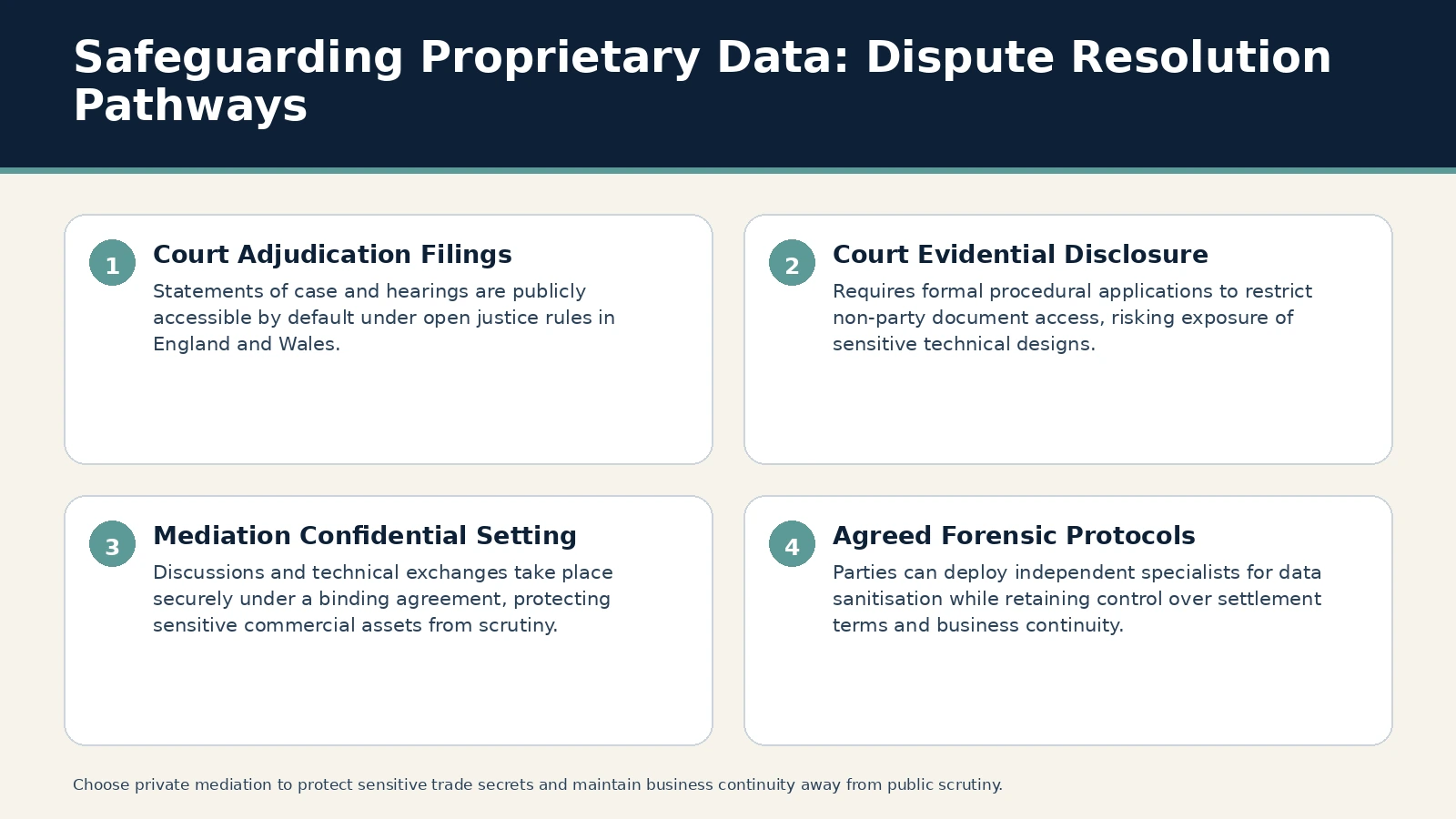
Court hearings in England and Wales are open to the public by default, and statements of case filed at court are generally accessible to non-parties. While courts have discretionary powers to sit in private or impose confidentiality rings in exceptional circumstances, open justice remains the standard starting point. When a claimant sets out the misappropriated information in particulars of claim, or when a defendant submits technical materials to demonstrate independent creation, those details risk wider exposure to competitors, investors, and industry observers.
Establishing a statutory trade secret claim under the Trade Secrets (Enforcement, etc.) Regulations 2018 also requires demonstrating that the information has commercial value because it is secret, and that reasonable steps were taken to keep it confidential. Reviewing internal access controls, data handling histories, and distribution records in open court can disrupt funding rounds, strain key commercial relationships, and reveal operational vulnerabilities. Mediation offers an alternative pathway that protects confidentiality from the outset.
In high-stakes technical environments, the mere filing of public court proceedings can cause collateral damage across the business. Key enterprise customers may hesitate to renew multi-year contracts if they suspect their own commercially sensitive data was caught in a perimeter leak. Prospective venture capital or private equity investors conducting due diligence may pause ongoing transactions upon discovering active High Court litigation over core codebases or software architecture. By resolving an intellectual property dispute in a private setting, both sides can address the real commercial friction without generating public court records that raise alarms across the wider market.
Furthermore, digital assets rarely move in clean, isolated packages. When employees leave an organisation, data often sits across a dispersed landscape of personal devices, cloud repositories, chat logs, and legacy backups. Attempting to catalogue and contest every digital interaction through formal legal pleadings can escalate legal spend quickly, diverting executive and engineering attention away from primary commercial roadmaps.
Resolution Pathways: Comparing Public Adjudication and Commercial Mediation
When proprietary data is compromised, decision-makers must evaluate whether their immediate priority is establishing public legal fault or securing the swift containment, verification, and safe return of business-critical information. Mediation provides a private forum that focuses on practical containment and commercial viability.
| Dispute Dimension | Court Adjudication | Commercial Mediation |
|---|---|---|
| Public Visibility | Hearings and statements of case are generally accessible to the public. | A private dispute resolution process conducted under a binding mediation agreement, subject to recognised legal exceptions. |
| Information Protection | Restricting non-party access to statements of case requires a formal procedural application to the court, whereas access to most other court documents is restricted by default. | Discussions and technical exchanges take place on a protected, without-prejudice basis. |
| Outcome Design | Focused on formal legal remedies, monetary awards, or standard injunctions. | Parties can agree tailored forensic protocols, transition terms, and commercial licences. |
| Decision Control | In contested court proceedings proceeding to judgment, the judge determines the outcome based on the parties’ pleaded cases, evidence, and applicable legal principles. | Commercial principals retain control over whether to settle and the precise terms of any agreed settlement. |
| Commercial Disruption | Subject to formal court timetables, evidential disclosure stages, and potential appeals. | Can be convened rapidly to contain data leakage and protect business continuity. |
Mediation does not replace the law, but it shifts the practical focus towards containment and workable outcomes. In disputes involving intellectual property and technology, founders and technology executives often find that a private setting allows for candid technical evaluations that would be commercially hazardous in open court.
Practical Settlement Levers: Forensic Sanitisation and Commercial Undertakings
Court remedies focus on standard legal orders such as damages, accounts of profits, or prohibitory injunctions. Consensual mediation allows parties to build beyond these standard remedies to address the operational complexities of modern digital workplaces, where data may reside across personal hardware, cloud storage, and unmonitored communication platforms.
Through mediation, parties can design consensual operational solutions tailored to the technical realities of the intellectual property dispute. These terms can provide the claimant with verifiable protection while allowing the defendant to pursue legitimate commercial activities. Reviewing how to prepare for commercial mediation helps decision-makers arrive with clear, workable settlement options.
Agreed Forensic Sanitisation Protocols
A central challenge in confidentiality disputes is evidential verification. Claimants often fear that proprietary data remains on personal hardware or cloud repositories, while defendants maintain that all files have been deleted. In mediation, parties can establish an agreed joint protocol appointing an independent digital forensics specialist.
The protocol can specify precise keyword searches, identify agreed devices for inspection, and set out a secure process for deleting proprietary files without compromising personal correspondence. This gives the claimant verifiable certainty that proprietary assets have been permanently removed, while protecting the defendant from intrusive search orders.
Such protocols can also establish clear remediation steps if residual files are discovered during the scan. For instance, the parties can agree that any identified technical documentation will be quarantined and permanently erased by the independent expert, with a formal certificate of destruction issued to both sides. This eliminates the need for ongoing mutual accusations and creates a closed, objective verification process.
Calibrated Covenants and Clear Commercial Boundaries
Many confidentiality disputes arise when key personnel or technical directors move to a competitor or establish a new enterprise. Rather than engaging in protracted arguments over the strict enforceability of existing employment restrictions, mediation allows commercial principals to negotiate practical boundaries.
The parties can agree to ring-fence specific clients, target markets, or technical modules for an agreed timeframe, while permitting the individual to undertake non-conflicting work. This directly addresses the commercial risk while allowing both sides to move forward without ongoing litigation.
In addition, mediation allows parties to establish clear communication protocols concerning shared commercial contacts, prospective joint clients, or mutual industry partners. Agreeing on a neutral, joint commercial narrative prevents either party from disparaging the other in the market, protecting reputations and avoiding secondary business disputes.
Commercial Licensing and IP Transition
In certain scenarios, disputed data or code has already been integrated into an operational product or software stack. Demanding an immediate total shutdown can destroy commercial value for all involved.
Mediation provides room to explore constructive commercial arrangements, such as transitioning the disputed asset into a formal commercial licence with agreed royalty terms or a fixed settlement fee. This approach is frequently used in intellectual property licensing disputes to turn an adversarial conflict into a manageable commercial agreement.
Where code separation is required, the parties can agree on a managed transition period. Rather than forcing an abrupt system outage, the settlement can define an agreed grace period during which the defendant rewrites specific software libraries or migrates away from disputed data sets, backed by independent milestone reviews to ensure compliance.
Managing Technical Leaks in an Intellectual Property Dispute
When an intellectual property dispute stems from departing technical staff, tensions often centre on what constitutes individual general skill and knowledge versus protected proprietary code or trade secrets. In a contested hearing, both sides are often forced into entrenched, all-or-nothing arguments. Claimants often argue that substantial protectable code or proprietary elements were copied, while defendants typically assert independent development or use of unprotected ideas and non-proprietary components.
During mediation, the technical leads from both organisations can discuss code architectures in a confidential caucus or joint technical session. A neutral mediator can facilitate dialogue around specific modular dependencies, agreed code rewrites, or escrow mechanisms that protect the claimant’s core IP while giving the outgoing engineers an unencumbered pathway to build non-competing software.
This technical dialogue often addresses grey areas, such as shared open-source components, third-party software dependencies, and common development frameworks. By breaking down the software codebase into distinct architectural layers, the parties can agree on precise boundary lines that protect genuine trade secrets without unnecessarily restricting general industry expertise.
Preparing for Mediation: Evidence, Audits, and Mandates
Effective preparation for mediation focuses on facilitating risk management and constructive problem-solving rather than simply assembling evidence for trial.
Clarifying the Information Perimeter
Define the exact scope of information in the intellectual property dispute, whether it involves source code, customer pricing structures, manufacturing formulas, or business strategies. Creating a clear schedule of the specific materials at risk prevents discussions from devolving into vague allegations and allows advisers to assess the commercial exposure accurately.
When dealing with complex technical assets, categorising the data by sensitivity helps establish proportionate protection measures. Distinguishing between core proprietary algorithms and non-confidential operational information allows both sides to focus negotiations on protecting what truly matters to the commercial enterprise.
Reviewing the Digital Evidence Base
Collate download timestamps, repository access logs, and communications records before the session. Many data movements stem from routine remote-working practices rather than deliberate exfiltration. Arriving with organised technical logs while remaining receptive to technical explanations helps establish an objective basis for verification.
It is equally useful to identify potential data overlap across cloud tools, corporate email inboxes, and external backup systems. Knowing where residual data might reside enables parties to design realistic, comprehensive sanitisation terms during the mediation rather than leaving loose ends that could spark renewed conflict later.
Setting Commercial Settlement Mandates
Prior to mediation, leadership teams should clarify their core business objectives. Whether the priority is verifiable data sanitisation, non-solicitation undertakings, or financial compensation, knowing where your business requires certainty and where it can be flexible enables your representatives to negotiate effectively.
When approaching an intellectual property dispute, it is equally vital to determine who will represent the business at the table. Having both a commercial decision-maker with settlement authority and a technical lead who understands data infrastructure ensures that proposed forensic undertakings can be evaluated in real time, avoiding costly delays or misunderstandings.
Establishing clear authority boundaries before entering the mediation room prevents internal hesitation. When unexpected technical proposals or commercial compromise options emerge during discussions, the negotiating team can assess risks and make binding decisions with confidence.
Procedural Context and Cost Considerations
English courts actively encourage parties to consider alternativeintellectual intellectual property dispute resolution in intellectual property disputes. Under CPR 44.2, a court has wide discretion regarding costs and can take a party’s unreasonable refusal to mediate into account when making cost orders. Participating constructively in mediation not only protects commercial data in private, but also demonstrates procedural reasonableness.
If your organisation is managing a trade secret or confidentiality issue, early mediation can help protect your business-critical assets. To discuss how mediation can be structured for your situation, you can speak to an EDR mediator for confidential, practical assistance.
Frequently asked questions
How does commercial mediation protect trade secrets during negotiations?
Mediation takes place under an agreement providing confidentiality, with negotiations and settlement proposals conducted on a without-prejudice basis, subject to established legal exceptions. This allows parties to review technical evidence, data logs, and source code securely without risking public exposure or prejudicing their legal positions if court proceedings continue.
Can mediation resolve an intellectual property dispute if interim court proceedings have started?
Yes. Mediation can run in parallel with court proceedings. Where urgent interim court relief has been sought to prevent immediate asset destruction or data dissipation, parties can use mediation shortly afterwards or during a procedural stay to negotiate comprehensive technical undertakings and avoid full trial expense.
What practical and technical remedies can be negotiated in mediation?
Mediation allows parties to craft bespoke commercial and technical outcomes. These include agreed independent forensic data sanitisation protocols, adjusted non-compete covenants, defined customer ring-fencing, transition periods, and commercial licensing arrangements tailored to the operational needs of both businesses.
Who should attend a trade secret mediation session?
Attendance usually includes commercial decision-makers with full authority to settle, legal advisers, and relevant technical experts such as chief technology officers or digital forensic specialists. Having technical leads present ensures that forensic protocols and code boundaries can be evaluated and agreed directly.
What happens if a party refuses an offer to mediate an intellectual property dispute?
English courts expect parties to consider alternative dispute resolution constructively. An unreasonable refusal to engage in mediation can be taken into account by the court when determining costs orders, potentially leading to adverse costs consequences even for a party that succeeds at trial.
Authoritative UK guidance and further reading
Primary and official sources
- Speech by the Chancellor of the High Court: The new Business and Property Division – Courts and Tribunals Judiciary (judiciary.uk)
- PART 39 – MISCELLANEOUS PROVISIONS RELATING TO HEARINGS – Civil Procedure Rules – Justice UK (justice.gov.uk)
- PART 5 – COURT DOCUMENTS – Civil Procedure Rules – Justice UK (justice.gov.uk)
- The Trade Secrets (Enforcement, etc.) Regulations 2018 (legislation.gov.uk)
This guide provides general information about dispute resolution and mediation. It is not legal advice. The appropriate approach depends on the facts, documents, procedural position and the parties involved; obtain legal advice where required.