

In brief
The question: How should commercial parties prepare their position statements, document bundles, and settlement authority to maximise their chances of resolving a dispute when they prepare for mediation?
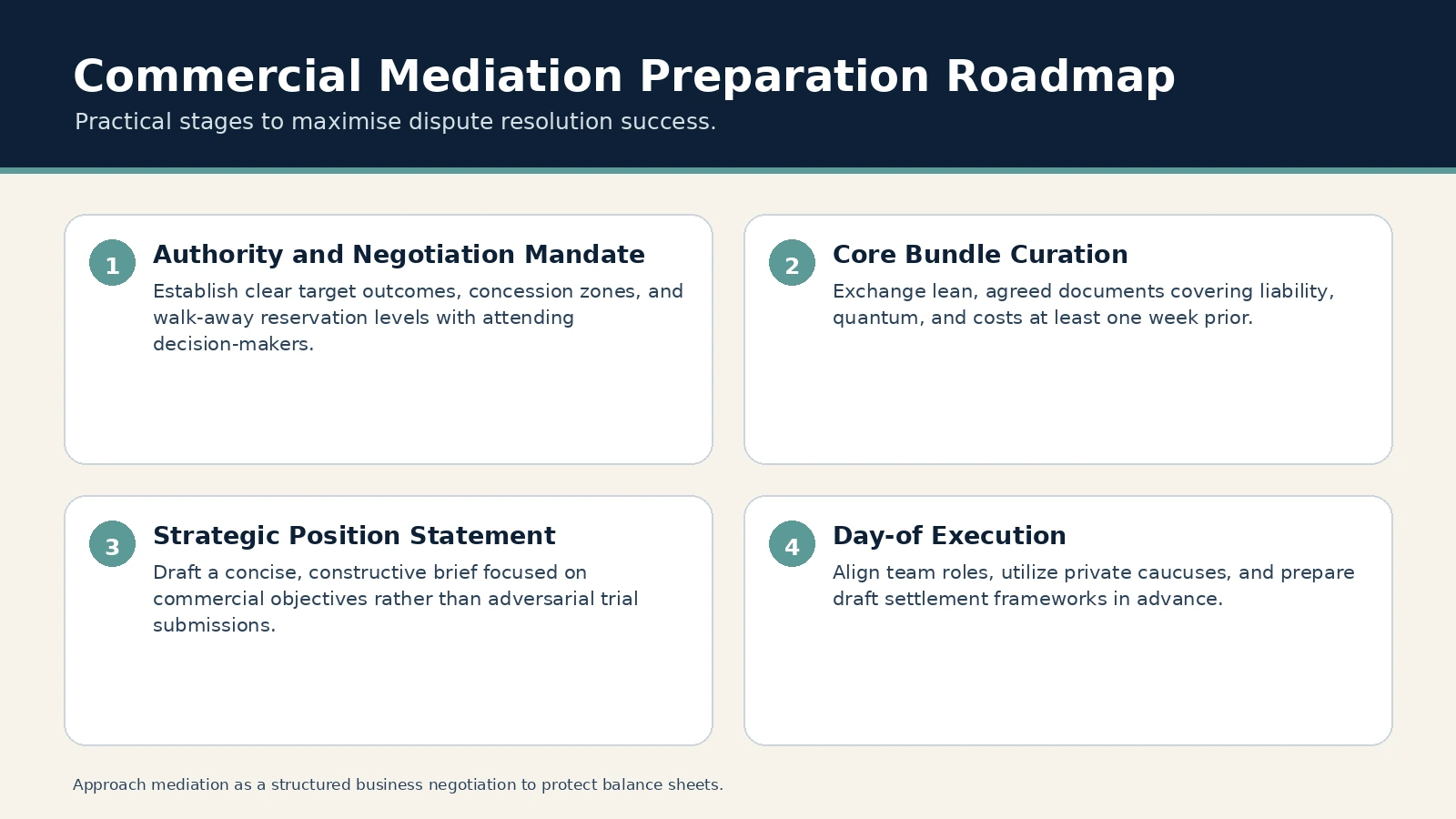
The short answer: To properly prepare for mediation, commercial parties should approach the process as a structured business negotiation rather than an adversarial court hearing. Effective preparation rests on three practical disciplines: drafting a concise, constructive position statement aimed directly at the opposing decision-maker; curating a lean core bundle of critical documents exchanged in advance, usually no less than one week before the session; and ensuring that attending representatives hold comprehensive settlement authority backed by clear negotiation parameters. By focusing on practical problem-solving and commercial exposure rather than entrenched legal arguments, parties can design workable terms that protect balance sheets and avoid the mounting expense of trial.
Rethinking the Position Statement: Communicating with the Opposing Decision-Maker
When parties prepare for mediation in a commercial dispute, the initial instinct is often to treat the process like an interim court application. Legal teams may feel compelled to draft exhaustive skeleton arguments designed to demonstrate total legal merit and highlight every flaw in the opponent’s case. In commercial dispute resolution, this approach is often counterproductive.
The primary audience for a mediation position statement is not a judge or an arbitrator tasked with imposing a binding ruling. Nor is it solely the mediator, who acts as an impartial facilitator rather than a determinative tribunal. The true audience is the commercial decision-maker on the other side of the dispute—the director, chief executive, or business owner who holds the authority to sign a settlement agreement. An aggressive statement rarely persuades an opposing principal; instead, it tends to entrench their position, raise emotional barriers, and waste valuable negotiation time. An effective brief strikes a balance between legal clarity and commercial realism, signalling a genuine readiness to explore workable outcomes through commercial mediation.
Key Structural Elements of an Effective Statement
Commercial best practice favours a concise position statement focused on key issues and commercial objectives rather than extensive trial submissions. When drafting a structured position paper, parties should consider covering:
- Executive summary: A brief overview of the dispute, identifying the commercial relationship, core issues in dispute, and current procedural posture.
- Factual background: A concise narrative of key events, referencing contemporaneous records and correspondence rather than subjective grievances.
- Summary of core issues: A measured assessment of the central contractual terms, liabilities, and contested points, setting out arguments clearly without hyperbole.
- Quantification and financial exposure: A realistic breakdown of sums claimed or defended, alongside an honest assessment of incurred legal costs and projected expenditure through to trial.
- Settlement objectives: A constructive outline of commercial priorities, such as structured payment terms, ongoing operational dependencies, release of securities, or supply chain continuity.
Confidential Briefing Notes to the Mediator
In addition to the open position statement exchanged between the parties, it is often beneficial to provide a separate, confidential briefing note exclusively to the mediator. Because mediation is a private and confidential process, this note allows a party to be candid about internal constraints, board governance parameters, sensitive pricing considerations, or commercial priorities that cannot be disclosed openly to the opposing party.
Sharing these underlying drivers enables the mediator to understand your true commercial interests from the outset. This assists the mediator in exploring realistic settlement structures during private caucus sessions without compromising your open negotiating posture.
Curating the Core Document Bundle: Relevance Over Volume
A frequent obstacle to productive negotiation is the delivery of voluminous, multi-lever-arch document bundles. Producing hundreds of pages of peripheral correspondence obscures the central issues and inflates legal costs.
A mediation bundle serves a different purpose from a trial bundle. It should be a curated, agreed collection containing only the core documents necessary to evaluate liability, quantum, and negotiation parameters. In standard commercial mediation practice, the agreed core bundle and position statements should be delivered to the mediator and exchanged between the parties in advance, usually no less than one week before the mediation session.
What to Include in a Lean Mediation Bundle
To keep preparation focused and proportionate, a commercial mediation bundle should generally be limited to a single manageable volume containing:
- Statements of case or pre-action correspondence: Pleadings or key pre-action letters that define the parameters of the dispute.
- Core contractual documents: The underlying agreement, relevant schedules, agreed variations, or purchase orders governing the relationship.
- Key contemporaneous correspondence: Essential emails, notices, or minutes that substantiate the primary factual assertions.
- Expert or quantum summaries: Concise financial schedules, invoices, loss assessments, or expert summaries substantiating the figures in dispute.
- Current costs schedules: An updated breakdown of legal costs incurred to date by each side, alongside realistic projections of expenditure required to take the matter to trial.
For parties addressing complex commercial claims, reviewing practical approaches for contract dispute mediation can assist in identifying which financial and contractual documents are genuinely pivotal.
Structuring Settlement Authority: Negotiation Bands and Mandate Governance
One of the most critical practical requirements when preparing for mediation is establishing proper settlement authority. Mediations can stall or lose momentum if an attending representative reaches the limit of their authority and must pause negotiations to contact an unavailable decision-maker.
Under the Civil Procedure Rules (including CPR 1.4, CPR 3.1, and CPR 44.2), the court has active case management powers to encourage and direct alternative dispute resolution, and can reflect party conduct—including unreasonable failures to engage in ADR—in costs orders. Attending mediation without genuine authority to negotiate risks wasting the opportunity to settle and can lead to adverse costs consequences in subsequent litigation.
Developing a Three-Tier Mandate Framework
Corporate decision-makers and their instructing solicitors should establish a clear authority framework before the mediation session. Rather than working to a single rigid number, negotiating teams should agree three operational parameters:
- The Target Outcome: The commercial result representing an optimal, realistic resolution based on sound legal risk analysis and commercial objectives.
- The Concession Zone: A pre-approved range within which the lead representative has discretion to trade monetary sums, payment terms, contract variations, or non-monetary concessions without seeking further board sign-off.
- The Walk-Away Reservation Level: The absolute limit beyond which continuing litigation or pursuing other formal remedies becomes commercially preferable to settling on the proposed terms.
Where corporate governance requires external board or committee sign-off, those decision-makers should be formally scheduled for immediate live contact by video or telephone throughout the duration of the mediation. For broader context on procedural ADR requirements, see our guidance on court ordered ADR compliance.
Pre-Mediation Engagement and Procedural Alignment
Preparation should also involve preliminary communication with the mediator prior to the session. Commercial mediators frequently arrange pre-mediation telephone or video calls with each party’s lead representative and legal counsel to clarify procedural mechanics.
These initial discussions allow the parties to agree on the schedule for the day, confirm the format of opening sessions (such as whether a joint plenary meeting or direct private caucuses will be more effective), and test remote or hybrid technology where applicable. Pre-mediation discussions also enable the mediator to understand interpersonal dynamics and commercial sensitivities, ensuring the day is structured efficiently around commercial resolution.
Preparation Mindsets Compared: Adversarial Litigation vs Strategic Mediation
The strategic shift required when commercial entities prepare for mediation can be understood by comparing the approach taken in adversarial litigation with that of structured commercial mediation.
| Preparation Dimension | Adversarial Court Approach | Strategic Mediation Approach |
|---|---|---|
| Primary Audience | A judge or arbitrator deciding historical fault and legal liability. | The opposing commercial decision-maker with authority to settle. |
| Document Strategy | Comprehensive bundles containing all peripheral evidence. | Lean, agreed core bundle focused on liability, quantum, and costs. |
| Position Statement Tone | Polarised, formal, and aimed at exposing the opponent’s weaknesses. | Firm on core merits, constructive, and open to commercial solutions. |
| Authority and Mandate | Advocates arguing predefined positions on specific instructions. | Commercial representatives holding dynamic, pre-agreed negotiation bands. |
| Primary Objective | Securing a binding adjudication and favourable costs ruling. | Designing a mutually acceptable, binding commercial agreement. |
Practical Steps on Mediation Day: Team Roles and Settlement Execution
Disciplined preparation extends to how the negotiating team functions on the day. Before attending, the team should establish clear operational roles: deciding who will present opening statements, who will address factual and technical questions, and who will lead financial proposals. Ensuring alignment between commercial directors and legal advisers prevents mixed messaging and maintains negotiating focus.
During private caucus sessions, parties should use the mediator’s independent feedback to test their assumptions and evaluate settlement structures realistically, weighing a negotiated outcome against the ongoing costs, management distraction, and risks of continuing proceedings.
Finally, parties should prepare draft settlement terms and key clause frameworks in advance. Having template settlement agreements, mutual release clauses, and payment schedules ready allows the parties to convert an agreement in principle into a signed, legally binding settlement document on the day without unnecessary administrative delay.
If your organisation is preparing for negotiations or requires an independent commercial mediator, you can contact Echelon Dispute Resolution to discuss appointment and procedural arrangements.
Frequently asked questions
How long should a commercial mediation position statement be?
In commercial mediation, position statements should be concise, focusing on key facts, core legal issues, quantum, and commercial priorities rather than extensive trial submissions. The objective is to provide a clear, constructive summary aimed at the opposing commercial decision-maker rather than producing an exhaustive court skeleton argument.
When should the mediation bundle and position statements be exchanged?
Standard commercial mediation practice expects agreed core document bundles and position statements to be delivered to the mediator and exchanged between the parties in advance, usually no less than one week before the mediation session. This ensures all participants have adequate time to review the material.
Who needs to attend the mediation to ensure proper settlement authority?
A commercial decision-maker with full authority to negotiate, agree, and sign a binding settlement should attend in person or via live link. If internal governance requires external board approval, key decision-makers should be formally scheduled for immediate live contact throughout the day.
Can I share sensitive financial or commercial information only with the mediator?
Yes. Mediation is a confidential process. Parties may provide a separate, confidential briefing note directly to the mediator to disclose internal constraints, commercial priorities, or bottom-line parameters without disclosing them to the opposing party.
What happens if a party attends mediation without sufficient settlement authority?
Attending without adequate authority can stall negotiations, waste time, and cause the mediation to fail. Under the Civil Procedure Rules (such as CPR 44.2), the court has discretion to reflect party conduct—including unreasonable failures to engage properly in ADR—in subsequent costs orders.
Authoritative UK guidance and further reading
Primary and official sources
- The Civil Procedure (Amendment No. 2) Rules 2026 (legislation.gov.uk)
- Civil – Civil Procedure Rules – Justice UK (justice.gov.uk)
Further professional reading
- What documents to send to the mediator and what to bring to the mediation | Laurence Gray Mediation (laurencegray.com)
- emmagoodingmediator.co.uk (emmagoodingmediator.co.uk)
This guide provides general information about dispute resolution and mediation. It is not legal advice. The appropriate approach depends on the facts, documents, procedural position and the parties involved; obtain legal advice where required.