
In brief
The question: How can licensors and licensees resolve complex royalty calculation disputes, field-of-use disagreements, and digital territory conflicts without damaging valuable commercial partnerships or incurring disproportionate litigation expenditure in England and Wales?
The short answer: Intellectual property mediation provides a private, structured, and commercially adaptable forum to resolve intellectual property and licensing disagreements. Rather than exposing sensitive financial metrics, confidential pricing structures, or proprietary technical documentation to open court examination, mediation allows licensors and licensees to renegotiate terms collaboratively. Guided by an accredited mediator, parties can settle retrospective audit discrepancies, restructure future royalty tiers, clarify ambiguous scope parameters, and adjust regional distribution permissions. This consensual pathway enables enterprises to safeguard operational continuity and protect high-value revenue streams while fulfilling procedural expectations under the English Civil Procedure Rules regarding early alternative dispute resolution.
Anatomy of a Licensing Impasse: Royalty Audits, Metric Drift, and Territory Ambiguity
Commercial licensing arrangements rarely deteriorate because either party sets out to breach an agreement in bad faith. More often, dispute friction develops because real-world commercial and operational practices outpace contract terms negotiated years before. As digital platforms expand, software migrates to multi-tenant cloud architectures, or physical consumer brands pivot into cross-border e-commerce, the boundaries established in legacy agreements inevitably become strained.
When licensors and licensees reach an operational stalemate, the underlying disagreement typically stems from three primary commercial friction points:
- Royalty calculations and retrospective audit discrepancies: Disagreements frequently emerge over contractual interpretations of gross versus net revenue, permissible operational deductions for cloud hosting or payment processing, volume tier thresholds, or minimum annual revenue commitments. Formal audit exercises often produce unexpected retrospective claims that present licensees with sudden balance-sheet liabilities while leaving licensors concerned that revenues have been under-reported.
- Field-of-use interpretation and scope drift: Licences drafted for on-premises enterprise software, standalone hardware, or specific internal business units create serious operational ambiguity when a licensee implements microservice architectures, automated integration pipelines, or hybrid cloud environments. The parties often disagree over whether these broader deployments constitute authorised implementation under existing permissions or unlicensed commercial exploitation.
- Digital distribution and geographic territory boundaries: Online product delivery and cross-border digital marketing make traditional national territory boundaries difficult to maintain. Disagreements arise when agreements grant exclusive rights within a specific country, yet global software access, regional server routing, or international online customer orders inevitably touch overlapping jurisdictions.
When operational friction surfaces, formal legal correspondence often hardens commercial positions. Licensors may issue notices of default or threaten immediate licence termination, while licensees may respond by withholding scheduled milestone royalties or alleging failure of technical support. To examine how these tensions emerge within wider enterprise software deployments, read our guide on resolving SaaS implementation and licensing disputes, or explore our broad framework for intellectual property and technology disputes.
Engaging in intellectual property mediation at this early juncture allows commercial principals to pause legal escalation, evaluate mutual exposure, and renegotiate workable terms before procedural costs harden their respective negotiating positions.
Commercial Settlement Levers Achieved in Intellectual Property Mediation
A core benefit of resolving licensing conflicts through intellectual property mediation is the capacity to design forward-looking commercial solutions that reflect operational reality. In formal litigation, an adjudicator evaluates past conduct to establish liability, contractual breach, or infringement based on historic pleadings. Mediation, by contrast, gives commercial partners complete procedural autonomy to restructure their legal and financial relationship on terms that make sound economic sense for the future.
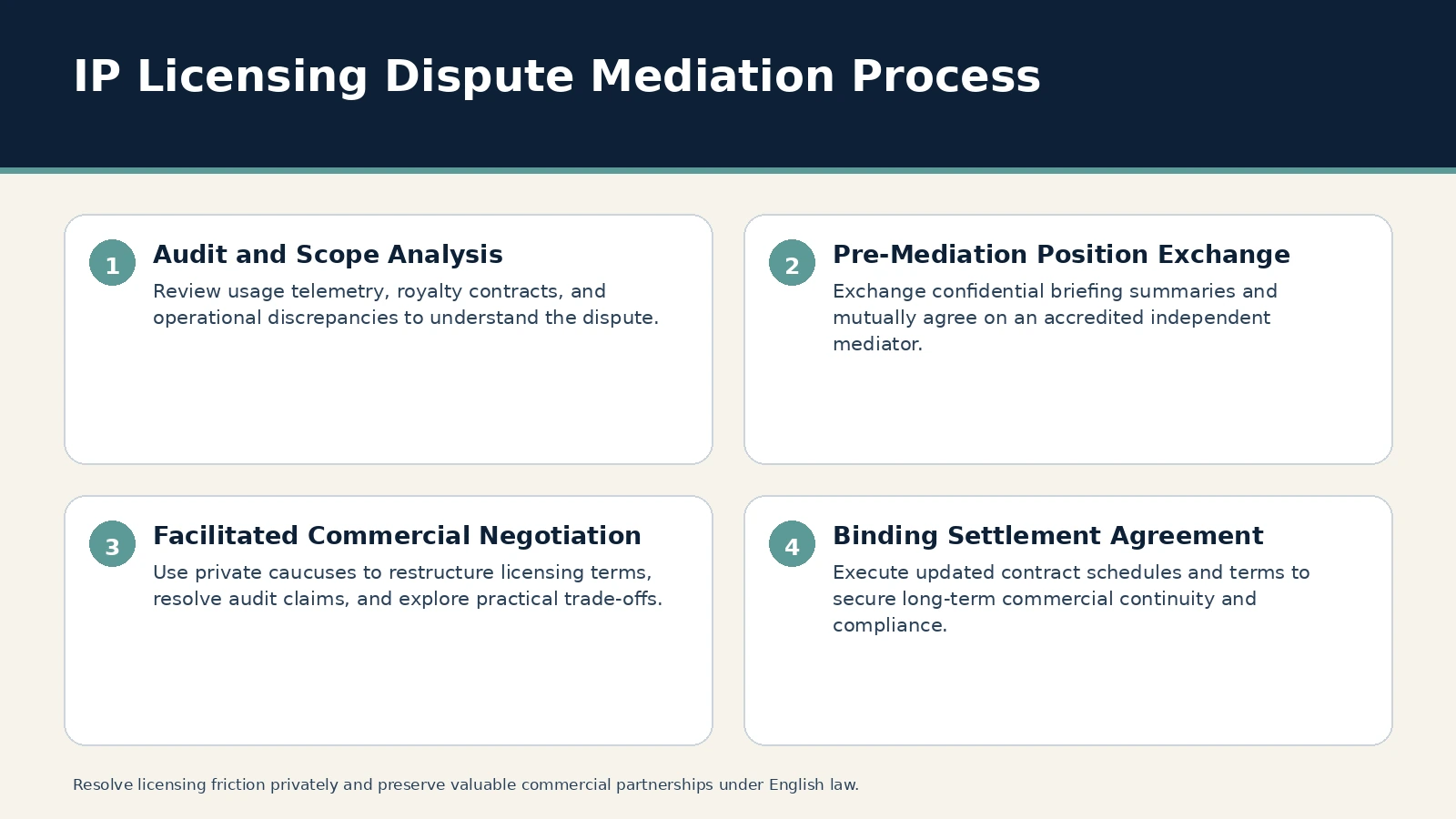
During private, confidential caucus sessions, an independent mediator works with each side to test underlying assumptions and explore practical trade-offs that extend well beyond narrow legal remedies:
- Restructuring royalty mechanisms: Rather than demanding an immediate single payment for disputed retrospective audits, parties can convert contested balances into adjusted future royalty bands, volume-based performance milestones, extended multi-year contract terms, or modified minimum annual revenue commitments.
- Clarifying technical architecture schedules: Agreements can be updated with clear technical schedules, telemetry-sharing protocols, API connection parameters, and precise definitions governing cloud deployment, server calls, and data processing rights.
- Recalibrating distribution and territory rights: Exclusive and non-exclusive distribution permissions can be reallocated across digital channels, vertical industries, or geographic territories, frequently incorporating joint marketing incentives or revised revenue-sharing arrangements.
- Structured transition and orderly run-off arrangements: Where parties determine that their commercial partnership cannot continue over the long term, mediation enables them to agree on phased run-off periods, customer support transition windows, code handovers, and structured data return protocols that protect downstream clients and avoid sudden market disruption.
Official guidance on intellectual property mediation from the UK Intellectual Property Office highlights the commercial utility of resolving technical and brand conflicts through confidential structured dialogue. Mediation ensures that proprietary code bases, confidential pricing matrices, wholesale margins, and customer databases remain entirely protected from open scrutiny, maintaining market reputation and commercial standing.
Comparing Resolution Pathways: Facilitated Intellectual Property Mediation vs Formal Court Adjudication
When licensing conflicts escalate, parties must decide whether to pursue formal proceedings through the Intellectual Property Enterprise Court (IPEC) or the High Court (Chancery Division / Patents Court), or to explore alternative dispute resolution. Evaluating how these pathways function in practice assists corporate boards, general counsel, and commercial managers in selecting the most proportionate procedure.
| Dispute Dimension | Formal IP Litigation (IPEC / High Court) | Commercial Intellectual Property Mediation |
|---|---|---|
| Primary Focus | Establishing past liability, contractual breach, or legal infringement. | Resolving commercial friction and structuring practical ongoing terms. |
| Outcome Adaptability | Determines legal rights based strictly on pleaded claims and defences. | Enables parties to agree on renegotiated royalties, modified scope, and new terms. |
| Confidentiality | Public court proceedings, statements of case, and published judgments. | Private contractual confidentiality protecting sensitive financial and technical data. |
| Process Management | Determined by court timetables, procedural directions, and court availability. | Convened swiftly by mutual agreement at a time chosen by the parties. |
| Commercial Relationship | Adversarial dynamic that places distribution and development partnerships under severe strain. | Collaborative dynamic designed to preserve distribution channels and licensing arrangements. |
Under the English civil justice framework, parties are expected to consider alternative dispute resolution before trial. The CPR Practice Direction on Pre-Action Conduct and the case management guidelines in IPEC encourage early settlement discussions. Courts actively manage IP cases and can grant stays in proceedings to enable parties to negotiate or explore alternative dispute resolution. For a thorough comparison of procedural timelines and financial exposures across different dispute formats, see our detailed guide on intellectual property mediation versus litigation costs in commercial disputes.
Preparing Data, Audit Telemetry, and Negotiation Mandates for Mediation
The success of intellectual property mediation depends substantially on structured and objective preparation. Because commercial licensing disputes frequently turn on nuanced financial calculations and complex technical usage logs, attending a mediation session with unsubstantiated positions can quickly create friction. Effective preparation involves assembling clear commercial documentation, agreeing on technical baseline data, and establishing practical negotiation parameters before entering joint talks.
1. Assembling Commercial Records and Technical Telemetry
Prior to the mediation session, both licensor and licensee should prepare concise, data-driven briefing summaries supported by primary operational records:
- Audited usage records and system telemetry: Objective logs showing server queries, active seat allocations, concurrent application instances, or unit production records that substantiate or answer audit findings.
- Commercial and financial modelling: Clear financial models illustrating how proposed adjustments to royalty percentages, minimum annual fees, or tiered thresholds will affect cash flow, product margins, and capital planning over multi-year horizons.
- Contractual documentation history: The core licensing agreement alongside subsequent variations, technical schedules, side letters, email records of operational changes, and course-of-dealing evidence demonstrating how the parties operated the licence in daily practice.
- Operational dependencies: An objective assessment of critical dependencies, including ongoing client commitments, third-party software integrations, and maintenance deadlines that require uninterrupted commercial continuity.
2. Structuring Commercial Authority and Negotiation Teams
Parties should ensure that representatives attending the intellectual property mediation have settlement authority or immediate access to ultimate decision-makers to conclude a binding agreement. Because commercial licensing solutions frequently involve multi-faceted contractual adjustments—such as trade-offs between cash settlements and forward-looking licence extensions—the negotiating delegation should comprise individuals capable of evaluating both financial and operational commitments.
A balanced mediation team typically includes:
- A principal commercial decision-maker: A chief commercial officer, managing director, or executive board member holding mandate authority to agree to restructured financial terms, contract variations, and revised delivery commitments.
- In-house legal counsel or specialist IP solicitors: Legal advisers responsible for evaluating contractual risks, assessing procedural exposure, and drafting terms of settlement as consensus emerges.
- Technical or financial specialists: Heads of software engineering, technical architects, or audit managers who can interpret telemetry logs, verify calculation formulas, and confirm operational feasibility in real time during private caucuses.
To evaluate how strategic negotiation timing and procedural conduct rules interact during settlement talks, read our guide on settlement timing, ADR strategy, and costs protections.
Executing Enforceable Settlement Terms in Licensing Disputes
When parties reach commercial consensus in mediation, the final procedural step is to convert those agreed terms into a formal, binding contract. A well-constructed settlement agreement removes future ambiguity by defining operational rights and obligations with complete precision.
In intellectual property licensing disputes, a comprehensive settlement framework typically addresses:
- Mutual releases and discharge of past claims: Full and final legal release of all historic claims relating to the disputed audit periods, alleged scope breaches, or unapproved territory sales, extinguishing the risk of ongoing litigation.
- Updated licensing schedules: Formal amendments to the underlying commercial contract that explicitly incorporate revised royalty calculations, updated telemetry verification procedures, and unambiguous field-of-use definitions.
- Future audit and verification protocols: Clear, balanced governance mechanisms setting out how future usage will be reported, how frequently audits may be conducted, and who will bear inspection costs under defined verification thresholds.
- Dispute escalation frameworks: Multi-tiered dispute resolution clauses requiring early commercial discussions and mediation before either party can initiate formal court proceedings regarding future contractual disagreements.
By transforming contentious audit claims and scope friction into a structured, forward-looking commercial agreement, parties protect valuable intellectual assets and preserve ongoing market revenue without the disruption and cost of formal trial proceedings.
If you are managing an unresolved licensing, royalty, or territory dispute, you can contact our commercial dispute team to discuss how structured mediation can assist in resolving your conflict.
Frequently asked questions
When is the best time to consider intellectual property mediation during a licensing dispute?
Mediation can be initiated at any stage, but it is most effective either immediately after an audit discrepancy is identified or following the initial exchange of formal pre-action correspondence. Engaging early allows parties to explore commercial settlement options before substantial legal fees are incurred and before working relationships become entrenched.
How does mediation protect sensitive trade secrets and royalty calculations?
Intellectual property mediation is governed by a private mediation agreement that establishes strict contractual confidentiality alongside without-prejudice privilege. Unlike open court proceedings, negotiation exchanges and mediation materials are confidential and without prejudice, meaning they generally cannot be disclosed to external parties or used in future legal proceedings, subject to recognised legal exceptions.
Who needs to attend an intellectual property licensing mediation?
Parties should ensure that representatives attending the intellectual property mediation have settlement authority or immediate access to ultimate decision-makers to conclude a binding agreement. It is standard for parties to be accompanied by their legal representatives and, where appropriate, technical or financial specialists who understand the disputed usage data.
What happens if parties cannot reach an agreement during the mediation session?
If an immediate settlement is not achieved, the parties retain all their legal rights to pursue court proceedings or arbitration. However, the mediation process frequently clarifies the core commercial issues, narrows disputed technical points, and establishes a framework that enables the parties or their advisers to conclude a settlement in the days following the session.
Authoritative UK guidance and further reading
Primary and official sources
- Intellectual property mediation – GOV.UK (gov.uk)
- Courts and Tribunals Judiciary (judiciary.uk)
- Let’s talk: A mediator’s tale – Intellectual Property Office blog (ipo.blog.gov.uk)
- Civil – Civil Procedure Rules – Justice UK (justice.gov.uk)
This guide provides general information about dispute resolution and mediation. It is not legal advice. The appropriate approach depends on the facts, documents, procedural position and the parties involved; obtain legal advice where required.