
In brief
The question: How can enterprise buyers and SaaS vendors resolve critical implementation delays, milestone acceptance deadlocks, and licensing audit conflicts without jeopardising ongoing operations or proprietary technology?
The short answer: When an enterprise software contract dispute arises, formal litigation often forces parties into rigid positions that threaten service continuity and risk public disclosure of sensitive commercial architecture. Commercial mediation offers a private, structured forum where technical leaders and commercial executives can negotiate realistic solutions. Rather than pursuing retrospective fault finding under the pressure of project breakdown, parties use mediation to establish technical standstill agreements, re-baseline delivery timetables, restructure recurring revenue models, or negotiate an orderly, secure transition of services. This pragmatic approach preserves working relationships and contains costs while satisfying procedural expectations under English civil practice that court action should be a measure of last resort.
Operational Friction Points in an Enterprise Software Contract Dispute
Modern enterprise software rollouts rarely break down overnight. Tension tends to accumulate across extended integration cycles where initial expectations, evolving technical architecture, and contractual specifications gradually pull in opposite directions. For corporate customers, a stalled enterprise deployment ties up substantial capital, causes operational disruption across business units, and threatens strategic transformation initiatives. For software vendors, an escalating customer disagreement interrupts cash flow, consumes senior engineering resources, and places predictable recurring revenue at risk.
Several distinct operational, financial, and technical tensions commonly trigger a serious software contract dispute:
- User Acceptance Testing (UAT) Deadlocks: Disagreements over whether delivered functionality meets contractual acceptance criteria. These disputes often turn on subjective test criteria, disputed severity levels for non-critical bugs, or shifting customer business processes that were not accounted for during initial scoping.
- Scope Creep and Statement of Work (SOW) Ambiguity: Discrepancies between pre-contract sales demonstrations and the binding Statement of Work. Customers may believe complex custom integrations were included in the core subscription, while vendors treat any departure from standard multi-tenant features as a billable change request.
- Milestone Payment Withholding and Threat of Service Revocation: Customers withholding scheduled deployment fees or annual recurring payments due to delivery delays, prompting vendor notices warning of platform access suspension, API throttling, or cessation of support.
- Licensing Audits and Indirect Access Claims: Contested findings from automated compliance audits alleging that third-party system connections, automated data queries, or unassigned user logins constitute unlicensed indirect usage, generating unexpected and contentious true-up demands.
- Data Migration and Third-Party Dependencies: Delays caused by legacy database extraction, third-party API rate limits, or integration incompatibilities where neither party accepts contractual responsibility for the resulting deployment bottleneck.
When these disagreements escalate into formal legal letters, project teams frequently stop direct communication. In complex enterprise integrations, engaging in commercial mediation early provides a mechanism to decouple day-to-day engineering problem-solving from defensive contractual positioning.
Why Court Litigation Threatens System Continuity and Proprietary IP
Pursuing an IT or software contract dispute through formal court litigation carries commercial and operational consequences that go far beyond direct legal fees. Court proceedings are retrospective by nature: a judge evaluates past conduct to determine breach of contract, assess liability, and award financial compensation. While this provides a definitive legal finding, it is poorly suited to preserving an active, mission-critical technology environment.
For both technology providers and enterprise customers, public litigation introduces operational vulnerabilities:
- Public Disclosure of Technical Architecture: Disclosing system integration frameworks, API architecture, code vulnerabilities, or sensitive commercial pricing models in open court filings can compromise intellectual property and commercial competitiveness.
- Immediate Operational Severance: Adversarial court proceedings often make continued commercial collaboration untenable, increasing the likelihood of sudden platform deactivation, suspended software updates, or restricted data access that directly impairs customer business operations.
- Inflexible Legal Remedies: A court judgment typically focuses on financial damages or contract termination. It cannot easily order parties to collaborate on revised deployment roadmaps, adjust service levels, or establish bespoke technical testing protocols.
Under English civil justice procedure, parties are expected to explore consensual dispute resolution before issuing formal proceedings. Paragraph 8 of the Practice Direction – Pre-Action Conduct and Protocols establishes that parties should actively consider alternative dispute resolution, such as mediation, before commencing court proceedings. Exploring resolution through structured commercial mediation allows organisations to demonstrate procedural compliance while retaining full control over technical and commercial outcomes.
Resolution Pathways: Commercial Software Mediation vs Formal Court Litigation
Navigating a stalled software deployment or licensing audit requires choosing a forum that matches the commercial realities of enterprise software. While litigation provides an external determination of past breaches, commercial mediation allows technical and commercial decision-makers to restructure the active delivery model by agreement.
| Dispute Dimension | Formal Court Proceedings | Commercial Software Mediation |
|---|---|---|
| Process Confidentiality | Hearings and filed court documents are generally open to the public, creating reputational exposure and public disclosure of commercial terms. | Conducted under a private mediation agreement, keeping proprietary technical architectures, financial models, and negotiations confidential. |
| Operational Continuity | Adversarial dynamic frequently leads to immediate termination of service, revoked system access, and prolonged business disruption. | Facilitates technical standstills, allowing ongoing system hosting, maintenance support, or phased testing during negotiations. |
| Milestone and Scope Flexibility | Judges assess compliance strictly against historical contract terms without authority to re-write statements of work. | Enables commercial and technical decision-makers to re-baseline delivery schedules, adjust acceptance criteria, and refine specifications. |
| Range of Outcomes | Predominantly focused on financial awards, declarations of breach, or formal contractual termination. | Can incorporate tailored commercial outcomes such as service credits, restructured licence tiers, or managed exit arrangements. |
| Procedural Position | Court proceedings may involve formal disclosure, expert technical witness reports where permitted by the court, and compliance with procedural timetables. | Flexible, party-driven process that satisfies pre-action procedural expectations to explore consensual resolution. |
Where software conflicts involve underlying ownership questions regarding bespoke development or source code access, examining parallel considerations in software IP ownership disputes can help parties evaluate risks before mediation begins.
Practical Remedies Achievable in a Software Contract Dispute
The principal strength of mediation in an enterprise software contract dispute is the freedom to craft forward-looking, practical solutions that align with operational requirements. Because terms are agreed by the parties rather than imposed by an external judge, organisations can design technical compromises that preserve sunk investment and protect ongoing revenue.
1. Establishing Technical Standstills and Preserving System Access
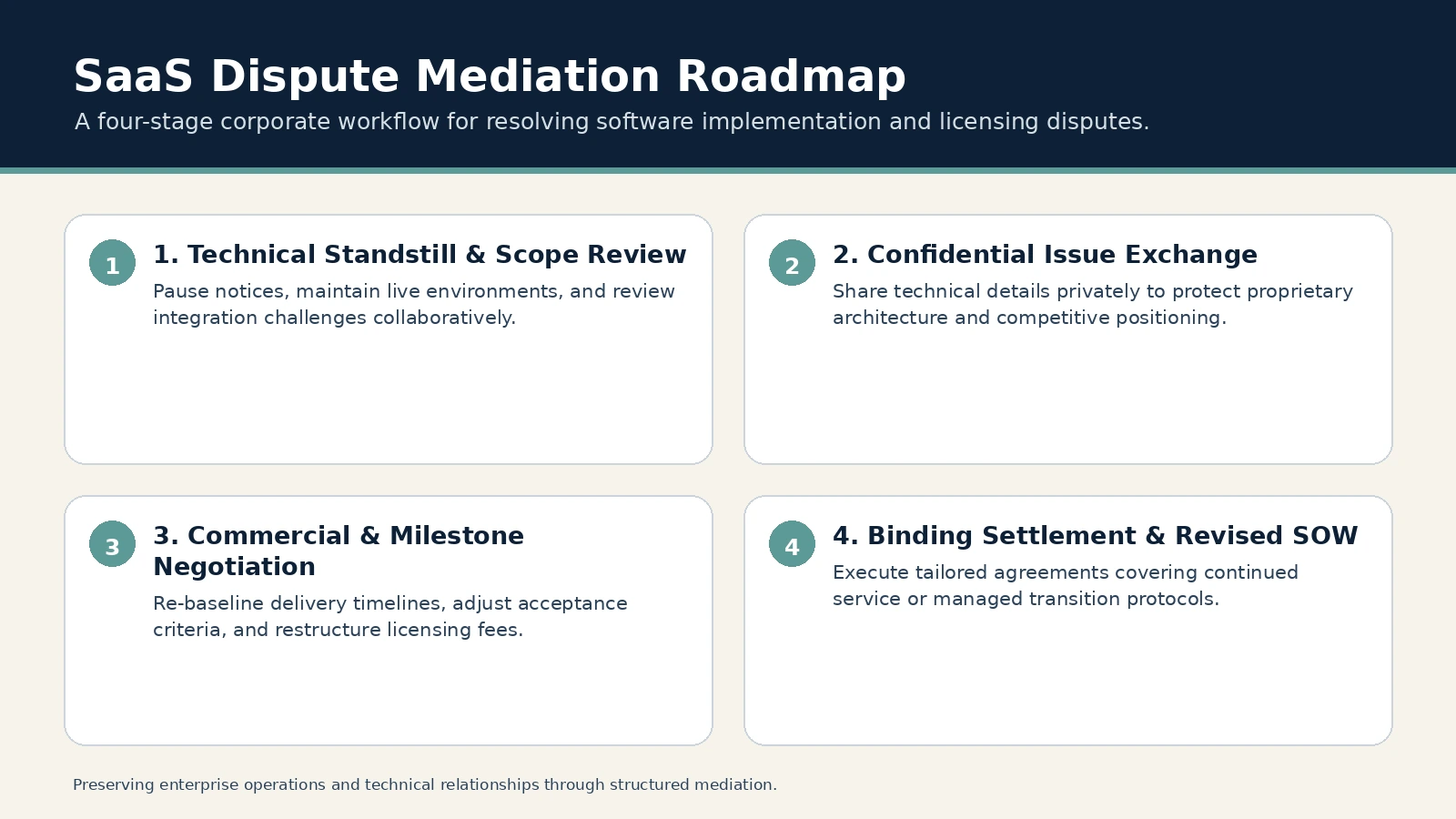
When an implementation deadlocks, the immediate risk is unilateral escalation: vendors may threaten platform disconnection or support withdrawal, while customers may threaten termination and demand full refunds. A mediator assists the parties in establishing an immediate technical standstill. Under this arrangement, live environments remain accessible, critical security patches continue, and unilateral contractual notices are paused while commercial and technical leads focus on negotiated resolution.
This interim breathing space prevents irreversible operational disruption, such as enterprise enterprise resource planning (ERP) freezing or critical customer-facing portal outages, while preserving the commercial status quo.
2. Re-Baselining Statements of Work and Acceptance Criteria
Implementation disputes frequently trace back to over-optimistic project schedules, ambiguous user stories, or unmanaged scope growth. Mediation enables engineering leads and project managers to re-baseline the deployment framework by:
- Clarifying contested specifications and agreeing on objective, reproducible testing protocols for User Acceptance Testing (UAT).
- Establishing a tiered delivery schedule that prioritises essential core workflows while deferring non-critical customisations to subsequent product phases.
- Reallocating engineering resources, clarifying client dependencies, and setting achievable milestone delivery dates reflecting real-world system complexity.
- Agreeing clear governance protocols for managing future change requests to prevent recurring disputes during subsequent rollout stages.
3. Restructuring Licensing Tiers and Resolving Audit Claims
Licensing disputes involving indirect access, API query volumes, or expanded user counts can threaten the commercial viability of an enterprise software relationship. In mediation, parties can move away from contentious retrospective penalty claims and negotiate practical commercial realignments. Potential solutions include converting disputed historical true-up amounts into prepaid credits toward premium modules, adjusting tiered subscription tiers, or restructuring contract terms to reflect actual organizational usage patterns.
4. Negotiating an Orderly Separation and Managed Transition
When the commercial relationship cannot be repaired, mediation provides a safe mechanism to negotiate an orderly separation. Rather than enduring sudden service disruption or protracted litigation over termination rights, parties can agree on a structured exit protocol that includes:
- A defined timetable for complete data extraction, database schema export, and verified data migration to a replacement solution.
- Guaranteed transitional hosting access and defined service level agreements (SLAs) during the decommissioning phase.
- Mutual releases from ongoing contractual claims alongside explicit terms governing confidentiality and IP rights.
- Apportionment of transition costs, including third-party migration assistance or escrow release protocols.
For organisations managing wider commercial contract breaches, reviewing principles of contract dispute mediation for commercial breaches offers valuable context on drafting clear, enforceable settlement terms.
Structuring Preparation for SaaS and Software Contract Dispute Mediation
Effective preparation directly shapes the quality and durability of any mediated settlement in an IT or software dispute. Both parties benefit from approaching the mediation with a clear view of technical interdependencies, commercial alternatives, and legal risk parameters.
Composing a Balanced Negotiation Team
Reaching a workable resolution requires synchronising technical feasibility with commercial authority. An effective mediation team brings together:
- A Commercial Decision-Maker: An executive with formal authority to agree contractual variations, adjust financial commitments, or sign settlement agreements without external sign-off during the mediation.
- A Technical Delivery Lead: A CTO, Chief Architect, or lead technical project manager who understands system architecture, API dependencies, and the realistic engineering effort required to complete disputed milestones.
- Commercial Legal Advisers: In-house or external solicitors who evaluate contractual exposure, advise on settlement risk, and draft the formal settlement agreement.
Preparing Core Technical and Financial Documentation
Parties should exchange concise, focused documentation that illuminates the root causes of the dispute without burying the mediator in unnecessary technical logs. Essential documents include the Master Services Agreement, the disputed Statements of Work, change order logs, documented UAT test outcomes, and correspondence regarding milestone acceptance. Creating a clear, agreed chronology of key project milestones helps keep negotiation sessions focused on constructive problem-solving rather than historical factual arguments.
Defining Realistic Walkaway Positions and Commercial Alternatives
Before entering the mediation room, each party should evaluate its Best Alternative to a Negotiated Agreement (BATNA). For a buyer, this involves assessing the real-world cost, timeline, and business disruption of procuring an alternative software platform versus salvaging the current integration. For a vendor, it means weighing the immediate loss of recurring revenue, potential reputational fallout within target industry verticals, and the internal cost of tying up senior developers in adversarial litigation. Understanding these commercial baselines allows negotiators to evaluate compromise options with clear perspective.
Resolving a Software Contract Dispute with Commercial Certainty
Engaging in commercial mediation gives SaaS vendors and enterprise buyers a direct method to resolve an escalating software contract dispute before it inflicts lasting operational harm or triggers public litigation. By bringing technical leaders and commercial executives into structured, confidential dialogue, mediation creates space to protect intellectual property, maintain vital infrastructure, and agree on practical, enforceable settlement terms.
When parties approach negotiation with technical clarity and commercial flexibility, mediation transforms a hostile project deadlock into a manageable contractual recalibration. If your organisation is experiencing a software rollout deadlock, disputed acceptance testing, or an escalating SaaS licensing claim, you can contact an EDR mediator to discuss whether commercial mediation is appropriate for your dispute.
Frequently asked questions
When should an organisation propose mediation in a software contract dispute?
Mediation can be proposed as soon as direct project negotiations reach an impasse, particularly before formal notices of termination are served or legal proceedings are issued. Initiating mediation early allows parties to agree on technical standstills, prevent service suspension, and re-baseline delivery timetables before commercial relationships become irrecoverable.
Who should attend a SaaS contract mediation session?
Each party should ensure attendance by a commercial decision-maker with full authority to agree financial terms and contract variations, accompanied by a senior technical lead (such as a CTO or project director) who understands system architecture and delivery realities, alongside their legal advisers.
How does mediation protect proprietary source code and technical architecture?
Discussions and settlement material generated during mediation are generally confidential under the terms of the mediation agreement and protected without prejudice, helping prevent sensitive commercial metrics, system architecture, or proprietary code from entering the public domain, subject to legal exceptions.
What happens if parties cannot reach a settlement during the mediation?
Mediation is a consensual dispute resolution process where parties retain control over settlement, although participation can be directed by the court. If the parties do not reach an agreement, neither party is bound by unexecuted proposals, and each retains all legal rights to pursue formal court proceedings, arbitration, or further direct negotiations.
Is an agreement reached during software dispute mediation legally binding?
A mediated settlement becomes legally binding once both parties agree on the terms and execute a formal written settlement agreement, often accompanied by revised statements of work or contractual variations drafted by their legal counsel.
Authoritative UK guidance and further reading
Primary and official sources
- Civil – Civil Procedure Rules – Justice UK (justice.gov.uk)
- Courts and Tribunals Judiciary (judiciary.uk)
- Pre-Action Protocol for Construction and Engineering Disputes – Civil Procedure Rules – Justice UK (justice.gov.uk)
- PRACTICE DIRECTION – PRE-ACTION CONDUCT AND PROTOCOLS – Civil Procedure Rules – Justice UK (justice.gov.uk)
This guide provides general information about dispute resolution and mediation. It is not legal advice. The appropriate approach depends on the facts, documents, procedural position and the parties involved; obtain legal advice where required.