
In brief
The question: When a commissioning company falls out with an independent software agency or freelance developer, who owns the underlying source code under English law, can the business force the immediate handover of repository access, and how can the commercial deadlock be broken before institutional funding or client operations collapse?
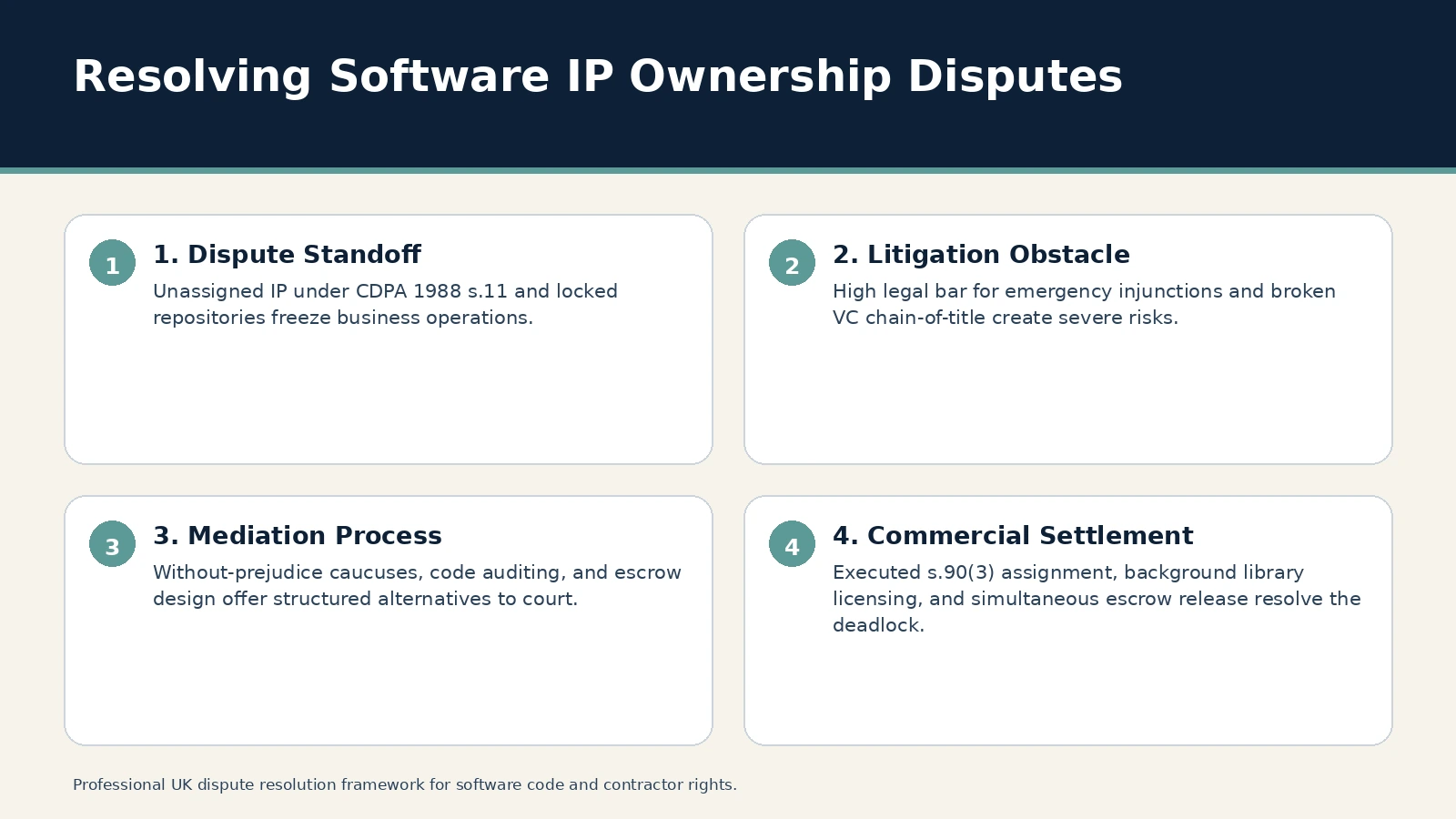
The short answer: Under Sections 11(1) and 90(3) of the Copyright, Designs and Patents Act 1988 (CDPA 1988), an independent contractor automatically retains first copyright ownership unless there is an executed, signed written assignment. Paying development invoices transfers no legal copyright on its own. If relations collapse and the developer withholds repository access, seeking an emergency court order for the delivery-up of code faces an extraordinarily demanding legal test where damages are considered an adequate remedy. Commercial mediation provides a structured alternative, using simultaneous code inspection, background library licensing, and solicitor-held escrow release protocols to transfer intellectual property and repository control without fatal litigation.
The Statutory Framework and the ‘Payment Equals Ownership’ Fallacy
A widespread assumption among technology founders, commercial directors, and commissioning enterprises is that paying a software agency’s invoices automatically vests copyright ownership in the client company. Under the law of England and Wales, this assumption is incorrect and frequently precipitates severe commercial conflict.
The statutory framework governing software copyright is established by the Copyright, Designs and Patents Act 1988. The Act creates a fundamental distinction based on the employment status of the author:
- Employees: Under Section 11(2) of the CDPA 1988, where a computer program is created by an employee in the course of their employment, the employer is the first owner of any copyright, subject to any agreement to the contrary.
- Independent Contractors and Agencies: Under Section 11(1) of the CDPA 1988, an individual freelance developer or independent contractor will ordinarily be the first owner of copyright in software they create, unless ownership is otherwise determined by agreement. Where the supplier is a development agency, ownership depends on who actually authored the code and the agency’s employment, subcontracting and assignment arrangements. The important point for the commissioning customer is that paying an external supplier to develop software does not, by itself, transfer copyright ownership to the customer.
To transfer legal copyright from the contractor to the commissioning client, Section 90(3) of the CDPA 1988 imposes a mandatory formal requirement: an assignment of copyright is not effective under English law unless it is in writing and signed by or on behalf of the assignor. An informal exchange of emails, an oral understanding, or a standard purchase order lacking express assignment terms leaves legal title with the developer.
Where a commissioning company does not hold an effective written assignment, its rights may depend on the express contract and any licence that can properly be implied from the circumstances. English courts take a fact-sensitive approach and will not imply wider rights than are necessary to give effect to the purpose of the engagement. Depending on the project, an implied licence may allow the client to operate and use the software, but it does not automatically confer the broader rights that would accompany copyright ownership. Uncertainty over the ability to transfer, sub-license or commercially exploit the software can therefore create significant problems during investment, acquisition or other due-diligence exercises.
Legal Mechanisms of Software Copyright Allocation
The legal mechanism governing software code dictates the commercial rights transferred, the vulnerability of the codebase during disputes, and its viability during institutional technical audits.
| Legal Mechanism | Statutory / Legal Basis | Ownership & Commercial Rights Conveyed | Risk / Limitation for Commissioning Enterprise |
|---|---|---|---|
| Statutory Default (No Contract) | CDPA 1988, s.11(1) | Contractor retains 100% of legal and equitable copyright. | Client holds no express rights; highly vulnerable to infringement claims upon external exploitation. |
| Implied Licence (Informal Commission) | Common law business efficacy principles | Non-exclusive, non-transferable licence for internal operational use and essential maintenance. | Client generally cannot assign IP, grant sub-licences, or sell the codebase without express agreement; fails venture capital chain-of-title audits. |
| Equitable Assignment (Rare Implied Term) | Equitable principles (beneficial ownership) | Beneficial ownership recognised; contractor holds legal title on bare trust for client. | Requires formal court declaration or subsequent signed assignment deed; rarely granted for modular software. |
| Statutory Written Assignment | CDPA 1988, s.90(3) & s.91 | Complete transfer of legal and beneficial copyright ownership to the commissioning client. | Requires signed writing; must explicitly delineate third-party and open-source dependencies. |
| Mediated Commercial Settlement | Enforceable Settlement Agreement & s.90(3) Deed | Bespoke partition: full bespoke application assignment, retained background licences, clean escrow handover. | Requires structured consensus; cannot be unilaterally forced without court stay or joint agreement. |
The Injunction Dilemma: Judicial Restraint in Code Handover Applications
When an agency-client relationship fractures over disputed scope, delayed milestones, or unpaid invoices, contractors frequently exercise technical self-help by revoking access to GitHub, GitLab, continuous integration pipelines, and cloud hosting consoles. The commissioning business, faced with frozen operations, often seeks an emergency interim mandatory injunction in the High Court to compel the immediate handover of source code and administrative credentials.
This litigation strategy carries substantial risk. Interim mandatory injunctions require the court to consider which course is likely to involve the least risk of injustice if the eventual decision at trial proves the interim decision to have been wrong. Because a mandatory order requires positive action before the underlying rights have been finally determined, the court may also consider whether it has a high degree of assurance that the applicant will establish the asserted right at trial. That is not an absolute prerequisite: the overall assessment remains focused on the comparative risk of injustice in granting or refusing interim relief.
In Transparently Ltd v Growth Capital Ventures Ltd [2022] EWHC 144 (TCC), the Technology and Construction Court refused an application for an interim mandatory injunction seeking delivery up of source code and software materials, holding that the least risk of injustice favoured refusal where damages were an adequate remedy and the high threshold for mandatory interlocutory relief was not met.
Litigation in the Technology and Construction Court or Chancery Division regularly takes 9 to 18 months. For early-stage companies and established enterprises alike, litigating an interim application absorbs financial runway while the software assets deteriorate. Parties evaluating formal proceedings must weigh these procedural realities against the alternative dispute resolution frameworks analysed in our comparison of contract dispute litigation and mediation costs.
Commercial Consequences: Broken Chains of Title and Hostage Repositories
A software IP ownership dispute rarely stays confined to an internal contract argument. Its secondary consequences quickly threaten the operational stability of the enterprise.
1. The Institutional Due Diligence Roadblock
Modern venture capital funds, private equity houses, and corporate acquirers conduct rigorous technical and intellectual property due diligence before releasing capital. A missing Section 90(3) assignment constitutes a serious governance defect. An implied licence under common law does not provide an investable chain of title because it prevents the company from giving customary warranties regarding unrestricted, unencumbered ownership of its core technology.
2. Software Atrophy and Security Vulnerabilities
When an agency freezes repository access, routine vulnerability patching, library updates, and continuous integration stop. If the standoff persists for several months, critical third-party dependencies become obsolete or insecure, damaging the enterprise valuation far more than the original financial claim.
3. The Developer’s Reusable Framework Dilemma
Agencies face an equally acute commercial risk. Bespoke software applications often incorporate the contractor’s proprietary, pre-existing background code, core libraries, and deployment scripts. If an agency executes a broad, poorly drafted assignment deed under pressure, it risks inadvertently transferring its own foundational toolkits, compromising its ability to service other clients.
Distinguishing Civil Withholding from Criminal Offence: Retaining code repositories deployed on developer-owned servers during a fee dispute is a civil contractual disagreement. However, using administrative access to enter a client’s independent servers to intentionally delete code, alter live databases, or insert logic bombs engages Section 3 of the Computer Misuse Act 1990, exposing the actor to serious criminal liability.
Hypothetical Scenario: The Series A Repository Standoff
To examine how these competing interests interact in practice, consider the following illustrative, composite scenario under English law.
Illustrative Scenario: Health-Tech Scale-Up and Agency Scope Dispute
A UK health-tech scale-up engaged a boutique development agency to build a proprietary patient triage portal. The engagement proceeded under an informal statement of work that lacked a clear copyright assignment clause. The client paid £180,000 across four development phases.
Prior to the final phase, a scope dispute arose regarding complex third-party electronic health record integrations. The agency issued an invoice for £45,000 in additional engineering hours. The client refused payment, citing missed milestone deadlines and defective code architecture. In response, the agency revoked the client’s access to the private GitHub repository, staging servers, and API keys.
The scale-up was midway through institutional due diligence for a £2.5 million Series A investment round. The lead investor gave the company three weeks to prove unencumbered intellectual property ownership and demonstrate an active deployment pipeline. Legal advisers prepared an emergency High Court application for an interim mandatory injunction for delivery-up of the codebase, estimating legal fees at £55,000 with significant procedural obstacles regarding damages adequacy. The agency faced escalating legal exposure and the prospect of an uncapped counterclaim for consequential commercial losses.
Rather than entering high-risk litigation, the parties agreed to an urgent, confidential one-day commercial mediation.
Negotiation Dynamics: De-Escalating IP Standoffs
In high-stakes software disputes, both sides tend to anchor on extreme positions: the commissioning client demands an immediate, unconditional transfer of all code under threat of urgent court action, while the developer refuses any handover until every disputed invoice is paid in full.
Resolving an IP ownership dispute requires unbundling these positions into addressable technical and commercial elements:
- Separating Application Code from Background Libraries: The client rarely needs ownership of the agency’s generic developer utilities; they need complete, unencumbered ownership of the unique application architecture, database schemas, and proprietary business logic.
- Separating Immediate Code Access from Ultimate Cash Realisation: The developer primarily seeks security of payment, while the client requires operational continuity and a clean chain of title for investors.
- Confidentiality and Commercial Protection: Open litigation creates a public record of defective software, project management failures, and broken title, deterring future commercial partners for both businesses. Mediation remains strictly confidential and covered by without prejudice privilege.
Parties can learn more about aligning negotiation timetables with CPR cost considerations in our detailed analysis of dispute settlement timing and ADR strategies.
The ‘Escrow-to-Push’ Resolution Protocol
Commercial mediation resolves software deadlocks by introducing technical settlement mechanisms that neither party can achieve unilaterally through early litigation. The centerpiece of a mediated software settlement is the structured escrow protocol.
- Independent Code and Dependency Verification: The parties agree on a neutral technical expert or conduct a structured, real-time code audit during mediation to confirm that the repository contains clean, compilable source code without hidden dependencies or intentional deletions.
- Partitioned Intellectual Property Assignment: A formal Section 90(3) CDPA 1988 deed of assignment is drafted. It conveys 100% of the legal and beneficial copyright in the bespoke application layer to the client, while granting the contractor an irrevocable, royalty-free, perpetual licence to retain and reuse their pre-existing background libraries and general-purpose tools.
- Concurrent Settlement and Handover: The parties can use an agreed stakeholder, third-party escrow provider or other appropriately structured payment mechanism so that settlement funds are released only when specified handover conditions have been satisfied. Those conditions might include transfer of Git repository administration, agreed cloud credentials, deployment documentation and the executed IP assignment. Where solicitors are involved, the precise mechanism for holding and releasing funds should be structured by the legal advisers in accordance with the applicable professional and client-money requirements.
- Warranty and Mutual Release Structure: The agreement concludes with mutual waivers of outstanding claims, balanced code-quality warranties, and non-disparagement covenants.
In structured disputes of this nature, this mediated protocol allows the commissioning business to present an executed assignment deed and restored repository control to investors within days, while securing a guaranteed, escrow-backed settlement payment alongside clear protection for the agency’s proprietary background tools.
Frequently asked questions
Does paying an external software agency’s invoice mean our company owns the copyright?
No. Under Section 11(1) and Section 90(3) of the Copyright, Designs and Patents Act 1988, independent contractors and development agencies retain legal copyright ownership of code they write, even if invoices are paid, absent a signed written assignment. To transfer ownership, English law requires an express assignment of copyright executed in writing and signed by or on behalf of the developer. Without this document, the client generally holds only an implied, non-exclusive licence for internal use.
Can a company get an emergency injunction to force a developer to hand over withheld source code?
Securing an interim mandatory injunction to force the delivery-up of source code is extraordinarily difficult. English courts apply the strict ‘least risk of injustice’ test and require a high degree of assurance that the applicant will succeed at trial. Courts routinely refuse such orders where financial damages would provide an adequate remedy at trial if a breach is established.
What is the commercial difference between an implied licence and a statutory copyright assignment?
A statutory assignment under Section 90(3) of the CDPA 1988 transfers full legal and beneficial ownership of the copyright to the client, allowing them to sell, sub-license, assign, and raise capital against the code. An implied licence typically permits the client to use the software only to the extent necessary for internal business efficacy. The precise scope of an implied licence is fact-sensitive, and uncertainty over transfer, sub-licensing or commercial exploitation rights can create significant concerns during investment or acquisition due diligence.
Is a contractor committing a criminal offence by withholding repository access during a dispute?
Passive withholding of source code or repository access held on a contractor’s own infrastructure will ordinarily raise contractual and intellectual-property issues rather than, without more, amounting to a criminal offence. Whether withholding access breaches the development agreement depends on the parties’ contractual delivery, access, payment and termination obligations. A different position may arise if someone knowingly performs unauthorised acts against another party’s computer systems—for example, altering or deleting software, impairing systems, or preventing authorised access—in circumstances capable of engaging the Computer Misuse Act 1990.
How does commercial mediation resolve software source code deadlocks?
Mediation provides a confidential forum where parties can implement an ‘escrow-to-push’ technical protocol. This synchronises the handover of repository keys, admin credentials, and a Section 90(3) copyright assignment deed with the release of agreed settlement funds from a solicitor’s escrow account, while preserving the developer’s retained rights over generic background libraries.
Authoritative UK guidance and further reading
Primary and official sources
- Copyright, Designs and Patents Act 1988 (legislation.gov.uk)
- Computer Misuse Act | The Crown Prosecution Service (cps.gov.uk)
- falkirk.gov.uk (coins.falkirk.gov.uk)
- enfield.gov.uk (enfield.gov.uk)
- Courts and Tribunals Judiciary (judiciary.uk)
- Courts and Tribunals Judiciary (judiciary.uk)
- Copyright, Designs and Patents Act 1988 (legislation.gov.uk)
Further professional reading
- UK Software IP Lawyers | AI-Assisted Development & Ownership (pailsolicitors.co.uk)
This guide provides general information about dispute resolution and mediation. It is not legal advice. The appropriate approach depends on the facts, documents, procedural position and the parties involved; obtain legal advice where required.