

In brief
The question: How can enterprise software buyers and technology suppliers resolve commercial deadlocks when iterative agile delivery clashes with a rigid, fixed-price contract structure?
The short answer: Fixed-Price Contract Disputes in Agile Software arise because predictable, lump-sum financial commitments sit uncomfortably alongside iterative backlog refinement and evolving technical requirements. When an enterprise client withholds milestone payments because the delivered increment does not match unwritten expectations, or when a software developer halts sprint work due to unbudgeted burn rates, delivery stalls. Commercial mediation provides a confidential, structured negotiation forum where commercial directors, delivery leads, and their legal advisers can recalibrate user backlogs, transition into workable hybrid pricing models, or structure an orderly handover of code repositories and intellectual property, while satisfying pre-action civil justice expectations in England and Wales.
The Friction Between Fixed Commercial Baselines and Iterative Sprints
Commercial contracts for bespoke software delivery often attempt to merge two contradictory philosophies. Procurement teams naturally seek commercial predictability through fixed-price, fixed-scope, and fixed-schedule agreements. Conversely, engineering teams rely on agile delivery principles—such as those articulated in the Agile Manifesto and the Scrum Guide—which presume that functional requirements cannot be fully known at the outset and must evolve through empirical observation and progressive backlog refinement.
This mismatch does not usually stem from bad faith. In the early stages of an engagement, both client and supplier share genuine enthusiasm for collaborative delivery. The contract incorporates an initial statement of work with high-level user epics, accompanied by an agile working framework. As sprint cycles progress, however, the practical realities of technical discovery begin to challenge early assumptions. Architecture decisions require unforeseen refactoring, third-party application programming interfaces (APIs) present unexpected integration hurdles, and end-user testing reveals that initial user stories fail to satisfy operational business needs.
At this juncture, the commercial foundation begins to buckle. The client’s product owner views functional changes as necessary refinements to achieve the agreed business objective. The supplier’s technical lead views the same changes as uncosted additions that expand effort beyond the fixed commercial budget. When formal contractual change mechanisms prove too cumbersome for rapid development cadences, the parties postpone commercial reconciliations. The friction steadily builds until milestone deadlines pass, deliverables are rejected, and informal collaboration is replaced by formal contractual correspondence. These strains are familiar across complex technology procurement, as examined in our wider analysis of commercial contract disputes.
The UK Cabinet Office and Central Digital & Data Office note in The Digital, Data and Technology Playbook that traditional fixed-price arrangements for an entire programme are generally ill-suited to iterative agile delivery or uncertain technical scope. When organisations attempt to force iterative discovery into rigid pricing constraints without dynamic adjustment mechanisms, disputes over acceptance, scope, and payment arise.
Milestone Sign-Offs, Acceptance Criteria, and Withheld Payments
In standard fixed-price software procurement, supplier cash flow depends on achieving predefined commercial milestones. These milestones often require formal User Acceptance Testing (UAT) sign-offs or delivery of functional modules described in static contract schedules. In a sprint-based environment, however, software is produced incrementally, with functionality refined across successive iterations against a negotiated Definition of Done.
Deadlock occurs when delivered software satisfies specific user story acceptance criteria at the sprint level but fails to satisfy the client’s broader commercial expectations for an end-to-end business workflow. Clients, feeling that the software is not commercially fit for purpose, withhold approval of milestone certificates and suspend staged payments. Suppliers, facing mounting payroll and infrastructure costs without matching revenue, respond by pausing sprint planning, reducing developer capacity, or restricting access to testing and deployment environments.
Once development pauses, both sides face immediate operational exposure. The client holds unfinished, non-deployable software while their operational deadlines slip. The supplier carries unpaid invoices and disputed work in progress that strain working capital. At this point, formal correspondence threatens contract termination or claims of repudiatory breach. Engaging an independent neutral before positions become entrenched allows the parties to address these commercial standoffs constructively through commercial mediation, before litigation destroys project value entirely.
Progressive Backlog Refinement Versus Scope Creep
A central dispute in agile projects centres on the boundary between routine backlog refinement and out-of-scope expansion. Agile governance relies on grooming user stories: breaking down high-level epics into actionable tasks as technical understanding deepens. In a time-and-materials engagement, continuous adjustment is standard practice because the client pays for developer capacity rather than predetermined deliverables.
Under a fixed-price arrangement, every unbudgeted story point absorbed by the development team reduces the supplier’s commercial margin. When clients request user interface enhancements, altered database schemas, or additional user permission tiers during sprint planning, disagreement arises over whether these features were implicit in the original specification. Suppliers argue that such requests constitute scope creep requiring formal contract variation and additional funding. Clients respond that the supplier’s initial cost estimate ought to have accounted for standard development complexities, and that the features are essential for a working product.
Because formal contractual variation procedures can take weeks to negotiate—conflicting with two-week sprint cadences—teams proceed on informal verbal understandings or optimistic assumptions that differences can be reconciled later. When the cumulative weight of unbilled hours becomes unsustainable, the commercial relationship fractures. Similar implementation impasses are explored in our detailed analysis of SaaS implementation and software licensing disputes.
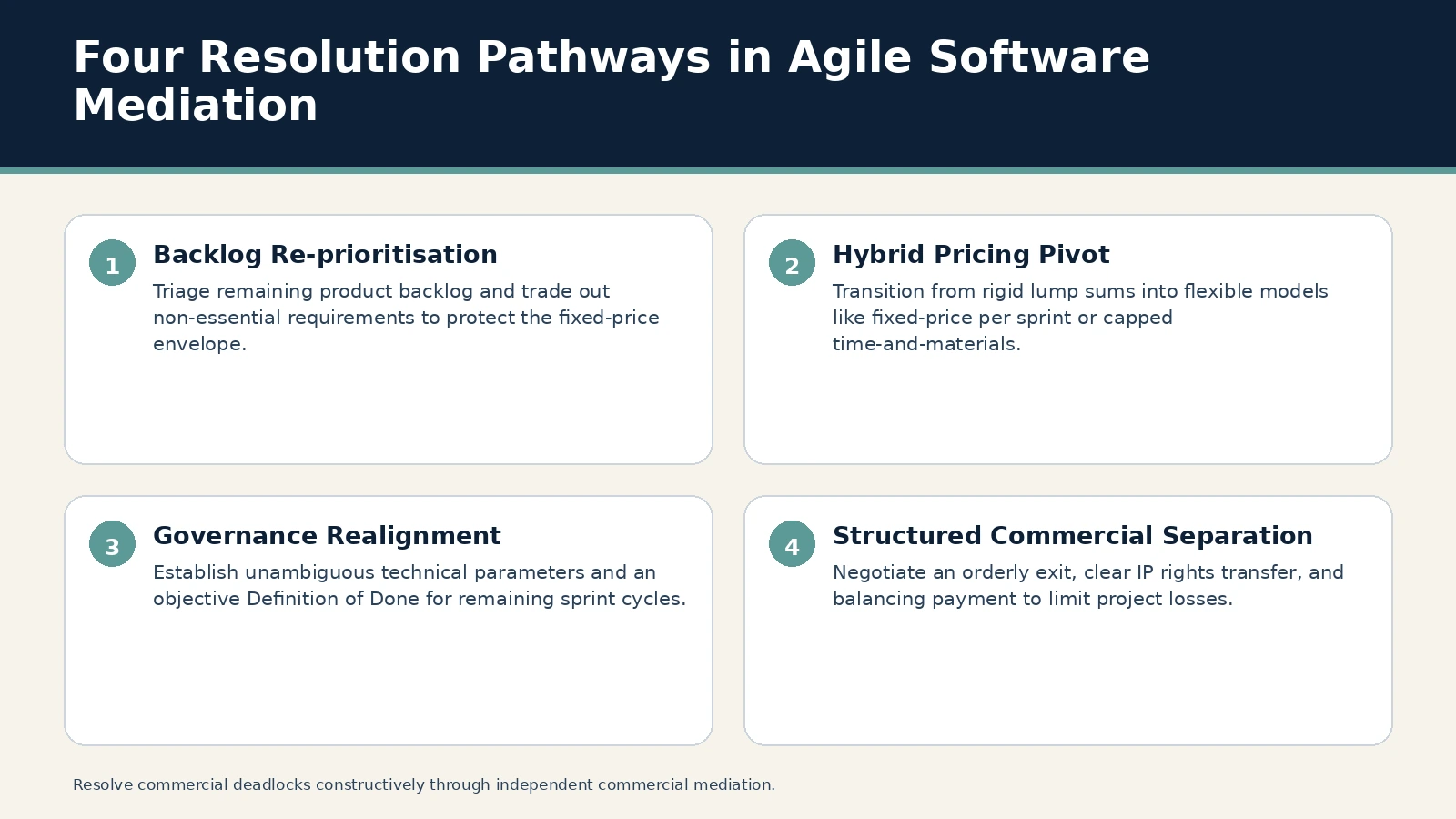
Commercial Resolution Pathways: Restructuring the Agile Engagement
When parties reach commercial deadlock, proceeding to court litigation in the Technology and Construction Court introduces substantial delay, legal expense, and operational disruption. Formal proceedings require forensic reconstruction of historic git commits, extensive sprint ticket audits, independent technical expert reports, and public disclosure of internal correspondence. Commercial mediation enables decision-makers to step away from contentious adversarial posturing and evaluate practical commercial options.
Working with an experienced mediator who understands software delivery mechanics—including sprint velocity, story estimation, and release governance—the parties can explore distinct commercial choices.
Backlog Re-prioritisation and Scope Trading
Where both organisations retain a strategic interest in completing the software build, mediation provides a confidential space to conduct structured commercial triage. Rather than arguing over who was responsible for past sprint delays, technical leads and commercial directors can review the remaining product backlog against available project funding.
The parties can agree to trade non-essential functional requirements out of the immediate release scope. Lower-priority user stories, cosmetic interface refinements, or secondary reporting modules can be deferred to post-launch phases or dropped altogether. In return, the supplier commits their primary development capacity to delivering mission-critical core functionality within the remaining fixed-price envelope. This scope-trading mechanism allows the client to obtain a viable, working system while protecting the supplier from uncontrolled engineering losses.
During this negotiation, the mediator helps the parties establish an objective, unambiguous Definition of Done. Clarifying exact technical parameters—such as automated test coverage thresholds, performance benchmarks, and user sign-off criteria—removes future ambiguity and establishes a stable delivery baseline for remaining sprints.
Commercial Restructuring into Hybrid or Sprint-Based Models
In many instances, the technical dispute is merely a symptom of an unsuitable contract structure. Forcing iterative software development into a whole-project lump sum creates an ongoing incentive conflict that undermines technical collaboration. Mediation allows the parties to renegotiate their commercial terms for future delivery without prejudicing their existing legal positions.
Parties use mediation to transition from an unworkable lump-sum arrangement into modern hybrid commercial models. Viable structures include:
- Fixed-Price-per-Sprint: The client funds agreed two-week development sprints at a fixed cost, with the supplier dedicating a ring-fenced engineering squad of specific seniority and velocity. Scope within each sprint remains flexible and directed by the client’s product owner.
- Capped Time-and-Materials: Work proceeds on an hourly or daily rate basis against prioritised backlog items, subject to agreed monthly budget caps and regular delivery reviews.
- Target-Cost with Pain/Gain Sharing: The parties agree on a realistic target cost for functional epics, sharing cost overruns or savings according to pre-agreed percentage ratios.
By restructuring the contract into an arrangement where risks and uncertainties are shared transparently, the delivery team can refocus on engineering quality rather than defensive contractual documentation.
Structured Commercial Separation and Asset Transfer
Where technical confidence has broken down, or the commercial relationship has become unworkable, attempting to force continued delivery is often counterproductive. The sensible commercial priority becomes structuring an orderly, clean separation that limits losses and secures corporate assets.
Unassisted contract terminations can degenerate into destructive standoffs: suppliers withhold source code repositories, disable cloud development environments, or assert liens over intellectual property, while clients withhold all outstanding fees and issue formal demand letters. In mediation, the parties can negotiate an agreed exit agreement that addresses operational issues simultaneously. Key settlement components include:
- Agreement on a single balancing payment to resolve outstanding invoices, unbilled work in progress, and disputed transition costs.
- A structured timeline for transferring git repositories, continuous integration pipelines, architecture documentation, and administrative credentials for cloud infrastructure.
- Delivery of developer handover sessions to enable the client’s internal team or a replacement technology supplier to onboard cleanly.
- Formal confirmation of intellectual property assignments or software licensing rights, ensuring the client possesses commercial freedom to exploit the codebase.
- Mutual releases from further contractual claims, accompanied by clear non-disparagement covenants to protect corporate reputations.
Securing clear title to software deliverables and contractor work product is critical during separation, as discussed further in our guide to software IP ownership and contractor source code disputes.
Comparing Court Proceedings and Commercial Mediation
Choosing the appropriate dispute resolution forum requires an understanding of how court proceedings differ from commercial mediation across technical and operational dimensions. The following comparison illustrates how each process handles disputes arising from agile development projects.
| Dispute Dimension | Technology and Construction Court Litigation | Commercial Mediation |
|---|---|---|
| Process Timelines and Momentum | Formal legal pleadings, procedural directions, and court scheduling that take extended periods to reach trial. | Convened rapidly by agreement, allowing parties to address delivery deadlocks before momentum is lost. |
| Flexibility Over Technical Scope | Determines historic breaches against the static contract; cannot rewrite backlogs or alter agreed milestone gates. | Empowers parties to re-trade user stories, refine acceptance criteria, and re-scope functional deliverables by agreement. |
| Commercial Pricing Restructuring | Assesses claims for damages, debt, or contractual remedies based on historic performance. | Allows commercial restructuring into hybrid pricing, capped sprints, or milestone-based adjustments for ongoing delivery. |
| Protection of Proprietary Code and Reputation | Public court proceedings with documented judgments, expert reports, and open evidence. | Conducted entirely in private, protecting proprietary codebases, trade secrets, and corporate standing. |
| Operational and Relationship Impact | Adversarial legal positioning that disrupts day-to-day collaboration between engineering teams. | Facilitated negotiation that can restore professional communication between product owners and suppliers. |
Negotiation Dynamics: Realigning Backlogs, Pricing Models, and Exit Terms
Commercial mediation succeeds when technical reality and commercial objectives are integrated into a coherent negotiation strategy. Resolving Fixed-Price Contract Disputes in Agile Software typically benefits from assembling factual project records that demonstrate how the software build was actually run, rather than relying solely on the formal text of the master services agreement.
Core Delivery Artefacts to Collate
Both suppliers and clients should compile objective project records that reflect day-to-day development interactions:
- The Contractual Baseline: The master services agreement, statement of work, agreed payment milestones, and any documented change control procedures.
- Sprint Management Records: Exported project management tracking data (such as Jira or Azure DevOps logs) showing sprint backlogs, committed versus completed story points, sprint burn-down charts, and velocity histories.
- User Story Documentation: Written acceptance criteria, Definition of Done checklists, and documented records of sprint review and retrospective meetings.
- Written Change Correspondence: Email trails, messaging exchanges, and meeting minutes recording functional scope discussions, backlog prioritisation decisions, and commercial warnings.
- Financial and Time Records: Clear schedules of invoiced sums, disputed deductions, developer time-sheeting data, and quantified remediation or transition costs.
The Pre-Action Context in England and Wales
Disputing parties must consider their procedural obligations under the English civil justice system before embarking on formal litigation. Under the Practice Direction – Pre-Action Conduct and Protocols (specifically paragraphs 8 to 11), litigation should be a last resort. Parties are expected to explore alternative dispute resolution, such as mediation, before issuing formal court claims.
Engaging in commercial mediation demonstrates constructive procedural conduct. While the court retains discretion depending on the specific circumstances of the case, an unreasonable refusal to participate in alternative dispute resolution can result in adverse cost penalties at the end of proceedings, even for a successful party. Participating constructively in mediation allows commercial organisations to explore practical business outcomes while fully satisfying their pre-action responsibilities.
Securing Binding Commercial Finality
According to official UK Government guidance on civil mediation, the process is an impartial, confidential negotiation conducted on a without-prejudice basis. This structure allows both suppliers and clients to discuss delivery difficulties, budget limits, and technical compromises candidly, knowing that proposals explored during discussions cannot be used against them in future court proceedings if agreement is not reached.
This framework is vital in technology disputes, where parties may need to acknowledge engineering oversights, budget ceilings, or technical debt without fear of legal exposure. When the parties reach consensus—whether on realigned backlogs, pricing adjustments, or commercial separation—the terms are drafted into a formal settlement agreement. Once executed by authorised representatives, this agreement forms a legally binding contract that supersedes earlier disputed arrangements, providing commercial certainty for future sprints or establishing clear closure for an agreed separation.
Practical Next Steps for Commercial Leaders
Managing deadlocks in software development requires prompt intervention before sprint momentum is permanently lost and costs escalate. Delaying action while unresolved backlog tickets accumulate increases financial exposure and hardens personal positions across both delivery and executive teams.
To evaluate whether commercial mediation is appropriate for your software dispute, discuss the commercial and technical issues confidentially, or arrange the appointment of an experienced mediator, you can contact Echelon Dispute Resolution.
Frequently asked questions
Why do fixed-price contracts frequently cause conflict in agile software projects?
Fixed-price contracts demand rigid upfront baselines for scope, cost, and time, whereas agile methodologies rely on continuous discovery and progressive backlog refinement. When unexpected technical complexities arise or product owners adjust functional requirements, disputes emerge over whether the changes constitute natural development detail or unbudgeted scope expansion.
Can commercial mediation help if software development has already stopped?
Yes. Mediation provides a private forum where parties can negotiate whether to restart work under realigned sprint backlogs and restructured pricing, or to arrange an orderly commercial separation. Discussions can resolve disputed invoices, source code handover, deployment access, and intellectual property transfers without initiating court proceedings.
What procedural risks arise if a party refuses mediation in an agile contract dispute?
Under the Practice Direction – Pre-Action Conduct and Protocols (specifically paragraphs 8 to 11), litigation should be a last resort. While the court retains discretion depending on the specific circumstances of the case, an unreasonable refusal to participate in alternative dispute resolution can result in adverse cost penalties at the end of proceedings, even for a successful party.
Are agreements reached through software mediation legally enforceable?
Yes. Although discussions in mediation are confidential, terms agreed upon during the process become legally binding once they are documented in a formal written settlement agreement signed by authorised representatives of both parties.
Authoritative UK guidance and further reading
Primary and official sources
- The Digital, Data and Technology Playbook – GOV.UK (gov.uk)
- PRACTICE DIRECTION – PRE-ACTION CONDUCT AND PROTOCOLS – Civil Procedure Rules – Justice UK (justice.gov.uk)
- A guide to civil mediation – GOV.UK (gov.uk)
- Contracting For Agile Guidance Note (HTML) – GOV.UK (gov.uk)
This guide provides general information about dispute resolution and mediation. It is not legal advice. The appropriate approach depends on the facts, documents, procedural position and the parties involved; obtain legal advice where required.