

In brief
The question: How can senior executives and organisations effectively resolve deadlock and conflict between business transformation sponsors and technical delivery directors without derailing critical programmes, burning capital, or triggering formal employment disputes?
The short answer: Conflict Between Transformation Sponsors and Delivery directors arises from structurally competing remits rather than personal bad faith. Commercial sponsors face direct board pressure to realise strategic benefits, meet investor milestones, and control expenditure. Technical delivery directors carry operational accountability for execution feasibility, architectural resilience, vendor deliverables, and team capacity. When these differing obligations produce entrenched deadlock, internal executive escalations often falter because internal teams lack the perceived neutrality or peer-level standing required to broker workable operational concessions. Introducing an independent, confidential dispute resolution process such as workplace mediation gives both leaders a private forum to step outside political posturing, assess delivery constraints, and reset governance mechanisms. This voluntary intervention preserves professional standing, protects capital investment, and brings programme scope back into balance with technical capacity.
The Structural Roots of Executive Transformation Deadlock
Major corporate programmes rarely falter through an absence of technical capability or executive ambition. Friction between strategic sponsors—such as Senior Responsible Owners, Chief Commercial Officers, or Business Unit Heads—and technical delivery directors is a natural consequence of complex organisational change. The sponsor’s core mandate centres on commercial value realization: fulfilling board commitments, capturing market share, or securing regulatory compliance within tight financial windows. The delivery director’s professional standing rests on engineering integrity, operational resilience, vendor performance, and sustainable team capacity.
When delivery friction develops, these differing remits create contrasting pressures. What an executive sponsor considers decisive programme leadership—such as defending a committed go-live date—the delivery lead can view as an unrealistic disregard for operational dependencies. What the delivery director regards as responsible engineering governance, the sponsor can interpret as obstruction, risk aversion, or an absence of commercial urgency. Without structured intervention, constructive professional debate can harden into positional entrenchment.
This friction occurs across enterprise environments and wider organisational disputes, as outlined across our workplace disputes guide. Role-based tensions also emerge across iterative frameworks, as explored in our guide on Scrum Master and Product Owner conflict in SAFe transformations. When strategic and execution responsibilities operate without agreed operational assumptions, friction ceases to be productive and begins to threaten programme viability.
Operational Indicators of Transformation Deadlock
Leadership friction does not emerge unannounced. It follows an identifiable trajectory from initial collaborative tension to defensiveness and governance paralysis. Recognising these indicators early enables organisations to intervene before the executive relationship fractures:
- Reporting and RAG-status disputes: Disagreements over programme dashboards, where sponsors challenge the validity of Amber or Red statuses while delivery directors maintain that technical risks are being downplayed to satisfy executive committees.
- Backchannel governance lobbying: Leaders bypassing established reporting lines to brief non-executive directors, Chief Executives, or Audit Committees privately, seeking to reinforce their narrative before programme boards meet.
- Conflicting executive instructions: Programme managers, engineering leads, and technical teams receiving contradictory directives regarding scope, priorities, and quality thresholds, resulting in team paralysis, falling morale, and rising contractor expenditure.
- Disputed assurance reviews: Commissioning assurance reviews or vendor audits intended less to uncover genuine technical insights and more to build an evidential case against the other leader’s capability.
- Withdrawal from collaborative governance: Delegating steering group attendance to deputies, cancelling informal check-ins, and insisting on formal written correspondence to confirm routine operational requests.
When these patterns emerge, the disagreement is no longer confined to schedules or technical trade-offs. It becomes a governance breakdown that puts individual careers and programme investments at risk.
The Statutory Context and Implied Employment Obligations
When tension between senior executives escalates, organisations can make the mistake of ignoring interpersonal friction or resorting prematurely to formal investigation procedures. Both paths carry operational and employment risks under England and Wales practice.
The procedural baseline for managing workplace grievances is set out in the Acas Code of Practice on Disciplinary and Grievance Procedures (2015). The Foreword and paragraph 32 of the Acas Code encourage employers and employees to explore informal resolution of workplace issues wherever possible before formal grievance procedures are triggered. For senior leaders, initiating a formal grievance process often hardens positions, requiring parties to assemble documentation and adopt adversarial positions that undermine ongoing collaboration.
Furthermore, under England and Wales employment contracts, an implied duty of mutual trust and confidence exists between employer and employee. When an organisation permits bad-faith scapegoating, sidelines a delivery director’s professional authority, or allows a sponsor to be undermined through hostile backchannels, it risks breaching this fundamental contractual duty. If unaddressed, this conduct can trigger formal grievances, constructive dismissal risks, or protracted executive departures. Senior executive disputes often mirror the relational fractures analysed in our overview of director dispute mediation and boardroom deadlocks, where commercial realignment must precede personal resolution.
Evaluating Pathways to Resolve Leadership Deadlock
Boards and Chief People Officers facing executive deadlock have several potential intervention pathways. Selecting the appropriate mechanism depends on whether the underlying driver is technical ambiguity, interpersonal breakdown, or structural governance failure.
| Resolution Pathway | Operational Focus | Relational Impact | Governance Outcome | Party Autonomy |
|---|---|---|---|---|
| Informal Internal Facilitation | Internal HR or Chief of Staff addresses surface-level disagreements. | Limited repair; often hindered by perceived political bias or lack of seniority. | Temporary fixes; underlying authority clashes often re-emerge under delivery pressure. | Moderate; parties remain subject to internal organisational politics. |
| Technical Delivery Assurance | External review assesses architecture, estimates, and programme milestones. | Adversarial; can feel like an external audit aimed at apportioning professional blame. | Clarifies technical data but leaves interpersonal leadership friction unaddressed. | Low; outcomes are defined via expert technical evaluation. |
| Independent Workplace Mediation | Confidential, facilitated dialogue addressing delivery realities and leadership dynamics. | Constructive potential; rebuilds professional respect and shared accountability. | Generates agreed governance compacts and practical recalibration plans. | High; both leaders retain full ownership of any agreed solutions. |
| Formal Grievance Investigation | Adjudication of formal workplace complaints under statutory frameworks. | Polarising; hardens positional hostility and limits collaborative capacity. | Produces a finding on specific allegations; does not resolve underlying project misalignment. | Low; control rests entirely with investigators and internal decision-makers. |
| Executive Exit or Reassignment | Negotiated departure or removal of one leader to end delivery paralysis. | Permanent severance; can damage team continuity and transformation momentum. | Costly; institutional knowledge is lost and delivery milestones are delayed. | Low to moderate; resolved through individual contractual negotiation. |
As the comparison shows, technical assurance reviews cannot resolve relational mistrust, while formal internal investigations tend to dismantle the collaboration required to steer complex programmes. Independent mediation offers organisations a way to address operational disagreements while maintaining executive capability and momentum.
The Workplace Mediation Process for Transformation Executives
Workplace mediation between transformation leaders is a structured, voluntary, and private process led by an independent mediator. Unlike internal management meetings, external mediation provides an impartial setting where executives can articulate operational constraints without political exposure. This is an important step when conflict between business transformation sponsors and technical delivery directors arise.
Initial Private Consultations
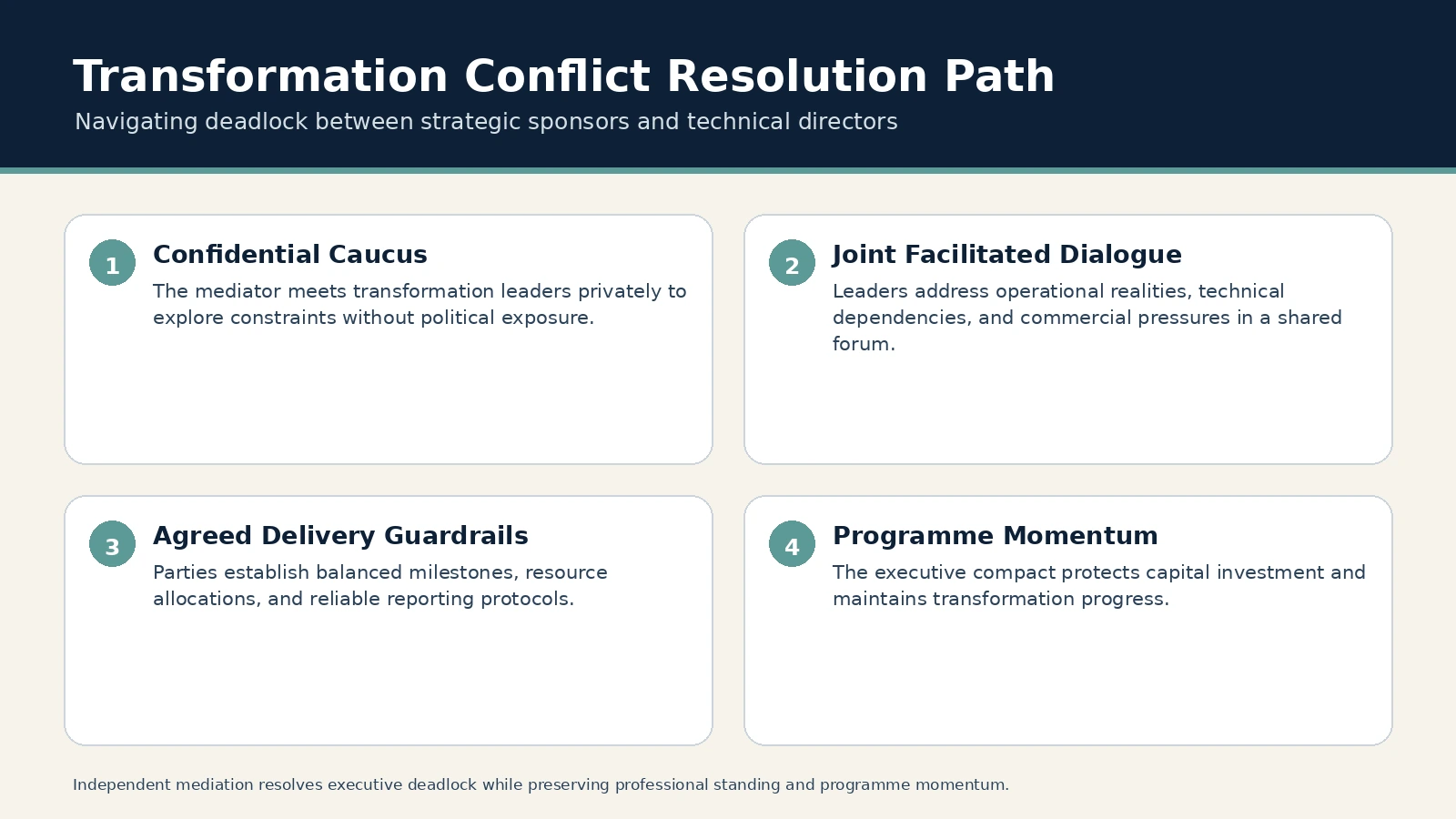
The mediator meets with the transformation sponsor and delivery director separately. These confidential sessions allow each leader to explain their perspective without maintaining an executive posture. The sponsor can voice concerns regarding board commitments, commercial exposure, or investor milestones. The delivery director can candidly outline technical architecture bottlenecks, vendor performance challenges, or team capacity issues. The mediator uses this stage to separate operational constraints from interpersonal friction, helping each participant recognise the legitimate pressures operating on the other.
Structuring the Facilitated Joint Session
Once both leaders understand the process and agree on the agenda, they attend a facilitated joint session. The mediator establishes ground rules: mutual professional respect, direct communication, and a focus on forward-looking commercial solutions rather than past miscommunications. In this forum, leaders can evaluate how their counterpart’s decisions are shaped by organizational incentives rather than personal bad faith.
Commercial and Operational Recalibration
The joint discussions focus on practical programme realignment. Rather than debating abstract performance metrics, the leaders examine concrete operational realities: critical-path milestones, minimum viable scope, resource allocation, and reporting protocols. The mediator helps the parties move from defensive positions to practical problem-solving, exploring how technical dependencies and commercial priorities can be balanced realistically.
Designing the Executive Compact
The conclusion of a successful mediation is an operational and behavioural agreement—often termed an executive compact. Agreements reached in workplace mediation are informal behavioural and operational understandings rather than legally binding commercial contracts. The compact establishes written guardrails defining how the sponsor and delivery director will interact, make decisions, and manage emerging variances.
Practical Governance Mechanisms to Prevent Re-escalation
A successful executive mediation produces concrete governance mechanisms designed to protect the transformation from future relational breakdowns. In addressing recurring friction and Conflict Between Transformation Sponsors and Delivery directors, the agreed outcome should establish clear operational protocols:
- Calibrated escalation triggers: Explicitly defined thresholds specifying when an operational variance requires sponsor notification versus when it remains within the delivery director’s operational discretion.
- Agreed single source of reporting truth: A shared protocol for board dashboards that includes joint review before status updates are distributed, ensuring neither leader feels ambushed in governance committees.
- Two-stage conflict resolution protocol: An agreed process that any future impasse over scope or schedule will be discussed privately between the sponsor and delivery director before either party escalates the matter to executive leadership.
- Scope and resource equilibrium mechanisms: An operational principle that any demand for accelerated milestone delivery must be paired with an agreed reduction in functional scope or an immediate release of additional capital.
By translating interpersonal alignment into practical governance guardrails, the organisation protects its capital investment and establishes an environment where senior executives can navigate transformation challenges collaboratively.
Preparing for Mediation: Guidance for Decision-Makers and HR Leaders
For Chief People Officers, General Counsel, and board directors managing an executive conflict between transformation sponsors and delivery directors, structured preparation is critical to ensuring the dispute resolution process succeeds:
First, ensure the participation of both leaders is voluntary. Forcing senior executives into mediation under duress undermines the process before it begins. Frame the intervention not as remedial performance management, but as a strategic leadership alignment session designed to protect programme momentum and executive autonomy.
Second, select an external mediator with credible experience at executive and technical interfaces. Senior directors engage more productively with facilitators who understand programme lifecycles, enterprise architecture, and commercial governance. A workplace mediator is an impartial facilitator who does not judge past actions, decide technical feasibility, or impose binding decisions on the parties.
Third, brief the mediator on the institutional context while leaving the resolution entirely to the participants. While the board or Chief People Officer defines the commercial boundaries within which the transformation must operate, the day-to-day working relationship and execution compromises must be designed and owned by the sponsor and delivery lead themselves.
For further perspective on addressing executive deadlock, see our guidance on resolving workplace communication breakdowns through mediation. If your organisation is experiencing leadership friction that threatens a critical programme, you can speak to an EDR mediator to discuss whether independent workplace mediation is an appropriate step.
Frequently asked questions
Can external workplace mediation resolve fundamental project budget or schedule shortfalls?
Mediation cannot create additional budget or resources beyond the participants’ operational authority. However, it provides a confidential, realistic forum for the sponsor and delivery director to agree on what is genuinely deliverable. Once interpersonal friction is removed, the leaders can jointly present pragmatic scope adjustments, revised milestones, or transparent capital requests to the board, replacing defensive reporting with a credible, unified delivery plan.
How is executive workplace mediation kept confidential?
Workplace mediation is voluntary and confidential between the participating parties and the mediator under an agreed procedural and contractual framework. Matters discussed during private and joint sessions cannot generally be disclosed to the board, HR, or colleagues without both leaders’ permission, except where overriding legal or health and safety obligations apply. Shared output is generally restricted to what participants mutually authorise, typically an agreed executive compact or completion notice, subject to overriding exceptions for unlawful conduct or serious health and safety risks.
What happens if one of the executive leaders refuses to participate in mediation?
Workplace mediation is voluntary and confidential between the participating parties and the mediator, meaning it cannot be mandated. If an executive declines to participate, the organisation must consider alternative pathways, such as formal internal grievance procedures, independent technical assurance reviews, or restructuring executive accountabilities. However, senior leaders frequently agree to participate once they understand that mediation is a private, non-judgmental process designed to preserve their autonomy and professional standing.
Are agreements reached in executive workplace mediation legally binding?
Agreements reached in workplace mediation are informal behavioural and operational understandings rather than legally binding commercial contracts. They reflect mutual professional commitments regarding governance, reporting, communication, and decision-making. If parties decide an executive departure is necessary, a formal statutory settlement agreement requires advice from a relevant independent adviser; contractual alterations, however, can be implemented via standard contractual variation.
How does external mediation fit alongside internal HR or grievance procedures?
External mediation aligns with the Acas Code of Practice on Disciplinary and Grievance Procedures (2015), which encourages early, informal resolution of workplace issues wherever possible before formal mechanisms are triggered. It can be initiated at any stage—either as a preventative step before formal grievances are raised, or paused during formal processes—provided all parties consent to participate.
Authoritative UK guidance and further reading
Primary and official sources
- Defra project initiation: lessons learned report (Accessible version) – GOV.UK (gov.uk)
- projectdelivery.gov.uk (projectdelivery.gov.uk)
- projectdelivery.gov.uk (projectdelivery.gov.uk)
- Digital services at the border programme: SRO appointment letter (accessible version) – GOV.UK (gov.uk)
This guide provides general information about dispute resolution and mediation. It is not legal advice. The appropriate approach depends on the facts, documents, procedural position and the parties involved; obtain legal advice where required.