

In brief
The question: How should employers, line managers, and human resources professionals handle severe interpersonal friction, operational siloing, and defensive silence between colleagues when ordinary managerial conversation has failed?
The short answer: Addressing a workplace communication breakdown through mediation provides an independent, voluntary forum to rebuild operational dialogue before conflict calcifies into formal disciplinary or grievance disputes. Rather than investigating past blame, an accredited mediator facilitates a structured, confidential discussion that shifts focus onto future working expectations, shared operational dependencies, and clear behavioural protocols. Under official Acas good practice guidance, employers and employees are encouraged to resolve issues informally where possible, and internal grievance procedures may be paused by mutual agreement to explore mediation, while the statutory Acas Code of Practice on Disciplinary and Grievance Procedures (2015) sets formal procedural standards (noting at paragraph 32 that formal grievances should be raised where informal resolution is not possible). Outcomes take the form of consensual, morally binding communication compacts that establish workable day-to-day boundaries without altering underlying employment contracts or compromising statutory employment rights.
Workplace Communication Breakdown Through Mediation: Anatomy of Team Friction
Interpersonal friction within professional environments rarely emerges without warning. Strained communication usually begins with small misunderstandings: conflicting interpretations of an email, divergent expectations around project delivery, or mismatched working styles between hybrid and office-based colleagues. When individuals feel unheard or undermined, self-protective habits take over. Direct spoken exchanges diminish, tone becomes guarded, and messages are channelled through defensive written records. Colleagues start copying senior managers onto routine updates, avoiding collaborative meetings, or speaking through intermediaries.
Left unaddressed, this operational siloing creates organisational drag. Project information slows down, decision-making stalls, and surrounding team members are drawn into subtle factional alliances. Sickness absence often climbs as stress accumulates. At this stage, line managers frequently struggle to intervene effectively. A line manager is part of the operational hierarchy; their involvement carries authority, performance assessment, and potential bias, which can prompt defensiveness rather than candour. When informal management conversations fail to restore direct dialogue, exploring our broader guidance on workplace disputes or engaging specialist workplace mediation services offers a constructive mechanism to reset the relationship before positions harden permanently.
The progression of communication failure follows a recognisable operational trajectory:
- Withdrawal from spontaneous dialogue: Colleagues cease informal desk check-ins or quick telephone calls, moving entirely to formal, documented channels.
- Defensive documentation: Routine emails are drafted with extreme caution, loaded with transactional language, or deliberately copied to peers to establish an evidential trail.
- Attribution of negative intent: Neutral actions—such as a delayed reply, an abrupt calendar invitation, or an overlooked agenda item—are automatically interpreted as deliberate slights or acts of bad faith.
- Proxy communication: Disputants begin interacting through third parties, asking peers or direct reports to deliver messages, relay updates, or negotiate deliverables on their behalf.
- Procedural deadlock: Direct collaboration halts, resulting in stalled projects, management escalation, and mutual threats of formal complaint.
When this pattern establishes itself, direct conversation cannot easily be restored by management fiat. Telling two professionals to sit in a room and sort it out often intensifies defensive posturing. The individuals feel their professional standing is under scrutiny, leading them to justify past choices rather than consider adjustments. Resolving a workplace communication breakdown through mediation succeeds because it introduces an impartial structure where neither individual is on trial and both retain agency over the outcome.
Why Formal Grievance Procedures Exacerbate Communication Failures
When communication collapses entirely, the default organisational reflex is often to invoke a formal grievance procedure. An employee submits a detailed complaint alleging unreasonable behaviour or poor management, which triggers formal written statements, investigator interviews, and evidence bundles. While grievance procedures are essential for serious allegations of unlawful discrimination, fraud, or gross misconduct, applying them to interpersonal communication failures often causes lasting harm to working relationships.
A formal grievance investigation is retrospective and adjudicative. Its mandate is to examine historical events, evaluate conflicting testimony, and deliver a finding on whether policy has been breached. This structure inherently encourages an adversarial posture. To validate their experience, each colleague feels compelled to assemble an exhaustive catalogue of the other person’s perceived missteps, casual remarks, and operational shortcomings over preceding months. The process creates winners and losers. Even when a grievance is not upheld, the individuals must still face each other on Monday morning, now carrying the emotional weight of formal written accusations and disclosed interview transcripts. Formal investigation does not teach people how to communicate; it documents their inability to do so.
A structured approach to a workplace communication breakdown through mediation sidesteps this dynamic. Rather than assigning fault or assessing historical blame, mediation concentrates on practical remedies for the future. You can read more about managing these procedural transitions in our guide to workplace mediation under the Acas Code, which outlines how informal resolution integrates with statutory standards.
In mediation, the conversation shifts from evidential proof to personal impact. Participants do not need to prove that a colleague acted with malice; they need only explain how specific behaviours affect their ability to deliver their work. This distinction allows individuals to hear concerns without feeling compelled to prepare a formal defence.
Comparing Investigative Grievances with Facilitative Mediation
To determine the appropriate intervention for strained working relationships, human resources leaders and directors should evaluate the practical differences between an adversarial investigation and facilitative dispute resolution.
| Operational Parameter | Formal Grievance Investigation | Facilitative Workplace Mediation |
|---|---|---|
| Core Objective | Investigating historical fault and delivering an adjudicative determination (upheld or dismissed). | Rebuilding mutual understanding, de-escalating interpersonal friction, and agreeing future working practices. |
| Control of Outcome | Imposed by the designated investigator, hearing manager, or appeals panel. | Retained entirely by the participants through mutually acceptable behavioural commitments. |
| Communication Dynamic | Indirect, formalised, and adversarial; conducted primarily through formal statements and evidence bundles. | Direct, facilitated dialogue in a private setting managed by an independent third party. |
| Confidentiality and Records | Disclosed to investigators, HR panels, and witnesses; findings remain recorded on internal personnel files. | Confidential as agreed between the participants; working notes are destroyed and details are not shared with management. |
| Impact on Working Relationships | Risks entrenching defensive positions, breaking trust, and causing lasting team alienation. | Focuses on restoring collaborative protocols, mutual boundaries, and functional day-to-day engagement. |
Where formal investigations produce findings that bind management to policy actions, facilitative mediation produces tailored working compacts designed by the people who must live with them. This direct ownership substantially increases the likelihood that agreed adjustments will be observed over time.
A Decision Framework: Assessing Suitability for Mediation
Not every workplace difficulty is suitable for mediation, nor is every communication failure an intractable dispute. Organisational decision-makers should evaluate the character of the conflict before selecting a pathway. The official guidance from Acas on informal conflict resolution highlights that early, independent dialogue yields the best results when participants retain an underlying desire to resolve matters.
When Mediation Is Appropriate
- Interpersonal and style clashes: Colleagues whose communication preferences, working tempos, or professional boundaries cause persistent operational friction.
- Manager and direct report friction: Disputes centred on management style, perceived micro-management, feedback delivery, or role clarity, where both parties must maintain a reporting line. Additional guidance on these scenarios can be found in our analysis of conflict between managers and employees in performance settings.
- Peer-to-peer project deadlocks: Siloed teams or cross-functional leads whose inability to exchange information directly threatens operational milestones.
- Post-grievance relationship repair: Situations where a formal complaint has concluded its procedural path, but the colleagues still need to collaborate professionally.
When Mediation Is Inappropriate
- Allegations of gross misconduct or criminal acts: Serious matters such as physical violence, fraud, theft, or severe regulatory breaches require formal investigation and disciplinary action.
- Unlawful harassment or severe discrimination: Where an employee requires formal institutional protection, policy sanction, or judicial determination, informal mediation should not replace statutory safeguards.
- Involuntary participation: If an individual refuses to take part, or feels coerced by management into attending, the process lacks the voluntary foundation necessary for genuine dialogue.
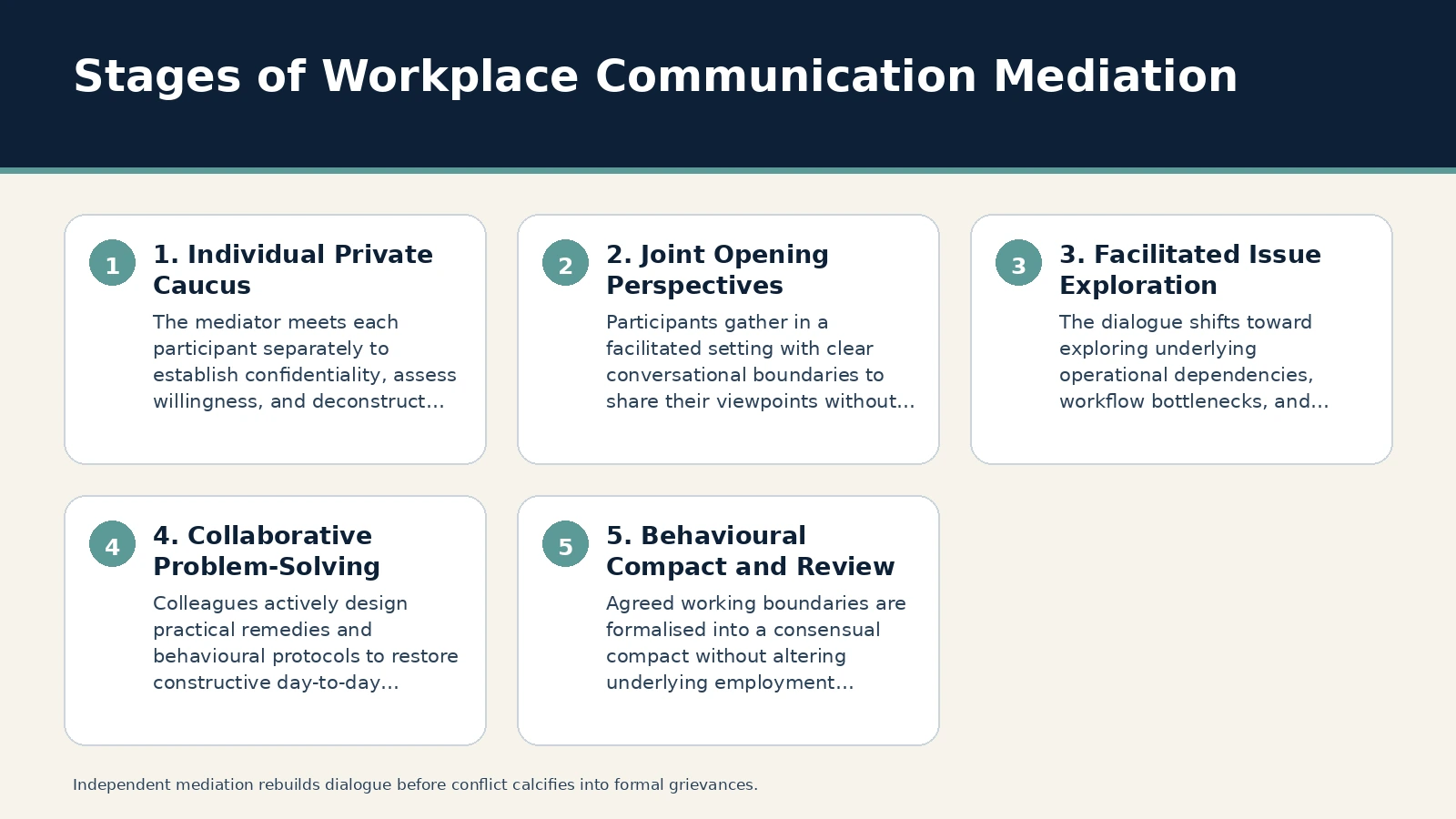
The Facilitative Mediation Architecture: Step by Step
Resolving a workplace communication breakdown through mediation follows a structured, facilitative framework designed to create psychological safety and deliberate momentum. This process unfolds across five coordinated phases.
1. Preliminary Assessment and Individual Private Meetings
The mediator meets each participant separately in a private, confidential setting. These individual meetings allow the mediator to listen to each person’s perspective, identify the unstated issues driving the conflict, and evaluate their willingness to engage constructively. Crucially, the mediator checks that participation is entirely voluntary and clarifies the ground rules of confidentiality. The participants are invited to consider not just what has gone wrong, but what a manageable working relationship would look like in practice.
During these individual sessions, the mediator also helps each participant deconstruct their emotional narrative into tangible operational components. Disputants frequently enter the room armed with sweeping generalisations about their colleague’s character. The mediator works to translate these defensive evaluations into observable behaviours, specific workflow bottlenecks, and concrete expectations, preparing both individuals to converse constructively in the joint session without escalating hostility.
2. The Joint Session and Opening Perspectives
When both parties are ready, the mediator brings them together into a joint facilitated meeting. The session begins with the mediator setting conversational boundaries: mutual respect, uninterrupted speaking time, and a focus on resolution rather than personal attacks. Each participant provides an opening perspective, explaining how the current communication dynamic affects their daily work. This is often the first time the colleagues have heard each other explain their experience without interruptions, defensiveness, or third-party filtering.
The mediator maintains strict adherence to the conversational framework. If one party attempts to interrupt, contradict, or cross-examine the other, the mediator intervenes calmly to preserve the speaker’s uninterrupted time. Hearing an account directly, delivered in first-person language rather than filtered through management emails or grievance summaries, often alters the emotional dynamic in the room and dispels inaccurate assumptions about deliberate malice.
3. Facilitated Exploration and Issue Mapping
The mediator facilitates direct dialogue between the participants, helping them move beyond defensive talking points to explore the operational root causes. Through reframing inflammatory language and prompting active listening, the mediator assists the parties in identifying shared concerns, operational dependencies, and mutual misunderstandings. Private caucuses can be convened if emotions run high, allowing individuals time to reflect, regain composure, and consider proposals privately with the mediator.
In this phase, the mediator maps out the key areas where miscommunication occurs. These frequently include handovers between teams, feedback on completed work, differing interpretations of urgency, and the use of instant messaging. By breaking down the broad sense of breakdown into distinct, manageable operational themes, the mediator enables the parties to address each element systematically rather than becoming overwhelmed by accumulated grievance.
4. Collaborative Solution Design
Once the core friction points have been explored, the focus pivots to practical problem-solving. Moving through a workplace communication breakdown through mediation requires turning abstract promises of goodwill into tangible operational agreements. The participants co-design the protocols that will govern their professional interactions going forward.
During solution design, the mediator encourages both participants to test prospective solutions against practical workplace realities. If an individual proposes a weekly meeting, the mediator probes how that meeting will be structured, what happens when urgent deadlines intervene, and how agendas will be compiled. This reality-testing ensures that the resulting agreements are resilient, realistic, and directly applicable to daily operational pressures.
5. The Working Agreement and Follow-Up Milestones
The agreed points are captured in a written working agreement. In workplace mediation, these agreements are morally binding personal compacts rather than legally enforceable commercial contracts. They govern behaviours, communication channels, and dispute escalation protocols between the individuals. The parties agree on review milestones—typically meeting again informally at designated intervals to review progress and adapt their protocols as working demands evolve.
Follow-up reviews serve as a vital safety valve. Rather than treating the mediation day as a permanent cure, the scheduled review acknowledges that rebuilding trust takes deliberate practice. If a minor misunderstanding emerges during the initial weeks, the knowledge that a structured review meeting is approaching prevents the parties from relapsing into defensive avoidance.
Drafting Practical Behavioural Protocols
Vague agreements such as “we will communicate more respectfully” rarely survive the first operational deadline or stressful client handover. Effective agreements produced in facilitative workplace mediation contain concrete, highly specific operational protocols. A well-constructed communication compact addresses the practical friction points that derail collaboration:
- Agreed communication channels: Specifying which tools are used for which tasks (for example, reserving instant messaging for urgent operational updates, using email for formal project logs, and committing to brief phone calls rather than multi-recipient email chains when clarifying complex issues).
- Meeting etiquette and agendas: Agreeing that one-to-one catch-ups will have advance agendas, clear start and end times, and agreed minutes recorded collaboratively.
- Feedback delivery: Defining how critical or constructive feedback should be shared—such as holding constructive conversations in private rather than raising concerns in open team channels or client meetings.
- Disagreement escalation: Establishing a direct “pause and clarify” protocol if an exchange begins to feel tense, agreeing to step away for a designated cooling-off period before resuming the discussion.
- Information sharing and visibility: Defining clear guidelines on who needs to be copied into correspondence, eliminating defensive blanket cc-ing designed to score points or demonstrate administrative surveillance.
Detailed insight into restoring functional collaboration after severe disputes can also be found in our resource on workplace mediation after a grievance.
When parties draft these compacts, the mediator ensures the language reflects shared responsibility. Rather than framing an item as one party correcting an error, the wording outlines mutual actions. For instance, instead of recording that a line manager must stop sending late-night emails, the agreement might state that work requests will be issued during agreed core hours, and neither party is expected to review or respond outside those times unless an agreed urgent protocol is activated.
Managing Procedural Boundaries and Employment Rights
A frequent concern for HR professionals and participating employees is how workplace mediation interacts with statutory rights and internal policies. In England and Wales, resolving communication breakdowns through mediation operates alongside formal workplace procedures. While the statutory Acas Code of Practice on Disciplinary and Grievance Procedures (2015) establishes procedural standards for formal proceedings (indicating that formal grievances should be raised where informal resolution is not possible), official non-statutory Acas guidance confirms that employers and employees can mutually agree to pause internal grievance timetables to attempt mediation.
If mediation achieves a workable outcome, the employee may choose to withdraw the formal grievance. Crucially, participating in workplace mediation does not waive an employee’s statutory employment rights or prevent them from initiating or resuming a formal grievance if mediation does not achieve resolution. If the mediation does not achieve resolution, or if one party withdraws from the process, the formal grievance can simply be resumed from the point at which it was paused.
Discussions within workplace mediation are confidential as agreed between the participants, meaning admissions or working discussions are not disclosed into internal investigation records or personnel files. This procedural confidentiality provides the candid environment necessary for genuine behavioural change. Mediation agreements are personal behavioural understandings between colleagues; they do not alter terms and conditions of employment, nor do they function as statutory settlement agreements.
A Practical Implementation Checklist for Organisations
To successfully navigate interpersonal conflict and rebuild operational dialogue, organisations should follow a disciplined procedural approach:
- Identify the pattern early: Intervene before defensive habits become entrenched grievances. Watch for rising email antagonism, avoidance of meetings, and sudden siloing between dependent roles.
- Verify voluntary engagement: Ensure both individuals understand that mediation is an entirely voluntary invitation to problem-solve, not an informal disciplinary sanction.
- Select an independent mediator: Appoint an accredited, independent workplace mediator who has no line management, reporting, or personal stake in the team dynamic. Professional standards can be reviewed via the Civil Mediation Council workplace mediation guidance.
- Agree on procedural terms: Confirm in writing that the discussions will remain confidential to the participants and mediator, and that any existing grievance process is paused by mutual consent.
- Support the implementation of the compact: Give the participants the operational space to test their new communication agreements, ensuring managers respect the private nature of the outcome while supporting the scheduled follow-up reviews.
If your organisation is managing an entrenched interpersonal dispute or team friction, you can contact Echelon Dispute Resolution to discuss whether mediation is appropriate for your situation.
Frequently asked questions
Can an employee be forced to participate in workplace mediation?
No. Workplace mediation is an entirely voluntary process requiring the informed consent of all participating individuals. An employer can encourage mediation as a constructive way to resolve interpersonal difficulties, but an employee cannot be compelled to attend, nor does declining mediation forfeit statutory employment rights.
What happens if our communication issues are not resolved during the mediation?
If workplace mediation does not result in an agreement, the participants retain all their original options. Any paused formal grievance can be resumed by mutual agreement or procedural request from the point it was put on hold. Because discussions are confidential as agreed between the participants, working discussions are not disclosed into internal investigation records.
Is an internal line manager allowed to mediate between their direct reports?
While managers should facilitate good day-to-day communication, they should rarely act as formal mediators for serious communication breakdowns. A line manager holds operational authority, conducts performance reviews, and may be perceived as biased. Appointing an accredited internal mediator from another department or an independent external mediator ensures impartiality and procedural confidentiality.
Is a workplace mediation agreement legally enforceable?
No. Agreements reached at the conclusion of internal workplace mediation are morally binding behavioural understandings between colleagues rather than legally enforceable commercial contracts. They govern communication habits, personal boundaries, and working protocols without altering statutory employment rights or overriding formal employment contracts.
Can mediation resolve a workplace communication breakdown when trust is completely lost?
Yes, provided both individuals engage voluntarily in good faith. Facilitative mediation does not require personal friendship or emotional reconciliation; it focuses on establishing workable operational boundaries, clear communication channels, and realistic behavioural expectations so that colleagues can collaborate effectively and professionally.
Authoritative UK guidance and further reading
Primary and official sources
- gresfordcommunitycouncil.gov.uk (gresfordcommunitycouncil.gov.uk)
- A guide to civil mediation – GOV.UK (gov.uk)
- Options if you're owed money – GOV.UK (gov.uk)
Further professional reading
- cipd.org (cipd.org)
This guide provides general information about dispute resolution and mediation. It is not legal advice. The appropriate approach depends on the facts, documents, procedural position and the parties involved; obtain legal advice where required.