

In brief
The question: How can organisations resolve acute interpersonal friction between a line manager and a team member during performance reviews or capability procedures without lowering commercial standards or inviting formal employment claims?
The short answer: Conflict Between Manager and Employee arises when supervisory assessments are perceived as subjective, unfair, or personal criticism rather than constructive operational guidance. This friction routinely stalls structured capability procedures, prompting defensive counter-grievances, medical stress leave, or complete disengagement. Independent workplace mediation introduces an impartial, confidential setting that separates necessary commercial expectations from mismatched communication habits and unspoken workplace pressures. Rather than allocating blame for historical friction, mediation enables both participants to agree on realistic working protocols, transparent targets, and structured support. Crucially, the process protects management’s legitimate authority to expect competent delivery while ensuring the employee receives fair, objective assistance—or, where reconciliation proves unworkable, allows for the confidential exploration of a dignified, agreed departure.
Conflict Between Manager And Employee: The Operational Cost of Line Management Impasses
Performance management is designed as a practical dialogue regarding standards, outputs, and business resources. When delivery slips, however, supervisory conversations carry significant professional vulnerability for both participants, transforming an operational discussion into an acute personal dispute.
Research published in Acas’s report, Prevalence of conflict at work in Great Britain, indicates that performance and capability issues account for 38% of workplace disputes, with line manager friction involved in 32%. When an organisation relies solely on administrative procedures to resolve these tensions, the underlying relational friction remains unaddressed. The outcome is often protracted procedural delays, damaged team morale, and substantial management distraction.
The Counter-Grievance Trap and the Oversight Cycle
In practice, performance disagreements follow a clear pattern of escalation. A supervisor identifies falling delivery or missed deadlines and initiates an informal capability review or introduces a formal Performance Improvement Plan (PIP). An employee, anxious about their standing and ongoing employment, may interpret the critique not as supportive guidance, but as an engineered attempt to force their departure.
Under acute stress, the employee may lodge an internal grievance alleging bullying, unreasonable scrutiny, or victimisation. Submitting a formal grievance usually pauses active capability procedures while internal investigators evaluate the manager’s supervisory conduct. Normal day-to-day management breaks down across several predictable lines:
- Supervisory isolation: First-line managers often feel unsupported when ordinary oversight attracts personal allegations, making them hesitant to address ongoing operational deficits.
- Employee defensiveness: Even after lodging a grievance, the employee experiences heightened anxiety and perceives routine operational requests as retaliatory pressure.
- Hardened positions: Both individuals retreat behind formal correspondence, recording interactions, searching email exchanges for subtext, and preparing defensive arguments for internal panels.
This dynamic feeds an oversight cycle. As performance concerns persist, a manager increases monitoring, tracking individual tasks with tighter deadlines and detailed check-ins. The employee experiences this close oversight as suffocating scrutiny. The resulting anxiety erodes their confidence, inducing further operational errors that appear to validate the supervisor’s initial critique.
Unpacking Competing Workplace Pressures
Addressing persistent conflict between manager and employee requires recognising that capability disputes rarely stem from malice. Instead, they reflect competing operational pressures, unaligned working habits, and unacknowledged workplace constraints.
Line managers carry direct delivery responsibilities. They must meet department targets, manage stakeholder demands, and maintain team output. When an individual struggles, the manager absorbs the shortfall or reallocates work to colleagues who may already carry high workloads. While technically capable, many managers have received limited development in conducting difficult capability discussions without provoking defensiveness. Faced with persistent delivery gaps, a supervisor may become blunt or inflexible, inadvertently communicating frustration rather than constructive support.
For the employee, facing formal capability scrutiny threatens both professional identity and financial security. In many instances, performance issues are influenced by factors that have not been disclosed during standard check-ins:
- Ambiguous standards: Responsibilities that have evolved organically without updated role descriptions or measurable performance indicators.
- Undisclosed personal stressors: Underlying health conditions, neurodivergent traits requiring workplace adjustments, or bereavement and caring responsibilities outside work.
- Operational friction: Competing instructions from different project leads or matrix managers that make standard priorities difficult to maintain.
- Mismatched working styles: Differences in communication habits, such as a manager who prefers concise written summaries working with a team member who relies on verbal exploration.
During a formal capability meeting, these underlying factors are rarely shared openly. Employees worry that acknowledging difficulties will accelerate their dismissal, while managers worry that showing flexibility will undermine their formal standing. An independent mediator provides a confidential setting where these factors can be examined safely without becoming disciplinary admissions.
Formal Capability Procedure vs Facilitated Mediation
When interpersonal friction stalls performance management, organisations can persist with investigative and capability procedures or introduce independent mediation to re-establish constructive communication. While formal processes remain available for administrative determinations, mediation approaches the problem through collaborative problem-solving.
| Process Dimension | Formal Capability Procedure | Facilitated Workplace Mediation |
|---|---|---|
| Primary Focus | Evaluating past performance against evidentiary standards to determine administrative outcomes. | Identifying communication and operational hurdles to co-design workable day-to-day arrangements. |
| Working Dynamic | Adversarial and procedural; participants prepare formal evidence, review past records, and submit written statements. | Collaborative and confidential; guided dialogue focused on clarifying working expectations, operational barriers, and support needs. |
| Ownership of Solutions | Determined by internal panels, hearing managers, or HR advisers in accordance with organizational policies. | Jointly authored and voluntarily agreed between the manager and employee, fostering genuine commitment. |
| Operational Impact | Risks procedural delays, stress-related absences, team disruption, and diversion of management time. | Encourages prompt engagement, addresses interpersonal friction directly, and supports continued working delivery. |
| Managerial Authority | Exercised through formal directives and oversight, which can risk triggering defensive counter-allegations. | Supported by establishing transparent operational standards and mutual agreements on supervision styles. |
Under the Acas Code of Practice on Disciplinary and Grievance Procedures (2015), employers and employees are explicitly encouraged to resolve workplace disputes informally wherever practical. Where formal grievances have been raised alongside capability reviews, parties can consider pausing formal grievance procedures by mutual consent to allow mediation to take place. This temporary pause relieves immediate procedural pressure and gives genuine dialogue an opportunity to succeed.
The Practical De-Escalation Pathway
Resolving entrenched conflict between manager and employee requires a clear, equitable structure. The workplace mediator acts neither as an arbitrator nor an internal HR investigator; they do not assess technical capability or impose business targets. Instead, the mediator facilitates a structured pathway designed to re-establish constructive communication and mutual accountability.
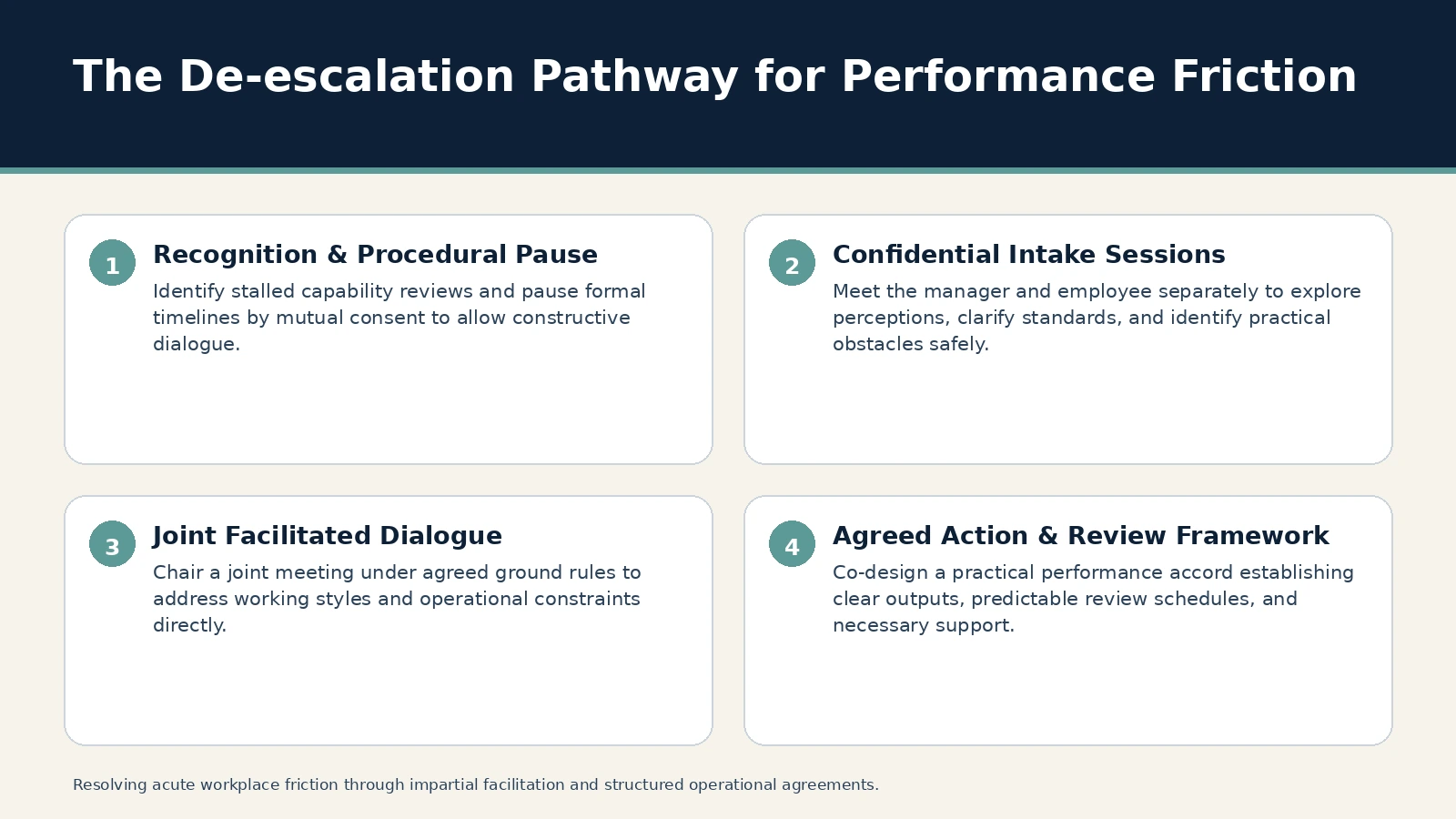
Early Identification and Procedural Agreement
The process begins when HR or organisational leaders recognise that a capability review has stalled due to personal friction. Mediation is offered to both parties as a voluntary option. Entering mediation does not prevent an employer from managing performance or resuming capability processes if agreement is not reached. When participants agree to mediate, active grievance or capability timelines are temporarily paused by mutual consent, removing the immediate threat of formal hearings.
Private Intake Sessions
The mediator meets with the manager and the employee separately in individual, confidential discussions. These sessions allow both individuals to speak candidly:
- Exploring perceptions: Each participant can describe their experience of the dispute, their frustrations, and their concerns without worsening the relationship.
- Clarifying standards: The mediator helps the manager distinguish necessary business standards from personal frustrations with working habits or delivery styles.
- Identifying practical obstacles: The employee can discuss previously unmentioned hurdles, including training shortfalls, workload distribution, or health-related adjustments.
- Assessing common ground: The mediator determines whether both parties are ready to listen to the other’s perspective and explore realistic operational adjustments.
Joint Facilitated Discussion
When both participants are prepared, the mediator chairs a joint meeting governed by agreed ground rules: uninterrupted speaking time, respectful engagement, and a focus on practical solutions. The conversation moves through structured stages:
Each person outlines how the current situation affects their work, addressing perceptions directly rather than arguing over past documentation. The manager explains why specific business standards are essential and how performance shortfalls affect wider delivery. The employee explains how the manager’s oversight style affects their work and what specific assistance would help them meet expectations. By guiding this direct discussion, the mediator helps both parties look beyond defensive assumptions and understand the practical constraints influencing each other’s actions.
Agreeing the Practical Framework
The concluding phase focuses on building a concrete, workable performance agreement. Rather than an imposed management plan, this document represents an agreed operational framework. It outlines what the employee will deliver, how the manager will provide feedback, and what specific training or resources will be provided, giving both parties a direct interest in its success.
Structuring a Performance and Support Accord
A mediated resolution in a capability context must be operationally practical. General intentions to communicate better are rarely enough to resolve concrete performance shortfalls. The outcome is typically recorded in a clear Performance and Support Accord agreed and held by the two individuals.
To resolve ongoing conflict between manager and employee effectively, the accord should focus on practical mechanics:
- Clear output definitions: Setting out core deliverables using specific, measurable criteria rather than broad qualitative expectations.
- Predictable review schedules: Replacing ad-hoc, reactive corrections with regular, scheduled check-ins supported by structured agendas.
- Agreed feedback methods: Establishing acceptable ways to share feedback, such as providing written notes before review meetings rather than giving verbal critiques in public settings.
- Practical support provisions: Detailing any agreed training sessions, mentoring, adjustments to working patterns, or redistributed responsibilities.
- Escalation protocols: Setting out clear steps for how either party will flag emerging difficulties before frustration triggers renewed conflict.
It is important to recognise that under Section 98 of the Employment Rights Act 1996, capability remains a potentially fair reason for dismissal, provided the employer acts reasonably in all the circumstances. Mediation does not replace the commercial need for competent performance, but it helps manager and employee address communication breakdowns, clarify ambiguous targets, and agree on how feedback and support will be delivered in practice. By establishing clear expectations and practical support, mediation ensures that if performance does not improve, the employer has demonstrated procedural fairness while giving the employee a genuine opportunity to meet required standards.
Exploring Consensual and Dignified Departures
Not every capability disagreement can be resolved by continuing the working relationship. In some circumstances, joint exploration makes it clear that the required performance cannot be achieved, the operational demands are no longer suitable for the employee, or mutual trust has broken down irretrievably. Where standard formal procedures can lead to acrimonious disputes, mediation offers a confidential setting to assess reality honestly.
When parties realise that continuing together is impractical, the mediation can turn constructively toward exploring an agreed, orderly departure. Within this confidential setting, the manager and employee can explore notice arrangements, handover priorities, internal messaging, and professional references without confrontation. Discussions regarding separation in this context are exploratory; achieving binding legal finality over statutory claims requires either a formal statutory settlement agreement or an Acas-conciliated settlement (COT3). This voluntary approach allows an individual to move on with dignity while allowing the business to avoid protracted formal disputes and maintain operational momentum.
Practical Guidance for Organisations Facing Capability Disputes
Addressing underperformance should not require enduring months of procedural paralysis or damaged workplace relationships. When supervisory oversight becomes entangled with interpersonal friction, an independent workplace mediator can provide the neutral framework needed to find a constructive path forward.
Organisations handling an acute performance dispute can take three practical steps:
- Examine the core impasse: Assess whether the difficulty is purely a matter of technical capability or whether communication barriers, perceived micromanagement, or defensive counter-grievances are preventing progress.
- Agree a procedural pause: Propose mediation to both participants as a voluntary, confidential process and agree to suspend formal grievance or capability steps while discussions take place.
- Engage an independent mediator: Introduce an external mediator who can facilitate direct, constructive dialogue without internal organisational involvement.
For further analysis on managing organisational disputes and procedural steps, explore our guide on workplace disputes. To discuss how independent mediation can assist in resolving a capability deadlock, speak to an EDR mediator.
Frequently asked questions
Can mediation take place while an employee is on a Performance Improvement Plan (PIP)?
Yes. Mediation can occur alongside an active Performance Improvement Plan or during a mutually agreed procedural pause. It does not replace the commercial need for competent performance, but it helps manager and employee address communication breakdowns, clarify ambiguous targets, and agree on how feedback and support will be delivered in practice.
What happens if a conflict between manager and employee cannot be resolved through mediation?
Because mediation is voluntary and confidential, neither party is forced into an agreement. If facilitated discussions do not resolve the dispute, the organisation retains its right to resume formal capability, disciplinary, or grievance procedures, and the parties return to their pre-mediation procedural positions without detriment to their formal rights.
Does entering mediation prevent a manager from holding an employee accountable to commercial standards?
No. A workplace mediator does not determine operational targets or force an organisation to accept substandard work. Mediation reinforces legitimate managerial standards by removing interpersonal defensiveness, ensuring expectations are communicated clearly, and establishing a fair, transparent support structure that enables the employee to perform.
When should an organisation instruct an external mediator rather than relying on internal HR?
External mediation is particularly valuable when internal HR is already perceived as aligned with line management, when formal grievances have been raised against senior leaders, or when the dispute involves complex interpersonal dynamics where an independent, neutral professional is essential to secure the employee’s trust.
How does mediation handle situations where underperformance is linked to undisclosed personal stress or health concerns?
Individual intake sessions provide a confidential, safe environment where an employee can disclose underlying challenges—such as mental health concerns, personal bereavement, or neurodivergence—without fearing immediate disciplinary repercussions. With the employee’s consent, the mediator helps introduce appropriate workplace adjustments and support structures into joint discussions.
Authoritative guidance and further reading
Primary and official sources
- The Employment Rights Act 2025 (Commencement No. 4 and Transitional and Saving Provisions) Regulations 2026 (legislation.gov.uk)
- A guide to civil mediation – GOV.UK (gov.uk)
- PRACTICE DIRECTION – PRE-ACTION CONDUCT AND PROTOCOLS – Civil Procedure Rules – Justice UK (justice.gov.uk)
Further professional and framework reading
- How prevalent is individual conflict at work in Great Britain in 2025? | Acas (acas.org.uk)
- Performance Management Disputes UK? Fight Unfair Reviews with Wildings Solicitors (wildings-solicitors.co.uk)
- Performance improvement plans: your rights on a PIP | National Employees Union (n-e-u.co.uk)
This guide provides general information about dispute resolution and mediation. It is not legal advice. The appropriate approach depends on the facts, documents, procedural position and the parties involved; obtain legal advice where required.