

In brief
The question: How can co-directors resolve personal fallouts and boardroom deadlocks without paralysing trading or triggering public litigation?
The short answer: Engaging in director dispute mediation allows co-directors to uncouple overlapping statutory, employment, and equity relationships in a private, structured forum. In privately held companies, a boardroom fallout rarely involves a single legal question; an executive director usually operates as an officer of the company, an employed manager, and a shareholder simultaneously. Formal court proceedings or unilateral board votes often resolve only one of these relationships, leaving the others exposed to retaliatory litigation. A commercial mediator facilitates structured negotiations to agree an orderly separation, interim operating boundaries, employment settlement terms, and a sustainable share buyout or equity restructuring concurrently, protecting enterprise value, supplier confidence, and commercial reputations.
Director Dispute Mediation: The Three Hats Dilemma: Untangling Office, Employment, and Equity
Disputes at board level differ fundamentally from standard commercial disagreements because of the intertwined roles executive directors hold in private enterprises. When strategic alignment breaks down or personal friction reaches an impasse, board members rarely interact on a single commercial plane. Instead, participants find themselves operating across three distinct legal and commercial capacities simultaneously:
- The Statutory Officer: The individual registered at Companies House, exercising board votes, managing regulatory filings, and carrying personal statutory responsibilities for company governance.
- The Executive Employee: The day-to-day manager drawing remuneration, directing staff, managing client relationships, and holding contractual rights under an executive service agreement alongside statutory employment protections.
- The Shareholder: The equity owner holding voting rights, dividend entitlements, capital value, and constitutional protections under the company’s Articles of Association.
When communication collapses, boards often attempt to resolve the impasse through formal corporate mechanisms, such as calling a general meeting to vote on removal under Section 168 of the Companies Act 2006. While an ordinary resolution can remove a director from office, it does not extinguish their separate executive employment rights, nor does it force them to sell their shareholding. The departed director remains an equity owner entitled to financial accounts and shareholder communications, while holding potential employment claims for wrongful or unfair dismissal.
Conversely, terminating an executive service contract on employment grounds leaves the individual in office as a statutory director unless separate corporate steps are concluded. Attempting to force an exit piecemeal creates friction across multiple fronts. Through structured director dispute mediation, all three capacities are addressed concurrently. This allows the board and the departing executive to negotiate a comprehensive separation package rather than conducting fragmented disputes across separate legal channels.
Operational Safeguards and Interim Protocols During Boardroom Impasse
An unresolved governance dispute can quickly disrupt ordinary commercial trading. When executive directors disagree on strategic direction, commercial commitments, or banking authorisations, operational uncertainty can undermine banking relationships, supplier credit, and team stability. In balanced ownership structures, unresolved deadlocks can bring decision-making to a complete standstill, as explored in our guide to 50/50 shareholder deadlock mediation.
Before entering substantive mediation sessions, establishing interim operational ground rules helps preserve trading stability and company value while negotiations proceed. Practical protocols often include:
- Banking Mandates and Expenditure Thresholds: Introducing dual-sign-off protocols for non-routine expenditure above an agreed financial threshold, while ensuring standard operational payments, payroll, and trade supplier settlements continue without disruption.
- Internal and External Communication Boundaries: Agreeing that neither party will make unilateral announcements regarding board disagreements to staff, commercial customers, suppliers, or lenders during discussions.
- Management Information and Records Access: Maintaining transparent access to current management accounts, banking information, statutory registers, and pipeline reports for all board members, preventing administrative controls from becoming tactical bargaining chips.
- Information Exchange Framework: Jointly collating management accounts, pipeline schedules, and balance sheet summaries ahead of mediation to establish a shared factual basis for buyout discussions.
Agreeing these short-term operating measures contains the dispute, prevents commercial disruption, and gives the parties space to work toward a durable resolution.
Structuring Comprehensive Exit and Realignment Settlements
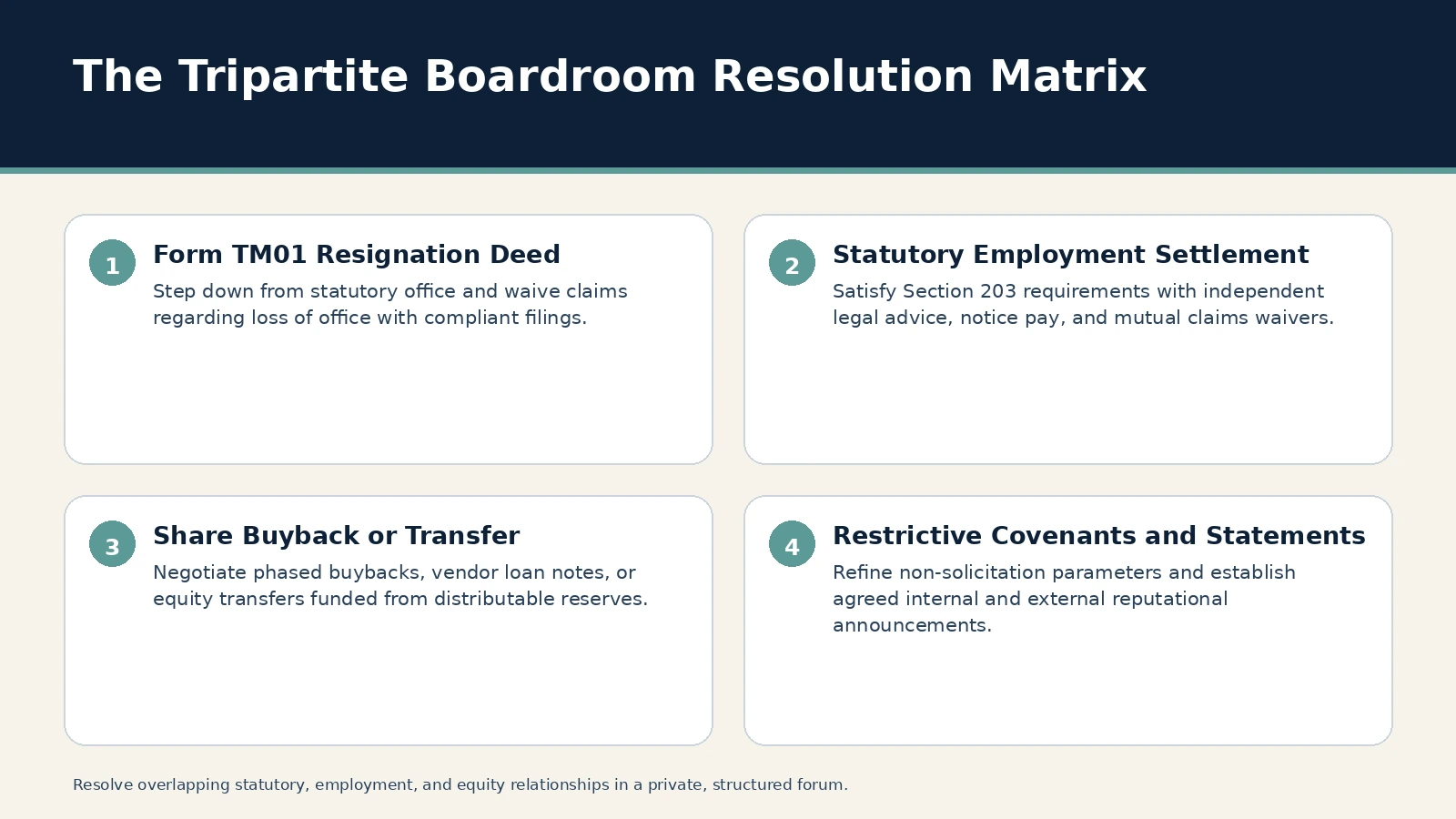
A core benefit of director dispute mediation is the flexibility to design structured commercial settlements that resolve corporate, employment, and equity matters together. Where the parties agree that a clean commercial separation is the most constructive outcome, a mediated settlement generally coordinates five main areas:
1. Corporate Resignation and Board Restructuring
The outgoing executive agrees to step down from statutory office by signing a formal deed of resignation and waiving claims against the business concerning loss of office. This is coordinated with agreed Companies House filings, bank mandate updates, and board minute approvals to ensure governance records remain clear and compliant.
2. Executive Employment Settlement
Statutory employment claims arising from the termination of an executive service agreement cannot be compromised through informal board minutes. To ensure finality, the parties document the executive exit using a compliant settlement agreement that satisfies Section 203 of the Employment Rights Act 1996, incorporating independent legal advice, agreed notice pay or termination payments, and mutual waivers of employment claims.
3. Share Buyouts, Valuation, and Deferred Consideration
Resolving equity ownership often forms the central financial element of executive exit discussions. Where working capital does not permit an immediate single lump-sum buyout, mediation provides room to negotiate manageable commercial structures. Options include phased share buybacks funded from distributable reserves, equity transfers to continuing shareholders, vendor loan notes with agreed repayment schedules, or adjusted dividend rights during an agreed transition period. For situations involving complex valuation mechanics, parties can review our guide to minority shareholder dispute valuation mechanisms.
4. Commercial Restrictive Covenants and Trading Demarcation
When an outgoing executive plans to remain active in the wider industry, existing service contract restrictions can lead to disagreement. In mediation, the board and the departing director can review and refine restrictive covenants to reflect the commercial reality. Adjusting non-solicitation periods, geographic parameters, or specific client lists allows the departing individual to earn a livelihood while protecting the company’s core client base and ongoing trading.
5. Joint Announcements and Reputational Safeguards
Protecting commercial reputation is vital for both the continuing company and the exiting executive. Mediated agreements typically establish agreed wording and release schedules for internal announcements to employees and external statements to major customers, suppliers, and industry contacts, supported by mutual non-disparagement terms.
Practical Stages of a Director Dispute Mediation
Understanding how a commercial mediation day unfolds helps directors and their legal advisers prepare effectively. While the mediator adapts the process to suit the dispute dynamics, a typical director dispute mediation follows a structured progression:
Initial Engagement and Position Summaries
Prior to the mediation, the mediator reviews background materials, constitutional documents, financial accounts, and concise written summaries from each party. The mediator may hold short preliminary calls with the legal representatives or board members to understand key priorities, personal dynamics, and any urgent trading deadlines.
Joint Sessions and Private Caucuses
The mediation session begins with an agreed agenda. Where useful, a brief joint meeting allows the mediator to outline ground rules and gives representatives an opportunity to state their objectives. Most detailed negotiations take place in private caucuses (separate breakout rooms). The mediator moves between rooms to test assumptions, explore alternative commercial structures, and communicate proposals without exposing parties to confrontational friction.
Commercial Option Generation and Stress-Testing
As discussions progress, the mediator works with both rooms to build workable exit options, testing tax feasibility, funding schedules, debt indemnities, and transitional handover arrangements. Exploring settlement ideas in private rooms allows directors to evaluate commercial alternatives without making premature public commitments.
Drafting Binding Settlement Documentation
Once broad commercial consensus is reached, the parties’ legal advisers draft the required binding documentation—including the settlement agreement, resignation deeds, and share transfer instruments. Concluding and signing these documents on the day ensures finality and eliminates the risk of post-mediation misunderstandings.
Comparing Resolution Pathways: Boardroom Determination vs Commercial Mediation
When boardroom friction escalates, directors can choose whether to pursue formal adversarial processes or engage in confidential mediation. The following qualitative comparison outlines how these approaches operate across primary commercial dimensions:
| Commercial Dimension | Formal Adversarial Route | Commercial Mediation Route |
|---|---|---|
| Confidentiality & Market Standing | Contested shareholder meetings, tribunal claims, or public filings can expose internal disputes to staff, clients, and competitors. | Conducted under contractual confidentiality and without-prejudice terms, protecting brand reputation and business value. |
| Scope Across Multiple Roles | Deals with governance, employment, and share ownership in separate, uncoordinated legal tracks. | Unifies statutory resignation, employment settlement, and share transfer into a single binding agreement. |
| Trading Continuity & Banking | Protracted friction risks operational paralysis, key employee departures, and loss of commercial focus. | Interim operating protocols protect daily trading and maintain banking relationships while talks proceed. |
| Flexibility of Settlement Terms | Relies on strict statutory procedures and formal legal orders that may not suit trading cash flow. | Permits tailored solutions including phased buybacks, earn-outs, refined restrictive covenants, and joint announcements. |
| Decision Control | Outcomes depend on third-party adjudicators or majority voting power that can leave minority rights unresolved. | The directors retain total control over the agreed terms; no settlement is binding until all parties sign. |
Preparing for a Director Dispute Mediation: Evidence, Valuation, and Authority
Thorough preparation allows director dispute mediation to proceed smoothly and reach a practical outcome. Board members, non-executive chairs, and legal advisers should organise core documentation and clarify settlement priorities ahead of the session:
- Constitutional and Contractual Documentation: Collate the company’s Articles of Association, shareholders’ agreements, director service contracts, IP assignment deeds, and recent board minutes.
- Financial and Trading Visibility: Assemble recent statutory accounts, current management accounts, aged debtors schedules, working capital forecasts, and an overview of bank covenants or personal guarantees.
- Professional Adviser Participation: Ensure independent corporate and employment legal advisers are present or accessible throughout the session to provide advice, draft settlement terms, and ensure compliance.
- Negotiation Variables and Priorities: Distinguish essential commercial requirements (such as personal guarantee releases or intellectual property retentions) from flexible settlement variables (such as handover schedules, vehicle transfers, or equipment retention).
Focusing on commercial realities rather than past grievances helps boards resolve deadlocks cleanly and preserve business continuity. If your company is facing board-level impasse or an executive fallout, you can contact our commercial mediation team to discuss how mediation can be structured for your board.
Frequently asked questions
Can a director be removed from office while mediation discussions are ongoing?
While a company technically retains the statutory power to call a general meeting and propose a resolution to remove a director under Section 168 of the Companies Act 2006, parties in mediation typically agree to pause formal removal steps. Taking unilateral action during negotiations undermines trust, risks retaliatory employment or equity claims, and jeopardises the chance of reaching an agreed settlement.
What happens if co-directors hold an equal 50/50 shareholding and cannot agree on a valuation?
In a 50/50 deadlock, neither director holds majority voting power to force a decision. In mediation, the parties can explore flexible valuation methods, such as commissioning an independent joint valuation, structuring an earn-out based on future financial performance, or negotiating deferred consideration terms that match the company’s projected cash flow.
Who attends a director dispute mediation session?
Typically, the disputing directors attend alongside their independent legal advisers. Where relevant, non-executive directors, board chairs, or company accountants may also participate to provide financial clarity. Having decision-makers and legal advisers present ensures that any agreed settlement deed can be reviewed, finalised, and executed on the day.
Are boardroom mediation discussions kept confidential from staff and external stakeholders?
Yes. Commercial mediation takes place under contractual confidentiality and without-prejudice protection. Subject to limited legal exceptions, information, settlement proposals, and concessions shared under mediation confidentiality agreements cannot be disclosed to third parties, allowing directors to explore pragmatic exit options without destabilising the ongoing business.
Authoritative UK guidance and further reading
Primary and official sources
- Companies Act 2006 (legislation.gov.uk)
- Companies Act 2006 (legislation.gov.uk)
- UK legislation — legislation.gov.uk (legislation.gov.uk)
- Insolvency Act 1986 (c. 45) (legislation.gov.uk)
This guide provides general information about dispute resolution and mediation. It is not legal advice. The appropriate approach depends on the facts, documents, procedural position and the parties involved; obtain legal advice where required.