

In brief
The question: How can landlords and commercial tenants resolve an entrenched rental impasse without surrendering the outcome to rigid, costly third-party determination?
The short answer: A commercial rent review dispute arises from specific contractual mechanisms within a business lease deed. While standard lease clauses stipulate formal referral to an independent expert or arbitrator through the Royal Institution of Chartered Surveyors if negotiations stall, parties retain complete autonomy to settle mutually at any stage. Consensual mediation introduces an independent, neutral facilitator to help property owners, asset managers, and commercial tenants move beyond opposing surveyor valuations. Unlike an appointed arbitrator, whose mandate is generally confined to determining the reviewed rent under the lease’s specific valuation criteria, mediation allows the parties to negotiate pragmatic, multi-dimensional business solutions. These can include staged rent uplifts, capital contributions, adjusted break dates, or extended lease terms, resolving the disagreement privately while preserving the long-term tenancy relationship.
Understanding the Commercial Rent Review Dispute
Rent reviews in commercial leases are designed to adjust the passing rent to current open-market levels at specified intervals—commonly every three or five years. However, when economic conditions fluctuate, shifts in retail footfall, office occupancy patterns, and investment yields create substantial divergence between what a landlord expects to receive and what an occupier believes the space is worth. When initial positional talks between retained chartered surveyors stall, a straightforward lease event can rapidly become an entrenched commercial rent review dispute.
At this stage, professional communication often narrows down to selective comparable transactions. Landlords point to high headline rents on nearby premises, while tenants highlight undisclosed incentive packages, such as extensive rent-free periods or fit-out contributions, that lower the true net effective rent. As each party digs in, the threat of invoking the lease’s default dispute escalation mechanism looms. Before initiating formal third-party processes, parties can explore tailored, facilitated negotiation through professional civil mediation, which provides a confidential space to test valuation evidence and negotiate pragmatic commercial terms.
The Mechanics of Impasse: Why Rent Talks Stall
A rent review negotiation does not happen in a commercial vacuum; it takes place within an ongoing, active business relationship. Understanding why dialogue breaks down is the first step toward unlocking a constructive resolution.
- Opaque Market Comparables: In changing commercial property markets, headline rents recorded on public registers rarely reflect reality. Landlords and tenants often possess asymmetrical information regarding the tenant incentives, capital contributions, or turnover top-ups attached to comparable lettings.
- Rigid Surveyor Posturing: When retained surveyors operate solely as partisan advocates, negotiations can become defensive. Surveyors may commit early to extreme figures in an effort to anchor expectations, leaving both sides little room to adjust without losing face.
- Hypothetical Assumptions vs Practical Realities: Leases require rent to be assessed against a hypothetical letting that ignores the tenant’s goodwill and specific occupation, yet the parties living with the financial outcome are real businesses managing real cash flows. This disconnect between legal fiction and commercial reality frequently creates friction.
- Ancillary Friction: Historical disagreements over operational issues, such as those addressed in a commercial lease dispute over service charges or repair covenants, can spill over into rent review discussions, complicating purely financial assessments.
The Default Escalation: RICS Third-Party Determination
When parties reach an impasse, standard commercial lease drafting directs them to apply to an external body—most commonly the Royal Institution of Chartered Surveyors (RICS)—to appoint either an Arbitrator or an Independent Expert under the RICS Commercial Rent Review Appointment Service DRS1. Initiating this administrative appointment requires an upfront application fee of £425, which represents only the very start of the process costs.
Once appointed, the independent expert or arbitrator directs a formal timetable for detailed written submissions, counter-submissions, and valuation reports. Both parties incur substantial ongoing fees for their retained chartered surveyors and legal advisers. Crucially, the appointed third party possesses a narrow contractual mandate: they must determine the exact open-market rental figure strictly in accordance with the hypothetical letting criteria and disregards set out in the lease deed.
An appointed arbitrator or expert has no authority to adjust lease terms, grant a rent-free breathing space, alter payment schedules, or agree to a lease extension. They deliver a single binding figure, which often leaves one or both parties commercially dissatisfied and the ongoing landlord-tenant dynamic strained.
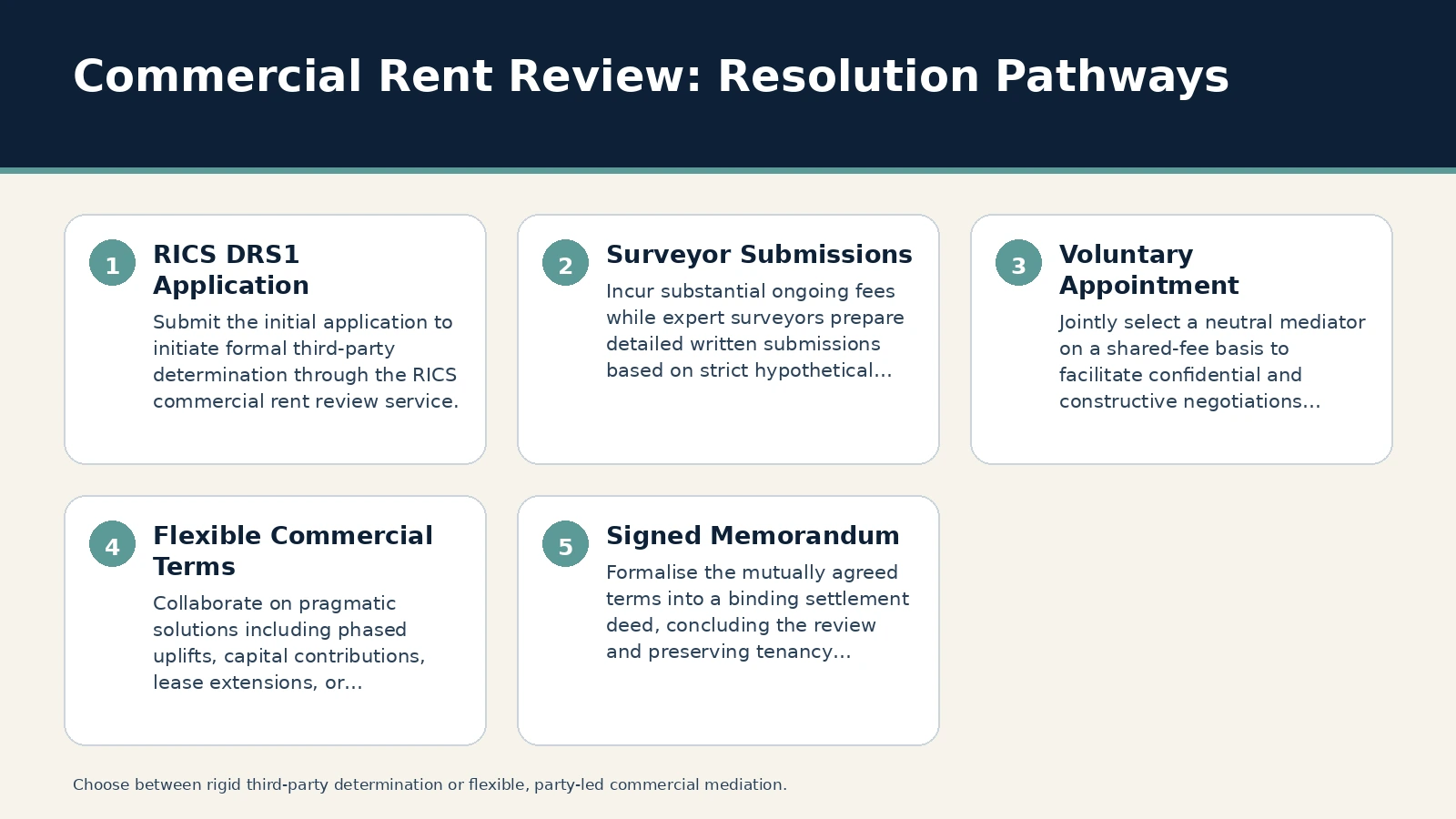
Commercial Rent Review Dispute: Mediation vs RICS Determination
Choosing mediation over formal third-party determination shifts the focus from an adversarial legal battle to a flexible commercial negotiation. The table below illustrates how the two pathways differ in practice.
| Dispute Dimension | RICS Third-Party Determination | Consensual Commercial Mediation |
|---|---|---|
| Decision-Maker | An external surveyor (Arbitrator or Independent Expert) under formal appointment. | The landlord and tenant retain full authority; no agreement is binding without mutual consent. |
| Scope of Solution | Confined strictly to fixing a single open-market rent based on hypothetical lease criteria. | Broad and flexible: can incorporate phased uplifts, lease extensions, altered breaks, or capital works. |
| Process Style | Adversarial and formal, relying on rigid written valuation submissions and evidence rebuttals. | Collaborative and confidential dialogue facilitated by an impartial, trained professional mediator. |
| Initial Upfront Machinery | Requires formal appointment steps, including the RICS DRS1 administration fee alongside decider rates. | Agreed directly between parties on an agreed, shared-fee basis with no institutional barriers. |
| Impact on Tenancy Relationship | Risks entrenching opposing positions midway through a long-term commercial lease term. | Preserves and often strengthens commercial communication for the remainder of the tenancy. |
Strategic Commercial Concessions an Arbitrator Cannot Award
The core advantage of commercial mediation in a rent review context is the freedom to craft multifaceted business solutions. In formal determination, the outcome is zero-sum: every pound per square foot gained by the landlord is a direct cost to the tenant. In mediation, rent is treated as one component of a broader ongoing business arrangement.
Parties can explore practical trade-offs that align with their respective strategic goals:
- Stepped or Phased Uplifts: If market comparables justify an increase but tenant cash flow is currently constrained, the parties can agree to phase the uplift gradually over the remaining review period rather than imposing an immediate jump.
- Lease Term Extensions and Re-gears: A landlord may agree to moderate their rental aspirations in exchange for the tenant removing an upcoming break clause or extending the overall lease term, enhancing the investment’s capital value.
- Capital Contributions and Alterations: Landlords seeking to maintain headline rental levels for investment purposes may agree to fund energy-efficiency upgrades, tenant fit-out allowances, or planned maintenance programmes.
- Turnover-Linked Components: In retail or leisure tenancies, parties can structure hybrid arrangements combining a lower base rent with an agreed turnover share, sharing commercial risk and upside.
- Addressing Associated Property Liabilities: Discussions can cleanly integrate other pending property negotiations, such as future obligations examined in commercial dilapidations mediation, arriving at a comprehensive financial settlement.
The Role of Surveyors and Asset Managers in Mediation
Mediation does not replace the expertise of chartered surveyors; rather, it reframes how their expertise is used. In formal arbitration, surveyors act primarily as adversarial advocates constructing protective arguments. In mediation, asset managers, corporate tenant directors, and retained surveyors collaborate to assess real commercial risk.
During private mediation sessions, a mediator helps the parties test the strengths and weaknesses of their comparable transaction evidence in confidence. Surveyors can explain the technical valuation nuances without committing their clients to an all-or-nothing position. Meanwhile, commercial principals can weigh the financial reality of continuing the dispute against the certainty of an immediate, tailored agreement. For guidance on structuring internal teams and evidence before discussions begin, review our practical guide on how to prepare for commercial mediation.
Resolving a Commercial Rent Review Dispute Step by Step
Navigating an unresolved rent review through mediation follows a straightforward, party-led progression designed to produce an enforceable agreement with minimal operational disruption.
1. Assessing Deadlock and Proposing Mediation
When surveyor negotiations fail to close the valuation gap, either party can propose mediation. Because mediation is voluntary, proposing it signals commercial pragmatism rather than weakness. It is entirely possible to mediate even after an initial application to RICS has been submitted, provided parties agree to pause formal steps while talks proceed.
2. Selecting an Independent Mediator
The parties jointly select a professional commercial mediator who understands business tenancies and valuation mechanics. The mediator does not act as an arbitrator or provide legal advice; their role is to facilitate productive negotiation, challenge unrealistic assumptions, and help the parties uncover areas of mutual flexibility.
3. Document Exchange and Valuation Preparation
Preparation in rent review mediation is focused and efficient. Instead of drafting exhaustive, formal legal pleadings, each side provides a concise statement of their commercial position, the lease terms, and their key comparable evidence. This gives the mediator a clear overview of the valuation gap and the underlying business priorities.
4. The Mediation Session
The mediation takes place either in person at neutral offices or via a secure online platform. It combines joint discussions with confidential, private breakout sessions (caucuses). In private caucus, the mediator helps each party evaluate the genuine commercial risks of formal third-party determination, explore alternative concession packages, and formulate constructive settlement proposals without disclosing their bottom line to the other side prematurely.
5. Documenting the Settlement
Following a successful mediation, the parties formalise their agreed terms in a Rent Review Memorandum or binding settlement deed. Once signed by authorised representatives, this document creates a binding contractual amendment to the lease, concluding the review and providing commercial certainty for both businesses.
Moving Forward with Clear Tenancy Outcomes
Allowing an unresolved rent review to drift into formal third-party determination often leads to substantial legal and professional costs, weeks of administrative distraction, and lingering tension in an ongoing commercial tenancy. Mediation offers a confidential, controlled forum to take ownership of the financial outcome and craft solutions tailored to your operational realities.
If you are facing a valuation deadlock and wish to explore constructive dispute resolution, please contact Echelon Dispute Resolution to discuss whether mediation is appropriate for your commercial lease circumstances.
Explore our Property & Real Estate Disputes guides.
Frequently asked questions
Can we mediate our commercial rent review dispute if our lease specifies RICS arbitration?
Yes. Commercial leases outline default procedures if parties cannot agree, but they do not prevent parties from settling by mutual consent.
Does proposing mediation in a rent review dispute show weakness?
No. Proposing mediation is a commercially pragmatic step to control dispute costs and manage business risk. It demonstrates confidence in your market evidence while opening a private channel to explore structural solutions—such as lease extensions or stepped rents—that an appointed arbitrator cannot grant.
What happens to contractual lease deadlines while we mediate?
Mediation does not automatically suspend or pause contractual lease deadlines, review notices, or counter-notice requirements. Landlords and tenants should formally agree in writing to a standstill or extension of contractual deadlines to ensure neither party’s legal position is prejudiced during discussions.
How is an agreement reached during rent review mediation made legally binding?
Once parties reach an agreement, their surveyors or legal representatives draft and execute a formal Rent Review Memorandum or binding settlement agreement.
Authoritative UK guidance and further reading
Primary and official sources
- Arbitration Act 2025 (legislation.gov.uk)
- English Devolution and Community Empowerment Act 2026 (legislation.gov.uk)
- parliament.uk (commonslibrary.parliament.uk)
- Arbitration Act 2025 (legislation.gov.uk)
This guide provides general information about dispute resolution and mediation. It is not legal advice. The appropriate approach depends on the facts, documents, procedural position and the parties involved; obtain legal advice where required.