

In brief
The question: How can commercial landlords, managing agents, and business tenants resolve unexpected service charge increases, disputed year-end reconciliations, and withheld payments without risking lease forfeiture or issuing expensive court claims?
The short answer: Commercial service charge obligations are governed by the express contract terms agreed in the lease under the law of England and Wales. When an unbudgeted balancing charge or major repair cost arises, unilateral withholding of funds risks placing an occupier in breach of covenants prohibiting deductions, while formal debt litigation strains ongoing trading relations. Engaging in structured civil mediation provides an effective, confidential alternative. The process allows the parties to review detailed accounting entries, assess apportionments alongside guidance such as the RICS Professional Standard on commercial service charges, and negotiate practical commercial solutions—including phased payments, budget adjustments, or forward cost caps—while complying with court expectations for early commercial lease dispute resolution.
Commercial Lease Dispute: The Anatomy of Service Charge Friction in Commercial Property
Shared operational expenditure in commercial property is one of the most frequent catalysts for friction between property owners and occupiers. Depending on the lease terms and management agreement, managing agents are typically responsible for maintaining common parts, operating plant, ensuring compliance, and providing security and cleaning services. Because these operational costs fluctuate with energy prices, labour rates, and maintenance demands, annual expenditures rarely match initial projections with complete precision.
A commercial lease dispute over service charges rarely develops from simple bad faith. More often, it arises from structural and operational tensions inherent in commercial property asset management:
- Budget variance and cash-flow shock: Tenants build annual business forecasts around the landlord’s estimated advance service charge demands. A substantial year-end balancing invoice, particularly one involving unexpected plant overhaul or structural maintenance, can disrupt business cash flow and prompt immediate challenge.
- Information gaps and timing: Occupiers often feel removed from operational procurement decisions. They frequently receive reconciliation statements and apportionment matrices months after the expenditure has already been incurred and paid by the landlord or managing agent, creating suspicion regarding value for money.
- Service standards versus cost control: Managing agents are tasked with asset protection, statutory compliance, and long-term building preservation. Tenants, balancing their own immediate trading overheads, scrutinise whether enhanced service specifications—such as extensive communal upgrades or high-specification cleaning contracts—provide tangible value to their day-to-day operations.
- Drafting and recovery ambiguities: Older commercial leases may contain broad or ambiguous service charge drafting. This leaves scope for disagreement over whether specific items, such as sustainability retrofits, statutory management fees, or capital replacements, fall within recoverable operational costs or remain the capital responsibility of the landlord.
For further perspective on how property conflicts develop across commercial estates, see our wider guidance on property dispute mediation for real estate and leases.
The Pay Under Protest Principle: Managing Cash Flow and Forfeiture Risks
When a tenant believes a quarterly interim demand or year-end reconciliation invoice is inaccurate or unreasonable, an intuitive operational response is often to withhold payment until the dispute is settled. In commercial property, however, unilateral withholding introduces serious legal and operational risks.
Commercial leases standardly contain strict covenants requiring rent and service charge sums to be paid on specified quarter days without deduction, set-off, or counterclaim. If an occupier withholds payments unilaterally, the landlord may be entitled to charge contractual default interest, commence debt recovery actions, draw on an existing rent deposit deed, or take procedural steps toward lease forfeiture. At the same time, if a landlord faces withheld funds across several units in a multi-let building, property cash flow is compromised, leaving essential communal services, plant maintenance, and insurance cover unfunded.
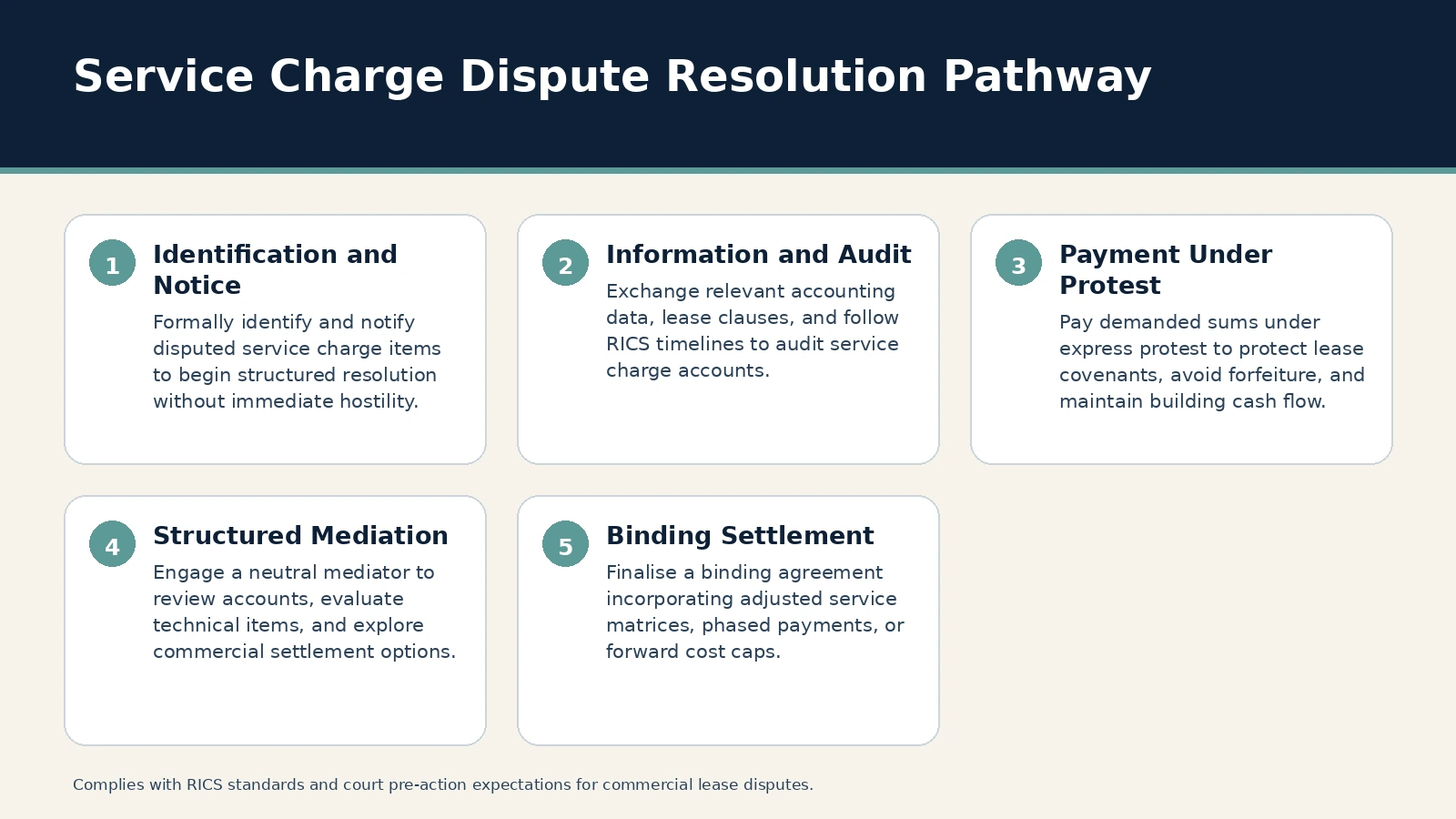
To prevent an accounting disagreement from escalating into an existential commercial lease dispute that threatens the tenant’s ongoing occupation, parties frequently adopt the practical mechanism of paying under express protest:
- Protecting tenancy covenants: By paying the demanded sum while stating explicitly in writing that the payment is made under protest and without prejudice to an ongoing dispute regarding underlying liability, the occupier avoids lease default and removes the immediate threat of forfeiture or rent deposit drawdown.
- Safeguarding building operations: The managing agent receives the operating funds required to pay contractors, maintain mechanical systems, and keep the building operational without incurring an account deficit.
- Creating space for structured review: Payment under protest separates the immediate cash-flow requirement from the substantive review of the underlying accounts. It allows both parties to inspect invoices, contracts, and apportionment schedules in a calm, structured environment rather than under the pressure of default notices.
Where balancing charges relate to substantial plant degradation or communal fabric repairs, service charge disagreements often overlap with wider end-of-term obligations, as discussed in our guide to commercial dilapidations and repair claim mediation.
Professional Standards and Court Expectations for Dispute Resolution
Two primary frameworks influence how commercial landlords, managing agents, and tenants should approach service charge disagreements before contemplating litigation: industry professional standards and court pre-action conduct rules.
First, the Royal Institution of Chartered Surveyors (RICS) publishes professional standards governing service charges in commercial property. For RICS-regulated managing agents and property firms, these standards set mandatory rules covering financial transparency, communication timetables, and dispute management, while serving as recognised best practice across the commercial property sector. Under these standards, managing agents are expected to provide annual service charge budgets at least one month before the start of the service charge year and provide certified or approved year-end accounts within four months of the year-end. The guidance emphasises clear separation between day-to-day operational maintenance and capital expenditure, requires fair and equitable apportionments, and encourages alternative dispute resolution over formal litigation.
Second, civil courts expect commercial parties to act constructively and exchange clear information before commencing debt or breach-of-covenant proceedings. Under standard court pre-action guidance, parties are expected to consider whether an out-of-court settlement is possible before issuing a claim. An unreasonable refusal to engage in mediation or explore dispute resolution can result in adverse cost orders at the conclusion of litigation, even if the refusing party partially succeeds on the technical interpretation of the lease.
Commercial Lease Dispute: Comparing Resolution Routes for Lease Accounting Conflicts
When communication between property managers and commercial tenants reaches an impasse, parties must choose an appropriate dispute resolution route to address the commercial lease dispute. Evaluating the structural characteristics of each method helps decision-makers select the most effective path.
| Resolution Route | Decision-Making Control | Confidentiality | Scope of Commercial Solutions | Relationship Impact | Pre-Action Alignment |
|---|---|---|---|---|---|
| Direct Negotiation | Full control retained by landlord and tenant. | Private between the direct parties. | Flexible in theory, but frequently stalls once positions harden around accounting detail. | Can become strained if correspondence becomes formal and adversarial. | Initial expected step, but offers limited momentum once deadlock occurs. |
| Commercial Mediation | Full control retained; no outcome is imposed without mutual agreement. | Confidential and private, subject to standard legal exceptions. | Broad; enables rent credits, phased balancing payments, forward caps, and service level revisions. | Preserves and often improves working relationships across multi-let estates. | Strongly aligned with court pre-action expectations for proactive ADR engagement. |
| Expert Determination | Transferred to an independent surveyor or forensic accountant. | Private to the contracting parties. | Confined strictly to the technical accounting or apportionment question referred. | Neutral to moderate tension depending on the binding result. | Recognised dispute mechanism where expressly stipulated in the lease. |
| Court Litigation | Transferred entirely to a judge. | Public proceedings and recorded judgments. | Confined to determining legal liability under the contractual lease covenants. | High risk of lasting relationship damage between landlord and occupying tenant. | Formal end-stage route once pre-action procedures have been exhausted. |
The Service Charge Mediation Process: From Audit Review to Agreed Settlement
Mediation provides an efficient, commercially focused forum tailored to the operational realities of a commercial lease dispute. Because the process is consensual, parties can involve technical advisers—such as managing agents, building surveyors, and property accountants—alongside legal representatives to examine accounting points constructively.
1. Information Exchange and Document Preparation
A successful mediation depends on structured transparency rather than voluminous bundles of unorganised receipts. Prior to the session, the parties agree on a concise core bundle containing essential property and financial records:
- The relevant lease clauses governing service charge definitions, recovery mechanisms, reserve funds, and payment timetables.
- The initial annual budget and explanatory narrative issued before the service charge year commenced.
- The year-end reconciliation accounts, certified statements, and apportionment matrices showing how the tenant’s specific percentage was calculated.
- An itemised schedule of disputed line items, clearly setting out the variance between budgeted figures and actual expenditure.
- Contractor tenders, invoices, or specialist survey reports relating to major repairs or mechanical plant works.
2. The Mediation Session: Examining the Numbers and Commercial Realities
During the mediation, the neutral mediator facilitates discussions between the property owner or asset manager and the tenant’s commercial decision-makers. Rather than conducting an adversarial hearing, the mediator helps the parties move beyond defensive positions and examine the practical choices available.
The mediator works systematically through the disputed accounting schedule. Where arguments arise over whether an expense constitutes a capital improvement or an operational repair, the mediator assists both parties in evaluating the commercial costs, management time, and risks of formal proceedings. In private breakout sessions, each side can test its legal arguments, discuss settlement parameters confidentially, and explore flexible settlement terms without prejudicing its negotiating position.
3. Structuring Tailored Commercial Settlements
A key advantage of mediation in a commercial lease dispute is the ability to construct forward-looking solutions that reflect operational realities. By mutual agreement, landlords and tenants can implement bespoke commercial settlement terms, including:
- Apportionment revisions: Adjusting weighting formulas or floor-area calculations for common facilities to reflect updated trading patterns or altered space usage.
- Phased balancing payments: Structuring agreed historical balancing contributions across future quarterly demands to protect tenant cash flow while ensuring landlord cost recovery.
- Forward budget caps: Agreeing on percentage caps or expenditure ceilings for discretionary service lines in upcoming accounting years to provide budget certainty.
- Service specification adjustments: Modifying cleaning frequencies, security rotas, or landscaping schedules to align with occupier needs and reduce recurring building costs.
- Future rent or charge credits: Applying negotiated reductions as credits against upcoming quarterly advance demands or future sinking fund contributions.
Once acceptable terms are agreed, the parties’ legal advisers record the settlement in a binding agreement, resolving the commercial lease dispute conclusively and establishing a stable commercial footing for the remainder of the tenancy.
If you are managing an unresolved service charge conflict or require guidance on structured dispute resolution, you can contact Echelon Dispute Resolution to discuss how an experienced commercial mediator can assist.
Frequently asked questions
Can a commercial tenant refuse to pay a disputed service charge invoice?
In most commercial leases under the law of England and Wales, covenants strictly prohibit deducting or withholding sums from rent and service charge demands. Unilaterally refusing to pay disputed charges can place the tenant in breach of the lease, potentially triggering contractual default interest charges, debt recovery proceedings, drawdowns on rent deposits, or lease forfeiture. To maintain lease compliance while challenging demands, tenants often choose to pay disputed sums under express written protest.
What does paying 'under protest' mean in a commercial lease dispute?
Paying under protest involves settling the demanded service charge sum while confirming in writing that the payment is made without prejudice to an ongoing dispute regarding underlying liability or apportionment. This approach protects the tenant from lease default or forfeiture and keeps building operations funded, while preserving the tenant’s right to challenge the accounting entries through mediation or alternative dispute resolution.
How do RICS professional standards affect commercial service charge reconciliations?
The RICS Professional Standard on commercial service charges sets mandatory requirements for RICS-regulated managing agents and serves as industry best practice across commercial property. It requires managing agents to issue annual service charge budgets at least one month before the accounting year begins and provide certified or approved year-end reconciliations within four months of year-end, while encouraging transparent communication and ADR to resolve cost conflicts.
What documents should parties prepare ahead of a service charge mediation?
Parties should assemble a concise core bundle containing the relevant lease covenants, initial annual budgets, certified year-end reconciliation accounts, apportionment schedules, and an itemised breakdown of disputed sums. Including supporting invoices, contractor quotes, and relevant building surveyor reports helps the mediator and parties evaluate accounting variances and commercial settlement options efficiently.
What happens if a commercial landlord or tenant refuses to mediate?
Under court pre-action guidance in England and Wales, parties are expected to consider mediation or other forms of dispute resolution before initiating legal proceedings. If a party unreasonably refuses an offer to mediate, civil courts have the discretion to impose adverse cost sanctions at the conclusion of litigation, even if that party is partially successful on the substantive contractual claim.
Authoritative UK guidance and further reading
Primary and official sources
- PRACTICE DIRECTION – PRE-ACTION CONDUCT AND PROTOCOLS – Civil Procedure Rules – Justice UK (justice.gov.uk)
- parliament.uk (commonslibrary.parliament.uk)
Further professional reading
- Amending the CPR to Accommodate the Impact of Churchill — Civil Mediation (civilmediation.org)
- Service Charge Disputes in Commercial Leases | Osbourne Pinner (osbournepinner.com)
This guide provides general information about dispute resolution and mediation. It is not legal advice. The appropriate approach depends on the facts, documents, procedural position and the parties involved; obtain legal advice where required.