
In brief
The question: How can academic institutions, deep-tech spinouts, and corporate partners resolve complex disagreements over foreground intellectual property, publication schedules, and grant milestones across the Oxfordshire innovation ecosystem without resorting to public litigation?
The short answer: Managing Research Collaboration Disputes in Oxfordshire through commercial mediation provides a structured, confidential environment where project partners can resolve competing claims outside the public courtroom. Mediation allows technology transfer offices, spinout founders, and corporate R&D sponsors to address ambiguous intellectual property boundaries, patent priority timing, and academic publication pressures. Rather than risking project dissolution, reputational harm, or public grant clawbacks, the process enables parties to negotiate commercial accommodations—such as field-of-use licensing, staged patent filings, and adjusted project milestones—with the assistance of an independent neutral, preserving commercial momentum and scientific working relationships.
The Dynamics of Research Collaboration Disputes in Oxfordshire
The innovation cluster spanning Oxford, Harwell, and Culham brings together high-calibre academic research, private venture capital, and multinational industrial sponsors. While these consortia foster transformative scientific breakthroughs, the competing objectives of the participating parties frequently produce friction. Academic institutions often operate under mandates to publish peer-reviewed scientific findings promptly and demonstrate public research impact. In contrast, corporate sponsors and venture-backed spinouts often seek to protect competitive advantages, secure appropriate patent protection, and safeguard proprietary know-how.
When unexpected discoveries occur, these differing priorities can create severe contractual strain. Resolving Research Collaboration Disputes in Oxfordshire demands a clear understanding of the operational pressures unique to science and technology partnerships, including:
- Foreground versus Background IP Boundaries: Disagreements often arise when newly developed technical breakthroughs blend inextricably with pre-existing background intellectual property, creating contested claims regarding who owns the commercialisation rights.
- Publication Versus Patent Filing Timelines: Tensions mount when academic researchers prepare to present data at international symposia while commercial partners insist on delay to file priority patent applications or protect unpatented trade secrets.
- Chain-of-Title and Contested Inventorship: Collaborative research often involves visiting academics, postgraduate researchers, and external contractors whose employment status or intellectual property assignments are disputed, creating due-diligence hurdles during venture financing.
- Consortium Milestone Slippage: Multi-partner research projects dependent on public funding bodies, such as Innovate UK or UK Research and Innovation (UKRI), face grant clawback risks or mutual breach claims when one consortium member fails to deliver technical deliverables on schedule.
- Valuation and Licensing Deadlocks: Disagreements between university technology transfer offices, academic founders, and commercial licensees regarding royalty rates, equity distribution, or milestone payments can stall product commercialisation.
Engaging a professional neutral through commercial mediation allows consortium members to address these technical and commercial deadlocks in private, without publicising preliminary lab findings or jeopardising institutional standing.
Consortium Friction and Relationship Preservation
Research partnerships differ significantly from standard commercial supply contracts. They rely on deep scientific synergy, shared laboratory infrastructure, and ongoing trust between principal investigators. When disagreements arise, aggressive correspondence between external solicitors often exacerbates conflict, hardening positions and chilling daily scientific collaboration across the laboratory bench.
A central vulnerability in Oxfordshire research disputes involves collaborative public grant funding. Under standard consortium arrangements, public grant providers require timely milestone completion and open collaboration. If collaborative conflict leads to formal litigation, the entire research programme may be suspended. This leaves all participants exposed to funding withdrawals, repayment liabilities, and damaged institutional reputations when applying for future regional or national research awards.
Furthermore, early-stage spinouts operating across science parks in Oxford require clean intellectual property titles to secure Series A and follow-on venture rounds. An active High Court dispute over inventorship or licence terms introduces unacceptable legal risk for institutional investors, effectively freezing balance-sheet capital when the enterprise most needs commercial velocity. Resolving differences collaboratively, with reference to practical guidance such as the Lambert Toolkit collaboration agreements provided by the UK Intellectual Property Office, helps consortia address governance disputes before financing windows close.
Resolving Research Collaboration Disputes in Oxfordshire: Mediation vs Court Proceedings
While formal court proceedings offer definitive judicial determinations of liability or breach, they are designed to adjudicate legal rights rather than accommodate the ongoing collaborative needs of research consortia.
The comparative table below outlines the practical distinctions between resolving research disputes through commercial mediation and initiating formal litigation:
| Dispute Parameter | Commercial Mediation | High Court Litigation |
|---|---|---|
| Confidentiality & Data Protection | Private under contractual mediation terms; experimental lab notes, negative results, and patent strategies remain protected from public inspection, subject to recognized legal exceptions. | Generally conducted in open court under CPR 39.2; pleadings and evidence enter the public record unless the court orders a private hearing or imposes confidentiality restrictions. |
| Available Settlement Outcomes | Parties can design creative commercial remedies by agreement, such as field-of-use licences, revised milestone schedules, or staged publication windows. | Judgments determine contractual breach and allocate financial damages or declarations, resolving legal rights without restructuring project operations. |
| Impact on Ongoing Research & Grants | Maintains laboratory collaboration and satisfies public funding requirements by managing consortium disputes cooperatively without formal breach declarations. | Can lead to suspension of research activity, risking grant default, funding clawbacks, and strained working relationships between research institutions. |
| Resolution Timetable | Arranged swiftly around research milestones, urgent patent priority application deadlines, or pending venture financing rounds. | Constrained by formal court timetabling and procedural milestones, often taking months or years to reach trial. |
| Control Over Final Determination | Full party autonomy; under standard mediation terms, no settlement is binding unless all participating entities agree to its terms and execute a written agreement. | Where a dispute proceeds to trial, determination rests with the judge, whose binding judgment applies legal remedies that may produce outcomes neither party preferred. |
Where licensing terms and intellectual property rights form the core of the conflict, parties can explore further settlement strategies through intellectual property licensing mediation to establish workable royalty and territorial rights.
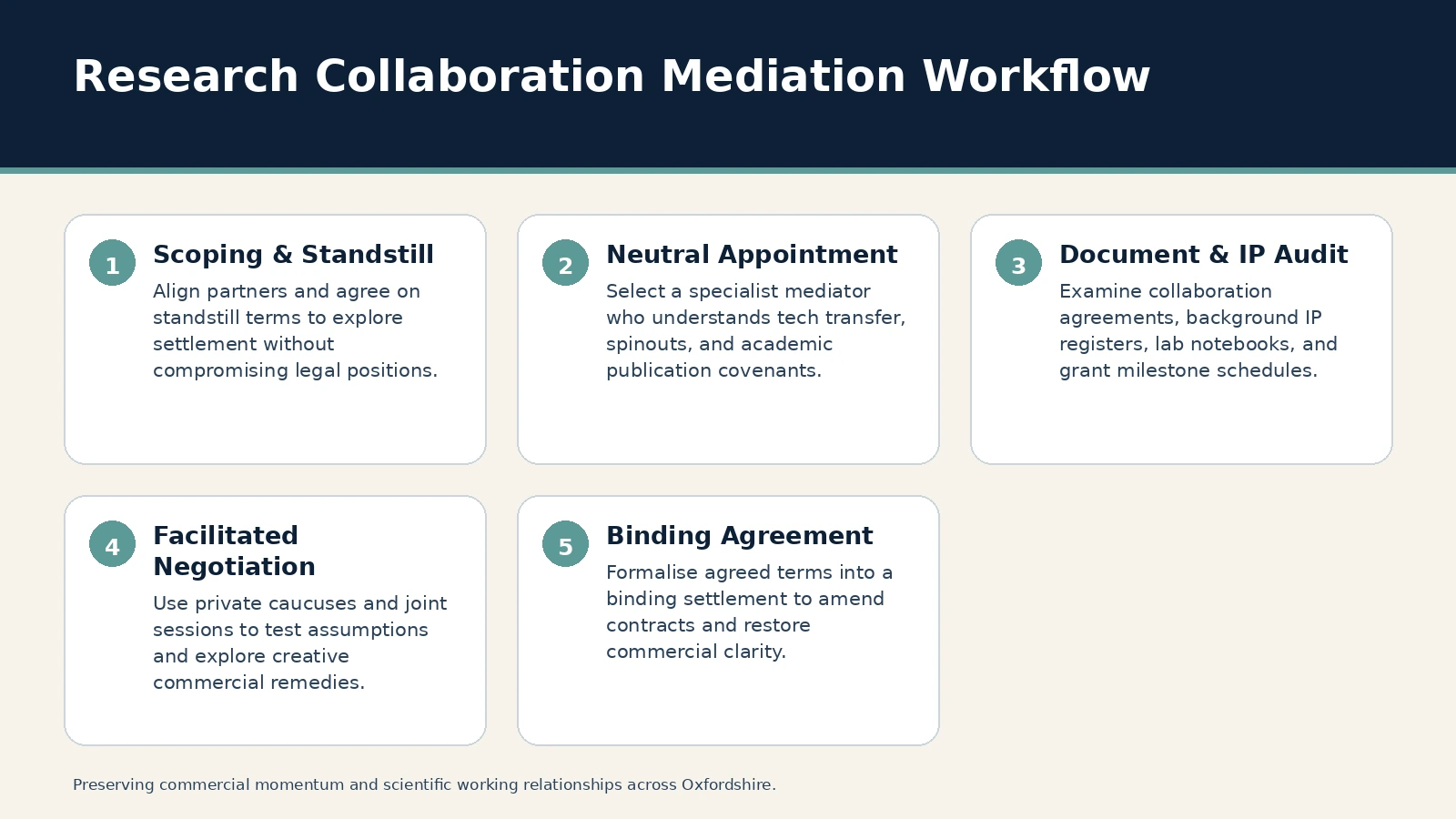
The Structured Mediation Pathway for Research Consortia
Commercial mediation for research collaborations follows a structured, interest-focused pathway designed to unpack complicated technical, financial, and institutional tensions without damaging personal working relationships.
1. Joint Scoping and Standstill Alignment
Before entering detailed discussions, the disputing partners may agree on a standstill arrangement. This step can pause internal contractual breach notices if agreed, though statutory patent priority filing deadlines continue running and suspending limitation requires an enforceable, binding contract or deed. Such arrangements allow representatives to conduct without-prejudice discussions to explore settlement without compromising their underlying legal positions.
2. Selecting an Appropriate Specialist Neutral
Unlike general commercial claims, disputes within the Oxfordshire deep-tech cluster benefit from a mediator who understands technology transfer, spinout equity dilution, academic publication covenants, and public research funding frameworks.
3. Scoping Core Disagreements and Document Exchange
Each consortium member prepares a concise, confidential position statement setting out their technical realities, commercial objectives, and core concerns. Essential research documents are exchanged, including the primary collaboration agreement, background intellectual property registers, and grant milestone schedules. For complex technical disputes involving proprietary algorithms, confidential compounds, or commercial know-how, teams often apply strategies drawn from safeguarding trade secrets via mediation to protect sensitive laboratory data throughout discussions.
4. Facilitated Dialogue and Private Exploration
During the mediation, the neutral shuttles between private breakout rooms and facilitates controlled joint sessions. In private caucus, parties can speak candidly about their institutional red lines—such as an academic department’s non-negotiable need for doctoral thesis submission or a spinout’s immediate venture due-diligence criteria. The mediator helps test assumptions, identify shared commercial interests, and explore solutions that address both entities’ objectives.
5. Drafting and Executing a Binding Resolution
When parties reach common ground, the agreed terms are reduced to a formal, legally binding settlement agreement signed by authorised institutional representatives. This document formally amends the collaboration contract, reallocates intellectual property licences, resets milestone deliverables, and restores commercial clarity.
Document Preparation for Research Collaboration Disputes in Oxfordshire
Effective preparation directly influences the success of commercial mediation. Consortia participating in Research Collaboration Disputes in Oxfordshire should gather and review core documentation before entering the mediation room:
- The Master Collaboration Agreement: Scrutinise the core contract, paying particular attention to definitions of background and foreground intellectual property, governance escalation clauses, and publication approval mechanisms.
- Background IP Schedules: Examine the formal registers completed at project commencement to verify which technologies, data sets, and patents were formally contributed as pre-existing assets by each partner.
- Laboratory Notebooks and Technical Milestones: Collate digital lab records, version-controlled source repositories, and project management logs demonstrating when and by whom contested breakthroughs were achieved.
- Grant Offer Letters and Consortium Agreements: Review public funding terms, particularly clawback conditions, milestone deadlines, and mandatory reporting covenants specified by bodies such as Innovate UK.
- Chain-of-Title Assignments: Compile formal intellectual property assignment deeds for all contributing personnel, including academic supervisors, postdoctoral researchers, PhD students, and third-party software engineers. Clarifying these rights is particularly vital when dealing with complex digital assets, as examined in our guide on software IP ownership and contractor deadlocks.
- Draft Patent Applications and Publication Manuscripts: Identify pending patent drafts and proposed academic journal papers to assess whether commercial filing dates and academic release timetables can be harmonised.
Consensual Settlement Arrangements in Collaborative Research
Because mediation allows parties to explore tailored commercial arrangements by mutual agreement, consortium members can establish operational solutions that courts rarely provide. Rather than arriving at an all-or-nothing determination on contract termination or damages, collaborative negotiations often yield practical adjustments such as:
- Field-of-Use Licences: Dividing newly generated foreground intellectual property by market sector or therapeutic application. For instance, an academic institution may retain ownership for diagnostic and research tools, while the corporate sponsor secures exclusive rights for commercial therapeutic manufacturing.
- Staged Publication Covenants: Agreeing on reasonable publication hold periods. This grants corporate partners an agreed window to prepare and submit priority patent applications, after which academic researchers are free to publish peer-reviewed papers without breaching confidentiality.
- Milestone and Resource Recalibration: Formally revising technical delivery timetables, reallocating grant tasks among consortium members, or adjusting staffing commitments to prevent project default and preserve public funding.
- Royalty Restructuring and Equity Adjustments: Modifying commercialisation returns, such as introducing sliding-scale royalty rates based on net sales or adjusting equity allocations within a spinout to reflect changing development contributions.
- Orderly Exit and Carve-Out Arrangements: Establishing clean, amicable departure terms for a partner seeking to withdraw, allowing remaining consortium members to continue research without continuing governance deadlocks.
Procedural Context and Court Expectations in England & Wales
Parties in dispute are expected to engage in constructive dialogue and explore alternative dispute resolution, including mediation, before pursuing formal court trials.
The UK Intellectual Property Office guidance on IP mediation reinforces this approach, actively encouraging commercial and academic research partners to use mediation to manage disputes swiftly and cost-effectively.
Next Steps for Consortium Partners
When disagreements arise in collaborative research programmes, escalating early to commercial mediation protects both the science and the commercial investment. Rather than allowing contested patent priorities or personality clashes to derail years of technical development, consortia can use mediation to find practical, confidential solutions.
If your organisation is navigating a multi-party research dispute, foreground ownership impasse, or grant milestone deadlock, you can contact Echelon Dispute Resolution to discuss whether mediation is appropriate for your circumstances and explore available appointment options.
Explore our Intellectual Property & Technology Disputes guides.
Frequently asked questions
Why is mediation well suited to research disputes in Oxfordshire?
Mediation offers a private, non-adversarial environment where research partners can resolve technical disagreements without making lab notes, patent filings, or business plans public. This process protects institutional relationships and ensures projects remain on track to meet public grant requirements.
How does mediation protect trade secrets and unpublished laboratory data?
Discussions, technical disclosures, and unfiled patent strategies shared during mediation are protected by confidentiality terms and without-prejudice privilege, preventing their use in court proceedings subject to limited legal exceptions.
Can mediation adjust public grant milestones, such as Innovate UK funding?
While a mediator cannot alter the terms set by public funding bodies directly, the process allows consortium members to agree on revised project work packages and internal delivery timelines. These agreed adjustments can then be presented collaboratively to the grant provider for formal approval.
What happens if a collaborative research mediation does not reach an agreement?
Because mediation is a voluntary and consensus-based process, parties do not forfeit their legal rights if discussions do not result in a settlement.
Who should attend a research collaboration mediation session?
Consider whether each participating organisation has identified who will cover the scientific context, commercial rights, legal advisory needs, and settlement authority.
Authoritative UK guidance and further reading
Primary and official sources
- University and business collaboration agreements: Lambert Toolkit – GOV.UK (gov.uk)
- University and business collaboration agreements: model agreement guidance – GOV.UK (gov.uk)
- Open innovation: collaboration between business and universities – the Lambert Toolkit – Intellectual Property Office blog (ipo.blog.gov.uk)
- ipo.gov.uk (ipo.gov.uk)
This guide provides general information about dispute resolution and mediation. It is not legal advice. The appropriate approach depends on the facts, documents, procedural position and the parties involved; obtain legal advice where required.