

In brief
The question: How can brand owners, commercial directors, and intellectual property advisers resolve trade mark infringement claims, passing off disputes, or registry opposition deadlocks without absorbing the high financial and operational costs of court litigation?
The short answer: Engaging in trade mark dispute mediation allows competing businesses to move beyond rigid claims of right and craft practical commercial compromises. While court proceedings produce binding findings on infringement or validity, courts cannot negotiate consensual coexistence agreements or agreed register amendments, though they can grant stayed or phased periods for stock disposal. Mediation provides a confidential forum where parties can negotiate commercial boundaries, delineate customer channels, and address disputed marks. Furthermore, exploring mediation satisfies court expectations under the Practice Direction on Pre-Action Conduct and Protocols and manages exposure to adverse costs under Civil Procedure Rules rule 44.2(5)(e) (read alongside rule 1.4(2)(e)).
The Friction of Trade Mark Impasses: Infringement, Registry Deadlock, and Commercial Exposure
A formal brand conflict rarely emerges in an operational vacuum. It typically surfaces at pivotal commercial junctures: during a product launch, midway through geographic expansion, or while raising investment capital. Whether the conflict arrives as a formal cease-and-desist letter or as an opposition filed against a UK trade mark application, the immediate operational impact can be disruptive.
Directors and brand managers suddenly face acute commercial friction. Product listings may face challenges on digital platforms. Packaging runs, marketing collateral, and domain acquisitions are placed on hold. When intellectual property disputes escalate, corporate due diligence during fundraising or debt refinancing can stall because unquantified litigation exposure introduces balance sheet uncertainty. Within the wider management of intellectual property and technology disputes, exploring formal commercial mediation services offers a constructive path to pause hostile exchanges and evaluate practical settlement structures.
Under the Practice Direction on Pre-Action Conduct and Protocols (paragraphs 8 and 11), court litigation is explicitly treated as a measure of last resort. Parties to a dispute are expected to explore alternative dispute resolution before initiating proceedings. If a party unreasonably fails to engage in dispute resolution, or fails to comply with an ADR order, the court can take that conduct into account under CPR rule 44.2(5)(e) (read alongside rule 1.4(2)(e)) when deciding who pays legal costs. Aside from procedural expectations, litigation carries real commercial risks: even in specialised forums such as the Intellectual Property Enterprise Court (IPEC) multi-track—where recoverable costs are capped under CPR Part 46, Section VII at £60,000 for liability and £30,000 for quantum—actual legal fees can exceed recoverable sums, leaving the winning party with unrecouped expenditure.
Beyond direct costs, litigation creates strategic distraction. Executive teams find themselves absorbed in evidentiary searches and formal witness statements rather than driving product growth. Brand exposure can also impact commercial partnerships, distributor arrangements, and retail supplier confidence, turning what began as a narrow naming conflict into an enterprise-wide disruption.
The operational stress is often magnified by the commercial asymmetry of the parties. A well-capitalised brand owner may issue sweeping demands that threaten an emerging challenger’s entire pipeline, while an established enterprise may feel its accrued goodwill is being eroded by an aggressive market entrant. When exchanges are conducted solely through formal solicitor correspondence, positions frequently harden into defensive entrenchment. Each side becomes invested in proving why its legal claim is unassailable, leaving little room to assess what each business genuinely requires to trade profitably and protect its investment.
Commercial Settlement Levers: Coexistence Agreements, Phased Rebrands, and Carve-Outs
The primary advantage of trade mark dispute mediation lies in the flexibility of remedies available by consensus. In court, an intellectual property judge determines whether a mark is valid and whether infringement or passing off has occurred. If infringement is established, standard remedies follow: an injunction restricting further use, financial compensation or an account of profits, and orders for the delivery up or destruction of infringing materials. A court cannot step into the shoes of the commercial parties to negotiate an operational compromise.
Through mediation, parties can explore tailored outcomes that preserve enterprise value on both sides:
- Formal Coexistence Agreements: Competing enterprises can agree to operate concurrently by defining distinct operational spheres. For example, parties can agree to restrict use to specific channels—such as business-to-business enterprise sales versus direct-to-consumer retail—or delineate distinct geographic regions or service offerings. Guidance on these arrangements can be found in the official UK coexistence agreement framework published by the government.
- Agreed Specification Amendments: Where an impasse arises during a UK Intellectual Property Office (UK IPO) registration or opposition proceeding, the applicant and opponent can negotiate agreed restrictions, divisions, or carve-outs to the disputed Nice Classification specifications, allowing the application to proceed without further contested hearings.
- Phased Rebrand Timetables: Rather than demanding the immediate destruction of packaging, mediation enables parties to agree on a practical transition schedule. This might allow the defending party an agreed run-out period to exhaust finished inventory, update product tooling, and redirect digital assets without writing off valuable stock.
- Visual and Digital Presentation Covenants: Parties can agree on distinctive visual modifications, such as mandatory use of contrasting colour palettes, permanent inclusion of qualifying trading names, or agreed covenants regarding digital advertising and paid search keyword bidding.
These negotiated parameters allow businesses to decouple brand identities without inflicting needless operational shocks on either party. Where broader trading arrangements or operational distribution chains are intertwined with the brand, resolving the trade mark conflict often requires addressing wider supply arrangements. In such scenarios, insights from supply chain dispute mediation can help parties structure comprehensive commercial settlements.
Securing a workable coexistence structure requires frank commercial discussion. In joint or private sessions, the mediator helps the parties test whether their real customer bases actually overlap or if perceived conflicts are driven by speculative future plans. By carving out precise product niches, setting agreed limits on digital keywords, or establishing guidelines for future brand extensions, commercial principals can achieve clear operational certainty while avoiding the unpredictable costs and delays of formal litigation.
Evaluating Resolution Paths: Trade Mark Dispute Mediation Compared to Court Adjudication
Deciding whether to continue formal litigation or convene a trade mark dispute mediation requires balancing practical commercial objectives against litigation risks. The table below outlines key practical differences between these two paths.
| Operational Dimension | Formal Court Adjudication | Trade Mark Dispute Mediation |
|---|---|---|
| Remedy Flexibility | Determines legal rights, validity, and infringement, applying standard statutory remedies where established. | Enables bespoke commercial solutions, including channel carve-outs, visual modifications, and negative search covenants. |
| Commercial Control | Adjudicative authority to determine the dispute rests with the trial judge, whose ruling is binding on the parties, subject to any appeal, unless the dispute is settled beforehand. | Commercial principals retain control throughout; under standard mediation agreements or subject to contract terms, no settlement is binding until mutually agreed and signed in writing. |
| Timetable & Scheduling | Subject to formal court timetables, listing delays, and procedural directions. | Can be scheduled promptly by mutual consent, potentially resolving operational uncertainty within days or weeks, depending on mutual party cooperation and agreement. |
| Treatment of Existing Stock | Injunctions can trigger immediate withdrawal, packaging write-offs, or stock destruction, though courts retain discretion to grant stayed transitional periods. | Parties can negotiate practical run-out periods to exhaust existing branded inventory orderly. |
| Privacy of Commercial Terms | Hearings and published judgments are placed on the public record, accessible to customers and competitors. | Conducted privately under contractual confidentiality terms alongside without-prejudice privilege, keeping financial terms and business plans discreet, subject to limited legal exceptions. |
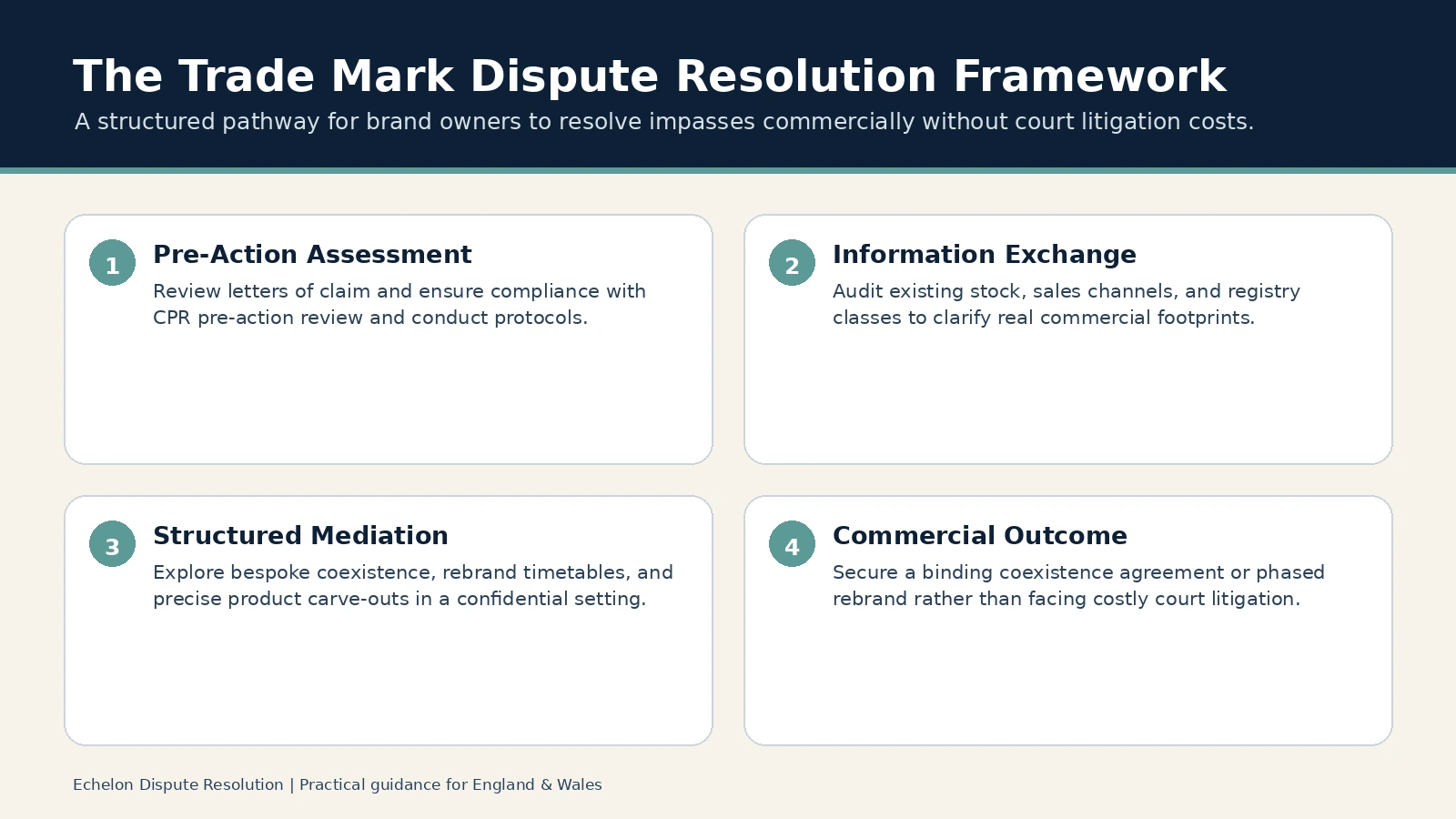
Preparing Commercial Positions and Evidence for a Trade Mark Mediation
Effective preparation for a brand mediation requires a different mindset from preparing for a trial. While legal advisers must assess the merits of trade mark validity, confusion, or passing off, commercial principals should focus on the underlying operational levers that unlock agreement. A successful mediation process depends on clarifying practical needs rather than merely repeating legal assertions.
Parties preparing for mediation should focus on four core preparation areas:
- Documenting Real Commercial Footprints: Assemble concrete records showing where, how, and to whom goods or services are actually supplied. Evidence of customer demographics, pricing points, distribution channels, and geographical spread helps clarify whether market confusion exists in practice or if operations are already separate.
- Auditing Inventory and Transition Costs: Quantify the exact financial impact of potential branding adjustments. Determine the current volume of branded packaging in stock, the lead time needed for new production runs, and the practical costs of altering digital domains and marketing materials. Knowing these figures allows a party to propose realistic, phased run-out terms.
- Clarifying UK IPO Registry Priorities: In opposition or cancellation proceedings, determine which specification terms are critical to current and medium-term operations, and which terms were included defensively. Identifying non-critical classes provides room to offer registry carve-outs without harming core commercial interests. Details on formal mediation structures are outlined in the official guidance on intellectual property mediation provided by the UK government.
- Appointing Decision-Makers with Settlement Authority: Ensure the commercial principal attending the mediation has the authority to make commercial decisions. When unforeseen trade-offs arise—such as trading a negative keyword restriction for a six-month packaging run-out window—progress relies on having an authorised decision-maker at the table.
Understanding these commercial fundamentals ensures that time in mediation is spent evaluating practical terms rather than debating unverified estimates. When a party can demonstrate the exact costs and operational lead times of a proposed transition, settlement discussions move swiftly from abstract rights to concrete deal structures. Where brand conflict overlaps with software licensing, technology branding, or technical service agreements, exploring strategies from intellectual property licensing dispute mediation can provide valuable approaches for defining territorial scope and usage boundaries.
When Mediation Is Effective—and When Immediate Interim Relief Takes Precedence
While mediation offers significant flexibility for resolving commercial friction, it is not appropriate for every brand conflict. Commercial decision-makers must distinguish between legitimate commercial boundary disputes and cases involving intentional, bad-faith counterfeiting.
Mediation is particularly effective where two legitimate businesses have adopted similar marks in good faith, where brand expansion brings historically separate enterprises into contact, or where registry opposition deadlocks delay product launches. In these situations, both parties share an interest in avoiding open-ended litigation costs, managing adverse cost exposure under court rules, and securing market certainty to conduct their business safely.
Conversely, mediation is generally unsuitable where urgent court protection is required. If a rogue party is actively distributing deliberate counterfeits, passing off substandard products, or liquidating assets to evade enforcement, an urgent application to the court for an interim injunction or search order is necessary. In such circumstances, seeking immediate judicial relief takes precedence over voluntary dialogue. Once emergency protective orders are in place, the parties may still turn to mediation to address long-term settlement terms, financial compensation, or disposal protocols away from a public trial.
When parties engage in trade mark dispute mediation early in the life of a dispute, they maintain control over their commercial reputation, protect their brand value, and reach tailored solutions that court adjudication simply cannot provide. To explore whether your brand conflict is suitable for consensual resolution, you can contact Echelon Dispute Resolution to discuss our commercial mediation process with an experienced mediator.
Frequently asked questions
Can a private trade mark coexistence agreement guarantee UK IPO registration?
No. While a private coexistence agreement binds the signing parties regarding how they use and enforce their marks, it does not bind the UK Intellectual Property Office on absolute grounds of refusal. However, consenting to concurrent use can help overcome relative grounds objections or resolve third-party oppositions during the registration process.
What happens if our business chooses not to engage in trade mark dispute mediation?
Under Civil Procedure Rules rule 44.2(5)(e), courts take into account whether a party unreasonably failed to engage in alternative dispute resolution when determining costs orders. If your refusal is judged unreasonable, the court can impose costs sanctions, even if you are successful at trial on the substantive trade mark infringement claim.
How does mediation resolve disputes over packaging and finished branded stock?
In litigation, a court finding of infringement can lead to an immediate injunction and orders to deliver up or destroy stock, though courts retain discretion to grant stayed transitional periods. In mediation, the parties can agree on a practical, phased run-out period. This allows the defending business to sell through existing inventory while transitioning packaging to a modified brand mark.
Who should attend a trade mark dispute mediation session?
Parties should attend alongside their legal advisers (such as an IP solicitor or trade mark attorney) and ensure that a commercial principal with full settlement authority is present. Having a decision-maker at the table allows the business to evaluate practical commercial concessions, such as channel carve-outs, in real time.
Can mediation resolve trade mark registry oppositions before the UK IPO?
Yes, where the parties are willing to negotiate. While settlement depends on mutual agreement and is not guaranteed, mediation can effectively resolve UK IPO opposition deadlocks. Rather than proceeding to formal registry hearings, the applicant and opponent can explore agreed specification carve-outs, class divisions, or geographic limits, allowing a mutually acceptable trade mark application to proceed to registration without a contested hearing.
Authoritative guidance and further reading
Primary and official sources
- Intellectual property mediation – GOV.UK (gov.uk)
- Let’s talk: A mediator’s tale – Intellectual Property Office blog (ipo.blog.gov.uk)
- Coexistence agreement: fact sheet – GOV.UK (gov.uk)
Further professional and framework reading
- Trademark procedures and strategies: United Kingdom (penningtonslaw.com)
- How to Check If Someone Is Infringing Your UK Trademark | Trademark Dashboard (trademarkdashboard.com)
- forresters-ip.com (forresters-ip.com)
This guide provides general information about dispute resolution and mediation. It is not legal advice. The appropriate approach depends on the facts, documents, procedural position and the parties involved; obtain legal advice where required.