

In brief
The question: How can commercial organisations resolve B2B supply chain disruptions, delivery failures, and contract termination disputes without collapsing essential operations or becoming entrenched in contested court proceedings?
The short answer: Contract dispute mediation offers commercial counterparties a confidential, structured setting to re-baseline delivery milestones, restructure pricing mechanisms, or manage an orderly contract exit while preserving interim operational continuity. When delivery delays or cost pressures trigger formal default notices, immediate escalation to litigation threatens ongoing supply and creates exposure to counter-claims. Through commercial mediation, businesses can establish interim supply arrangements, protect downstream customer obligations, and align with English civil pre-action expectations while crafting workable commercial solutions that address operational realities.
Operational Pressures and Supply Breakdown: The Anatomy of a B2B Contract Dispute
Supply chain disputes rarely arise from bad faith alone. More frequently, they stem from sudden external friction—such as raw material inflation, freight disruptions, labour shortages, or component lead-time shocks—that collides with rigid contractual commitments. When a supplier cannot meet agreed production milestones or seeks emergency price adjustments, the purchasing organisation faces immediate pressures from downstream customers, internal production schedules, and board commitments.
In many supply relationships, the immediate reaction to missed delivery dates or unilateral price surcharges is legal escalation. Formal notices of default, reservation of rights letters, and threats of contract termination are issued to preserve legal positions. While these steps are often taken to protect contractual entitlements, they alter the commercial dynamic abruptly. Communication shifts from operational problem-solving between procurement leads to defensive exchanges between legal advisers.
This operational breakdown introduces distinct commercial vulnerabilities for both sides:
- Supply continuity risks: A purchaser that issues an immediate termination notice may find itself without an alternative source of supply, particularly where specialised tooling, regulatory approvals, or lengthy qualification cycles are involved.
- Operational counter-claims: A supplier faced with termination or withheld payments may suspend further shipments, assert liens over components, or bring counter-claims for wrongful termination and unpaid work-in-progress.
- Downstream liability exposure: Delivery failures upstream quickly compound downstream, creating potential breach-of-contract claims and reputational damage across multiple customer tiers.
- Executive distraction and cost inflation: Managing an active supply chain dispute consumes leadership time and commercial capital, diverting focus away from core operations.
When parties recognise that formal legal conflict threatens their broader enterprise, exploring structured alternatives such as contract dispute mediation for commercial breaches allows decision-makers to regain control over the outcome.
Resolution Pathways Compared: Commercial Litigation vs Supply Chain Mediation
When a B2B supply contract breaks down, parties face a strategic choice regarding how to handle the dispute. Formal court proceedings focus on establishing legal liability and determining retrospective financial compensation. By contrast, mediation operates as a proactive problem-solving framework that allows commercial leaders to address current operational dependencies and future commercial viability.
Under the English civil justice framework, parties are also subject to procedural expectations before issuing proceedings. The Practice Direction – Pre-Action Conduct and Protocols requires parties to consider whether alternative dispute resolution, such as mediation, could settle the dispute before litigation is launched. Furthermore, under the Civil Procedure Rules (CPR), courts actively manage cases by encouraging the use of ADR, and judges possess discretion to take an unreasonable refusal to mediate into account when making cost orders, regardless of who ultimately wins at trial.
The comparison below outlines how formal litigation and commercial mediation function across core operational dimensions:
| Operational Dimension | Commercial Court Litigation | Supply Chain Contract Mediation |
|---|---|---|
| Supply Continuity | Contested proceedings create friction that can disrupt active deliveries and halt day-to-day collaboration. | Parties can agree on interim delivery protocols and buffer stock arrangements to keep goods moving while negotiations proceed. |
| Outcome Flexibility | Judgments determine monetary damages, contractual declarations, or termination rights based on past breach. | Parties can agree on commercial arrangements such as revised delivery schedules, index-linked pricing, volume adjustments, or structured supplier exits. |
| Confidentiality | Court hearings and filed judgments are matters of public record, exposing supply chain vulnerabilities and dispute details. | Discussions generally remain private and confidential under the terms of the mediation agreement, subject to established legal and statutory exceptions. |
| Commercial Control | A judge decides the final outcome based on legal arguments and contractual interpretation. | Commercial decision-makers retain complete autonomy to accept, reject, or shape any proposed settlement terms. |
| Pre-Action CPR Alignment | Represents the final, contested forum if preliminary engagement fails. | Directly demonstrates reasonable engagement with pre-action ADR expectations. |
Understanding these distinctions helps commercial directors balance legal rights against the practical necessity of keeping goods and services moving. For deeper analysis on the financial implications of each path, see our guide on mediation versus litigation costs in contract disputes.
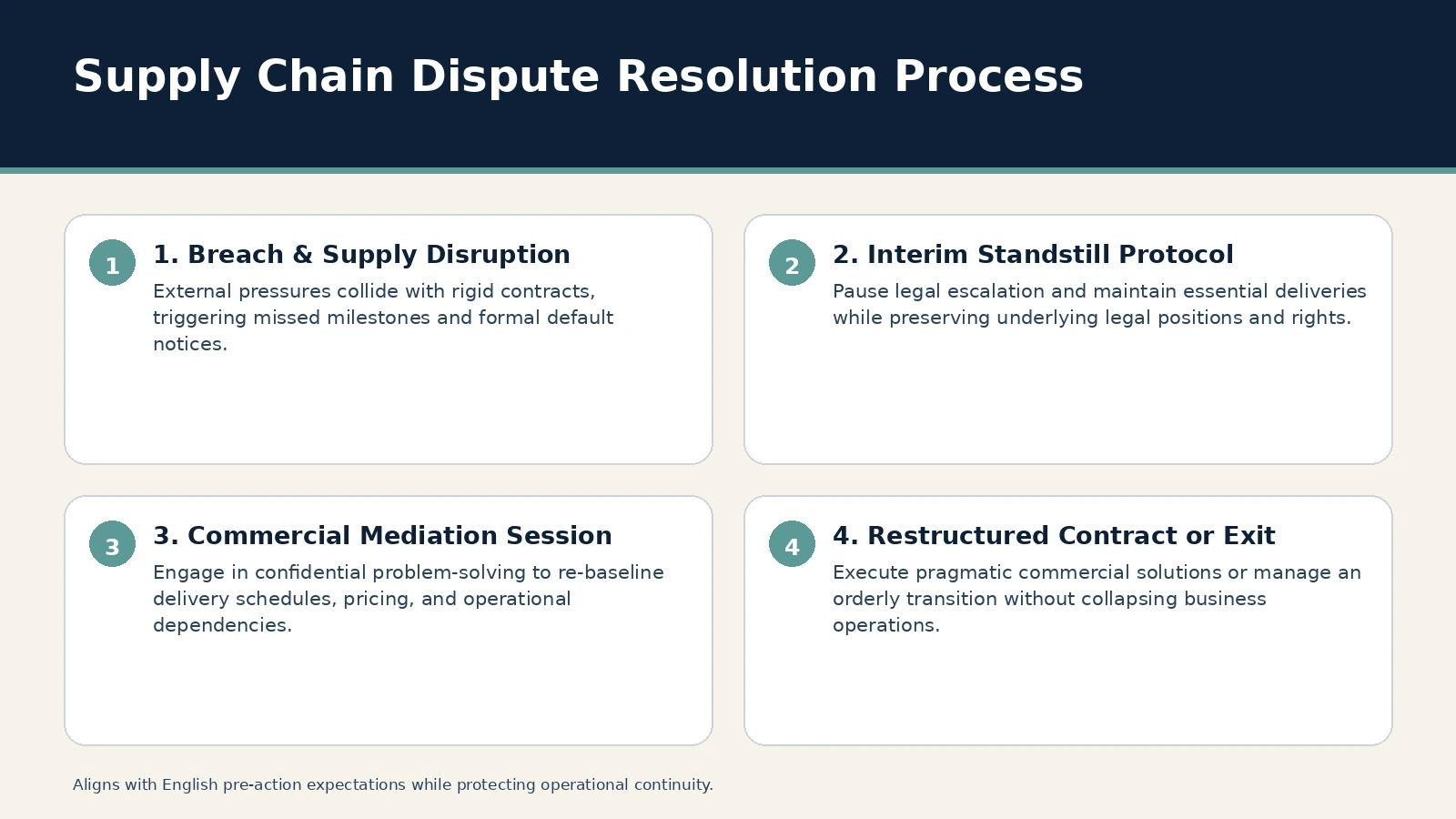
Commercial Settlement Levers in Contract Dispute Mediation
In a formal breach situation, common legal remedies focus primarily on financial damages, termination, or specific performance, alongside equitable remedies like injunctions and agreed contractual mechanisms. In commercial practice, however, supply chains operate within fluctuating market conditions where rigid performance may have become economically unviable for one side or operationally unworkable for the other. Engaging in contract dispute mediation allows both parties to explore pragmatic levers that align with real-world constraints.
1. Restructuring Delivery Schedules and Production Milestones
Where a supplier has fallen behind schedule due to component shortages or logistics bottlenecks, insisting on the original deadline rarely produces goods faster. In mediation, parties can examine the operational baseline and construct realistic, re-baselined delivery timetables. These can be reinforced by agreed production milestones, interim inspection checkpoints, or priority batch releases to satisfy critical downstream customer commitments.
2. Re-indexing Margins and Surcharges
When steep raw material or freight increases make contract performance loss-making for a supplier, the risk of sudden operational failure or insolvency rises. Mediation provides a private setting where suppliers can explain underlying cost changes without publicly disclosing commercially sensitive cost structures. Counterparties can agree to temporary energy surcharges, shared-pain cost-indexing models, or tiered rebate structures that stabilise the supplier while maintaining economic fairness for the purchaser.
3. Negotiating an Orderly and Managed Contract Exit
There are situations where commercial relations have deteriorated beyond repair, or market shifts make long-term performance unfeasible for either party. Precipitous termination can trigger supply blackouts, disputed ownership over tooling, and immediate litigation over lost profits. Through contract dispute mediation, parties can structure an orderly transition:
- Agreeing on a phased rundown of inventory and work-in-progress over an agreed transitional timeframe.
- Coordinating the release and handover of proprietary tooling, design drawings, software code, or regulatory documentation.
- Setting clear protocols for final payments, defect rectification windows, and mutual releases from future contractual liabilities.
The Standstill Protocol: Protecting Supply Continuity During Dispute Negotiations
One of the central tactical dilemmas in a supply chain conflict is how to pause escalation without forfeiting legal remedies or suffering an immediate halt to deliveries. If a purchaser engages in informal talks without protective measures, it risks compromising contractual notice periods. Conversely, if it serves an immediate demand for damages, the supplier may stop production entirely.
The solution lies in implementing an interim standstill protocol alongside the decision to proceed with commercial contract dispute resolution. A standstill agreement suspends or extends limitation periods for an agreed timeframe, though pausing active litigation steps requires a court stay, and any suspension of notice periods or interim operating terms must be expressly agreed between the parties.
An effective standstill supply protocol typically includes:
- Interim Delivery Commitments: The supplier agrees to maintain essential shipments or produce agreed baseline volumes while discussions are underway.
- Interim Payment Terms: The purchaser commits to maintaining agreed payment flows for current deliveries, often separated from the disputed historic sums.
- Reservation of Legal Rights: Both parties agree that interim performance and confidential discussions will not prejudice their underlying contractual claims or defences if a settlement is not achieved.
- Time-Limited Window: A clearly defined period to hold the mediation session and conclude formal terms.
Using this mechanism decouples operational continuity from the legal dispute, giving commercial teams the space required to resolve complex disagreements productively. For strategic insights on procedural timing and negotiations, review our guidance on settlement strategy and pre-action timing.
Preparing for Contract Dispute Mediation: Practical Commercial Steps
Effective preparation for mediation differs markedly from court preparation. Rather than compiling adversarial witness statements designed solely to assign blame, commercial teams should focus on assembling the operational, financial, and logistics data needed to build workable settlement options.
Assemble Operational and Financial Documentation
Parties should gather objective materials that illustrate the practical reality of the supply failure:
- Logistics tracking records, bills of lading, and freight documentation showing precise delivery timelines and chokepoints.
- Purchase orders, variation requests, and email trails relating to milestone amendments.
- Clear quantification of direct financial losses, mitigation steps taken, and costs incurred in sourcing alternative components.
- Independent market indices verifying raw material price volatility or freight benchmark changes where price escalation is disputed.
Identify Decision-Makers and Authority Limits
A mediation cannot succeed if the participants in the room do not have the commercial authority to approve structural contract changes. Organisations should ensure that their attending representatives include:
- A senior commercial executive (such as a Managing Director, Supply Chain Director, or Procurement Head) with authority to renegotiate terms or agree settlement values.
- The operational lead who understands day-to-day manufacturing constraints and delivery dependencies.
- Legal counsel to advise on contractual protections and draft binding settlement agreements once commercial consensus is reached.
Engaging Productively in Joint and Private Sessions
During the mediation, the neutral mediator facilitates both joint discussions and confidential private caucuses. In joint sessions, commercial principals can articulate the operational impact of the disruption without the posturing that often accompanies formal legal correspondence. In private caucuses, each party can explore settlement concessions, cost-sharing thresholds, and risk appetites with the mediator in strict confidence.
This dynamic enables parties to test commercial scenarios—such as revised pricing tiers, modified batch sizes, or transition timetables—without binding themselves until a complete, integrated package is agreed. When supply tensions arise, escalating directly to court can permanently damage valuable supplier networks and customer delivery schedules. Engaging in structured contract dispute mediation offers a constructive, commercially astute way to protect operational continuity and resolve contractual deadlocks.
If your organisation is facing a delivery breakdown, pricing conflict, or contract termination dispute, you can contact Echelon Dispute Resolution to discuss how commercial mediation can support your operational objectives.
Frequently asked questions
When is the right time to propose contract dispute mediation in a supply chain conflict?
Mediation is most effective as soon as direct discussions between procurement teams reach an impasse, but before formal court proceedings or contract termination notices are executed. Proposing mediation early allows parties to implement standstill protocols and prevent supply disruptions before commercial relationships become irreparably damaged.
Can mediation resolve a supply dispute if contract termination has already been threatened?
Yes. Even after formal default or termination notices have been served, parties can agree to mediate. Mediation provides a private setting either to withdraw default notices under revised operational terms or to negotiate an orderly, phased contract exit that avoids costly breach-of-contract litigation.
How are goods kept moving while a commercial mediation is arranged?
Parties can enter into an interim standstill or operational protocol. An interim agreement can maintain deliveries and interim payments under an express reservation of rights, helping downstream operations continue while seeking to preserve each party’s contractual remedies during negotiations.
Are settlements reached in commercial supply chain mediation legally binding?
Yes. While discussions during the mediation process remain confidential and non-binding, any agreed resolution becomes legally binding upon both parties once it is drafted into a formal, written settlement agreement and signed by their authorised representatives.
Who should attend a supply chain mediation on behalf of a corporate party?
Corporate parties should be represented by a senior executive with full commercial authority to settle the dispute, an operational or supply chain manager who understands daily production realities, and their legal adviser to assist with settlement drafting.
Authoritative UK guidance and further reading
Primary and official sources
- About us – Civil Procedure Rule Committee – GOV.UK (gov.uk)
- Civil – Civil Procedure Rules – Justice UK (justice.gov.uk)
- PRACTICE DIRECTION – PRE-ACTION CONDUCT AND PROTOCOLS – Civil Procedure Rules – Justice UK (justice.gov.uk)
- Pre-Action Protocol for Professional Negligence – Civil Procedure Rules – Justice UK (justice.gov.uk)
This guide provides general information about dispute resolution and mediation. It is not legal advice. The appropriate approach depends on the facts, documents, procedural position and the parties involved; obtain legal advice where required.