

In brief
The question: How can commercial organisations unblock contested supplier invoices and preserve critical trading relationships without escalating straight into expensive, uncertain court litigation?
The short answer: Resolving a Supplier Payment Dispute Through Mediation provides commercial parties with a confidential, structured negotiation environment led by an independent mediator. Contested invoices rarely stem solely from a refusal to pay; they often involve underlying delivery disagreements, informal scope variations, or administrative sign-off delays. Rather than pursuing rigid adversarial claims, mediation allows buyers and suppliers to address both financial debts and operational friction simultaneously. In England and Wales, civil courts expect parties to consider mediation before initiating litigation, and any agreement formalised in a signed, written document forms an enforceable commercial contract.
Supplier Payment Dispute Through Mediation: The Operational Anatomy of Contested Supplier Invoices
When an invoice goes unpaid, standard credit control procedures often treat the problem as straightforward debt recovery. In commercial practice, contested supplier accounts frequently present as hybrid operational and commercial disputes. A supplier may demand immediate payment for goods or services delivered, while the purchasing business withholds funds citing partial delivery, non-conforming items, or unexpected price adjustments.
These disputes develop through specific operational pressures:
- Scope variations without paperwork: Urgent project demands lead operational teams to request additional work or expedited supply without issuing formal purchase orders or written contract variations. When the resulting invoice arrives, finance teams refuse clearance because the figures do not match approved internal budgets.
- Alleged defects and unilateral set-off: The buyer asserts that earlier shipments had quality defects or delayed a downstream milestone, claiming a right to set off their alleged losses against current outstanding invoices.
- Internal corporate bottlenecks: Changes in procurement leadership, software migrations, or budgetary freezes cause invoice approval delays, which the supplier interprets as bad-faith non-payment.
When communication breaks down, both sides face competing risks. For the supplier, pursuing rigid debt collection or issuing a statutory demand can terminate a valuable account and trigger formal counterclaims for breach of contract. For the buyer, withholding payment can lead to immediate supply halts, disrupting customer commitments. Exploring private commercial mediation within the broader framework of commercial contract disputes provides a forum to uncouple operational disagreements from underlying balance-sheet obligations before costs escalate.
Navigating Relationship Breakdown and Commercial Friction
Protracted payment deadlocks quickly erode personal trust. Once legal notices are threatened, project managers and procurement leads retreat behind formal written communications. Positions harden, and the practical commercial realities of both organisations become obscured by adversarial posturing.
Addressing a Supplier Payment Dispute Through Mediation changes this dynamic by introducing an impartial professional who facilitates structured dialogue. The mediator does not act as a judge, does not provide legal representation, and does not determine who is legally right or wrong. Instead, the process creates a forum where commercial decision-makers can communicate candidly about what is stalling settlement.
Mediation allows the parties to separate interpersonal irritation from balance-sheet facts. In many business relationships, the individuals communicating during a dispute are the same project managers whose decisions created the misunderstanding. Placing those individuals into an adversarial correspondence loop usually leads to defensiveness. In mediation, discussions can involve senior commercial directors who were not part of the day-to-day friction and who can evaluate the dispute on balance-sheet merit and forward-looking commercial utility.
Crucially, commercial mediation is confidential to the process. Discussions held within the session cannot be deployed as formal admissions or concessions in subsequent legal proceedings if no agreement is reached. This commercial privacy enables parties to discuss sensitive financial realities—such as temporary cash-flow constraints or supplier manufacturing margins—without exposing their commercial position to wider market scrutiny or damaging their standing with other supply chain partners.
Comparing Direct Court Litigation with Commercial Mediation
Before issuing court proceedings, commercial directors must weigh procedural risks against the likelihood of prompt cash recovery. While court litigation provides a formal adjudication based on strict contractual rights, it is governed by formal procedural stages that can span many months. Mediation offers a consensual alternative that prioritises practical business solutions.
The comparative dimensions below outline how direct commercial litigation differs from mediation when handling contested supplier accounts:
| Commercial Dimension | County Court Litigation | Commercial Mediation |
|---|---|---|
| Primary Objective | Securing an enforceable legal judgment based on strict legal liability and contractual entitlement. | Reaching a mutually acceptable settlement that resolves disputed accounts and addresses operational causes. |
| Control Over the Outcome | Determined by a trial judge whose decision is imposed upon both parties. | Retained by the commercial decision-makers; no settlement can be imposed without consent. |
| Flexibility of Remedies | Confined to legal remedies determined by contract terms, damages, interest, and procedural costs. | Parties can agree on revised delivery milestones, future order terms, credit notes, or structured payment schedules. |
| Impact on Trading Relationships | Adversarial formal process; positions harden and collaborative business often ceases. | Facilitates direct commercial problem-solving, allowing ongoing trading to continue where commercially viable. |
| Procedural Timetable | Subject to formal court timetables, standard disclosure, witness statements, and court listing availability. | Organised by mutual agreement, often taking place over a single day in person or online. |
Negotiation Dynamics: Structuring Solutions Beyond Cash Transfers
In formal litigation, court remedies are determined by contractual entitlements and financial claims. In mediation, parties can explore tailored commercial arrangements by agreement that resolve cash-flow problems while protecting underlying supply chain value.
When addressing a Supplier Payment Dispute Through Mediation, commercial parties can resolve deadlocks by negotiating flexible commercial solutions beyond the remedies typically available through court litigation:
- Phased settlement schedules: If a buyer faces temporary liquidity pressure, the mediator can assist in designing a staged repayment plan tied to specific dates, providing the supplier with cash predictability and the buyer with operational breathing space.
- Credit notes matched to future orders: Where goods were allegedly non-conforming or delivery was delayed, the parties can agree on partial credit notes applied to prospective purchase orders, preserving future trade volumes while settling historical arrears.
- Rectification and milestone realignment: If an invoice is stalled due to incomplete deliverables, settlement can specify immediate partial payment upon completion of agreed snagging or replacement items, supervised by clear operational milestones.
- Contractual protocol adjustments: Many payment disputes arise from administrative disconnects. Mediated settlements frequently establish improved ordering and sign-off protocols—such as mandatory electronic purchase-order confirmation—to prevent future billing deadlocks.
- Mutual release and clean-break terms: Where parties decide that continuing the business relationship is untenable, mediation enables a managed exit. This can include agreed handovers of technical files, return of tooling, clear warranties on previously delivered stock, and mutual releases from future claims.
For more detailed strategies on handling commercial invoice disagreements, review our practical guide on resolving commercial invoices and wider supply chain dispute mediation.
The Logistics of the Mediation Process
Understanding how a mediation day actually unfolds helps teams enter negotiations with confidence. Mediation is not an informal chat, nor is it a mini-trial where advocates make prolonged speeches to persuade a decision-maker. It is an intensive commercial negotiation managed by a neutral professional.
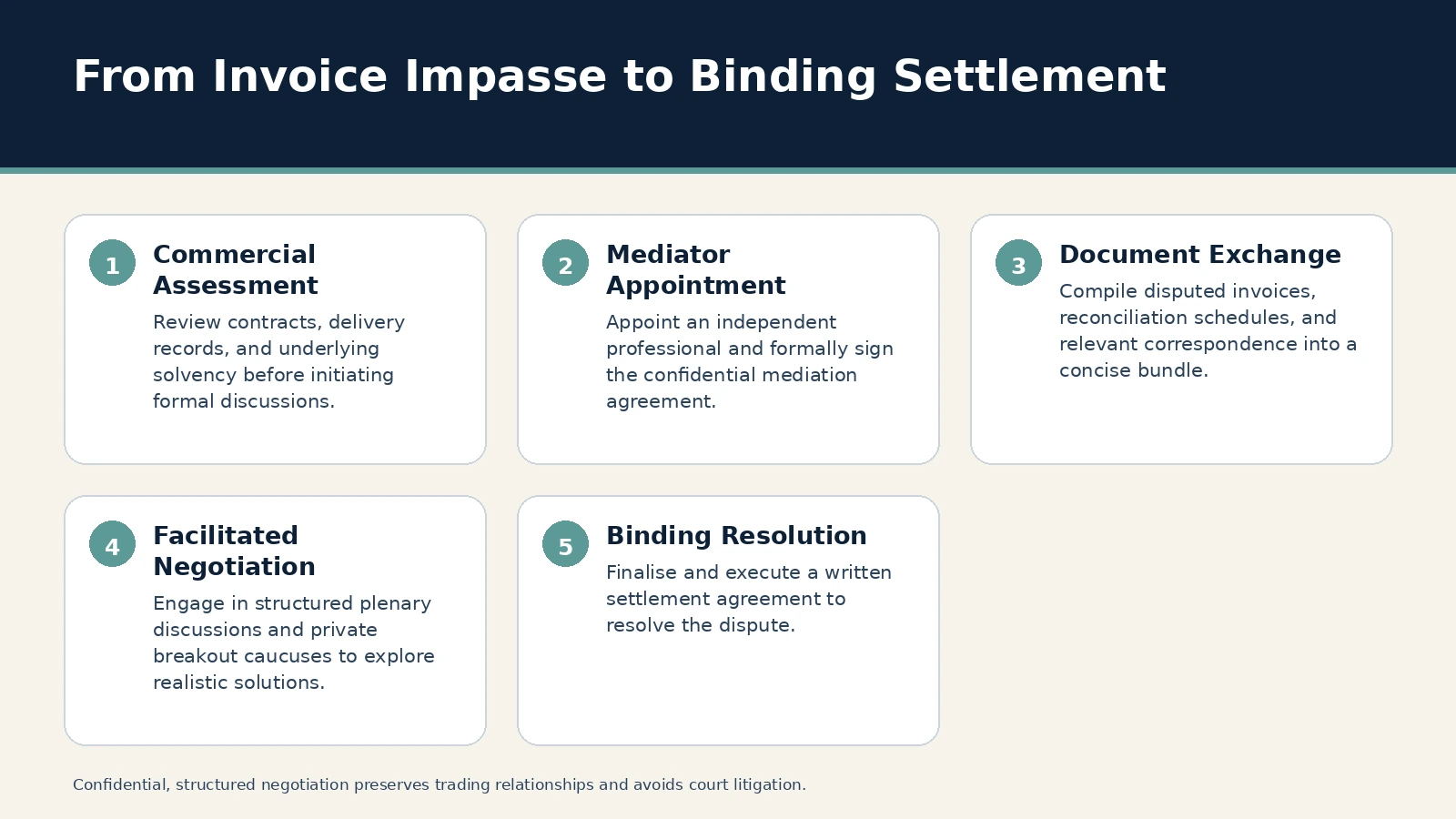
The process generally proceeds through distinct operational phases:
- The opening phase: The mediator welcomes both teams and confirms procedural ground rules, specifically ensuring that discussions remain confidential. In many commercial disputes, parties choose whether or not to hold a brief joint session. Where personal tensions are high, parties often start directly in separate private rooms.
- Private exploration (caucus sessions): The mediator spends the majority of the day moving between the parties in confidential caucus. In these private rooms, the mediator tests the strengths and weaknesses of each side’s position, probes the commercial reality behind stated positions, and explores what settlement terms are genuinely workable. Nothing shared in private caucus is disclosed to the other room without explicit permission.
- Option generation and reality testing: As financial positions become clear, the mediator helps both parties move away from abstract rights toward viable settlement options. This is where creative commercial terms—such as staggered payment tranches, offset stock, or revised delivery specifications—are formulated and evaluated against the alternative of protracted court proceedings.
- Drafting and execution: Once agreement in principle is reached, the legal representatives or senior commercial leads draft a binding settlement agreement. The mediation concludes only when this document is finalised and formally executed.
This structure can be delivered entirely online via secure video platforms with dedicated virtual breakout rooms, or in person at neutral office facilities. Online mediation has become a practical standard for supply chain disagreements, avoiding travel expenses and allowing key operational staff to remain available without losing full days away from their businesses.
Preparing Documentation and Authority for Mediation
Thorough commercial preparation is vital for an effective mediation. To maximise the value of the process, each organisation should compile a concise bundle containing core commercial records rather than inundating the mediator with unorganised email archives.
A well-prepared mediation bundle should contain:
- The primary contract, framework agreement, purchase order terms, or standard conditions governing the trade.
- Disputed invoices, credit notes, and associated delivery receipts or bills of lading.
- A clear, chronological financial schedule setting out invoice numbers, dates, amounts claimed, payments received, set-off deductions taken, and the exact outstanding balance.
- Contemporaneous written correspondence (such as emails, formal defect notices, or inspection logs) addressing alleged defects, delays, or agreed scope changes.
- A realistic assessment of the financial and management costs of taking the dispute through to a defended court trial if mediation does not succeed.
Representation is equally critical. While operational leads and advisers frequently attend to explain factual details, an authorised representative with authority to agree financial compromises should participate or be directly accessible throughout the mediation. If participants attend without the mandate to agree commercial compromises, discussions can stall when a breakthrough appears within reach.
Procedural Context and Settlement Enforceability
Engaging in commercial dispute resolution carries clear procedural significance in England and Wales. Under the Civil Procedure Rules Practice Direction on Pre-Action Conduct and Protocols (paragraphs 8 to 11), civil courts treat litigation as a last resort. Parties are expected to consider whether negotiation or alternative dispute resolution, including mediation, can resolve the dispute before issuing formal court claims. Demonstrating a constructive willingness to mediate aligns fully with these pre-action expectations.
A central question for business owners is how a negotiated outcome is secured. Mediation is entirely voluntary regarding whether terms are accepted; no party is compelled to enter an agreement against its commercial interests. However, once the terms of settlement are agreed, they are drafted into a formal written document and signed by authorised representatives of both organisations. Under the law of England and Wales, a signed written settlement agreement forms a legally binding and enforceable contract. If either party subsequently defaults on the agreed terms, the innocent party can take legal steps to enforce that settlement agreement directly.
Moving from Deadlock to Commercial Resolution
A frozen supplier ledger can distract key personnel, strain liquidity, and threaten essential commercial supply lines. Allowing a payment dispute to drift towards the court system consumes management time and professional fees, without guaranteeing swift payment recovery.
Resolving a Supplier Payment Dispute Through Mediation offers business directors, procurement leads, and instructing solicitors a practical route to regain control. By untangling operational complaints from legitimate payment entitlements in a private forum, organisations can achieve prompt financial clarity and protect ongoing business operations.
To review your options or discuss whether mediation may be suitable for resolving an outstanding supplier payment deadlock, get in touch with our commercial dispute team.
Frequently asked questions
Why consider mediation rather than issuing a court claim for an unpaid invoice?
Issuing court proceedings involves formal procedural timetables, alongside management time and legal costs that can become disproportionate to the sum in dispute. Mediation offers a confidential forum to resolve the dispute in days rather than months. It allows parties to address the operational friction causing non-payment and explore practical solutions—such as future trading discounts or restructured commercial terms—that court judgments cannot provide.
What documentation should a supplier prepare before entering mediation?
Parties should assemble the underlying contract or standard terms, all relevant purchase orders, delivery confirmations, and contested invoices. Crucially, a clear financial reconciliation schedule showing amounts claimed, payments made, and deductions disputed should be shared, alongside contemporaneous communications concerning any alleged quality defects or scope variations.
Who must attend the commercial mediation session?
While operational leads and advisers frequently attend to explain factual details, an authorised representative with authority to agree financial compromises should participate or be directly accessible throughout the mediation to approve any settlement terms.
Is an agreement reached during mediation legally binding?
Yes. While discussions during the mediation process remain non-binding and confidential, once the parties agree on settlement terms, those terms are documented in writing and signed by authorised representatives. Under English law, this written agreement constitutes a legally binding and enforceable commercial contract.
Can mediation take place if the parties prefer not to meet face to face?
Yes. Commercial mediation is highly flexible and frequently conducted online via video conferencing, or in person across separate conference rooms. The mediator facilitates negotiations by moving between private caucus rooms (or breakout rooms online), meaning parties do not need to sit in the same room if relations are strained.
Authoritative UK guidance and further reading
Primary and official sources
- Emma Jones – One Year On – Small Business Commissioner (smallbusinesscommissioner.gov.uk)
- UK sets global standard for small business payment rights – Small Business Commissioner (smallbusinesscommissioner.gov.uk)
- Commercial Payments Bill: overview – GOV.UK (gov.uk)
- service.gov.uk (assets.publishing.service.gov.uk)
This guide provides general information about dispute resolution and mediation. It is not legal advice. The appropriate approach depends on the facts, documents, procedural position and the parties involved; obtain legal advice where required.