

In brief
The question: How can suppliers and buyers resolve a contested retention of title dispute over unpaid inventory and Romalpa terms without triggering operational paralysis or formal insolvency?
The short answer: When commercial accounts fall overdue, suppliers often seek to reclaim goods while buyers struggle to protect working capital and ongoing production. A retention of title dispute arises when ownership rights collide with operational realities, such as mixed stock or disputed contract terms. Attempting unilateral repossession creates exposure to civil claims, whereas initiating formal debt proceedings can push a vulnerable counterparty into insolvency, where statutory rules restrict asset recovery. Engaging in pre-action commercial mediation enables both parties to pause escalation, perform a joint inventory check, and agree on practical commercial terms—such as structured repayment plans, partial stock offsets, or revised delivery arrangements—that protect business continuity and commercial relationships.
Operational Deadlock: Contested Stock, Raw Materials, and Cash Pressures
Unpaid commercial invoices present an immediate dilemma for any business supplying goods on credit. When an account becomes severely overdue, a supplier naturally reviews its sales terms to confirm whether a reservation of ownership clause applies. Under section 19(1) of the Sale of Goods Act 1979, parties may stipulate that ownership of goods remains with the seller until specific contractual conditions, such as payment in full, are fulfilled. On paper, this mechanism appears straightforward. On the warehouse floor, it frequently provokes acute operational deadlock.
For the supplier, reclaiming unsold stock seems the most direct method to mitigate bad debt exposure. Yet taking self-help measures—such as entering customer premises without explicit contractual permission or seizing items whose identity is contested—carries substantial legal hazards, including potential cross-claims in trespass or conversion. For the commercial buyer, a sudden attempt by a key trade creditor to reclaim stock can halt manufacturing lines, cause breaches with downstream customers, and accelerate cash-flow distress. What begins as an overdue account can swiftly deteriorate into a high-stakes commercial contract dispute.
These disputes are rarely simple disagreements over whether an invoice is due. They are heavily shaped by physical and contractual complexity:
- Stock commingling and alteration: Raw materials may have been integrated into finished assemblies, used in manufacturing, or commingled with identical products supplied by competing vendors. Determining which physical pallets remain subject to legal reservation is notoriously difficult once goods leave their initial packaging.
- The battle of the forms: Disagreements often turn on whose standard terms govern the trade. If the buyer’s purchase order purported to exclude supplier title clauses, or if delivery notes were signed without incorporating standard conditions of sale, legal ownership becomes fiercely contested.
- Commercial survival and supply dependency: Buyers often depend on existing inventory to generate the very revenue required to clear overdue balances. Suppliers, conversely, may balance the desire to recover goods against the commercial cost of permanently losing a substantial customer.
When communication breaks down, parties often resort to formal legal notices or threats of insolvency action. However, serving a winding-up petition or pursuing urgent court applications rarely resolves the underlying commercial problem. When a counterparty experiences acute trading distress, deploying EDR’s professional commercial mediation services offers a confidential setting to address outstanding debts and physical stock without the operational disruption associated with formal court enforcement.
Evaluating Resolution Paths: Court Recovery and Commercial Mediation
When parties reach an impasse over unpaid deliveries and ownership clauses, they face a fundamental strategic choice between litigating property rights in court or resolving the conflict through consensual commercial mediation. While formal court action provides an authoritative determination of legal rights, it follows rigid procedural rules, demands extensive documentary evidence, and introduces substantial timing risks.
A primary hazard in any protracted retention of title dispute is the intervention of formal corporate insolvency. Under Schedule B1, paragraph 43(3) of the Insolvency Act 1986, once a company enters administration, no steps may be taken to repossess goods held under a retention of title agreement without the consent of the administrator or permission of the court. If a supplier delays resolution by embarking on adversarial court correspondence, or conversely applies uncoordinated pressure that forces a buyer into administration, its repossession rights are immediately subject to this statutory freeze.
Conversely, resolving the dispute through structured negotiation or independent facilitation aligns with current procedural expectations. The Pre-Action Conduct rules under the Civil Procedure Rules expect parties in civil disputes to consider alternative dispute resolution before issuing claims. Guidance published by the Small Business Commissioner similarly recommends managing late payment conflicts through constructive dialogue and structured commercial arrangements rather than premature litigation.
| Dispute Dimension | Formal Court Proceedings | Commercial Mediation |
|---|---|---|
| Control over Outcome | A judge decides strict legal title and liability based on standard contract terms and available evidence. | The supplier and buyer directly shape and agree upon their own commercial and operational terms. |
| Process Pace and Timing | Proceeds through formal procedural timetables, creating exposure to intervening corporate insolvency or moratoria. | Can be scheduled promptly by mutual consent to address perishable, depleting, or unmixed inventory. |
| Flexibility of Terms | Decisions focus strictly on orders for delivery, damages for conversion, or money judgments for unpaid debts. | Facilitates tailored commercial arrangements such as joint stock audits, instalment schedules, or revised supply terms. |
| Confidentiality | Statements of case, open court hearings, and registered judgments become matters of public record, which can alert lenders, trade credit insurers, and competitors. | Discussions remain private between the participants, protecting business reputations and credit ratings. |
| Trading Relationships | Adversarial posturing and formal enforcement action often extinguish future commercial co-operation. | Constructive, facilitated dialogue allows parties to resolve historical arrears while evaluating future trading terms. |
Negotiating Operational Remedies: Stock Audits, Offsets, and Restructured Terms
The principal advantage of commercial mediation in a retention of title dispute lies in its ability to formulate practical operational remedies that match the economic realities of both businesses. Rather than arguing exclusively over abstract legal entitlements, the parties work alongside an impartial mediator to establish what assets exist and how liquidity can be restored.
An effective mediation typically begins by agreeing on a practical standstill. The buyer agrees not to sell, process, or relocate identifiable goods for an agreed period, while the supplier pauses formal debt recovery or repossession demands. This pause allows both parties to conduct a transparent, consensual inventory inspection. Establishing an agreed schedule of unmixed, identifiable, and resaleable stock removes the ambiguity that often fuels supplier anxiety and buyer defensiveness.
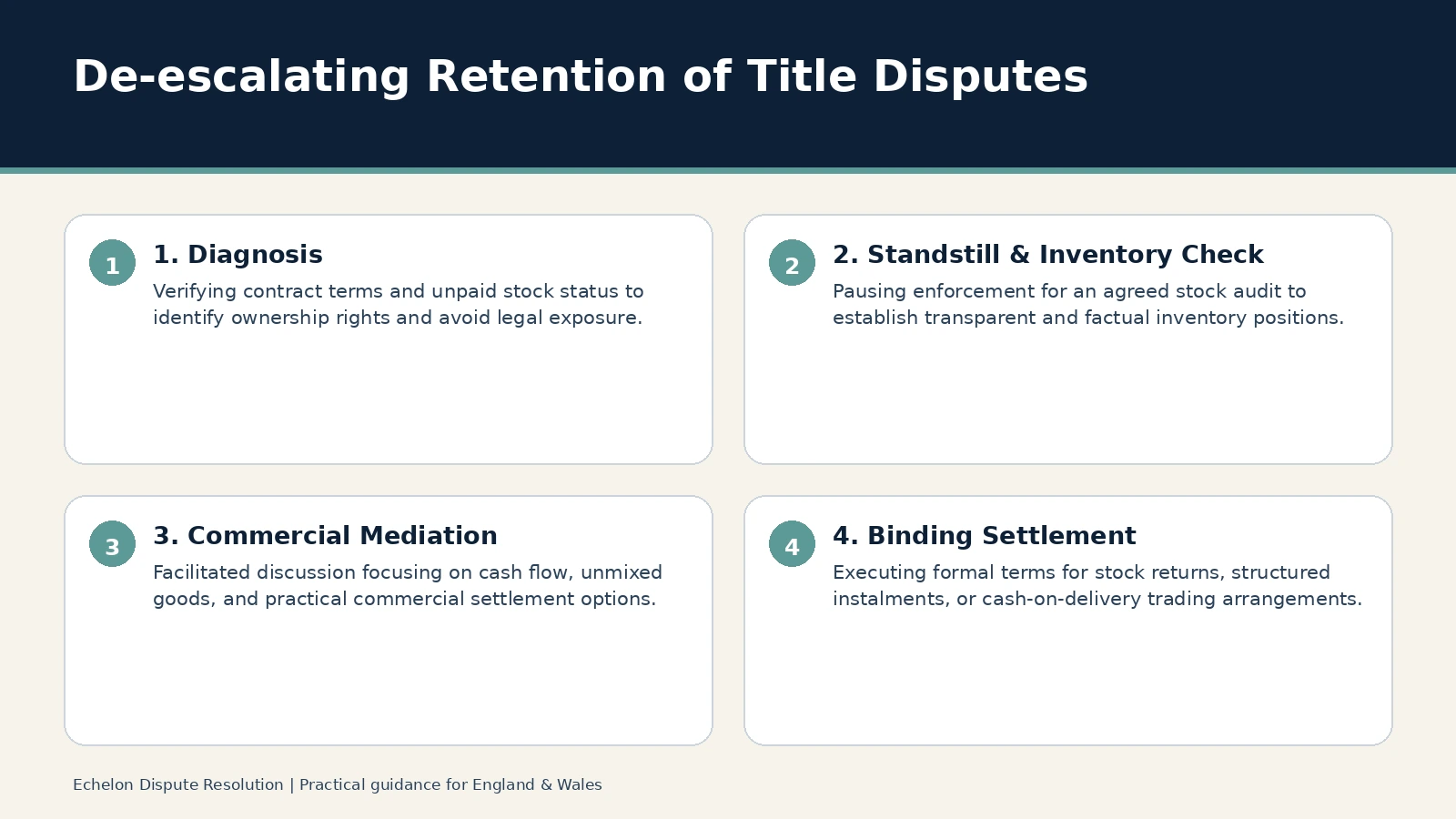
Once the factual inventory position is clear, the parties can explore flexible settlement frameworks tailored to their financial capacities:
- Consensual stock repatriation: Rather than risking disputed self-help enforcement, the buyer can agree to package and return designated batches of unmixed, original inventory. The supplier issues an agreed credit note against the outstanding debt, reducing the buyer’s exposure without impairing cash balances.
- Structured instalment schedules: Where the buyer requires the delivered materials to complete customer contracts and generate cash, the parties can negotiate realistic instalment plans secured against finished production or specific project milestones. Related strategies can be seen in our overview of B2B payment dispute mediation.
- Transitional supply models: To preserve the broader trading relationship while mitigating ongoing credit exposure, businesses can agree to transition remaining deliveries to a cash-on-delivery (COD) or pro-forma billing basis, establishing safe boundaries for future trade as explored in our guidance on supplier payment disputes.
- Downstream assignment of proceeds: In situations where finished goods have already been delivered to third-party end users, parties can agree on commercial arrangements to remit specific portions of downstream customer receivables directly toward clearing historical trade debts.
These negotiated structures prevent the sudden collapse of supply chains and provide measurable debt reduction for suppliers without forcing solvent buyers into catastrophic operational halts.
Retention Of Title Dispute: Documenting Inventory Status and Preparing for Mediation
Thorough commercial preparation is critical to resolving a retention of title dispute efficiently. Because these disputes depend on reconciling paperwork with physical warehouse stock, decision-makers should assemble clear records before entering mediation. Arriving at the table with verified data avoids wasted time and allows commercial negotiations to proceed smoothly.
Parties should gather and review the following documentation:
- Contractual foundations: Purchase orders, credit account applications, master service agreements, order acknowledgements, and signed delivery receipts illustrating when and how standard terms were incorporated into the trading relationship.
- Itemised invoice reconciliations: A comprehensive ledger detailing which specific invoices remain unpaid, matching individual line items to distinct product batches, serial numbers, or consignment references.
- Physical stock records: Up-to-date warehouse management reports, bills of materials, or photographic evidence showing whether delivered goods remain in their original packaging, have been commingled with other stock, or have been transformed during manufacturing.
- Operational cash flow summaries: For the buyer, an objective assessment of immediate working capital, projected receivables, and realistic weekly or monthly repayment capacity to ground settlement proposals in financial reality.
Beyond documentary preparation, both organisations must ensure that participants attending the mediation have sufficient commercial authority to negotiate and sign a binding agreement. In a complex retention of title dispute, operational directors, warehouse managers, and financial controllers often provide valuable commercial insights that legal advisers alone cannot supply. Resolving supply chain friction requires aligning commercial necessity with legal clarity, a discipline detailed further in our analysis of contract dispute mediation.
When parties reach a mutually acceptable resolution, their legal advisers draft the agreed terms into a formal, binding settlement contract. This agreement records the precise mechanics of any inventory return, sets realistic repayment schedules, and outlines future trading terms, bringing an orderly conclusion to what might otherwise have become an intractable corporate confrontation.
If your organisation is currently confronting contested stock recovery or overdue trade balances, you can contact Echelon Dispute Resolution to discuss whether commercial mediation is suitable for resolving your retention of title dispute before supply lines are permanently disrupted.
Frequently asked questions
Does having a retention of title clause automatically give a supplier the right to enter premises and seize goods?
No. A retention of title clause reserves ownership of goods until payment is made, but it does not automatically grant an unrestricted legal right to enter a customer’s private property without clear contractual permission or consent. Entering premises without authority can expose a supplier to civil claims in trespass or conversion. Mediation allows parties to arrange a lawful, consensual stock audit and agreed repossession process.
Can a supplier enforce a retention of title clause if the buyer enters formal administration?
Under Schedule B1, paragraph 43(3) of the Insolvency Act 1986, once a company enters administration, a statutory moratorium prevents any party from repossessing goods held under a retention of title agreement without the consent of the administrator or permission from the court. This makes early commercial mediation vital before trading distress deteriorates into formal insolvency proceedings.
What happens if unpaid goods have already been used in manufacturing or combined with other stock?
When raw materials or components are commingled with identical products or transformed into finished assemblies, determining property rights becomes highly contested. In commercial mediation, parties move past complex property debates to agree on pragmatic commercial compromises, such as crediting unaltered stock, restructuring outstanding balances across finished product sales, or adjusting future trading terms.
Who should attend a mediation regarding contested inventory and unpaid accounts?
Attendance should include senior commercial decision-makers who hold full authority to negotiate and execute a binding settlement agreement. It is often beneficial to include finance directors, procurement leads, or operations managers who understand the practical inventory reality, stock valuation, and ongoing cash-flow capabilities, supported by their legal advisers.
Authoritative UK guidance and further reading
Primary and official sources
- Insolvency Act 1986 (legislation.gov.uk)
- A guide to civil mediation – GOV.UK (gov.uk)
- Sale of Goods Act 1979 (legislation.gov.uk)
- PRACTICE DIRECTION – PRE-ACTION CONDUCT AND PROTOCOLS – Civil Procedure Rules – Justice UK (justice.gov.uk)
This guide provides general information about dispute resolution and mediation. It is not legal advice. The appropriate approach depends on the facts, documents, procedural position and the parties involved; obtain legal advice where required.