
In brief
The question: How does the probate inheritance dispute mediation process work in England and Wales, and what should executors, beneficiaries, and claimants expect from initial preparation through to a binding settlement?
The short answer: The probate inheritance dispute mediation process is a structured, voluntary, and confidential form of alternative dispute resolution led by an independent mediator. Across five distinct stages—pre-mediation groundwork, session structuring, confidential exploration and shuttle diplomacy, option generation, and formal documentation—parties can negotiate practical resolutions to contested wills, estate administration standstills, and financial provision claims. Rather than pursuing contentious litigation that depletes estate assets, participants work in separate rooms while the mediator ferries proposals and clarifies priorities. This protects privacy, reduces emotional confrontation, and enables tailored outcomes that reflect personal priorities alongside financial realities.
Understanding the Probate Inheritance Dispute Mediation Process
Disagreements over a deceased relative’s estate rarely turn solely on dry figures or statutory provisions. They typically surface during periods of acute bereavement, layered with decades of family history, strained communication, and differing expectations regarding what the deceased intended. When an estate becomes stalled by a caveat, a challenge to testamentary validity, an executor deadlock, or a dependency claim, the prospect of taking family members through court proceedings can be deeply unsettling.
Litigation in England and Wales is formal, publicly accessible, and inherently adversarial. In contrast, choosing a private civil mediation pathway allows the parties to retain control over their outcome. Rather than leaving the distribution of assets to a judge, the parties work with an accredited neutral facilitator to explore sustainable terms of settlement.
Under the Civil Procedure Rules, civil courts actively encourage parties to engage in alternative dispute resolution. Parties who unreasonably refuse to explore mediation face adverse costs risks at trial, regardless of whether their substantive legal arguments succeed. Consequently, engaging in structured negotiation is both an effective route to resolving family disagreements and a sensible measure to protect the net estate from escalating legal fees.
The Five Stages of the Probate Inheritance Dispute Mediation Process
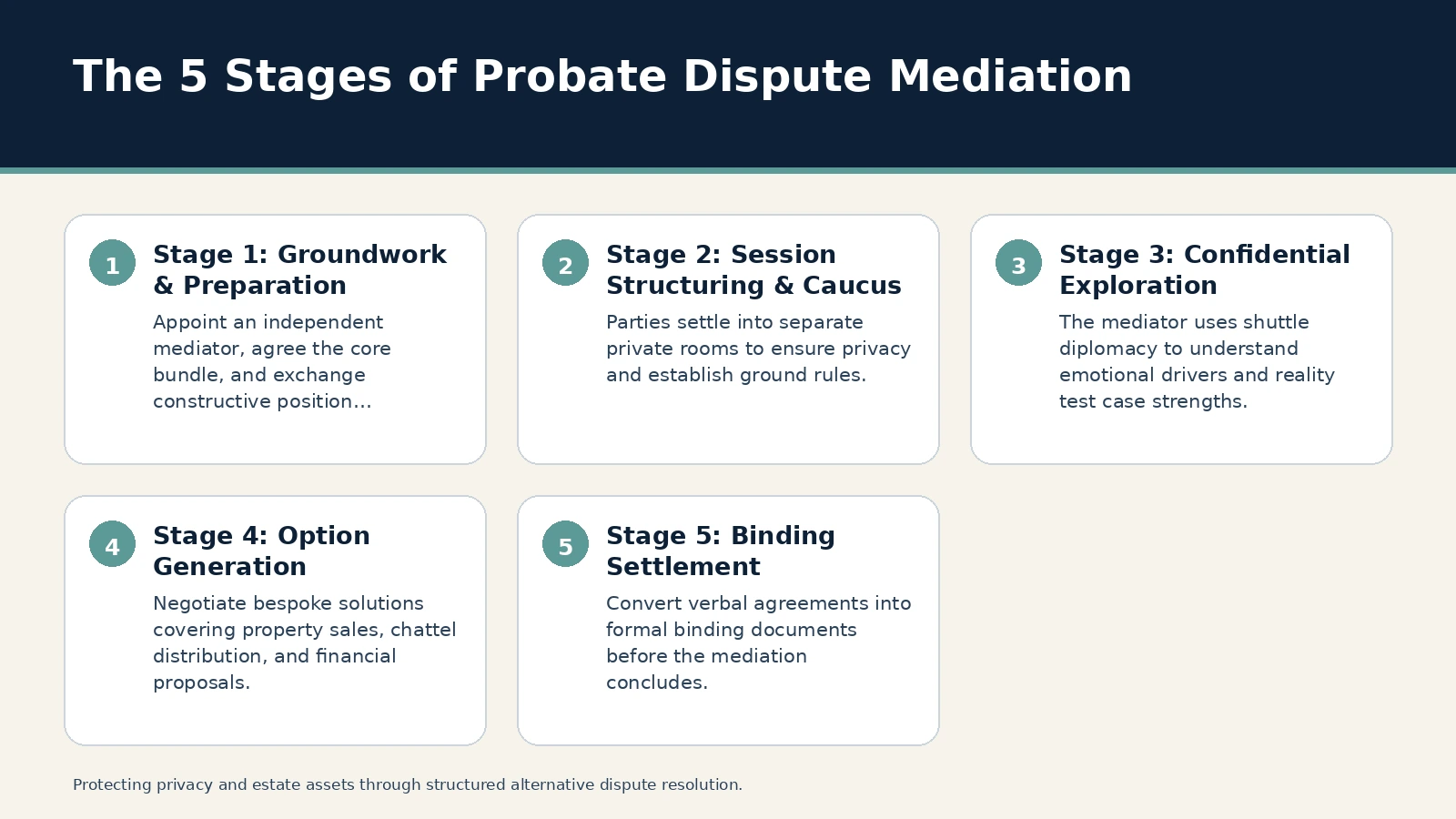
While every estate dispute has unique characteristics, a standard probate mediation follows a five-stage progression designed to move parties from initial entrenchment to a workable, documented compromise.
Stage 1: Pre-Mediation Preparation and Groundwork
Effective mediation begins well before the day of the joint session. The preparation phase ensures that the mediator and the disputing parties have a shared understanding of the estate’s composition, the key legal contentions, and the financial figures involved.
Preparation centres on three practical components:
- Selecting and Appointing the Mediator: The parties, usually through their instructed solicitors, jointly select an independent mediator with experience in contentious probate and estate administration. The mediator remains neutral, possessing no personal stake in the outcome and offering no binding judgment or individual legal advice.
- Agreeing the Core Bundle: A streamlined mediation bundle is compiled containing essential documents. This generally includes the Grant of Representation (if issued), relevant wills or codicils, testamentary capacity reports or medical notes where relevant, a schedule of estate assets and liabilities, and recent correspondence setting out each party’s position.
- Exchanging Position Statements: Each party prepares a concise position statement. Unlike adversarial court pleadings, a constructive mediation statement balances legal strengths with a pragmatic willingness to explore settlement. It outlines the background, identifies the central issues in dispute, and explains what matters most to the client without closing the door to flexible negotiation.
Where estate deadlock stems from fiduciary tensions or disputes between co-executors, clarifying the financial state of the estate early on is essential. Parties facing these dynamics may find further clarity in our detailed guide on resolving executor-beneficiary administration deadlocks.
Stage 2: Arrival and Session Structuring
On the morning of the mediation—whether conducted in person at neutral commercial rooms or virtually via video conferencing—each party is assigned a private room (a private caucus). Unlike commercial contract disputes where parties often start in a joint plenary session, inheritance disputes frequently dispense with joint meetings entirely.
Where personal animosity, estrangement, or acute grief make direct contact unhelpful, the mediator can conduct the entire probate inheritance dispute mediation process using “shuttle diplomacy”. The mediator visits each room individually to introduce themselves, confirm procedural ground rules, ensure all participants understand the voluntary nature of the day, and verify that those present have settlement authority.
Stage 3: Confidential Exploration and Shuttle Diplomacy
Once settled, the mediator spends dedicated time in private caucus with each side. This stage allows parties to speak candidly about what has brought them into conflict, away from formal posturing.
During these private discussions, the mediator performs several vital roles:
- Private Caucus Confidentiality: Everything shared with the mediator in a private room remains confidential. The mediator will not disclose information, personal reflections, or strategic positions to the other side without explicit permission, save where disclosure is required by law.
- Exploring Underlying Motivations: Probate conflicts frequently hinge on non-legal concerns—feelings of exclusion, unrecognised caregiving during the deceased’s final years, or attachments to specific family properties. The mediator helps untangle these emotional drivers from financial calculations.
- Objective Reality Testing: The mediator gently tests the strengths and weaknesses of each party’s case. By discussing the realistic delays of court proceedings, the commercial risk of adverse costs, and the practical impact of estate depletion, the mediator helps participants reassess rigid positions.
- Constructive Message Carrying: After developing a clear understanding of both sides’ fundamental priorities, the mediator moves between the private rooms, translating hostile assertions into constructive questions and exploring whether settlement signals meet broader financial objectives.
Stage 4: Option Generation and Overcoming Impasses
As discussions progress, negotiations move from general principles to specific settlement frameworks. In estate disputes, solutions are rarely restricted to simple cash distributions. Parties can agree on bespoke arrangements that reflect their practical circumstances, including:
- Structured timelines for selling real estate, appointing joint estate agents, or establishing clear mechanisms for independent property appraisals.
- Agreement on the distribution of personal chattels, heirlooms, and family records based on personal value rather than open-market auction estimates.
- Arrangements where one beneficiary buys out another’s share of an inherited property over an agreed timescale with defined security.
- Resignation, replacement, or neutral appointment of professional executors to bring an end to administrative delays.
When negotiations stall, the mediator assists the parties in working through the deadlock by reframing the alternatives. Disputants are encouraged to compare the compromise on the table against the true alternative: ongoing contentious litigation, public examination of private family affairs, and accumulating legal costs.
Stage 5: Formalising the Agreement into a Binding Settlement
Once commercial consensus is achieved, the final stage is to convert verbal agreements into an enforceable legal document before the mediation concludes. A mediated settlement is formalised on the day with the guidance of the parties’ legal advisers.
Depending on the nature of the dispute and whether formal legal proceedings have already commenced, the settlement terms may be enacted through various binding legal instruments, including:
- Written Settlement Agreement: A contractual document setting out the agreed distribution, mutual releases from future claims, and responsibility for estate administration costs.
- Tomlin Order: If litigation has already been issued in court, proceedings can be stayed by consent upon court sealing, with the agreed settlement terms recorded confidentially in an attached schedule.
- Deed of Variation: Where beneficiaries agree to alter the distribution of the deceased’s estate, a Deed of Variation executed as a deed can redirect inheritance assets. Under Section 142 of the Inheritance Tax Act 1984, qualifying variations executed in writing within two years of the date of death can benefit from retrospective inheritance tax treatment, provided statutory conditions are met.
Court Litigation vs. Probate Mediation: Practical Process Comparison
The differences between resolving an estate dispute through civil court proceedings and resolving it via mediation are substantial. The table below illustrates the key practical distinctions across core process dimensions:
| Process Dimension | Civil Court Litigation | Probate Dispute Mediation |
|---|---|---|
| Privacy and Confidentiality | Conducted in open court; judgments and witness statements become matters of public record. | Private and confidential between the parties and the mediator, subject to recognised legal exceptions. |
| Party Control over Outcome | A trial judge delivers a final binding judgment based on legal arguments and evidence. | Parties retain complete control; no settlement can be imposed without voluntary, mutual consent. |
| Communication Format | Formal cross-examination and exchange of written evidence through legal representatives. | Flexible shuttle diplomacy between separate private rooms, avoiding direct personal confrontation. |
| Flexibility of Remedies | Focused on formal legal remedies such as determining will validity or statutory financial provision. | Enables bespoke practical terms, including chattel allocation, property buyout structures, and tax-efficient variations. |
| Impact on Family Dynamics | Adversarial evidence and cross-examination frequently entrench family divisions. | Provides a private forum to address underlying concerns and seek workable closure. |
How to Prepare for Your Mediation Day
Thorough personal and legal preparation is the single most effective way to achieve a constructive outcome during the probate inheritance dispute mediation process. Parties entering mediation should approach the day with clear objectives, practical flexibility, and a thorough grasp of the underlying figures.
Key practical steps ahead of the session include:
- Clarify the True Net Estate: Ensure there is a transparent schedule of estate assets, debts, property valuations, and professional fees incurred to date. Constructive negotiations require reliable figures.
- Distinguish Needs from Demands: Identify essential financial requirements, preferred outcomes, and non-negotiable boundaries. Distinguish between core needs and secondary points that can be adapted in exchange for finality.
- Account for Ongoing Legal Costs: Ask your legal team for a realistic appraisal of the costs required to take the dispute through trial. Assessing an offer against the certainty of avoided litigation expenses often clarifies the true value of an early compromise.
- Prepare for Emotional Demands: Estate disagreements can be taxing. Having legal counsel or a trusted adviser present in your private room provides steady perspective throughout negotiations.
For parties seeking wider context on estate administration conflicts, exploring our guides on probate, wills, and inheritance dispute resolution can clarify how different dispute pathways develop.
If you are an executor, administrator, or beneficiary facing an inheritance disagreement and wish to avoid the financial and emotional toll of a courtroom trial, please contact Echelon Dispute Resolution to discuss how mediation can assist your case.
Frequently asked questions
Will I have to sit in the same room or speak directly to other family members during probate mediation?
No. In contentious probate disputes, the mediator frequently conducts the entire mediation through shuttle diplomacy. Each party remains in their own private room (in person or online), and the mediator moves between them to carry proposals, questions, and responses. You will not be required to meet face-to-face unless you explicitly agree that a joint meeting would be constructive.
Is what I discuss with the mediator in private kept confidential from the other parties?
Yes. Private caucus confidentiality is a fundamental principle of mediation. The mediator will convey information, background context, or settlement proposals to the other side only with your clear, express permission, unless compelled by law.
What happens if we reach the end of the mediation day without agreeing on a settlement?
If an agreement is not reached on the day, the mediation concludes without any binding outcome, and parties retain all their legal rights to continue litigation. However, mediation frequently narrows the issues in dispute and opens channels of communication, often leading to a negotiated settlement in the days or weeks following the session.
How is a mediated probate settlement made legally binding and enforceable?
Once parties agree on settlement terms, their legal representatives draft a formal written document. Depending on the dispute, this may be an enforceable Settlement Agreement, a Tomlin Order staying court proceedings upon court sealing, or a formal Deed of Variation executed as a deed. Once properly executed and completed, the agreement becomes legally binding.
Authoritative UK guidance and further reading
Primary and official sources
- Inheritance (Provision for Family and Dependants) Act 1975 (legislation.gov.uk)
- Civil – Civil Procedure Rules – Justice UK (justice.gov.uk)
- A guide to civil mediation – GOV.UK (gov.uk)
- PART 1 – OVERRIDING OBJECTIVE – Civil Procedure Rules – Justice UK (justice.gov.uk)
This guide provides general information about dispute resolution and mediation. It is not legal advice. The appropriate approach depends on the facts, documents, procedural position and the parties involved; obtain legal advice where required.