

In brief
The question: How can personal representatives and beneficiaries overcome acute estate administration deadlocks—from withheld accounts and stalled property sales to Section 50 removal threats—without draining estate funds or exposing executors to personal costs liabilities?
The short answer: Contentious estate administration rarely benefits from rigid Chancery Division proceedings. While frustrated beneficiaries frequently threaten removal applications under Section 50 of the Administration of Justice Act 1985, proving that an executor’s conduct materially endangers the estate requires meeting a demanding legal threshold. At the same time, personal representatives who defend their position stubbornly risk losing their indemnity under Civil Procedure Rules (CPR) Part 46.3, incurring personal adverse costs. Civil probate mediation offers a confidential forum to address the underlying administrative and personal friction. Parties can establish binding disclosure schedules, agree on independent property marketing terms, negotiate occupation rent adjustments, or arrange a consensual executor substitution via an uncontested consent order. Enforceable through formal settlement deeds, Tomlin orders, or Deeds of Variation under Section 142 of the Inheritance Tax Act 1984, mediation protects estate liquidity while aligning with judicial expectations on dispute resolution under CPR Part 44.
Sources of Administration Friction: Communication Breakdowns and Fiduciary Limits
Estate administration disputes in England & Wales rarely begin in court. Instead, they usually start with an operational divergence between the statutory obligations of personal representatives (PRs)—whether executors appointed under a will or administrators acting under intestacy—and the expectations of residuary beneficiaries. When communication falters, ordinary administrative delays quickly turn into mutual suspicion.
Information asymmetry is a frequent source of tension. Beneficiaries awaiting distribution or needing funds to settle their own liabilities naturally ask for progress reports. Meanwhile, lay executors—frequently overwhelmed by inheritance tax calculations, asset verifications, and clearance logistics—often become uncommunicative or defensive. Beneficiaries then wonder whether silence signals asset dissipation, improper expense claims, or plain inertia.
This dynamic is further complicated by misunderstandings surrounding the statutory timeframe for winding up an estate. Under Section 44 of the Administration of Estates Act 1925 (AEA 1925), known colloquially as the ‘Executor’s Year’, personal representatives cannot be forced to distribute estate assets before 12 months have elapsed from the date of death. Crucially, this statutory protection is not an absolute shield against accountability. It does not excuse an executor from actively securing and collecting assets, nor does it override the ongoing fiduciary duty under Section 25 of the AEA 1925 to maintain accurate accounts and exhibit a full inventory when called upon to do so.
Structural conflicts of interest add further pressure. In blended families or fractured sibling relationships, co-executors and beneficiaries frequently hold conflicting personal and financial interests. When an executor occupies the deceased’s former home without paying rent, or demands broad personal liability waivers from beneficiaries before releasing interim funds, ordinary administration stalls. For an analysis of broader inheritance conflicts, see our guidance on Probate, Wills & Inheritance Disputes.
Section 50 Removal Applications: Legal Thresholds and Personal Costs Exposure
When an executor-beneficiary dispute reaches a stalemate, beneficiaries often consider issuing proceedings in the High Court under Section 50 of the Administration of Justice Act 1985 (AJA 1985) and CPR Part 57.13 to remove or substitute the executor. Although the court possesses wide discretion to replace an executor, pursuing a contested removal claim involves notable procedural hurdles and financial exposure.
The guiding legal test applied by the Chancery Division, set out in Harris v Earwicker [2015] EWHC 1915 (Ch), establishes that the court’s paramount consideration is the welfare of the beneficiaries and the proper, orderly administration of the estate. While an applicant does not need to prove dishonesty or fraud, mere friction or hostility between the parties is not enough on its own. The applicant must show that the animosity actively prevents the trust from being executed or places estate assets at genuine risk.
For both sides, the financial mechanics of Section 50 litigation warrant careful reflection:
- Estate Depletion: A contested High Court removal application routinely costs between £30,000 and £80,000 or more per side. In modest or mid-sized estates, litigating an application through to a substantive hearing can consume a substantial portion of the residuary fund.
- Loss of Costs Indemnity (CPR 46.3): Lay executors often assume the estate will automatically cover their legal fees. Under CPR 46.3 and Section 31 of the Trustee Act 2000, an executor is only entitled to recover costs that were ‘properly incurred’ in their fiduciary capacity. If a court decides an executor defended a removal claim primarily to protect their personal position or acted unreasonably in withholding information, the litigation is categorised as hostile. The court can revoke the executor’s indemnity and order them to pay the other party’s costs personally.
- Judicial Expectations on ADR (CPR Part 44): Under reforms to the Civil Procedure Rules (specifically CPR 1.1, 1.4, 3.1, and 44.2(5)(e)), judges actively expect parties to attempt alternative dispute resolution. A party who unreasonably refuses to mediate faces severe adverse costs sanctions, regardless of who ultimately prevails on the underlying legal argument.
Comparing Section 50 High Court Litigation with Civil Probate Mediation
Chancery litigation delivers a narrow, binary outcome: a judge either removes an executor or dismisses the claim. The court does not have the procedural bandwidth to design practical arrangements for phased property sales, personal chattel divisions, or tax-efficient restructurings. The table below outlines how formal adjudication contrasts with structured probate mediation.
| Assessment Parameter | High Court Section 50 Claim (CPR Part 57 / Part 8) | Civil Probate Mediation |
|---|---|---|
| Primary Objective | Binary determination: judicial removal, substitution, or outright dismissal. | Comprehensive compromise: bespoke accounting rules, property sale protocols, or agreed executor succession. |
| Typical Timeline | 9 to 18+ months, depending on Chancery Division court listing availability. | 1 to 2 days of active mediation, with terms implemented within weeks. |
| Cost & Estate Impact | £30,000–£80,000+ per party; risks eroding the residuary fund. | Substantially lower, fixed professional fees shared proportionately or funded by agreement. |
| Costs Indemnity Risk (CPR 46.3) | High risk for PR: defending removal can be ruled hostile, triggering personal costs orders. | No adverse cost risk: discussions are confidential, without prejudice, and all terms are agreed. |
| Remedy Flexibility | Narrow statutory remedies: the court cannot reallocate chattels, rewrite will terms, or agree commercial timelines. | Wide flexibility: can include Deeds of Variation (s.142 IHTA 1984 / s.62(6) TCGA 1992), occupation rent offsets, and staged buy-outs. |
| Evidentiary Threshold | High: must prove the administration is materially obstructed or assets are endangered. | Pragmatic: focuses on resolving underlying operational, financial, and relational gridlocks. |
| Privacy & Family Relationships | Public court proceedings, permanent estrangement, and public judgments. | Strictly confidential; private caucuses de-escalate generational tension out of the public eye. |
| Enforceability | Enforceable as an order of the High Court. | Enforceable as a binding Settlement Agreement, Deed of Variation, or High Court Tomlin / Consent Order. |
For a detailed breakdown of procedure, timelines, and costs between court actions and ADR, see our guide comparing mediation vs litigation in the UK.
A Practical Framework for Resolving Core Estate Administration Impasses
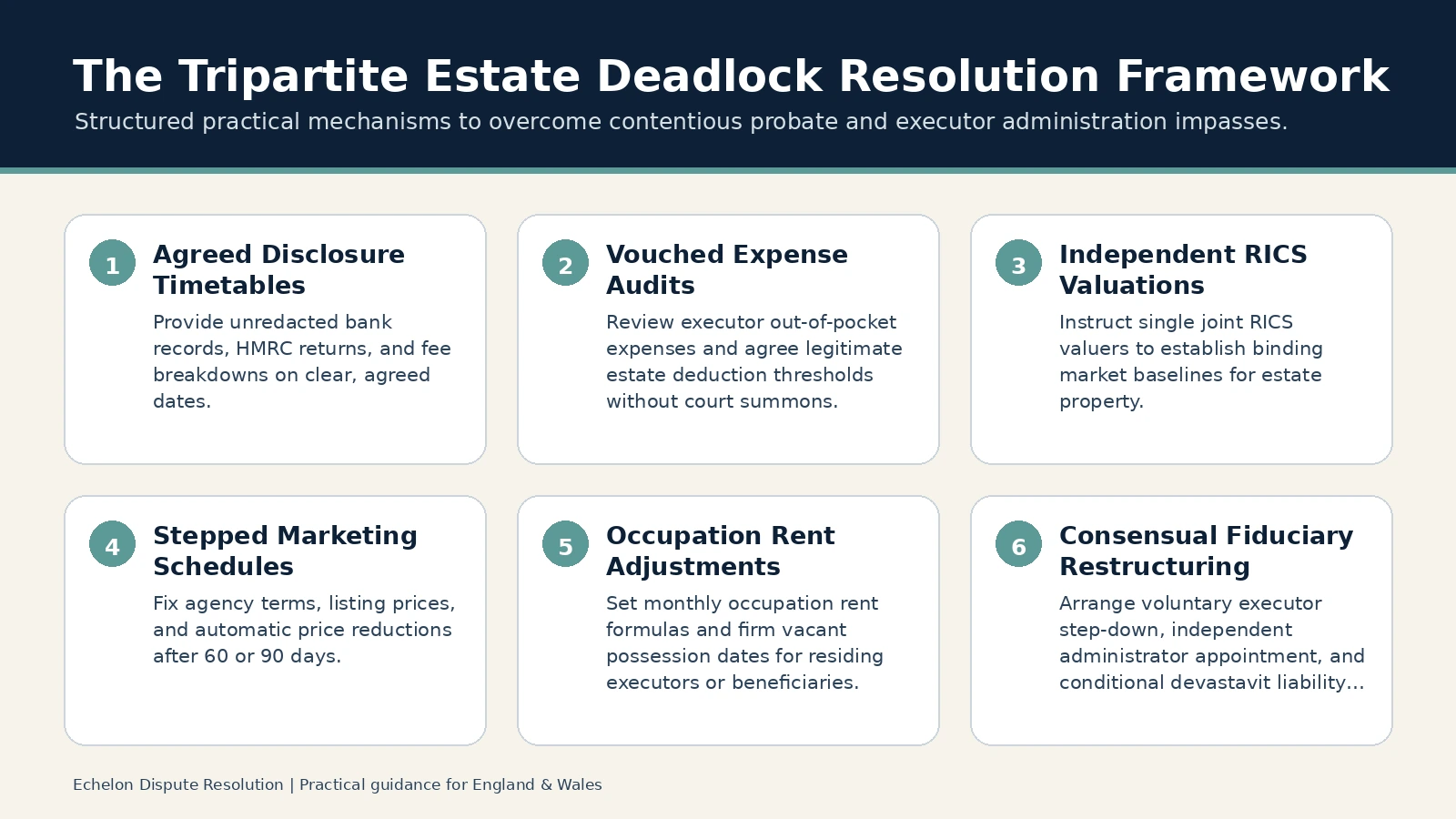
Rather than treating an estate dispute as an indivisible personal battle, practitioners and mediators divide administration deadlocks into three distinct, workable areas. This approach allows parties to address transparency, asset disposal, and fiduciary governance methodically.
Accounting Protocols and Financial Transparency
Beneficiary suspicion often subsides once reliable financial records are presented. Rather than applying to court under CPR Part 64 for an order for accounts or issuing a formal summons under Rule 61 of the Non-Contentious Probate Rules 1987, mediation allows parties to construct practical disclosure agreements:
- Agreed Disclosure Timetables: Setting specific dates for the executor to share unredacted bank statements, HM Revenue & Customs (HMRC) IHT400 returns, and professional fee breakdowns.
- Vouched Expense Verification: Creating a clear method to review out-of-pocket expenses claimed by the executor, establishing agreed thresholds for legitimate estate deductions.
- Staged Distributions: Agreeing partial interim distributions tied to administrative milestones, avoiding demands for sweeping, unconditional beneficiary indemnities.
Property Realisation, Valuation, and Occupation Agreements
Disputes frequently centre on real estate—particularly when an executor or sibling lives in the deceased’s home or parties dispute market values. As examined in property-related probate mediation, these issues can be resolved using clear commercial mechanisms:
- Single Joint Valuations: Instructing an independent Royal Institution of Chartered Surveyors (RICS) valuer to establish an objective baseline valuation that binds all parties.
- Stepped Marketing Schedules: Agreeing a conveyancing protocol that sets sole agency terms, an initial guide price, and automatic price reductions if no offer is received after 60 or 90 days.
- Occupation Rent and Vacant Possession: Setting an agreed monthly occupation rent for any residing beneficiary—either paid directly to the estate or credited against their eventual distribution—alongside a firm date for vacant possession.
Consensual Fiduciary Restructuring and Liability Releases
Where the working relationship between the personal representative and beneficiaries has broken down completely, mediation allows the administration to be restructured without the public acrimony of a contested hearing:
- Agreed Resignation: The disputed executor agrees to retire or consent to a Section 50 discharge, avoiding findings of personal fault.
- Independent Professional Appointment: The parties agree to appoint an independent solicitor or trust corporation to complete the administration under agreed fee caps.
- Mutual Liability Releases: Executing comprehensive releases from historic devastavit (maladministration) claims, conditional on complete and accurate final accounts.
Parties seeking to establish these terms can engage our civil mediation services or review our wider strategies for mediation and ADR settlement strategy.
Hypothetical Scenario: Deadlock Over Estate Property and Conflicting Interests
The practical operation of these principles is demonstrated in the following hypothetical scenario reflecting common contentious probate patterns in England & Wales.
Arthur died leaving an estate valued at approximately £650,000, consisting of a residential property in Gloucestershire valued at £500,000 and £150,000 in liquid funds. Arthur’s will appointed his adult children, David and Sarah, as joint executors and equal residuary beneficiaries. Following the Grant of Probate, the administration came to a complete halt.
David moved into the property rent-free, stating that he needed to manage maintenance, but subsequently refused to facilitate viewings or agree on an asking price. Sarah, facing 18 months of silence and unable to inspect estate bank accounts, instructed solicitors and threatened a High Court Section 50 removal application, seeking backdated occupation rent and adverse costs. In response, David submitted unverified invoices for property upkeep and relied on the Section 44 AEA 1925 ‘Executor’s Year’ to justify the pace of administration.
Faced with combined legal cost estimates exceeding £70,000 and the risk of court-imposed ADR penalties, the siblings agreed to pause correspondence and attend a one-day civil mediation. Through private caucuses, the mediator helped them separate long-standing family friction from their shared commercial objectives, reaching an agreed settlement:
- Buy-Out Window and Sale Schedule: David was granted a 45-day option to buy out Sarah’s half-share based on an independent RICS valuation of £490,000. If mortgage financing was not confirmed within that period, the property would be listed with an agreed agency at £490,000, with a mandatory £20,000 reduction if unsold after 60 days.
- Expense Offset and Occupation Rent: Rather than litigating a backdated occupation rent claim, David agreed to drop £12,000 of unvouched maintenance claims and consented to a £4,000 credit adjustment in Sarah’s favour upon final distribution.
- Independent Administrator Substitution: Both siblings agreed to step down as joint executors upon exchange of contracts, consenting to the appointment of an independent local probate solicitor to complete the conveyancing, obtain HMRC tax clearance, and distribute the net proceeds.
By resolving the matter in mediation, the parties finalised the administration within eight weeks of the session, safeguarding substantial estate value that would otherwise have been spent on contested Chancery litigation.
Formalising the Settlement: Consent Orders, Tomlin Orders, and Deeds of Variation
An informal agreement or an exchange of solicitor letters is rarely sufficient to conclude a contentious estate matter. Because personal representatives hold strict fiduciary responsibilities, any mediated agreement must be converted into legally binding instruments to provide full protection for all parties.
In practice, mediated settlements are documented through several complementary mechanisms:
- The Binding Settlement Agreement: A mediated settlement agreement forms an enforceable contract once written and signed by the parties (or their authorised representatives), setting out accounting schedules, property marketing terms, mutual liability waivers, and agreed cost arrangements.
- Section 50 Consent Orders: If a Grant of Probate has already been extracted, an executor cannot simply resign informally. Under Section 50 of the AJA 1985, a formal High Court order is required to discharge or substitute the personal representative. Mediation allows parties to draft an uncontested application and Consent Order, avoiding the delays and costs of a contested hearing.
- Tomlin Orders: When formal court proceedings have been issued, the action can be stayed under a Tomlin Order with terms scheduled to preserve privacy, granting the parties liberty to apply to the court for enforcement without issuing a fresh claim.
- Deeds of Variation (Section 142 IHTA 1984 & Section 62(6) TCGA 1992): Where the settlement involves altering testamentary distributions—for instance, to resolve a dependency claim or adjust asset allocations—a formal Deed of Variation can be completed within two years of the deceased’s death to secure available inheritance tax and capital gains tax reliefs.
A well-structured mediated settlement gives personal representatives clear protection against future personal claims while ensuring beneficiaries receive transparent, timely distributions. For an overview of how structured negotiation applies across other civil and chancery conflicts, see our guide on civil disputes.
Frequently asked questions
Can beneficiaries force an executor to step down without going to court?
No. Beneficiaries do not have an automatic statutory right to remove an executor. Once a Grant of Probate is issued, an executor who has intermeddled can only be formally removed or substituted by an order of the High Court under Section 50 of the Administration of Justice Act 1985. However, through mediation, parties can agree on a consensual retirement, submitting an uncontested consent order to the court and avoiding expensive, hostile litigation.
What is the 'Executor's Year' and does it prevent legal action for delays?
Under Section 44 of the Administration of Estates Act 1925, an executor cannot be compelled to distribute estate assets within 12 months of the deceased’s death. However, this does not give executors carte blanche to remain inactive. Executors must still fulfil their fiduciary duties, safeguard assets, and under Section 25 of the Act, they have a statutory duty to exhibit on oath a full inventory and render an account of the administration when required to do so by the court.
When does an executor become personally liable for legal costs in a dispute?
While executors are generally entitled to an indemnity from the estate for legal costs under CPR 46.3, this indemnity only applies to costs ‘properly incurred’. If an executor defends a Section 50 removal claim for personal or hostile reasons, fails to provide basic disclosure, or unreasonably refuses alternative dispute resolution (CPR Part 44), the court can disallow estate indemnity and order them to pay costs personally.
How does mediation resolve disputes where a beneficiary refuses to leave an estate property?
Mediation allows the parties to negotiate flexible, practical terms that a court cannot easily order. Solutions often include establishing a fixed timeline for voluntary vacant possession, agreeing on a commercial buy-out window supported by an independent RICS valuation, or deducting agreed occupation rent from the residing beneficiary’s ultimate share of the residuary estate.
Is an agreement reached at probate mediation legally binding?
Yes. A mediated settlement agreement forms an enforceable contract once written and signed by the parties (or their authorised representatives). Where formal court proceedings have been issued, the action can be stayed under a Tomlin Order with terms scheduled to preserve privacy, granting the parties liberty to apply to the court for enforcement without issuing a fresh claim.
Authoritative UK guidance and further reading
Primary and official sources
- The Non-Contentious Probate Rules 1987 (legislation.gov.uk)
- Administration of Justice Act 1985 (legislation.gov.uk)
- Courts and Tribunals Judiciary (judiciary.uk)
- PART 44 – GENERAL RULES ABOUT COSTS – Justice UK (justice.gov.uk)
- PART 57 – PROBATE, INHERITANCE, PRESUMPTION OF DEATH AND GUARDIANSHIP OF MISSING PERSONS – Civil Procedure Rules – Justice UK (justice.gov.uk)
- Administration of Estates Act 1925 (legislation.gov.uk)
- Inheritance Tax Act 1984 (legislation.gov.uk)
- Administration of Estates Act 1925 (legislation.gov.uk)
This guide provides general information about dispute resolution and mediation. It is not legal advice. The appropriate approach depends on the facts, documents, procedural position and the parties involved; obtain legal advice where required.