

In brief
The question: When delivery backlogs or component specification variances threaten an industrial manufacturing run, how can commercial buyers and specialised suppliers resolve their contractual disagreements without freezing ongoing deliveries or severing essential supply partnerships?
The short answer: Commercial contract dispute mediation offers a structured, private forum where engineering teams and commercial directors renegotiate technical tolerances, agree rework schedules, and realign delivery milestones with the guidance of a neutral facilitator. Rather than initiating formal court proceedings that can polarise positions and prompt immediate supply freezes, mediation addresses immediate plant-floor disruption through pragmatic adjustments. While the parties explore commercial and operational compromises in private, any mutually agreed resolution is formalised in a signed settlement agreement that constitutes an enforceable, legally binding contract under English law.
Operational Deadlock: Delivery Lags, Tolerance Variances, and Supply Stoppages
In modern manufacturing corridors—such as the precision engineering, automotive, and aerospace clusters across Birmingham and the wider West Midlands—production operates on tight, interdependent schedules. A minor deviation in a batch of CNC-machined castings or a delay in sub-assembly deliveries does not remain an isolated procurement issue; it threatens to stall an entire production line.
When deliveries arrive late or fail incoming quality audits, the standard commercial response often begins with formal contractual notices. Rejection notices, defect reports, and claims for delay damages quickly escalate tension between engineering managers and procurement heads. If these tensions lead to formal legal claims, the operational consequences can be severe. A specialised or single-source supplier faced with a breach of contract action may halt further dispatches to protect its own cash flow, leaving the manufacturing buyer with empty assembly stations and mounting customer delay liabilities. Furthermore, issuing proceedings can trigger cross-claims over disputed tooling ownership, raw material price escalation, or unpaid invoices for work-in-progress, potentially delaying access to critical tooling while operational disputes remain unresolved.
This is where commercial mediation provides an immediate alternative. By stepping away from adversarial positioning, parties can engage in contract dispute mediation to focus on operational survival: inspecting non-conforming batches, testing revised tolerance thresholds, and agreeing on interim dispatches while commercial liabilities are worked out concurrently. The process allows manufacturing teams to decouple urgent assembly needs from financial accounting disagreements, keeping the physical plant moving while commercial positions are resolved.
Evaluating Resolution Paths: Contract Dispute Mediation and Formal Proceedings
When high-value component contracts falter, commercial directors face a strategic choice between issuing court proceedings and proposing alternative dispute resolution. The Practice Direction – Pre-Action Conduct and Protocols within the Civil Procedure Rules expects commercial parties to consider mediation before initiating litigation, reserving court action as a genuine last resort.
Beyond procedural expectations, the practical divergence between the two paths is substantial. Formal litigation focuses on establishing historical liability, interpreting past contract versions, and calculating financial damages. In contrast, mediation addresses active production reality, enabling technical and financial decision-makers to craft bespoke arrangements that protect ongoing commercial delivery. While formal litigation typically focuses on financial compensation or contract termination after extended proceedings, a mediator helps parties structure immediate engineering concessions, interim batch audits, and staged payments that keep supply chains active.
| Operational Dimension | Contract Dispute Mediation | Court Proceedings |
|---|---|---|
| Impact on Active Production | Facilitates interim supply protocols and phased delivery buffers while negotiations proceed. | Risks an immediate freeze on dispatches from specialized suppliers pending legal outcomes. |
| Remedy Flexibility | Enables technical adjustments, rework cost-sharing, and revised inspection standards. | Focuses primarily on contractual determination and retrospective financial remedies. |
| Confidentiality of Defect Data | Maintains private discussions, protecting proprietary designs, failure rates, and margins. | Pleadings generally become open court records accessible to non-parties, and evidence may become public if deployed during open court hearings or accessed with court permission. |
| Commercial Relationship | Preserves long-term collaboration through joint problem-solving between technical peers. | Creates an adversarial environment that frequently impairs future commercial trust. |
Hypothetical Scenario: Component Variance on an Advanced Assembly Line
To understand how this dynamic functions in practice, consider a hypothetical dispute between a Tier-1 automotive subsystem assembler based in Birmingham and an engineering fabricator supplying critical pressed metal brackets. Under their multi-year supply agreement, the supplier committed to delivering precision brackets within strict dimensional tolerances.
Following a tooling adjustment at the fabricator’s workshop, a series of component batches arrived with minor dimensional variances. While the parts functioned in testing, they created assembly delays on the buyer’s automated line, prompting the buyer to reject two consignments, withhold £280,000 in invoiced payments, and issue a formal notice reserving rights to claim consequential production losses. In response, the supplier paused future dispatches, citing cash flow strain from the withheld payments, which threatened to halt the buyer’s production schedule entirely within days.
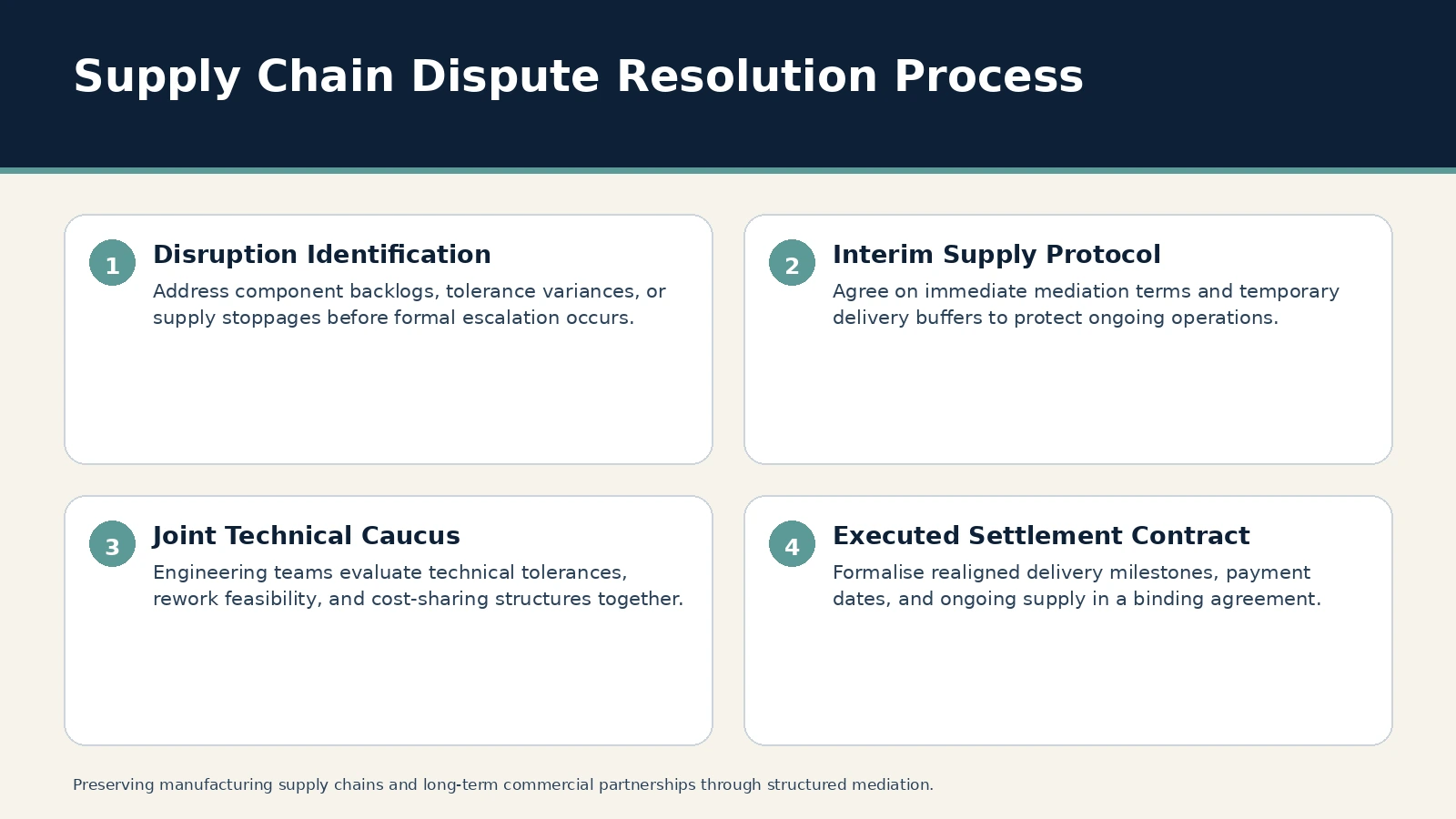
Rather than filing an emergency court application, the parties agreed to an accelerated contract dispute mediation. During the process, the mediator facilitated private caucuses between the buyer’s lead quality engineer and the fabricator’s operations director. These technical discussions revealed that the variance could be rectified on-site through a modified jig fixture, avoiding a complete batch scrap.
The resulting agreement included an interim supply protocol: the buyer released a portion of the withheld funds to support the supplier’s immediate tooling recalibration, the supplier agreed to provide on-site technical staff to oversee batch testing, and the remaining costs of rework were shared through agreed credit notes across subsequent orders. A production stoppage was averted, and the commercial relationship remained intact.
Negotiating Operational Remedies: Tolerances, Rework Costs, and Buffer Schedules
When parties participate in contract dispute mediation within the manufacturing sector, discussions rarely centre solely on financial compensation. Effective negotiations generally involve practical, technical compromises that resolve the immediate physical impasse on the plant floor. Similar practical dynamics often arise in wider supply chain dispute mediation, where delivery timelines and component specifications must align seamlessly.
1. Re-evaluating Technical Tolerances and Sampling Regimes
Disputes frequently arise when quality assurance teams apply rigid pass/fail standards that do not reflect the component’s functional requirements. In mediation, engineering leads can discuss whether non-critical dimensions can be temporarily relaxed or whether an alternative batch sampling plan—such as shifting from standard visual checks to automated coordinate measurement—can restore delivery flow without compromising end-product safety. Parties often establish a joint containment area on the plant floor, enabling cross-company technical pairs to carry out split-sample testing and agree on acceptable variance thresholds before components reach high-speed robotic integration cells.
2. Apportioning Rework and Tooling Investment
Scrapping out-of-specification components is often the most expensive choice for both sides. Mediation allows parties to explore whether parts can be reworked economically, whether the supplier can contribute labour to the buyer’s facility, or if the costs of modified tooling can be amortised over future purchase orders. These nuanced cost-sharing structures allow both businesses to maintain viable margins. Teams can also agree to ring-fence disputed scrap costs into an escrow or rebate pool while factory engineers focus entirely on modifying die fixtures or adjusting CNC feed rates to correct future output.
3. Establishing Buffer Inventories and Milestone Plans
Delays in Tier-2 and Tier-3 supplies can cascade through regional supply chains, including key enterprise hubs designated across Birmingham and the West Midlands (as outlined in GOV.UK guidance on Enterprise Zones). In mediation, buyers and suppliers can agree on realistic recovery schedules, temporary safety stock reserves, and shared logistics costs to insulate the assembly line from further delivery shocks. These operational recovery schedules frequently incorporate stepped production ramp-ups, dedicated courier shuttles between local plants, and weekly joint review meetings to verify that safety stocks are returning to contracted inventory minimums.
Preparing for Contract Dispute Mediation: Key Documents and Team Composition
Thorough preparation determines whether a mediation session achieves a workable settlement or stalls on contested assertions. For manufacturing businesses, preparation requires a coordinated effort between technical, commercial, and legal personnel.
Core Documentation to Assemble
- Contract Documents: Master supply agreements, valid purchase orders, agreed quality plans, and signed change orders.
- Technical Evidence: Non-conformance reports (NCRs), dimensional measurement logs, metallurgy test certificates, and calibrated inspection data.
- Financial Quantification: Documented extra-over assembly costs, line stoppage calculations, supplier material invoices, and scrap disposal fees.
- Delivery Records: Goods received notes, logistics tracking receipts, and historical lead-time correspondence.
Assembling the Mediation Team
A frequent error in commercial disputes is sending either purely legal representatives or operational managers without settlement authority. To succeed in contract dispute mediation, each party should be represented by:
- A Commercial Principal: An operations director, managing director, or commercial lead holding clear authority to negotiate terms, adjust credit arrangements, and sign a binding settlement.
- A Lead Engineer or Quality Manager: A professional capable of evaluating tolerance adjustments, tooling alterations, and rework feasibility in real time.
- Legal Advisers: In-house counsel or external solicitors who can advise on contractual rights, draft the terms of the settlement, and ensure the resulting agreement is robust and unambiguous.
Finalising Enforceable Settlements in Supply Chain Disputes
When parties reach consensus in mediation, the terms must be captured in writing without delay. In accordance with GOV.UK guidance on civil mediation, an agreement reached through mediation forms an enforceable, legally binding contract once documented and signed by both parties.
A comprehensive settlement agreement in a manufacturing supply dispute typically outlines the exact technical standards for future dispatches, specific payment release dates tied to quality milestones, the agreed treatment of rework costs, and mutual releases from past breach allegations. By solidifying these terms into an executed agreement, both parties gain legal certainty while immediately resuming regular production.
When component backlogs or specification disputes threaten scheduled assembly shifts, taking early steps toward a structured discussion can protect factory cash flow and key supplier partnerships. If your engineering or commercial teams are reviewing options to unblock a component standoff, you can speak to an EDR mediator to discuss how commercial mediation can be structured around your manufacturing deadlines.
Explore our Commercial & Contract Disputes guides.
Frequently asked questions
At what stage of a manufacturing delivery failure should contract dispute mediation be proposed?
Mediation can be proposed as soon as internal escalation between procurement and supplier commercial teams stalls, particularly when component rejections or delayed dispatches threaten upcoming assembly schedules. Introducing mediation before issuing formal court proceedings allows both organisations to address operational bottlenecks in private without triggering defensive supply halts.
How are component specifications and tolerances handled during a mediation session?
Mediation allows quality assurance leads and technical directors to discuss engineering tolerances directly with the assistance of a neutral mediator. Rather than arguing legal liability, the parties can review inspection reports, evaluate whether non-critical tolerances can be adjusted safely, and agree on practical rework or testing protocols to salvage affected batches.
Can components continue to be delivered while contract dispute mediation is underway?
Yes. Parties frequently negotiate an interim dispatch protocol prior to or at the outset of the mediation session. This arrangement enables critical components to be inspected and delivered under temporary agreed terms—such as increased batch sampling or partial payment release—ensuring assembly lines remain operational while broader commercial terms are settled.
What happens if a supplier fails to follow the terms agreed in mediation?
Once the terms agreed in mediation are drafted into a written document and signed by authorised representatives of both parties, that agreement constitutes a legally binding and enforceable contract. If either party fails to meet their commitments under the settlement, the other party can seek contractual enforcement through standard court remedies.
Authoritative UK guidance and further reading
Primary and official sources
- A guide to civil mediation – GOV.UK (gov.uk)
- Enterprise Zones – GOV.UK (gov.uk)
- PRACTICE DIRECTION – PRE-ACTION CONDUCT AND PROTOCOLS – Civil Procedure Rules – Justice UK (justice.gov.uk)
- Courts and Tribunals Judiciary (judiciary.uk)
This guide provides general information about dispute resolution and mediation. It is not legal advice. The appropriate approach depends on the facts, documents, procedural position and the parties involved; obtain legal advice where required.