
In brief
The question: How can London creative agencies, marketing leads, and instructing solicitors resolve disagreements over deliverable copyright, rejected pitch decks, and withheld design files without destructive public litigation?
The short answer: Managing Creative Agency Intellectual Property Disputes in London requires untangling a fundamental commercial reality under English copyright law: paying an agency invoice does not automatically convey copyright ownership to the commissioning client without an explicit written assignment signed by the assignor. In fast-paced branding, digital, and advertising production, commissioning organisations frequently assume full ownership upon payment, while agencies retain underlying master assets or discover broken chains of title caused by freelance subcontractors. Through private commercial mediation, agencies and corporate clients can step away from positional threats, negotiate bespoke commercial arrangements such as phased asset buyouts, tiered licensing, and structured master file releases, and protect market reputations while keeping creative campaigns moving forward.
Origins of Agency IP Friction: Invoice Assumptions and Deliverable Deadlocks
Disputes in London’s creative, design, and advertising sectors rarely begin with deliberate bad faith. Instead, they typically arise from misaligned assumptions at the boundary between commercial delivery and statutory copyright ownership. Agency teams and brand marketing departments often operate under compressed campaign timetables, agreeing project scopes over email exchanges, Slack threads, and preliminary purchase orders. When a campaign launches successfully, these informal working arrangements often remain unchallenged. However, when a working relationship fractures over scope expansion, disputed invoice revisions, or creative differences, the underlying ownership of the work immediately becomes contentious.
A central catalyst in creative agency intellectual property disputes in London is the widespread brand assumption that settling an invoice equates to purchasing outright ownership of every creative asset produced. Under English law, specifically sections 11(1) and 90(3) of the Copyright, Designs and Patents Act 1988, the author of a work is the first owner of copyright, and an assignment of copyright is not effective unless it is in writing signed by or on behalf of the assignor. Without an executed written assignment, a commissioning client generally acquires at most an implied licence to use the deliverables for the specific, contemplated purpose of the initial brief. Guidance published on GOV.UK on copyright ownership highlights this exact dynamic for commissioned creations.
This statutory reality frequently collides with agency-client practicalities. A client seeking to refresh a visual identity or port design files to an internal production studio may request the original vector files, font packages, layered master files, and codebase repositories. If project fees remain unpaid, or if the initial statement of work made no provision for raw source file handover, the agency may withhold production masters. The client often interprets this retention as unreasonable obstruction, while the agency views the master files as proprietary trade methodology and leverage against unpaid balances. What began as a commercial billing friction quickly escalates into an active IP standoff that threatens live campaign schedules and corporate communications.
Core Dispute Categories: Pitch Concepts, Master Assets, and Subcontractor Rights
Navigating creative agency intellectual property disputes in London often involves identifying where creative development diverged from legal clarity. Across creative partnerships, disputes tend to cluster into three distinct commercial categories.
Pitch Materials and Unselected Concepts
Competitive pitching represents a major investment of non-billable time and creative capital for London design and advertising studios. Agencies submit comprehensive pitch decks, mood boards, campaign straplines, and strategic positioning architectures to win prospective accounts. Friction emerges when a client declines to appoint the agency but subsequently launches an internal or competitor-led campaign that bears striking similarities to the agency’s pitch presentation.
These scenarios present complex evidential challenges. Copyright protects the tangible, original expression of ideas rather than marketing concepts or strategic themes in the abstract. Distinguishing between general sector trends, shared market insights, and the direct copying of protectable agency assets can be challenging. Agencies feel their creative equity has been appropriated without compensation, while commissioning brands contend that campaign ideas were either generated internally prior to the pitch or represent unprotectable commercial concepts. A formal IP claim risks reputational friction across the close-knit agency ecosystem, making consensual negotiation a sensible alternative.
Master Files, Source Code, and Retainers
Another frequent flashpoint involves the distinction between final consumer-facing deliverables and editable source assets. A standard client engagement may cover the supply of rendered video exports, compiled code, or flattened print-ready graphics. When a commissioning brand seeks to transition to another agency or bring campaign production in-house, they invariably demand access to editable design source files, layered project archives, and administrative digital credentials.
If the original contract is silent or ambiguous regarding source asset transfer, or if milestone payments remain outstanding, agencies frequently retain these production assets. Because the brand cannot modify, adapt, or resize assets for secondary channels without the source files, project delivery stalls. In severe instances, brand teams accuse agencies of conversion or contract breach, while agencies issue formal warnings regarding copyright infringement should the brand attempt to reverse-engineer or recreate the assets using third-party suppliers.
Freelancers and the Broken Chain of Title
Modern creative production relies heavily on flexible specialist networks across London, from 3D animators and specialist illustrators to freelance copywriters and sound designers. When an agency engages an independent contractor without executing a signed written copyright assignment, the independent freelancer remains the legal owner of their individual contribution. Even if the creative agency fully intended to transfer complete ownership to the commissioning brand, it cannot assign rights it does not hold.
This structural defect in the chain of title often surfaces at the worst possible moment—such as during institutional investment due diligence, an acquisition of the brand, or the global rollout of an advertising campaign. When brand legal advisers discover that key visual marks or digital assets are legally owned by an external freelancer who was engaged years prior on an informal invoice, the agency faces significant warranty and indemnity exposure. Resolving these defects requires constructive, tripartite commercial discussions rather than adversarial litigation.
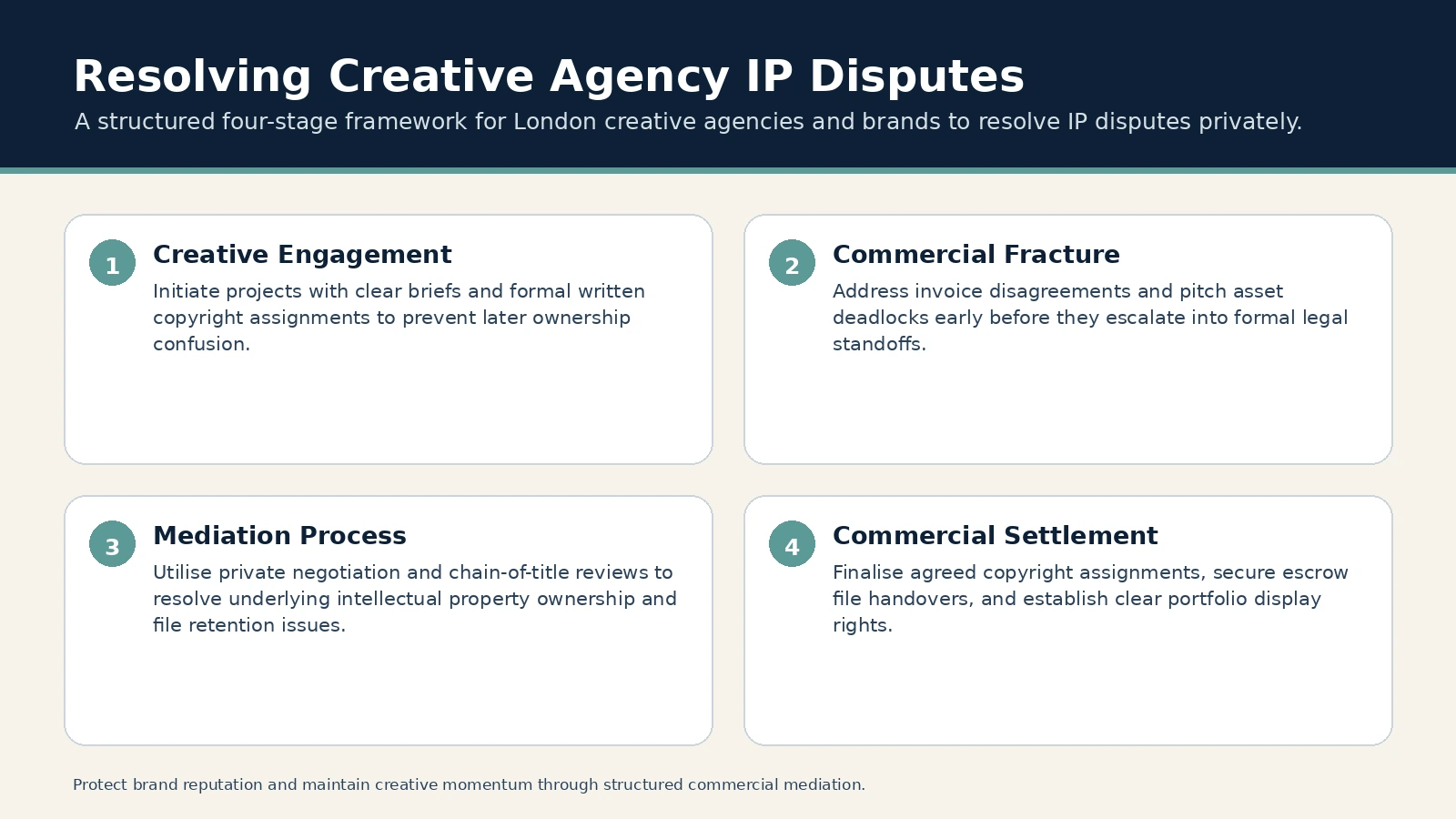
Resolution Pathways: Formal Court Proceedings Compared with Commercial Mediation
When parties reach an impasse, they face a choice of procedure. They can initiate formal contentious proceedings through the courts, or they can pursue structured negotiation through commercial mediation. For parties facing creative agency intellectual property disputes in London, evaluating these pathways generally involves balancing commercial realities, public exposure, and operational costs.
Formal litigation within the Intellectual Property Enterprise Court or High Court resolves disputes by examining historical legal and equitable entitlements. The court determines whether infringement occurred, whether an implied licence exists, or whether contract terms were breached. While litigation provides definitive judicial rulings, the process is public, procedural, and inherently adversarial. For high-profile consumer brands and creative agencies whose commercial standing depends on industry reputation, airing accusations of copyright infringement or unpaid invoices in public court lists can cause lasting commercial fallout.
Furthermore, civil justice practice in England and Wales strongly encourages disputing businesses to resolve matters through alternative dispute resolution before or during litigation. Under the Civil Procedure Rules governing pre-action conduct, courts expect parties to act reasonably by considering negotiation and mediation, and an unreasonable refusal to participate in ADR can result in adverse costs consequences, even for an otherwise successful party.
In contrast, commercial mediation provides a confidential, private forum where decision-makers can address commercial realities directly. A mediator does not impose a binding judgment or give legal advice, but helps the parties explore the real commercial drivers behind the dispute: brand launch schedules, source file accessibility, reasonable compensation for creative assets, and clean assignment documentation. Mediation allows parties to explore tailored arrangements that align with business needs, such as milestone-linked asset handovers, phased assignment payments, or structured licensing agreements.
| Process Feature | Formal Court Proceedings | Commercial Mediation |
|---|---|---|
| Focus of Resolution | Strict adjudication of historical liability, statutory ownership, and past breaches. | Pragmatic commercial problem-solving, future asset usage, and practical business continuity. |
| Copyright Allocation | Determines legal and equitable ownership based on executed documents, statutory provisions, or established implied contractual terms. | Allows parties to agree bespoke assignments, tiered licences, portfolio display rights, or territorial carve-outs. |
| Chain of Title Defects | Exposes missing contractor assignments, which can compromise claims or invalidate warranties. | Provides a private framework to invite freelancers into talks to execute confirmatory retrospective assignments. |
| Deliverable & File Handover | Focuses on monetary damages or formal asset delivery orders following full trial. | Enables immediate, milestone-conditioned release of vector masters, code repositories, and account credentials. |
| Confidentiality | Conducted in open court; pleadings, evidence, and judgments form part of the public record. | Conducted under private contractual mediation agreements, protecting brand plans and agency reputation. |
| Commercial Relationship | Adversarial positioning frequently damages commercial trust and ends future business dealings. | Facilitates professional closure, managed project transitions, or structured terms for ongoing collaboration. |
Where agency engagements touch on broader contractual breaches or wider intellectual property arrangements, exploring guidance on IP licensing dispute mediation and contract dispute mediation can help parties understand how parallel commercial issues are resolved concurrently.
Preparing Commercial Records and Technical Assets for Dispute Resolution
Achieving a satisfactory outcome when addressing creative agency intellectual property disputes in London requires disciplined preparation. Parties should approach the negotiation table not with emotional arguments about creative integrity, but with clear operational records, precise asset inventories, and practical business alternatives.
1. Audit the Creative Chain of Title
Before entering mediation, both parties should seek to understand the legal foundation of the disputed material. For the agency, this involves reviewing every agreement executed with internal employees and external subcontractors. Ensure that written contracts with freelancers contain explicit, signed copyright assignment clauses rather than ambiguous consultancy wording. For the brand, review initial procurement agreements, master service agreements, statements of work, and email exchanges concerning asset ownership. Establishing whether an implied licence arose or whether an express assignment was agreed in writing clarifies the negotiating landscape.
2. Distinguish Deliverables from Production Tooling
Disputes frequently deadlock because parties speak past one another regarding what constitutes the “deliverable”. A brand may demand “all files”, while the agency seeks to protect its underlying proprietary production frameworks, custom brushes, software libraries, and modular templates. Preparation involves creating an objective asset schedule that categorises:
- Final Campaign Assets: Rendered artwork, video exports, published websites, and campaign collateral designed for consumer dissemination.
- Raw Production Masters: Layered design files, typography licences, raw photographic footage, and source assets required for modifications.
- Background Proprietary Tooling: Agency-owned foundational code, internal production workflows, design libraries, and reusable agency components.
By categorising assets into these distinct tiers, parties can negotiate specific access rights, buyout fees, or licence permissions without threatening the agency’s broader operational toolkit or stalling the brand’s campaign launch.
3. Formulate Flexible Commercial Deal Structures
Mediation succeeds because it allows disputing businesses to build solutions that reflect their actual commercial priorities. Parties should consider creative settlement options prior to the session, including:
- Phased Buyouts: Structuring the assignment of master files across defined commercial milestones linked to stage payments.
- Tiered Scope Licences: Permitting the client to use disputed assets for specified geographic territories, market channels, or durations, with an optional purchase mechanism for full global copyright at a later date, in line with official guidance on licensing and marketing copyright material.
- Confirmatory Subcontractor Deeds: Agreeing to co-fund or coordinate retrospective assignment deeds from freelance contributors to cure chain-of-title defects.
- Portfolio Showcase Carve-Outs: Permitting the agency to display non-confidential project visuals within its industry awards, credential decks, and portfolio website while assigning commercial rights to the brand.
- Escrow Deliverable Release: Utilizing an agreed escrow mechanism or coordinated legal exchange where source files and administrative passwords are handed over simultaneously with verified settlement funds.
Commercial mediation enables London creative agencies and their client organisations to replace damaging public confrontation with professional, binding commercial settlements. If your organisation or client is facing an unresolved creative ownership or asset deadlock, you can contact Echelon Dispute Resolution to discuss whether mediation may be suitable for resolving the dispute efficiently and confidentially.
Explore our Intellectual Property & Technology Disputes guides.
Frequently asked questions
Why does paying an agency invoice fail to grant automatic copyright ownership?
Under English copyright law, paying an invoice does not automatically transfer legal ownership of creative assets. The creator remains the first owner unless legal title is transferred in writing and signed by the assignor. In the absence of an executed assignment, paying an invoice typically grants the client an implied licence to use the work for the specific purpose contemplated in the brief, rather than full copyright ownership.
Who owns creative concepts and designs presented during an unappointed pitch?
Pitch presentations, mood boards, and campaign concepts created by an agency remain the copyright property of that agency unless terms of the pitch agreement explicitly state otherwise. While copyright protects the tangible expression of creative materials rather than abstract marketing themes, a commissioning client cannot copy or reproduce original agency pitch assets without authorisation or an agreed licensing fee.
What happens if an agency used freelance designers without written copyright assignments?
When an agency engages independent freelancers without executing signed written assignments, the individual freelancers retain legal copyright in their work. The agency cannot assign rights it does not own to the client. In mediation, parties often resolve this broken chain of title by contacting the freelancers to execute retrospective confirmatory assignments as part of a comprehensive settlement package.
How does commercial mediation protect agency reputation and brand launch confidentiality?
Unlike court proceedings, which take place in open court and generate public records, commercial mediation is conducted under private mediation agreements. This helps ensure that sensitive campaign strategies, unreleased creative directions, financial fee disputes, and commercial disagreements remain confidential, protecting both agency reputation and brand market positioning throughout the negotiation.
Authoritative UK guidance and further reading
Primary and official sources
- Managing intellectual property when working with others – Business.gov.uk (business.gov.uk)
- Ownership of copyright works – GOV.UK (gov.uk)
- Copyright, Designs and Patents Act 1988 (c. 48) (legislation.gov.uk)
- License, sell or market your copyright material – GOV.UK (gov.uk)
This guide provides general information about dispute resolution and mediation. It is not legal advice. The appropriate approach depends on the facts, documents, procedural position and the parties involved; obtain legal advice where required.