

In brief
The question: How can commercial developers, main contractors, and trade subcontractors resolve deadlocked snagging lists, access refusals, and frozen retentions without incurring disproportionate legal costs?
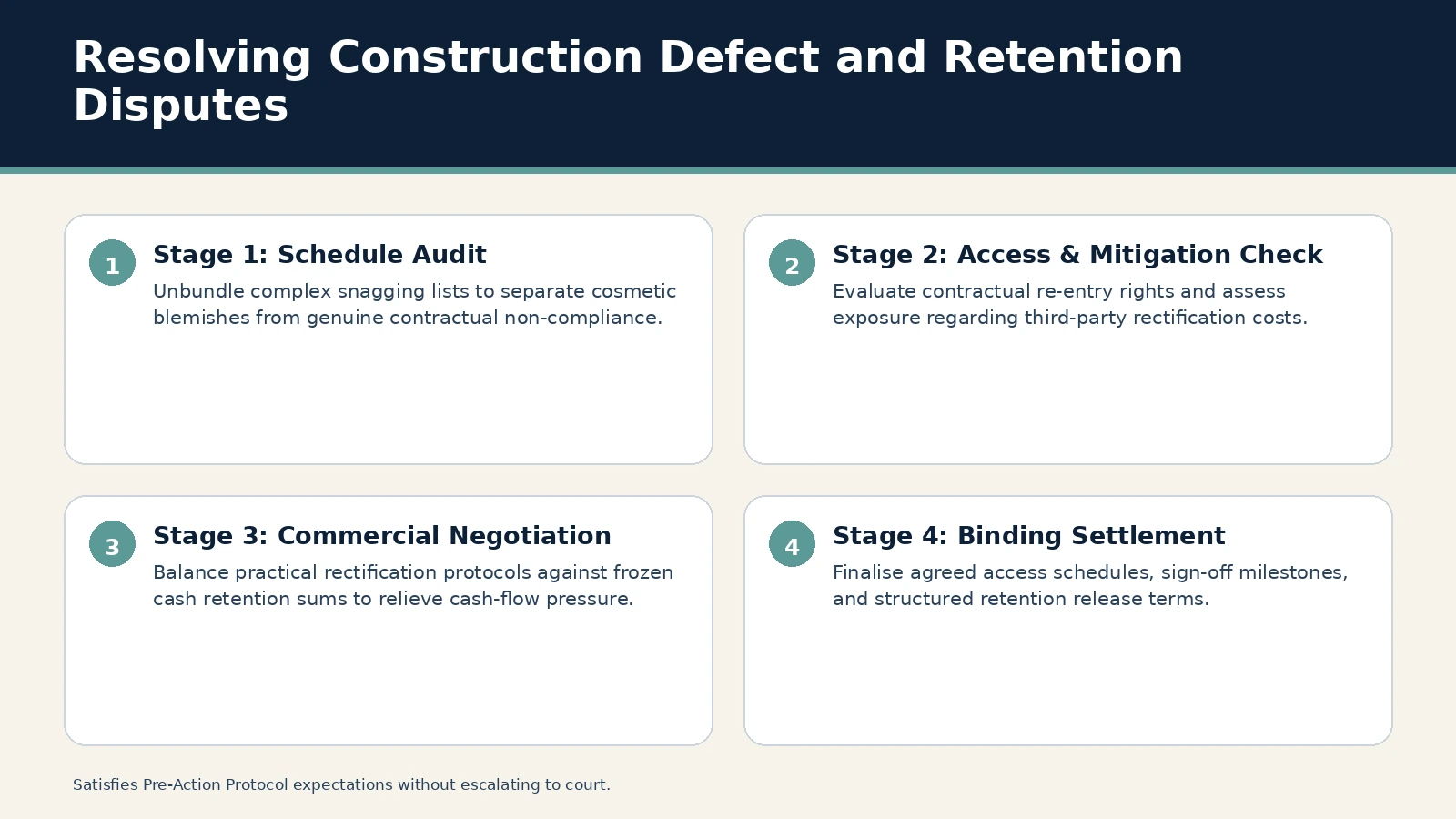
The short answer: Post-completion handovers often break down when building owners withhold cash retentions over extensive lists of alleged defects, while contractors argue the items are cosmetic snags, design faults, or that they have been unfairly denied site access to rectify them. Engaging in construction defect dispute mediation provides a structured, confidential forum where parties can unbundle complex defect schedules, separate cosmetic blemishes from genuine contractual non-compliance, and agree on practical site access or commercial retention adjustments. This approach enables parties to settle line-item disagreements through enforceable settlement agreements, satisfying court expectations under the Pre-Action Protocol for Construction and Engineering Disputes without escalating to the Technology and Construction Court or statutory adjudication.
The Defect Deadlock: Snagging Ambiguity, Access Denials, and Frozen Retentions
Towards the completion of a development, the working relationship between an employer and a main contractor often transitions from active collaboration into commercial defence. Practical completion and the end of the contractual defects rectification period represent critical financial milestones. Under standard UK construction contracts, practical completion typically triggers the release of the initial retention moiety (usually 50%). However, release of the remaining retention balance is not automatic upon the calendar expiry of the rectification period; it remains contingent upon the contractor making good all notified defects and the contract administrator issuing a formal Certificate of Making Good Defects (or equivalent). For the employer, this second retention moiety serves as the final commercial safeguard against sub-standard workmanship or uncompleted work.
Contractual retention deductions remain standard lawful practice under current UK construction contracts, as proposed legislative reforms to cash retentions are not currently in force. Disputes rarely arise from complete structural failure. Instead, they often stem from semantic and practical ambiguity across hundreds of minor items. An employer may produce a dense defect schedule containing hundreds of items, treating cosmetic issues as actionable contractual breaches to justify freezing the entire retention. Conversely, a contractor under pressure may dismiss genuine specification failures as minor snagging that does not justify withholding funds.
This dynamic deteriorates further when site access becomes contentious. If a building owner loses confidence in a contractor’s willingness or technical competence, they may lock them out and hire a replacement firm at premium rates. The employer then attempts to deduct those third-party costs from the retention. However, denying the original contractor access to inspect or carry out remedial works can compromise the employer’s legal ability to recover those expenses, as claimants are expected to mitigate their losses. Main contractors face identical tensions down the supply chain, often caught between developer deductions above and disputed contra-charges against specialist trade subcontractors below, as explored in our guide to subcontractor payment disputes and contra-charges.
When communication breaks down over access, commercial positions harden rapidly. The contractor asserts an absolute contractual right to rectify within the defect liability period at their own cost basis. Meanwhile, the employer insists that prior performance demonstrates an inability to execute works to specification, pointing to operational disruption, tenant complaints, or project handover commitments. As letters pass between legal representatives, the underlying defects remain unaddressed, while the withheld retention continues to generate cash-flow pressure across the trade supply chain.
Comparing Dispute Pathways: Construction Defect Dispute Mediation vs Adjudication and TCC Litigation
When technical defect schedules deadlock, parties typically face three procedural paths: construction defect dispute mediation, statutory adjudication, or litigation in the Technology and Construction Court (TCC). While engaging in mediation does not extinguish a party’s statutory right to refer a dispute to adjudication at any time prior to executing a binding settlement, understanding the operational distinctions between these routes helps commercial decision-makers choose the appropriate strategy before professional fees outstrip the cost of the physical works in dispute.
| Operational Dimension | Construction Defect Dispute Mediation | Direct Adjudication or TCC Litigation |
|---|---|---|
| Remedial Flexibility | Enables bespoke practical outcomes, such as agreed re-entry protocols, joint sign-off criteria, or hybrid cash adjustments. | Focuses on formal determinations or judgments of liability and financial awards rather than overseeing ongoing site access. |
| Multi-Tier Integration | Can convene developers, main contractors, architects, and trade subcontractors within a single collaborative forum. | Adjudication can require parallel, bilateral actions that create risks of inconsistent findings between upstream and downstream contracts. |
| Commercial Discretion | Private and confidential; discussions remain without prejudice, protecting commercial reputation and pre-qualification status. | Adjudication is private, but enforcement in court becomes a matter of public record; TCC judgments are generally public, subject to limited confidentiality or redaction exceptions under CPR 39.2. |
| Retention Resolution | Allows negotiated release schedules tied to defined completion milestones or commercial drop-hands settlements. | Retentions remain frozen pending formal determination, increasing financing strain across the project supply chain. |
| Pre-Action Compliance | Directly satisfies court expectations to consider alternative dispute resolution before initiating formal proceedings. | Requires formal procedural compliance, with early refusal to engage in negotiation posing potential cost exposure. |
As set out in the Technology and Construction Court Guide (Fourth Edition, July 2026), the courts actively manage cases toward alternative dispute resolution (ADR) and expect parties to explore mediation to resolve disputes proportionately. Engaging in structured commercial mediation services offers parties a pragmatic mechanism to resolve these issues collaboratively before committing substantial capital to expert determination or litigation.
Unbundling Contested Defect Schedules: Commercial Negotiation Levers
The primary barrier to resolving post-completion conflict is schedule agglomeration: treating an unmanageable spreadsheet of 150 disputed items as a single, indivisible grievance. In effective construction defect dispute mediation, the mediator assists the parties, their quantity surveyors, and technical experts in unbundling this schedule into manageable operational categories.
When parties view a schedule of defects as a consolidated monetary counterclaim, every line item becomes an all-or-nothing position. An employer feels justified in withholding hundreds of thousands of pounds because a portion of the works exhibits clear non-compliance, while the contractor views the entire withholding as bad-faith financial leverage because many entries appear trivial. Progress becomes possible only when the technical representatives dissect the schedule item by item, grouping issues by their real-world commercial and operational impact.
1. Separating Cosmetic Snags from Actionable Contractual Breaches
The term ‘snag’ is an informal industry colloquialism with no defined contractual status under standard UK contract suites (such as JCT or NEC) and no statutory definition in UK construction legislation. The distinction between a minor cosmetic blemish and an actionable defect rests upon express contractual specifications, manufacturer installation requirements, and recognised industry tolerances. Unbundling allows parties to isolate minor aesthetic grievances—which can often be rectified quickly or settled via modest nominal allowances—from genuine performance issues that affect durability or statutory compliance.
During mediation, the technical leads can review photographic schedules side-by-side against the contractual specifications. A scuffed skirting board, minor paint flashing under specific lighting angles, or a misaligned ceiling tile are rarely material breaches that justify withholding completion certification or entire retention balances. Conversely, compromised fire-stopping, water ingress through a facade interface, or improperly installed acoustic insulation represent substantive failures. By separating aesthetic touch-ups from functional defects, the parties can agree on distinct timelines and settlement mechanisms for each tier.
2. Disentangling Workmanship from Design Deficiencies
Workmanship claims frequently conceal underlying design discrepancies. An employer may allege that a subcontractor failed to install waterproofing or cladding correctly, while the subcontractor maintains they executed the architect’s details precisely as drawn. In construction defect dispute mediation, technical parties can explore whether an issue stems from trade execution or design coordination without immediately escalating into formal third-party proceedings against design consultants.
This dynamic is especially acute where specialist packages interface. If a curtain walling system leaks, the defect might stem from poor site sealant application, uncoordinated thermal movement allowances in the structural frame, or inadequate interface detailing by the lead design consultant. In formal adjudication, an employer pursues the main contractor, who in turn must launch a separate downstream adjudication against the specialist cladding subcontractor, alongside potential third-party claims against the architect. In mediation, all key decision-makers and their insurers can sit in the same confidential process, apportioning responsibility and agreeing on a combined remedial solution without multiplying proceedings.
3. Mitigating Third-Party Rectification Costs
When an employer secures external quotations to remediate disputed works, these figures are frequently higher than the internal cost for the original contractor to return and rectify them. Mediation allows contractors to test the reasonableness of these figures and enables employers to weigh the commercial savings of permitting supervised re-entry against the administrative friction of managing a hostile replacement contractor.
A replacement contractor inevitably prices in substantial contingency: they must inherit unknown site conditions, accept liability for touching another party’s installation, and mobilise plant and labour on short notice. Consequently, external rectification estimates can easily exceed the actual internal cost of repair. During mediation caucuses, the mediator can facilitate a realistic assessment of these figures. The employer is encouraged to examine whether their cost recovery would withstand scrutiny if they denied re-entry without reasonable grounds, while the contractor is confronted with the commercial reality that refusing to propose a workable re-entry protocol will guarantee that those third-party invoices are deducted at final account.
Where defective work allegations have delayed project milestones or triggered financial withholdings, parties should review our wider insights on construction and engineering disputes, including the construction contract dispute mediation process and resolving final account deadlock.
Structuring Practical Rectification Protocols and Settlement Terms
A successful mediation rarely concludes with a simple monetary exchange. Where the commercial relationship retains sufficient viability, resolution often hinges on drafting an operational Site Access and Rectification Schedule alongside the financial agreement. This framework transforms broad assertions of liability into clear, actionable steps:
- Defined Scope of Works: A schedule listing precisely which line items will be rectified, the agreed method statement, and the applicable technical standard.
- Controlled Access Parameters: Specified working windows, agreed site inductions, security provisions, and designated operational access routes.
- Named Supervisory Personnel: Identifying specific representatives from both sides authorised to inspect and sign off completed rectifications.
- Milestone Retention Releases: Agreeing that specific percentages of the withheld retention will be released in tranches as distinct packages of work receive joint sign-off.
- Drop-Hands Financial Compromise: Where personal relationships or trust have broken down entirely, agreeing on an adjusted commercial retention deduction in full and final settlement, releasing both parties from further contractual liabilities.
Drafting these operational parameters during the mediation avoids the common pitfall of reaching a verbal agreement in principle only to deadlock the following morning over site logistics. Specifying exact working hours prevents tenant disruption arguments from derailing remedial works. Agreeing upon named supervisory personnel ensures that the individuals inspecting the works are the qualified technical professionals who participated in the mediation, rather than site agents who may hold entrenched personal animosities.
Furthermore, linking retention tranches to physical sign-off milestones aligns commercial incentives. Rather than leaving the final 50% moiety completely withheld until the very last minor item is cleared months later, the settlement agreement can release pro-rata sums upon the joint sign-off of major technical packages, such as mechanical plant commissioning or external envelope repairs. This provides the contractor with immediate cash-flow restoration while maintaining an appropriate financial incentive to complete remaining minor cosmetic items.
Preparing the Defect Bundle and Rectification Protocols for Mediation
Thorough preparation determines the speed and commercial efficacy of a defect mediation. Unlike formal court disclosure, which often requires exhaustive, disproportionate document compilations, a mediation bundle should be lean, focused, and commercially targeted. Both parties should concentrate on compiling documents that demonstrate physical site reality and the contractual baseline.
For the employer or building owner, preparation involves structuring the defect register into clear categories rather than presenting an undifferentiated list. Photographic evidence should be indexed directly to specific room or grid-line locations, accompanied by the precise specification clause alleged to have been breached. If third-party rectification estimates have been obtained, the underlying scope and breakdown of those quotes must be transparent, enabling the contractor to understand exactly what remedial works are contemplated.
For the contractor and specialist subcontractors, preparation requires assembling clear contemporaneous records. These include requests for information (RFIs), architect site instructions, daily site diaries, and records demonstrating whether access requests were granted, ignored, or expressly refused. If the contractor contends that particular defects stem from design changes or subsequent trade damage caused by other contractors working on site after practical completion, the relevant handover records and photographic condition surveys must be readily accessible during the mediation.
Crucially, both commercial decision-makers must attend the mediation with the authority to agree binding operational and financial terms. Having the lead project surveyor, contract administrator, and key technical specialists present ensures that when practical compromises are proposed—such as adjusting a specification standard or agreeing an alternative remedial detail—the commercial principals can verify the technical feasibility immediately, avoiding post-mediation delays.
Parties preparing for construction defect dispute mediation should assemble their defect schedules, site diaries, inspection notices, and relevant specification extracts. To explore whether your project deadlock can be resolved through structured mediation, you can contact Echelon Dispute Resolution to discuss appointment logistics and suitability.
Frequently asked questions
What is the practical difference between a snag and a defect in mediation?
‘Snag’ is an informal industry term with no defined status in standard UK construction contracts and no statutory definition in UK law. In practice, snags are minor cosmetic or finishing imperfections that do not impair functionality or prevent occupation. By contrast, an actionable defect represents a failure to comply with contractual specifications, drawings, or statutory standards. Mediation allows parties to unbundle these categories line-by-line rather than treating an entire schedule as an indivisible contractual breach.
Can an employer withhold an entire retention balance over a minor defect schedule?
Retention withholding must reflect contractual terms and legitimate cross-claims for incomplete or defective work. Withholding 100% of a retention balance when the estimated cost of disputed rectification represents a modest fraction of that sum can lead to commercial dispute and payment claims. Mediation allows parties to agree on proportionate retention splits while rectifications proceed.
What risk does a building owner face by locking out the original contractor?
If an employer refuses site access to the original contractor during the contractual rectification period and hires an external contractor at premium rates, they may face challenges recovering those full costs. Claimants have an obligation to mitigate their losses, and unreasonable refusal to permit rectification by the original team can limit recovery to what it would have cost the original contractor to perform the work.
Does engaging in defect mediation satisfy pre-action court expectations?
Yes. The Pre-Action Protocol for Construction and Engineering Disputes explicitly recognises mediation as an appropriate process for the required pre-action meeting. Engaging in mediation demonstrates proactive, proportionate conduct in attempting to narrow or resolve issues before commencing formal litigation in the Technology and Construction Court.
What happens if mediated rectifications are not completed to standard?
A mediated settlement agreement is a legally binding contract. If a contractor fails to carry out agreed remedial works in accordance with the signed settlement terms and inspection milestones, the employer can enforce the agreement directly or release the remaining retained balance to alternative contractors under the pre-agreed default clauses included in the settlement document.
Authoritative guidance and further reading
Primary and official sources
- Pre-Action Protocol for Construction and Engineering Disputes – Civil Procedure Rules – Justice UK (justice.gov.uk)
- Courts and Tribunals Judiciary (judiciary.uk)
- The Scheme for Construction Contracts (England and Wales) Regulations 1998 (legislation.gov.uk)
Further professional and framework reading
- Defects Liability & Retention Disputes – Thomson Snell & Passmore (ts-p.co.uk)
- Snagging Guide for UK Builders and Contractors — Defects, Retention and Getting Paid in Full (2026) | Trade2Base Blog (trade2base.com)
- Snagging vs Defects: Where the Line Falls | 2VP London (2vp.uk)
This guide provides general information about dispute resolution and mediation. It is not legal advice. The appropriate approach depends on the facts, documents, procedural position and the parties involved; obtain legal advice where required.