

In brief
The question: How can main contractors, commercial employers, and sub-contractors resolve complex final account and valuation deadlocks when competing variations, delay claims, and withheld retentions result in circular disputes or the threat of costly litigation?
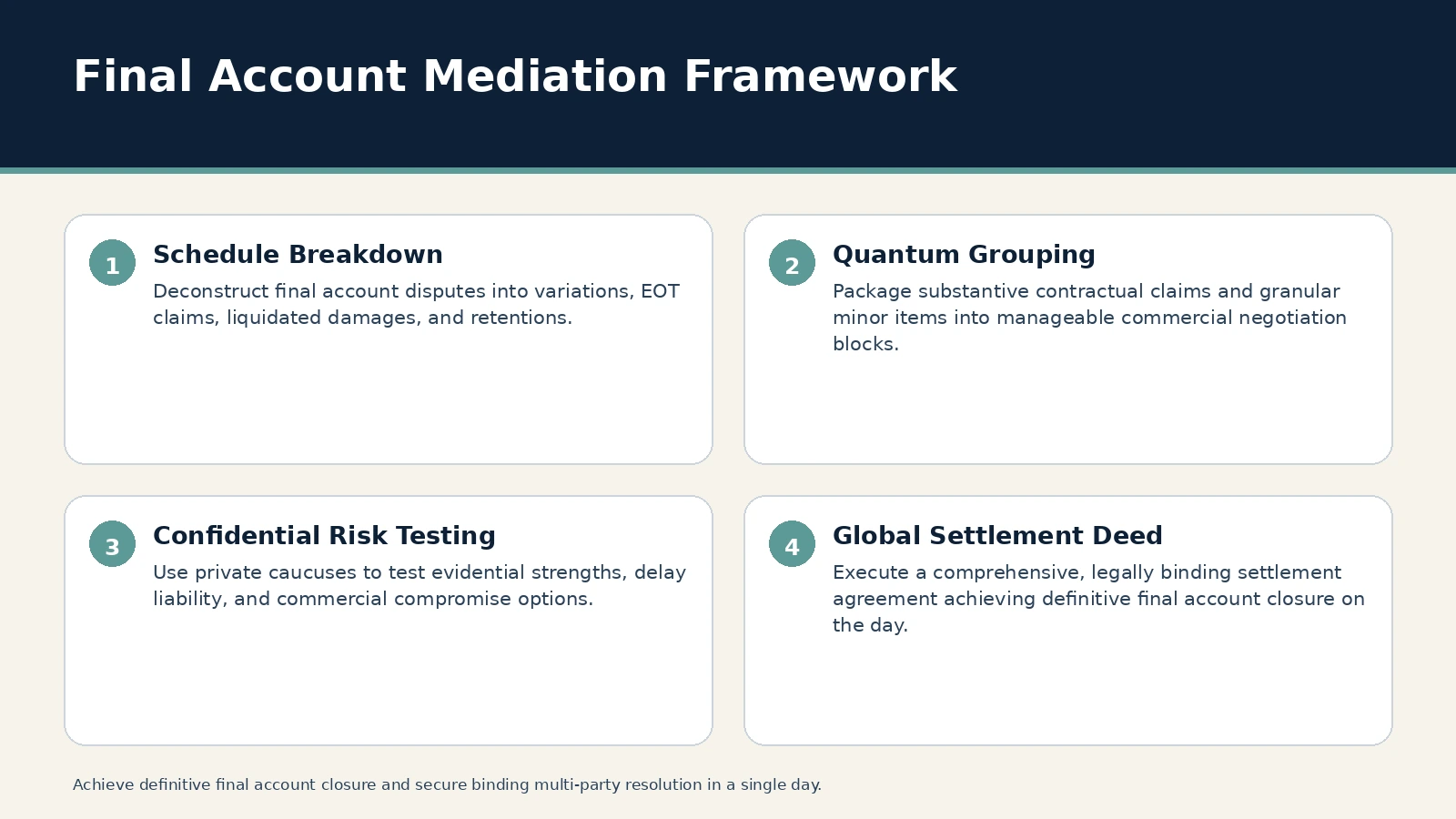
The short answer: Final account deadlocks rarely involve a single unpaid invoice. Instead, they represent a composite impasse involving contested variations, extension of time (EOT) claims, liquidated damages, snagging offsets, and unreleased retentions. While statutory adjudication provides temporary determinations on discrete issues and formal court proceedings demand exhaustive line-by-line proof, Construction Payment Dispute Mediation offers a private, without-prejudice process. By converting exhaustive spreadsheets into high-level commercial negotiation packages, commercial mediation enables the parties to explore risk-balanced compromises, agree on pragmatic rectification protocols, and execute a comprehensive, binding settlement deed in a single day.
The Mechanics of Final Account Deadlock: Why Commercial Accounting Stalls
Reaching financial closure on a completed construction project is rarely a straightforward mathematical calculation. By the time a cumulative final account statement is submitted, the working relationship between the employer, main contractor, and key sub-contractors has often absorbed months of operational friction, site delays, scope adjustments, and cashflow pressure. What began as an orderly contractual close-out frequently deteriorates into an entrenched commercial standoff.
In practice, final account disputes seldom arise from outright bad faith. More often, they stem from several compounding commercial and contractual dynamics colliding at project completion:
- Intertwined liability and circular counterclaims: A contractor’s claim for prolongation and loss and expense is met by an employer’s deduction for liquidated and ascertained damages. When neither party is willing to concede time liability in isolation, valuation discussions across the entire account stall completely.
- Granular Scott Schedule paralysis: When discussions break down, parties routinely compile exhaustive schedules containing hundreds of disputed variation lines, daywork claims, and re-measurement items. Debating each line item individually consumes disproportionate commercial time and legal expense, creating an analytical stalemate.
- Defect allegations and retention withholding: Employers or upstream contractors frequently withhold cash retentions well past practical completion or the expiry of the defect rectification period, citing unquantified defect lists or ongoing snagging concerns to justify non-payment.
- Multi-tiered supply chain exposure: Main contractors frequently find themselves caught between an employer’s valuation deductions upstream and trade sub-contractors’ final payment demands downstream. A valuation dispute at the upper tier can paralyse cashflow throughout the entire supply chain.
Under the Housing Grants, Construction and Regeneration Act 1996, parties have the statutory right to refer disputes to adjudication at any time. While adjudication provides an essential mechanism for interim cashflow relief, serial adjudications often create commercial whiplash. A party may succeed on a technical notice point in a summary adjudication, only to face an immediate counter-adjudication on the underlying true value of the works. Adjudication decides discrete contractual questions on a temporarily binding basis, but it does not compel the parties to sit down and agree on an overarching, permanent commercial figure. That is where engaging in commercial mediation becomes a decisive tactical and commercial advantage.
Translating Granular Quantum: Converting Complex Schedules into Negotiation Packages
The most common obstacle in final account dispute resolution is informational overload. When both parties arrive at a meeting armed with lever-arch files, detailed cost ledgers, and multi-tab spreadsheets containing hundreds of disputed items, direct discussions become bogged down in minor line-item arguments, losing sight of the broader commercial settlement.
In effective Construction Payment Dispute Mediation, the objective of commercial directors, quantity surveyors, and legal advisers is not to prove every single line item to the standard of a formal trial. Instead, preparation centres on translating granular technical data into manageable commercial negotiation packages. This is achieved by grouping contested items into three practical categories:
- The Core Contractual and Scope Items: High-value variations, major baseline omissions, or substantial design changes where the disagreement turns on contractual responsibility or scope definition.
- The Time, Delay, and Loss Balance: The composite balance between contractor prolongation or disruption claims and employer liquidated damages deductions, treating time entitlement and financial exposure as a single commercial calculation.
- The Granular Minor Items: The wide array of smaller variations, daywork rates, minor re-measurements, and snagging deductions that can be packaged into global commercial allowances rather than debated line by line.
By restructuring complex account positions into these defined packages, commercial decision-makers can evaluate the dispute through the prism of legal risk and commercial reality. Similar packaging techniques are vital when addressing subcontractor payment disputes over valuation conflicts and contra-charges on multi-tiered developments.
Construction Payment Dispute Mediation: Comparing Final Account Dispute Resolution Routes
When final account negotiations reach an impasse, parties must decide how to deploy their time, professional fees, and commercial resources. The table below illustrates how commercial mediation compares with formal dispute mechanisms in breaking final account deadlocks.
| Resolution Route | Decision-Making Control | Breadth of Resolution | Procedural Nature | Commercial Relationship | Finality of Outcome |
|---|---|---|---|---|---|
| Commercial Mediation | Complete: settlement terms are determined entirely by mutual agreement. | Holistic: encompasses variations, delay, defects, retentions, and future commercial terms globally. | Flexible and confidential: allows without-prejudice commercial trade-offs in a structured environment. | Collaborative: provides an opportunity to preserve trading relationships and complete project handovers. | Definitive: legally binding and enforceable upon execution of a formal settlement agreement. |
| Statutory Adjudication | None: an independent adjudicator decides the dispute, with powers to require written submissions, hold meetings, or conduct site visits. | Focused: restricted to the discrete dispute or narrow notice question referred. | Strictly timetabled statutory process: fast-paced determination based on submitted evidence. | Adversarial: often increases friction, particularly if serial adjudications follow. | Interim: binding until determined by agreement, litigation, or arbitration. |
| Formal Court Litigation (TCC) | None: a judge imposes an enforceable judgment based strictly on law and evidence. | Formally pleaded: claims and counterclaims are defined by statements of case and governed by the Civil Procedure Rules. | Rigid court procedure: governed by formal disclosure, expert witness exchange, and trial rules. | Adversarial: prolonged public proceedings that can exhaust commercial goodwill. | Final: enforceable judgment, subject only to strict grounds of appeal. |
Structuring the Mediation Session: Aligning Authority, Technical Claims, and Commercial Trade-Offs
A successful mediation day depends on disciplined preparation and fielding the right commercial team. Because final account disputes involve both complex technical calculations and broad commercial authority, participants must structure their attendance to ensure decisions can be made without delay.
An effective mediation team generally combines three distinct perspectives:
- The Commercial Decision-Maker: A board director, managing director, or senior commercial executive who possesses full authority to commit the business to a financial settlement and who is detached from day-to-day site friction.
- The Project Commercial Lead: The project quantity surveyor or commercial manager who understands the valuation build-ups, rate justifications, site instructions, and daywork sheets.
- The Legal Adviser: A construction solicitor who assesses contract liability, provides reality checks on litigation risk, and drafts the binding settlement agreement on the day.
The Pre-Action Protocol for Construction and Engineering Disputes establishes that parties should consider alternative dispute resolution, such as mediation, before commencing court proceedings. Engaging in Construction Payment Dispute Mediation during the pre-action phase allows parties to test the strength of their quantum evidence and contractual positions before incurring the substantial costs of formal proceedings. Commercial parties evaluating procedural timing can consult our guide on mediating construction disputes before court.
During the mediation session, the mediator shuttles between private rooms (caucuses), facilitating confidential discussions and testing the assumptions underpinning each side’s claims. Rather than deciding legal merits, the mediator acts as an independent commercial sounding board. They challenge optimistic assessments of delay liability, probe the evidential basis of contested variation rates, and help parties weigh the genuine net financial recovery of a negotiated settlement against the unrecoverable costs and operational disruption of protracted dispute proceedings.
Multi-Party Dynamics: Aligning Main Contractors, Employers, and Sub-Contractors
Final account deadlocks rarely exist in a simple two-party vacuum. On major projects, a main contractor’s financial exposure is frequently interlinked with upstream employer deductions and downstream sub-contractor accounts. If an employer withholds payment for alleged defective mechanical installations or delay damages, the main contractor often passes those deductions downstream to the trade contractors responsible.
In formal proceedings, resolving multi-tier disputes requires complex third-party notices, consolidated court actions, or parallel adjudications that run the risk of inconsistent outcomes. Commercial mediation provides a flexible setting where multi-party arrangements can be negotiated concurrently:
- Concurrent or back-to-back caucuses: The mediator can facilitate discussions between the employer and main contractor in one room while engaging with key sub-contractors in another, aligning expectations on valuation principles.
- Pass-through settlement structures: Upstream releases of retention or agreed scope variations can be linked directly to downstream settlements, ensuring the main contractor does not face irreconcilable liabilities.
- Direct technical clarifications: Specialist sub-contractors and employer design consultants can meet in focused side-caucuses to agree on technical rectification protocols without turning the entire account into a legal battle.
Achieving Definitive Closure: Drafting Binding Terms and Cashflow Release Protocols
The primary commercial goal of final account mediation is definitive finality. A successful mediation culminates in a written, binding settlement deed executed by all participating parties on the day.
To prevent future ambiguity and secure permanent financial closure, an enforceable settlement deed for a final account dispute should address several core commercial elements:
- Comprehensive Release of Claims: Clear contractual language confirming that the agreed settlement sum represents full and final settlement of all claims, counterclaims, variations, loss and expense claims, and statutory payment rights arising under or in connection with the contract.
- Retention Management and Release Triggers: Unambiguous terms governing the treatment and release of outstanding cash retentions, including specified dates for final inspections and the formal issue of making good certificates.
- Structured Payment Schedules: Defined payment milestones, explicit bank transfer details, and clear default mechanisms or interest provisions in the event of late payment.
- Scope of Rectification Works: Where outstanding snags or remedial items form part of the agreement, a clearly defined schedule of works specifying access dates, completion standards, and third-party inspection sign-offs.
- Latent Defect Provisions: Clear separation between known patent snags that are being compromised commercially and standard contractual liability for latent structural defects.
By resolving the entire final account globally, parties eliminate ongoing legal uncertainty, restore commercial focus to live operations, and release vital working capital back into their businesses. If your organisation is facing an intractable final account deadlock, you can speak to an EDR mediator to discuss whether commercial mediation is appropriate for your dispute.
Frequently asked questions
At what stage of a final account dispute should we consider mediation?
Mediation can be introduced at any point once the final account positions are sufficiently understood. It is frequently most effective after the draft final account and initial counter-schedules have been exchanged, during the Pre-Action Protocol stage before court proceedings are issued, or directly following an interim adjudication when both sides want to achieve a permanent, global resolution.
Can mediation resolve disputes involving complex defect claims and cash retentions?
Yes. Mediation is well suited to multi-issue disputes where defect allegations and withheld retentions are intertwined with payment claims. The parties can use the confidential process to agree on practical solutions, such as scoped remedial works, agreed third-party inspections, or staged retention releases that cannot be ordered easily in formal proceedings.
Who must attend the mediation session from our organisation?
To achieve a binding settlement on the day, your team should include or have immediate access to a representative with full authority to negotiate and execute an agreement. It is usually beneficial to have your project quantity surveyor or commercial manager present to clarify quantum calculations, alongside your legal representative to draft the formal settlement terms.
What happens if we cannot reach a settlement during the mediation?
Participating in mediation generally preserves your position without prejudicing your case, but statutory limitation periods continue to run unless protected by a standstill agreement or issued proceedings. If an agreement is not reached on the day, both parties remain free to pursue applicable dispute resolution routes, such as statutory adjudication, arbitration, or court litigation, subject to contract and statute. However, the discussions often clarify key issues, making subsequent negotiations much narrower and more manageable.
Authoritative UK guidance and further reading
Primary and official sources
- Courts and Tribunals Judiciary (judiciary.uk)
- Pre-Action Protocol for Construction and Engineering Disputes – Civil Procedure Rules – Justice UK (justice.gov.uk)
Further professional reading
- Amending the CPR to Accommodate the Impact of Churchill — Civil Mediation (civilmediation.org)
- Construction Final Account Disputes: Final Account Claims – Expert Commercial Law (expertcommerciallaw.co.uk)
This guide provides general information about dispute resolution and mediation. It is not legal advice. The appropriate approach depends on the facts, documents, procedural position and the parties involved; obtain legal advice where required.