

In brief
The question: How can organisations resolve communication breakdowns and contested reasonable adjustments between managers and neurodivergent employees before formal grievance or capability procedures damage working relationships?
The short answer: An interpersonal conflict between manager and employee involving neurodivergent team members—such as those with ADHD, autism, dyslexia, or dyspraxia—often originates in mismatched communication styles, unclarified expectations, or procedural delays surrounding workplace adjustments. When direct expressions, differing cognitive processing speeds, or sensory needs are misinterpreted as resistance or poor capability, working relations strain quickly. Independent workplace mediation provides a confidential, structured forum where line managers and employees can unpack functional barriers, translate communication preferences, and co-design testable operational adjustments. By stepping away from defensive positions, both parties can address day-to-day friction collaboratively, protecting operational performance and personal wellbeing while avoiding formal grievance investigations.
Operational Roots of Conflict Between Manager and Employee in Neurodiverse Teams
Interpersonal friction between a line manager and a direct report can emerge in any team. When neurodivergence is part of the working dynamic, ordinary operational misunderstandings can compound into entrenched friction. Differences in cognitive processing, executive functioning, and communication habits often lead to unintended misinterpretations on both sides of the reporting line.
In many workplaces, standard management practices rely heavily on implied social expectations, unwritten cultural rules, and ambiguous verbal instructions. For an employee with autism or ADHD, navigating these unspoken norms requires immense cognitive effort. When an employee responds with direct, literal language or questions a workflow to gain operational clarity, a manager may misread this as abruptness, defiance, or insubordination. Conversely, when a manager provides high-level verbal guidance without written parameters, the employee may struggle to prioritise competing tasks, leading to missed milestones or uneven delivery.
When these communication mismatches persist without structured intervention, the working dynamic deteriorates across several operational pressure points:
- Cognitive fatigue and masking: Employees expend substantial energy attempting to mask processing differences to fit conventional office expectations. Over time, prolonged masking generates cognitive exhaustion, heightened anxiety, and stress-related absence, which can culminate in sudden disengagement or sharp interpersonal friction.
- Managerial frustration and defensive oversight: Managers facing delivery pressures may interpret uneven task execution as a capability issue. In response, they often introduce closer supervision or rigid monitoring. For a neurodivergent team member, this increased scrutiny often heightens sensory and cognitive stress, exacerbating the very difficulties the manager is attempting to correct.
- Adjustment bottlenecks: When requests for workplace adjustments—such as asynchronous updates, quiet working spaces, or structured task briefs—are handled slowly or viewed as administrative concessions, employees feel unsupported. Managers, lacking clear operational guidance, may worry about setting inconsistent team precedents or compromising operational standards.
- Diagnostic uncertainty: Protracted waiting times for clinical assessments can leave both parties uncertain about how to proceed. Line managers often feel ill-equipped to offer tailored support without external guidance, while employees feel vulnerable discussing functional challenges without formal diagnostic validation.
Recognising these underlying dynamics allows organisations to treat the situation as an operational problem to be solved rather than an interpersonal fault.
The Limits of Formal Grievances and Performance Procedures
When communication breaks down, organisations often resort instinctively to formal HR frameworks, such as capability procedures, disciplinary investigations, or grievance hearings. While these processes have an established place in employment governance, their retrospective structure is ill-suited to resolving nuanced communication mismatches.
Formal capability or disciplinary processes require parties to gather documentary evidence, assign fault, and justify past actions. For a neurodivergent employee, receiving notice of a formal performance improvement plan or investigation can feel fundamentally punitive, particularly when difficulties stem from unaddressed sensory overload or inaccessible communication methods. In response, employees may submit formal grievances alleging unfair treatment or failure to support functional needs. This places the manager and HR on the defensive, solidifies adversarial positions, and halts constructive day-to-day dialogue.
Guidance from Acas on disciplinary and grievance procedures underlines the value of informal resolution and third-party mediation before formal processes escalate. Crucially, under official Acas guidance on reasonable adjustments, employers and managers do not need to wait for a formal clinical medical diagnosis before discussing and introducing practical workplace adjustments. By addressing functional barriers when they are first identified, organisations can resolve operational friction without triggering defensive formal processes.
De-escalating Friction: Formal Procedures Versus Independent Mediation
Deciding how to address a persistent conflict between manager and employee requires assessing whether the primary organisational objective is to adjudicate formal wrongdoing or to establish a viable, collaborative working dynamic. Formal investigations establish whether workplace rules or performance baselines have been breached; they do not repair broken communication channels or rebuild day-to-day trust.
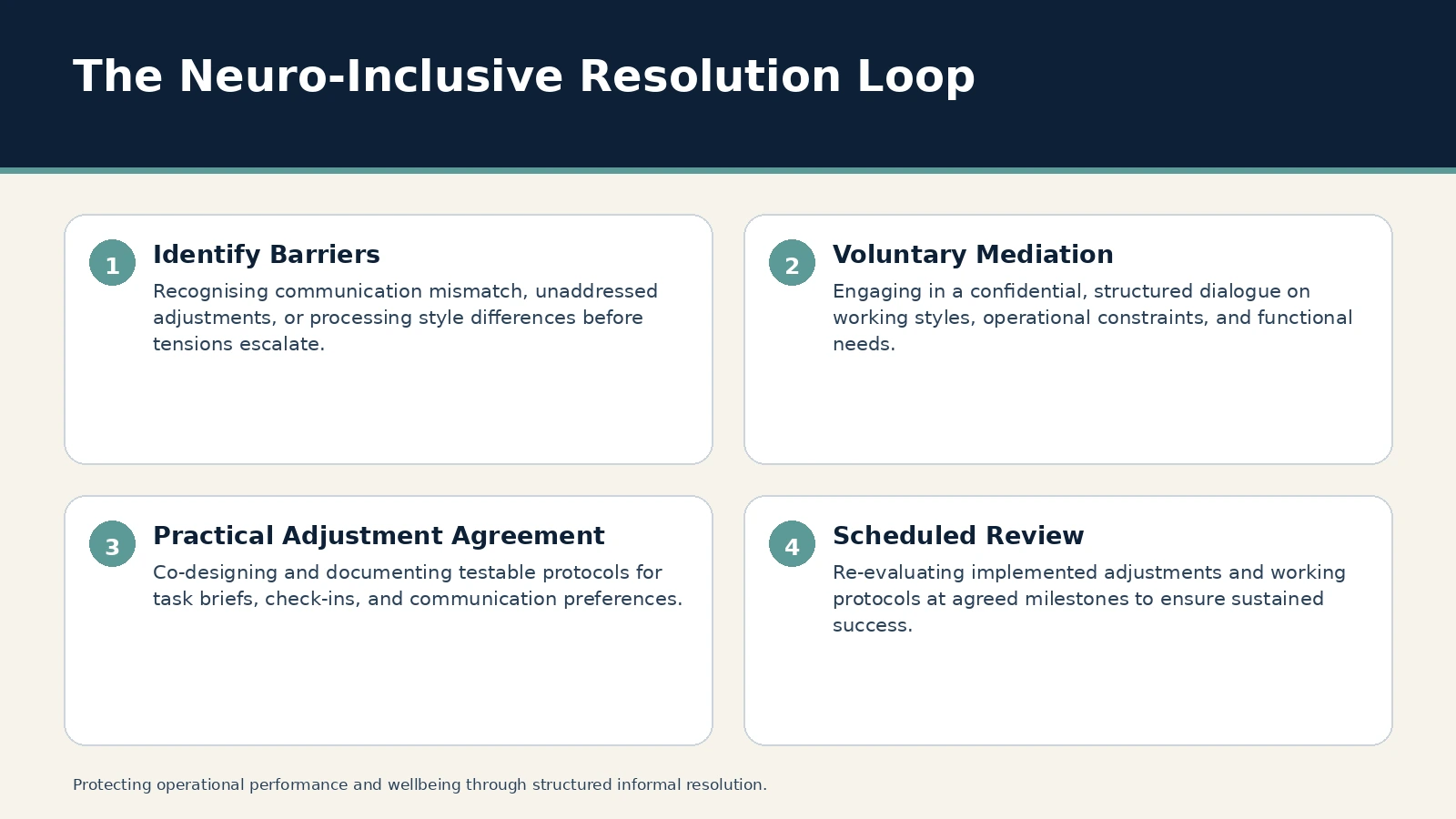
Workplace mediation shifts the focus from apportioning historical blame to co-creating practical, forward-looking arrangements. The table below outlines how independent mediation differs from formal grievance and capability mechanisms across key operational dimensions.
| Operational Dimension | Formal Grievance or Capability Process | Independent Workplace Mediation |
|---|---|---|
| Primary Focus | Investigates past conduct, assigns fault, and assesses rule compliance or formal performance standards. | Explores practical communication barriers, mutual expectations, and future day-to-day collaboration. |
| Communication Dynamic | Adversarial and procedural; statements and evidence are gathered through structured, separate hearings. | Facilitated, confidential dialogue enabling open explanation of processing styles and managerial constraints. |
| Adjustment Flexibility | Often rigid; adjustments are assessed administratively or deferred pending external medical evidence. | Highly collaborative; allows parties to co-design bespoke, practical adjustments with agreed review points. |
| Relationship Impact | Can increase defensiveness, entrench conflict, and create ongoing interpersonal estrangement. | Rebuilds direct understanding, repairs trust, and establishes clear, shared working protocols. |
| Process Control | Managed and decided by HR investigators, hearing chairs, or external panels. | Entirely voluntary; outcomes and practical commitments remain within the direct control of the participants. |
Adapting the Mediation Process for Neurodivergent Communication
Independent workplace mediation provides a structured, neutral setting to move parties from mutual frustration toward functional problem-solving. However, when managing neurodiversity-related disputes, the mediation process itself must be carefully adapted to ensure cognitive accessibility, psychological safety, and clear communication.
An experienced workplace mediator adapts the intervention across several practical stages:
1. Structured Preparation and Transparent Process Design
Ambiguity regarding the mediation process can generate significant anxiety, particularly for neurodivergent participants who value predictability. During individual pre-mediation meetings, the mediator clearly outlines the structure, purpose, and voluntary nature of the joint session. Providing a transparent overview of how the discussion will proceed allows both parties to prepare without fear of unexpected conversational confrontations.
2. Managing Communication Pacing and Cognitive Load
Fast-paced discussions, rapid interruptions, and emotionally charged cross-talk can cause cognitive overload, making it difficult for participants to process information and respond thoughtfully. The mediator actively regulates conversational pacing, ensuring each person has uninterrupted time to speak and reflect. Complex topics are broken down into discrete, manageable issues rather than addressed in overwhelming clusters.
3. Environmental and Sensory Considerations
Sensory factors can impact an individual’s ability to engage constructively. Mediation sessions are structured with regular, planned breaks in neutral, sensory-appropriate environments with manageable lighting and acoustic conditions. Where an online setting provides a more controlled, comfortable environment for managing sensory sensitivities, virtual mediation can be arranged effectively.
4. Translating Working Needs and Managerial Parameters
A central role of the mediator is acting as a communication translator. Direct or unconventional expressions of frustration from an employee can be explored to uncover the functional barrier beneath the emotion—such as sensory overload, unclear task criteria, or competing priorities. Simultaneously, the mediator helps the employee understand operational constraints, team dependencies, and commercial delivery requirements, framing these not as personal criticism but as shared operational parameters to work within. For broader strategies on addressing communication barriers, see our guide on resolving workplace communication breakdowns.
Co-Designing Practical Adjustments and Working Protocols
The primary outcome of mediation in neurodiversity disputes is an agreed, practical working framework tailored to the specific role and operational environment. Rather than relying on generic policies, mediation focuses on concrete, testable adjustments that both parties can implement immediately.
Practical adjustments agreed within mediation typically address three core operational areas:
1. Information Exchange and Task Briefings
Unclear task framing is a frequent catalyst for a conflict between manager and employee. Mediation allows parties to agree on concrete information-sharing protocols, such as:
- Supplementing verbal meetings with concise written summaries detailing deliverables, core priorities, and deadlines.
- Using objective, clearly defined milestones rather than subjective performance descriptions.
- Agreeing preferred communication channels, such as reserving asynchronous messaging for non-urgent tasks to prevent fracturing periods of deep concentration.
2. Meeting Structures and Feedback Routines
Unplanned interruptions or vague check-ins can create acute stress for neurodivergent team members and leave managers feeling uninformed about project status. Agreed working protocols often include:
- Establishing structured, regular one-to-one meetings with shared agendas circulated in advance.
- Providing advance notice when an upcoming conversation will address constructive feedback or shifting project priorities, allowing time for preparation.
- Defining realistic response-time expectations for internal communications during designated focus blocks.
3. Sensory and Environmental Arrangements
Physical and hybrid working environments heavily influence cognitive performance. Within mediation, parties can explore practical adjustments to workspace arrangements, such as designating quiet desk zones, permitting noise-cancelling headphones in open-plan areas, or structuring hybrid schedules that balance collaborative teamwork with quiet, focused home-working days. For further analysis on managing remote and office expectations, read our guide on resolving manager-employee hybrid working disputes.
Resolving Conflict Between Manager and Employee: Practical Steps for Organisations
When interpersonal tension begins to impact team collaboration or operational output, prompt action by HR leaders and managers can prevent an unaddressed communication clash from escalating into a formal grievance. Organisations navigating neurodiversity-related tension can implement several immediate, structured steps:
- Focus on functional workplace barriers early: Concentrate discussions on the practical day-to-day adjustments needed to support workflow delivery, rather than making support conditional on formal clinical assessments.
- Pause formal procedures by mutual agreement: If a formal grievance or capability procedure has already been initiated, the employer and employee can mutually agree to pause the formal timetable while they participate in mediation.
- Engage an independent workplace mediator: Appointing an external, impartial mediator provides a neutral setting where both the line manager and the direct report can speak candidly without concerns about internal bias or predetermined outcomes.
- Implement adjustments on a trial basis: Document agreed working protocols as practical trials with scheduled review checkpoints, allowing both parties to evaluate what works well and make practical refinements collaboratively.
Addressing operational misunderstandings through structured, confidential dialogue protects working relationships, supports employee wellbeing, and maintains operational delivery. When an organisation faces a persistent conflict between manager and employee involving communication differences or adjustment disputes, you can contact Echelon Dispute Resolution to discuss how independent workplace mediation can support an early, sustainable resolution.
Frequently asked questions
Can an employer agree workplace adjustments if the employee does not have a formal medical diagnosis?
Yes. Under official Acas guidance, employers and managers do not need to wait for a formal medical or clinical diagnosis to explore and implement practical workplace adjustments. If an employee experiences functional barriers related to communication, sensory environment, or task structuring, the employer and employee can collaboratively discuss and trial supportive adjustments immediately.
What happens to formal grievance or capability procedures during mediation?
Workplace mediation is a voluntary and confidential process. If a formal grievance or capability procedure has already been initiated, the employer and employee can mutually agree to pause the formal timetable while they participate in mediation. If an agreement is reached, the parties may decide to withdraw or resolve the formal process entirely.
How does mediation accommodate neurodivergent participants?
Mediators adapt the process to ensure accessibility by holding thorough pre-mediation briefings, establishing clear agendas, managing conversation pacing, and scheduling regular breaks. The environment can be tailored to manage sensory needs, and discussions can be held in person or online to provide a comfortable, structured setting for both parties.
Are agreements reached in workplace mediation legally binding?
Workplace mediation agreements are typically practical, working frameworks and behavioural commitments agreed between the parties rather than formal legal contracts. They establish shared protocols for communication, management cadences, and workplace adjustments, usually supported by agreed review dates to assess ongoing progress.
Authoritative UK guidance and further reading
Primary and official sources
- Equality Act 2010 (legislation.gov.uk)
- Solve a workplace dispute: Mediation, conciliation and arbitration – GOV.UK (gov.uk)
Further professional reading
- Code of Practice on disciplinary and grievance procedures | Acas (acas.org.uk)
- What reasonable adjustments are – Reasonable adjustments at work – Acas (acas.org.uk)
This guide provides general information about dispute resolution and mediation. It is not legal advice. The appropriate approach depends on the facts, documents, procedural position and the parties involved; obtain legal advice where required.