

In brief
The question: How can organisations resolve entrenched manager-employee friction arising from return-to-office mandates and hybrid working disagreements without triggering damaging formal grievance processes?
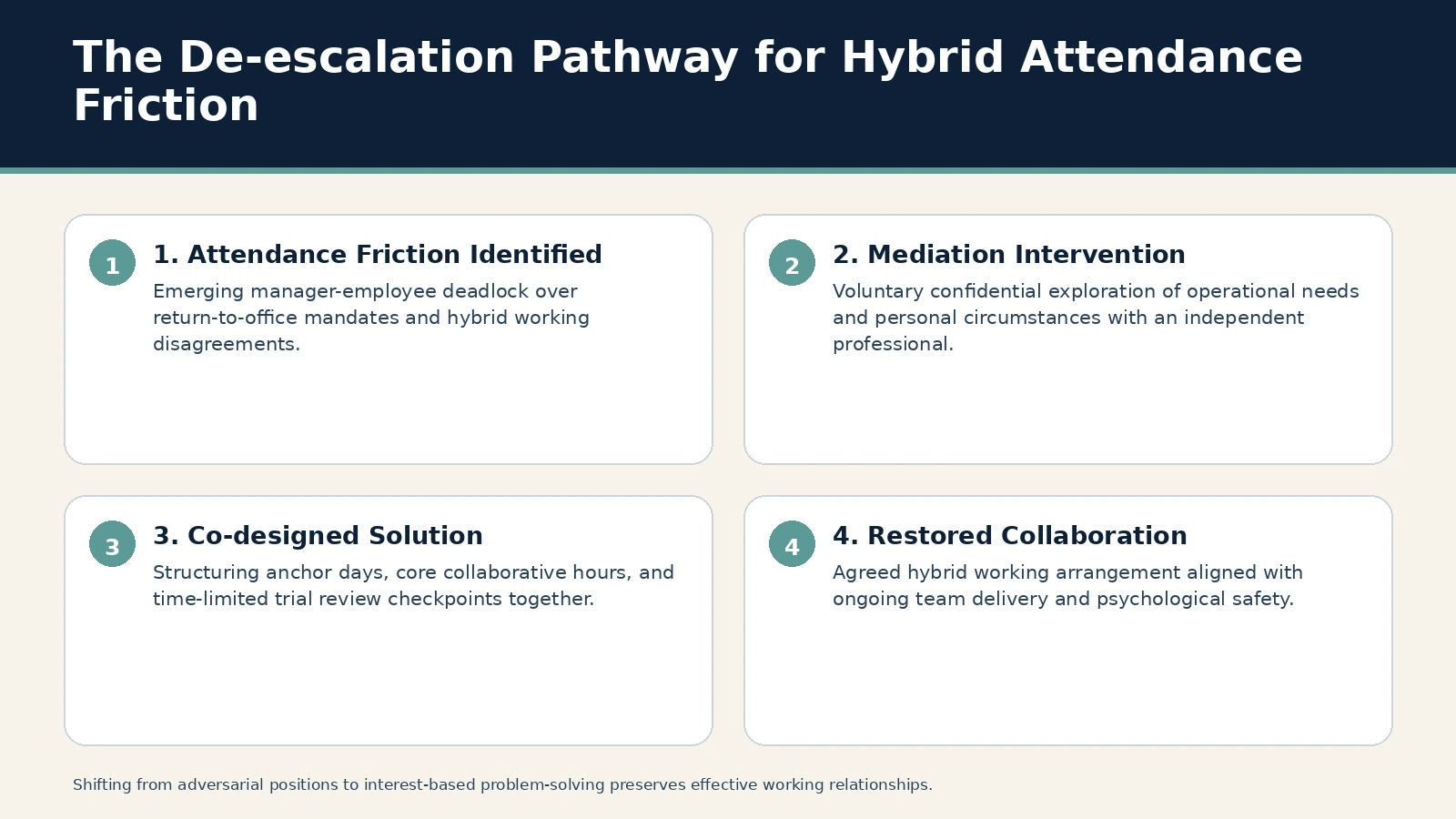
The short answer: A workplace conflict between manager and employee regarding attendance policies often stems from competing legitimate interests: the operational need for collaborative team presence versus personal productivity and domestic arrangements. When handled solely through rigid enforcement or formal grievances, communication tends to freeze into adversarial positions. Voluntary, confidential workplace mediation allows the parties to step away from formal rights-based arguments and explore the operational realities behind the dispute. By shifting the conversation to interest-based problem-solving, mediation enables line managers and staff to co-design bespoke hybrid working arrangements—such as structured anchor days, core collaborative hours, or time-limited trial periods—while preserving an effective ongoing working relationship.
The Relational Impasse: How Return-to-Office Mandates Strain Collaboration
Mandated return-to-office policies across England and Wales have placed operational pressure on day-to-day management dynamics. Line managers find themselves positioned between leadership directives requiring specific in-person attendance levels and team members who have established effective working patterns away from the central office. When individual expectations diverge from departmental rules, the resulting friction rarely remains purely administrative; it manifests as an interpersonal conflict between manager and employee.
In many workplaces, disagreements regarding attendance begin with informal pushback or declining compliance. A line manager, accountable for operational delivery and policy consistency across the team, feels compelled to monitor attendance rather than manage output. Conversely, an employee may perceive rigid policy enforcement as a lack of trust, micromanagement, or disregard for personal circumstances. Without a constructive forum for dialogue, mutual defensiveness increases. The manager interprets resistance as inflexibility, while the employee views managerial requests as indifferent to their performance record.
Left unaddressed, this relational tension erodes trust and psychological safety. When informal conversations break down, employees may feel their only recourse is to submit a formal flexible working request or lodge an internal grievance. Organisations seeking to understand the wider patterns behind these tensions can review our analysis of workplace communication breakdowns to identify early warning signs before positions harden.
The Procedural Backdrop: Flexible Working and Formal Grievances
Disagreements over hybrid working arrangements operate within an established statutory and procedural framework. Under the statutory flexible working framework in the Employment Rights Act 1996, employees have a Day-1 right to submit up to two statutory requests in any 12-month period. Employers have a duty to handle these requests in a reasonable manner, consult with the employee before refusing a request, and conclude the entire process—including any appeal—within two months, unless a time extension is agreed mutually.
When discussions stall, or when an employee feels an attendance mandate has been applied unfairly, formal grievance procedures are initiated. Under the in-force Acas Code of Practice on Disciplinary and Grievance Procedures (2015), employers and employees are encouraged to resolve workplace disputes informally wherever possible. The Acas Code encourages resolving issues in the workplace and highlights that employers and employees should consider using an independent third party or internal mediator.
While formal procedures provide essential due process for contractual or statutory breaches, they are poorly suited to resolving subjective, operational disagreements about where work is completed. A formal grievance investigation separates the parties, designates one individual as the complainant and the other as the subject of investigation, and channels communication through written statements and formal hearings. In doing so, it can crystallise an ongoing conflict between manager and employee into fixed, defensive positions.
Evaluating Resolution Routes: Formal Grievance Investigation vs Workplace Mediation
Choosing between a formal grievance investigation and independent workplace mediation involves contrasting procedural outcomes with relational and operational realities. Grievance processes focus on determining compliance, evaluating whether policies were applied correctly or whether conduct fell below acceptable standards. They deliver formal findings: a grievance is upheld, partially upheld, or dismissed. However, an outcome that dismisses a grievance does not rebuild the manager-employee relationship, nor does it resolve the practical friction of working together the following morning.
In contrast, workplace mediation provides a confidential, voluntary process facilitated by an independent third party who has no stake in the outcome. Rather than adjudicating fault, the mediator creates a structured environment where both individuals can discuss operational requirements, team dependencies, and personal constraints candidly. When organisations face formal escalation, understanding how to pause a formal grievance for mediation allows the parties to explore negotiated solutions safely without forfeiting procedural rights.
| Dispute Dimension | Formal Grievance Procedure | Workplace Mediation |
|---|---|---|
| Core Objective | Investigates procedural compliance, assigns fault, and delivers a formal ruling. | Facilitates dialogue to understand underlying interests and reach a mutually agreed working arrangement. |
| Communication Dynamic | Adversarial, indirect, and mediated through written evidence, HR representatives, and formal hearings. | Direct, structured, and confidential dialogue supported by an impartial professional mediator. |
| Role of the Line Manager | Acts as the investigated party or policy enforcer, defending managerial decisions against allegations. | Acts as a collaborative problem-solver, exploring practical operational solutions alongside the team member. |
| Nature of Outcome | Formal ruling with limited scope to create bespoke hybrid compromises. | Customised, practical agreement addressing specific operational needs, core hours, and review checkpoints. |
| Impact on Working Relationship | Can deepen interpersonal division, entrench defensiveness, and create ongoing workplace tension. | Rebuilds direct communication, restores psychological safety, and establishes agreed norms for future collaboration. |
| Acas Code Alignment | Operates as the formal mechanism where informal de-escalation has failed or is inappropriate. | Directly reflects the Acas Code principle prioritising early, informal, and consensual dispute resolution. |
Interest-Based Problem Solving: Practical Compromises in Mediated Hybrid Disputes
The primary advantage of mediation in attendance disagreements is the transition from positional bargaining to interest-based negotiation. In a positional dispute, the manager insists on a set in-office quota, while the employee insists on working entirely remotely. In mediation, the mediator helps both parties unpack the underlying interests behind those stances.
A manager’s underlying interest is rarely office presence for its own sake; it centres on team cohesion, spontaneous cross-functional collaboration, access during key project deliverables, and mentoring junior staff. An employee’s interest may revolve around uninterrupted focus time for complex tasks, managing commuting demands, or balancing personal responsibilities around core hours. By separating underlying operational requirements from rigid attendance quotas, the parties can design practical compromises that satisfy both perspectives.
Mediation allows the participants to construct nuanced, tailored solutions that formal HR processes cannot mandate. Common mediated outcomes in return-to-office disagreements include:
- Structured Anchor Days: Agreeing specific, high-collaboration days when the entire team is present for project workshops, cross-training, and team reviews, while preserving remote focus days for independent analytical tasks.
- Core Collaborative Windows: Establishing agreed in-office working hours that allow employees to travel outside peak commuter periods while ensuring full team availability during business-critical windows.
- Trial Periods with Clear Review Milestones: Implementing a proposed working schedule on a trial basis for an agreed period, supported by objective operational metrics and pre-scheduled review meetings to evaluate impact calmly.
- Role-Specific Task Mapping: Differentiating attendance expectations based on the specific phase of a project or nature of current deliverables, rather than applying a blanket departmental formula.
- Communication Charters: Co-designing clear expectations regarding response times, preferred communication channels, and check-in cadences to eliminate mutual anxieties over availability and oversight.
These structured agreements transform what was once an intractable conflict between manager and employee into an operational framework owned by both individuals. For a broader perspective on handling interpersonal friction in corporate teams, explore our guide to workplace disputes.
How Workplace Mediation Operates in Practice
Workplace mediation is an entirely voluntary process. It proceeds only when the participating parties mutually agree to take part in good faith. Under standard mediation agreements, discussions are confidential as a matter of operational agreement between the parties and the mediator (subject to agreed exceptions), providing a safe space where individuals can speak openly without fear that their concessions or disclosures will be used against them in subsequent formal hearings.
A typical workplace mediation follows a structured progression:
- Individual Private Sessions: The mediator meets separately with the employee and the line manager. These confidential meetings allow each person to articulate their perspective, voice frustrations, clarify their operational and personal needs, and identify what a workable future looks like.
- Joint Facilitated Dialogue: When both parties are prepared, the mediator convenes a joint session. The mediator establishes ground rules for constructive dialogue, helps the participants manage interpersonal tension, and ensures each person is heard without interruption.
- Exploring Underlying Operational Realities: The discussion moves from past grievances to examining what each person requires to perform effectively. The mediator assists in testing assumptions, clarifying miscommunications, and framing shared objectives.
- Developing and Testing Options: The parties brainstorm practical working arrangements, evaluating how different hybrid splits or anchor day models would function in practice within team constraints.
- Drafting the Mediated Agreement: Once acceptable terms are agreed, the mediator assists in documenting the arrangement in clear, practical terms. This document details the agreed working pattern, review mechanisms, and communication protocols.
Throughout this process, the mediator remains neutral. The mediator does not impose a judgment, give legal advice, or make formal findings of fact. The outcome is determined entirely by the parties themselves, ensuring genuine commitment to the agreed working pattern.
Managing the Interaction Between Mediation and Statutory Timelines
A practical concern for HR directors and managers is ensuring that engaging in mediation does not compromise procedural fairness or statutory compliance. Employers must conclude statutory flexible working requests within two months unless an extension is agreed. Where an employee has submitted a formal flexible working request or lodged a grievance, initiating mediation is compatible with statutory obligations.
To integrate mediation cleanly, HR can facilitate a formal, written agreement between the parties to pause the internal grievance process or extend the two-month statutory flexible working consultation window. This helps ensure that time spent in confidential dialogue does not trigger internal procedural defaults or prejudice the parties’ positions if formal procedures resume. If the mediation results in an agreed working pattern, the formal grievance can be withdrawn, or the flexible working request can be approved on the agreed terms. If the mediation does not achieve resolution, the formal process resumes from the exact point at which it was paused, with neither party’s procedural position prejudiced.
Engaging early in mediation when attendance friction emerges demonstrates an employer’s commitment to reasonable consultation and informal dispute resolution, aligning directly with the principles set out in the Acas guidance.
De-escalating a Conflict Between Manager and Employee: Practical Steps
When return-to-office expectations produce deadlock, continuing to enforce rigid attendance rules or proceeding directly to formal disciplinary or grievance hearings can exacerbate workplace disruption and damage team morale. Early intervention through independent workplace mediation provides a structured, professional mechanism to align organisational operational needs with employee flexibility.
Where a team is navigating attendance friction, taking proactive steps can re-establish constructive dialogue before positions harden:
- Initiate an Informal Scoping Conversation: HR or leadership can speak with both the manager and employee individually to assess willingness to engage in confidential, voluntary mediation.
- Establish a Procedural Pause: Agree in writing to pause any active grievance timescales or extend flexible working consultation windows while mediation is underway.
- Focus on Operational Problem-Solving: Encourage both participants to prepare by identifying their core operational requirements, rather than constructing formal arguments to defend past positions.
If your organisation is navigating persistent attendance friction, you can contact Echelon Dispute Resolution to discuss how independent workplace mediation can support your team.
Frequently asked questions
Can an employee be forced to participate in workplace mediation regarding attendance?
No. Workplace mediation is an entirely voluntary process. It proceeds only when the participating parties mutually agree to take part in good faith. Mediation is most effective when both participants enter the process willing to explore practical operational solutions collaboratively.
Are conversations during workplace mediation kept confidential?
Yes. Under standard mediation agreements, discussions are confidential as a matter of operational agreement between the parties and the mediator (subject to agreed exceptions), providing a safe space where individuals can speak openly without fear that their concessions or disclosures will be used against them in subsequent formal hearings.
What happens if mediation fails to resolve the hybrid working dispute?
If the parties cannot reach a mutually acceptable working arrangement, the mediation concludes without an agreement. Neither party forfeits their procedural or statutory rights. If a formal grievance or flexible working consultation was paused to allow for mediation, that formal process resumes from the point at which it was suspended.
How does mediation fit within the statutory flexible working timeline?
Employers must conclude statutory flexible working requests within two months unless an extension is agreed. When parties choose mediation during this period, they can mutually agree in writing to extend the consultation deadline, ensuring sufficient time to explore bespoke arrangements without breaching statutory rules.
Authoritative UK guidance and further reading
Primary and official sources
- Employment Rights Act 1996 (legislation.gov.uk)
- Employment Relations (Flexible Working) Act 2023 (legislation.gov.uk)
Further professional reading
- Considering a request – Statutory flexible working requests – Acas (acas.org.uk)
- Code of Practice on requests for flexible working | Acas (acas.org.uk)
This guide provides general information about dispute resolution and mediation. It is not legal advice. The appropriate approach depends on the facts, documents, procedural position and the parties involved; obtain legal advice where required.