

In brief
The question: How can organisations manage a contentious software vendor exit and secure business data handover when commercial disagreements, transition fees, and technical format disputes threaten operational paralysis?
The short answer: Contentious supplier offboarding disputes arise when financial arguments collide with technical extraction schedules. Successfully managing a contentious Software Vendor Exit and Business Data transfer requires separating operational records from platform software rights, decoupling fee disputes from extraction timetables, and structuring milestone-based transitions through commercial mediation. Rather than pursuing court applications that jeopardise continuity, parties can agree practical data schemas, transitional access tokens, and financial escrow mechanisms that preserve legal arguments while ensuring data is extracted, validated, and safely migrated to successor platforms.
The operational friction in software supplier transitions
Terminating a software supplier or enterprise cloud platform rarely mirrors the simple end of a standard commercial supply arrangement. In technology environments, offboarding involves an immediate operational disparity. The incumbent supplier manages administrative credentials, cryptographic keys, database backup routines, and bespoke integration scripts. The customer, by contrast, operates against business cutover targets, incoming supplier implementation timetables, and the practical demands of day-to-day operations. For wider dispute context across this sector, consult our practical overview on IP and technology dispute resolution.
These difficulties do not arise purely from adversarial conduct. They reflect systemic ambiguities in enterprise contracting. As discussed in our review of resolving SaaS implementation and licensing disputes, standard contracts often state that the outgoing supplier will provide reasonable assistance upon termination. Yet agreements seldom define what reasonable assistance involves in technical detail. Contracts regularly omit whether data must be exported as relational database dumps or flat text files, what engineer billing rates apply to migration queries, or how access is maintained if operational charges are disputed.
When the commercial relationship deteriorates, ordinary cooperation quickly breaks down. Vendors concerned about unbilled development hours, disputed termination fees, or historic service invoices may limit database transfer speeds or suspend administrative console access. Customers facing operational disruption or dissatisfied with system performance respond by withholding final payments. Without an established forum to manage the impasse, engineering teams stop talking, leaving commercial leaders locked in a standoff while contract expiry dates approach.
Distinguishing business data from platform intellectual property
A central obstacle in transition negotiations is confusion over the boundary between customer assets and vendor proprietary technology. Reaching an operational consensus requires distinguishing enterprise records from the software architecture that hosts them.
Under official UK Intellectual Property Office guidance on copyright ownership, the creator of a copyright work is generally the first owner. Commissioning custom software development or paying integration fees does not automatically transfer copyright ownership in underlying code to the customer absent an express assignment in writing. Subject to the contract and absent an express assignment, underlying proprietary software code and architecture typically remain the intellectual property of the supplier. For an analysis of codebase entitlements, see our review of software IP ownership and source code deadlocks.
However, customer operational data stands on an entirely different commercial footing. Transactional histories, customer relationship records, financial ledgers, product inventories, and operational inputs are enterprise assets. While an incumbent software provider retains proprietary rights over the underlying application engine, asserting ownership over customer business records is rarely supported by contract terms. Clarifying this division—separating the host software platform from the enterprise information contained within it—creates the factual foundation required to design practical data extraction procedures.
Decoupling technical migration from commercial fee disputes
When software exit discussions reach deadlock, parties frequently make the mistake of combining technical delivery with financial liability. The customer insists that disputed transition invoices will not be paid until the entire database is fully transferred, ingested, and signed off. The supplier responds that no engineer will run extraction scripts or grant transfer tokens until every disputed invoice is settled in full. The discussion turns circular, and migration halts.
Engaging in commercial mediation enables organisations to separate these issues into parallel negotiation tracks. Technical extraction protocols can proceed under agreed validation safeguards while contested financial claims are held securely at arm’s length. This separation removes the supplier’s perceived need to withhold system access as leverage, without requiring the customer to abandon contractual arguments regarding disputed invoices.
Within a structured mediation, commercial and technical teams can explore targeted operational tools:
- Escrow structures for contested sums: Disputed exit charges, final licence invoices, or transition engineering fees can be deposited into a neutral solicitor client account, releasing only when defined technical milestones are achieved.
- Phased extraction schedules: Handover can be divided into operational batches—such as core relational records, historical file stores, and system configurations—with proportionate financial releases or sign-offs tied to each batch.
- Transitional read-only environments: Parties can agree sandbox access or read-only database connections during cutover windows, enabling data migration while protecting system integrity.
- Facilitated technical discussions: Technical leads, database administrators, and incoming software architects can meet confidentially alongside commercial decision-makers to agree data schemas, API rate limits, and export formats directly.
- Sandbox validation and test environments: Technicians can configure isolated staging environments to test sample datasets, confirming that field definitions, character encodings, and relational keys match before triggering full-volume exports.
- Temporary API key and access token management: Parties can establish limited-scope API credentials dedicated solely to data extraction, governed by agreed expiration dates and automated query throttling to protect server infrastructure.
Evaluating resolution routes for vendor handover disputes
When transition talks stall, commercial teams must balance the practical differences between formal court adjudication and structured dispute resolution. The following comparison highlights key operational factors across both approaches.
| Decision Dimension | Court Proceedings | Commercial Mediation |
|---|---|---|
| Technical Adaptability | Relies on legal pleadings and standard witness evidence; limited flexibility for iterative engineering adjustments or real-time schema mapping. | Enables direct, flexible discussion between IT architects to agree concrete export specifications, file types, and delivery schedules. |
| Treatment of Disputed Fees | Determines contractual liability on legal merits; cannot easily establish escrow or commercial milestone swaps outside standard court orders. | Permits parties to ring-fence disputed invoices into escrow or release funds conditionally against verified migration milestones. |
| Operational Velocity | Dependent on court timetables, procedural steps, and evidence collation, which may not align with urgent system cutover dates. | Can be arranged swiftly within days or weeks, enabling real-time problem-solving before commercial continuity is breached. |
| Confidentiality and Relations | Hearings and judgments are generally public, risking customer reputation and supplier market standing. | Conducted as a private, commercially sensitive process, protecting proprietary data architecture and corporate reputations. |
| Procedural Expectation | Parties who litigate without exploring ADR risk adverse procedural consequences under civil pre-action rules. | Fulfills civil dispute expectations by demonstrating an active, reasonable commitment to consensual dispute resolution. |
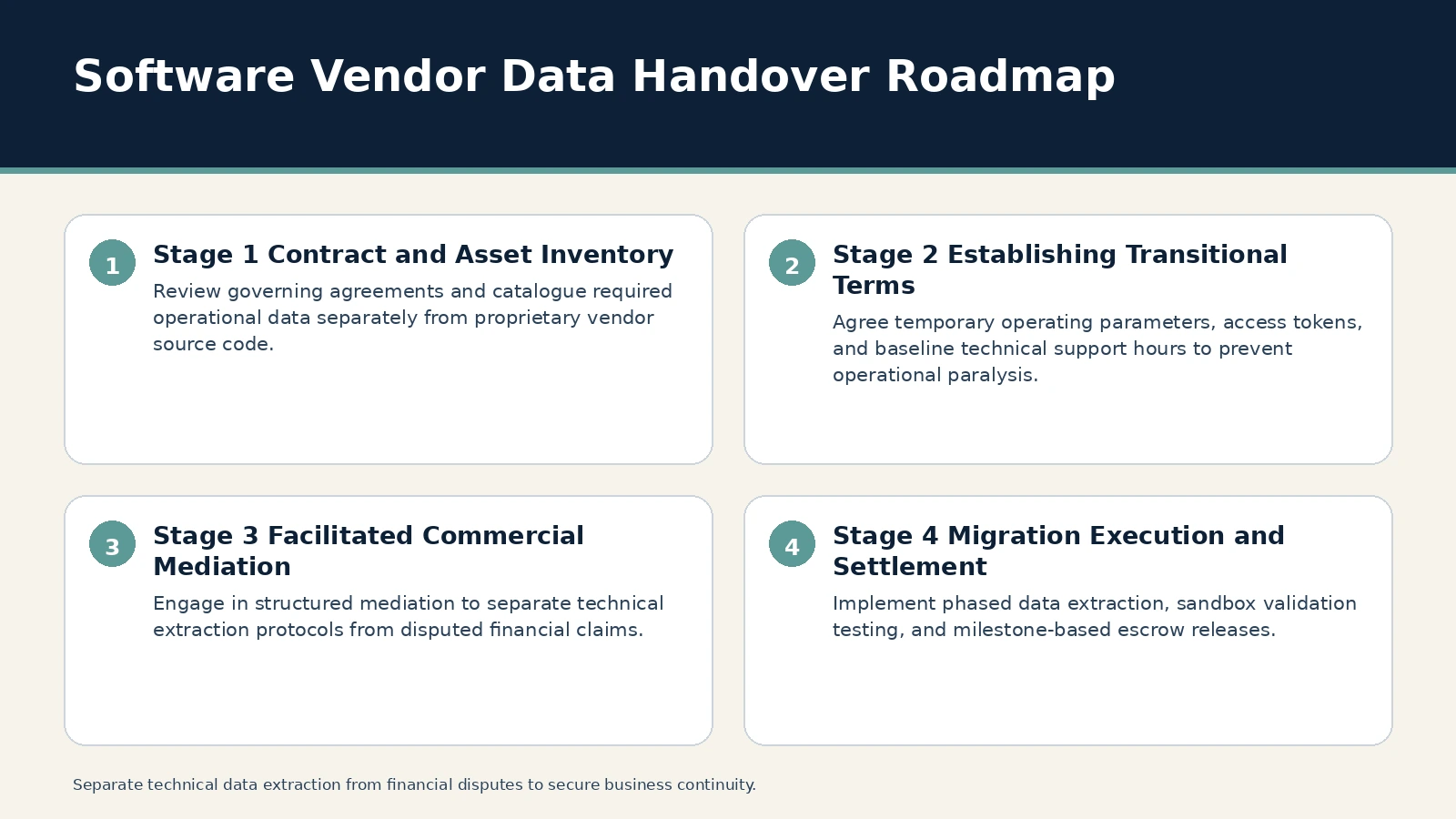
A practical roadmap for vendor data handover negotiations
Resolving software offboarding friction requires a balance of technical detail and commercial realism. Parties who achieve clean data migrations without damaging operational disruption generally work through a structured four-stage process.
1. Complete a contract and data asset audit
Before entering negotiations, each party should review the governing contractual terms. Identify master service agreements, statements of work, service level agreements, and exit provisions. Clarify specific obligations regarding data return formats, notice windows, and transitional support fees. Crucially, catalogue the operational data needed by the replacement platform, separating core business records from vendor configuration code, bespoke scripts, or third-party plug-ins.
It is equally valuable at this stage to map data dependencies. The incoming supplier will require specific database schemas, character encodings, and relational structures. Documenting these parameters early prevents parties from arguing over abstract migration rights and centres discussions on concrete technical specifications.
2. Establish temporary operating parameters
Rather than exchanging contentious legal letters while cutover dates draw near, organisations can agree an interim working arrangement, often structured as an interim Transition Services Agreement. This arrangement keeps system access active, defines baseline support hours, and specifies agreed day-rates for technical assistance during the handover window.
Setting temporary operating parameters protects ongoing business operations while substantive commercial disagreements are examined. It ensures that critical business processing continues without interruption while advisers structure a permanent settlement.
3. Engage in structured commercial mediation
Mediation brings commercial directors, technical leads, and legal representatives together in a managed, confidential setting. As highlighted by official Ministry of Justice guidance on civil mediation and the CPR Pre-Action Conduct Practice Direction (paragraphs 8-11), resolving commercial disputes through alternative processes allows parties to avoid unnecessary litigation while maintaining control over the outcome. Under civil justice rules, courts expect commercial parties to consider dispute resolution mechanisms before commencing formal court action.
In this environment, participants can set aside positional posturing to address engineering realities: settling export formats (such as relational SQL files, structured JSON, or CSV archives), establishing secure file transfer protocols, and scheduling technical validation windows. Simultaneously, commercial representatives can negotiate disputed balances, structure escrow terms, and agree mutual releases of liability.
4. Implement phased migration and milestone sign-off
A successful mediation concludes with a binding, enforceable settlement agreement setting out the transition protocol. Handover proceeds through clear checkpoints: pilot data extraction, ingestion testing, full batch delivery, and customer acceptance. Handover protocols can be structured to include validation periods, sample ingestion testing, and staged milestone releases from escrow, helping ensure settlement funds are released only once data delivery is confirmed.
Once data integrity is confirmed on the replacement platform, access credentials are systematically revoked, sandbox environments are decommissioned, and outstanding financial claims are formally settled.
Preparing for Software Vendor Exit and Business Data mediation
The success of commercial mediation depends largely on thorough, practical preparation. Entering discussions purely with general complaints about service failure or withholding conduct rarely yields workable technical outcomes. Both suppliers and customers should prepare targeted technical and commercial material.
Key preparation items include:
- Contractual documentation: Executed contracts, change notices, termination communications, and written records of exit assistance requests.
- Technical specifications: Data dictionary definitions, storage volume estimates, required export formats, database structure details, and ingestion criteria from the replacement software provider.
- Financial summaries: A clear reconciliation of paid invoices, disputed sums with itemised explanations, transition engineering cost calculations, and suggested escrow amounts.
- Operational timetables: Critical milestones, including legacy decommission dates, successor go-live targets, and dual-running licence cost implications.
- Infrastructure and security protocols: Defined bandwidth limits, secure transfer methods (such as SFTP or encrypted cloud buckets), and specific team contacts for real-time coordination during data delivery.
If your organisation is navigating an impasse over software offboarding or data migration, contact our dispute resolution team to discuss how structured mediation can help resolve the dispute while protecting ongoing business operations.
Frequently asked questions
Can a software vendor withhold business data over disputed exit invoices?
While contractual terms must be examined to determine whether service suspension is permitted, raw operational business records remain customer assets distinct from the vendor’s software. In practice, withholding access to critical data during commercial fee disputes often escalates liabilities. Mediation allows parties to place disputed sums into escrow while securing timely data delivery.
What is the practical difference between business data and software IP during an exit?
Under UK Intellectual Property Office copyright principles, the author of a copyright work such as software code remains the first owner unless legal ownership is assigned in writing. Conversely, the operational records, customer databases, and transactions stored inside that software are customer assets. Separating these assets allows parties to structure exports without infringing proprietary code.
How does mediation resolve technical data format and migration schema arguments?
Mediation provides a managed, confidential environment where technical architects and database administrators can collaborate directly alongside commercial directors. Rather than arguing in formal letters, technical teams can agree workable export formats, sample validation tests, API access windows, and secure delivery protocols that satisfy migration requirements.
What happens if extracted data is incomplete or corrupted after settlement?
A properly structured mediated settlement agreement avoids immediate final release until data integrity is verified. Handover protocols can be structured to include validation periods, sample ingestion testing, and staged milestone releases from escrow, helping ensure settlement funds are released only once data delivery is confirmed.
Do England and Wales court rules expect parties to attempt mediation before litigating a vendor exit?
Yes. Under the Civil Procedure Rules Pre-Action Conduct provisions and Ministry of Justice civil guidance, courts expect commercial parties to consider alternative dispute resolution, such as mediation, before issuing formal claims. Unreasonably refusing to participate in ADR can result in adverse costs orders, even for parties that subsequently succeed at trial.
Authoritative UK guidance and further reading
Primary and official sources
- Ownership of copyright works – GOV.UK (gov.uk)
- Dispute resolution and remedies in SEP licensing – GOV.UK (gov.uk)
- A guide to civil mediation – GOV.UK (gov.uk)
- Civil Procedure Rules and official guidance — justice.gov.uk (justice.gov.uk)
This guide provides general information about dispute resolution and mediation. It is not legal advice. The appropriate approach depends on the facts, documents, procedural position and the parties involved; obtain legal advice where required.