

In brief
The question: How can families, beneficiaries, and executors resolve complex inheritance disputes arising from unfulfilled family promises and reliance on estate property without exhausting estate assets in court?
The short answer: Choosing inheritance dispute mediation offers executors, claimants, and beneficiaries a confidential, structured forum to address high-stakes estate claims before litigation expenses erode the value of the estate. When an individual devotes years of labor or alters their life choices based on an unwritten assurance that they would inherit land, a home, or a family business, the resulting conflict places acute pressure on everyone involved. Rather than leaving the final outcome to an imposed court judgment, civil mediation allows the parties to negotiate bespoke, commercially workable arrangements. These may include land division, structured financial payments, lifetime residential rights, or tax-conscious restructuring that preserve relationships and protect family assets.
Disputes centered on unfulfilled promises—often framed in legal terms as proprietary estoppel—are among the most emotionally charged and financially demanding conflicts in contentious probate. When someone turns down external employment, works for nominal wages on a family farm, or invests personal funds into improving a property relying on an explicit or implicit pledge of future inheritance, a will that leaves those assets elsewhere triggers profound distress.
For executors and beneficiaries, responding to such claims presents difficult challenges. Estate funds can be depleted by contested litigation, while intergenerational family relationships face irreparable damage. Engaging an independent neutral through civil mediation services enables all parties to step back from adversarial posturing, examine practical realities, and design solutions that reflect both personal needs and commercial necessity.
Why Broken Estate Promises Create Acute Family and Financial Friction
Claims founded on verbal representations and detrimental reliance present distinct difficulties because they rarely involve clear, written contracts. Instead, they arise from decades of informal family conversations, unrecorded understandings, and personal sacrifices made within intimate domestic or working environments.
Several underlying dynamics make these estate conflicts especially volatile:
- Intermingled Family and Commercial Roles: In family businesses and agricultural holdings, personal relationships and operational duties overlap constantly. A claimant who worked for decades on reduced wages often perceives the dispute as an issue of fundamental fairness and recognition. In contrast, residual beneficiaries or non-working siblings may view the claim as an unjustified attack on the deceased’s formal testamentary wishes.
- Evidential Uncertainty: Because the person who allegedly made the promise has passed away, evidence often rests on competing recollections of private conversations, historic bank records, and witness testimony from neighbors or colleagues. This inherent evidential ambiguity introduces significant litigation risk for all participants.
- Executor Neutrality and Risk: Executors owe a duty to preserve the estate, yet they frequently find themselves caught between an assertive claimant and defensive beneficiaries. Navigating this deadlock without personal cost exposure requires careful procedural handling, as explored in our guide to executor-beneficiary dispute mediation and deadlock.
- Asset Illiquidity: Estate assets in these disputes are frequently indivisible or illiquid, such as a working farm, an owner-managed company, or the primary family residence. A protracted legal battle threatens the viability of the enterprise and risks forcing an unplanned sale on unfavorable terms.
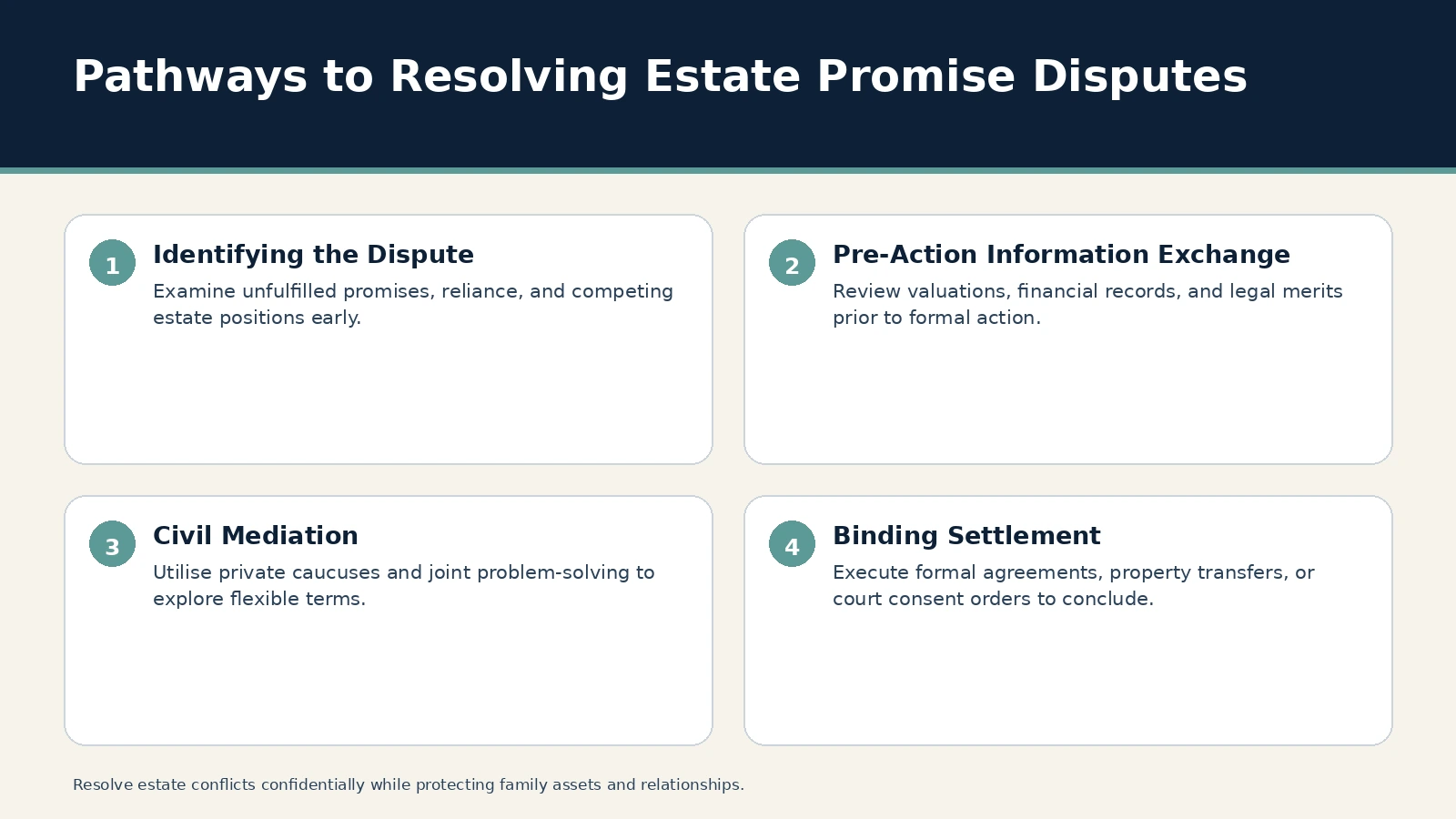
Under the Practice Direction – Pre-Action Conduct and Protocols, parties to civil disputes are expected to treat court proceedings as a last resort, share key documents early, and actively explore settlement avenues like mediation before embarking on formal litigation.
The Practical Realities of Detrimental Reliance and Executor Deadlock
When unfulfilled inheritance assurances surface during estate administration, the conflict quickly moves beyond purely legal arguments. Family members find themselves balancing historic emotional grievances against the cold reality of asset division. In many instances, the individual claiming an interest under proprietary estoppel has tied their entire personal and professional identity to the contested property, whether maintaining an agricultural enterprise or acting as an unpaid carer for an elderly relative.
At the same time, residuary beneficiaries named under the formal will often depend on their anticipated inheritance to clear mortgages, fund retirement, or support their own children. They may perceive the claimant’s position as an attempt to rewrite the deceased’s testamentary intentions after the fact. If executors attempt to defend the claim using estate funds, they risk draining the very residuary pot they are tasked with protecting, exposing themselves to criticism or applications for their removal.
In this high-pressure environment, inheritance dispute mediation serves as a circuit breaker. An experienced mediator does not act as a judge or impose an outcome. Instead, they facilitate structured, private discussions that help the parties separate genuine core needs—such as residential security, working capital, or clean financial separation—from entrenched positions that only serve to prolong the dispute.
Key Settlement Levers in Inheritance Dispute Mediation
The primary strength of inheritance dispute mediation is the freedom it gives parties to construct creative, nuanced outcomes tailored to their operational, financial, and personal priorities. In formal trial proceedings, a judge determines legal rights by applying legal and equitable principles, limiting remedies to available legal outcomes rather than flexible commercial compromises.
During mediation, parties can examine settlement structures that resolve the dispute constructively:
1. Land and Property Partition
Where the dispute involves agricultural land or multi-parcel property, parties can negotiate boundary adjustments, transfer specific fields or outbuildings to the claimant, and retain core acreage or homesteads for the remaining beneficiaries. Mediation provides a forum where the parties, supported by their surveyors and legal advisers, can examine maps and access rights directly to design a workable division.
2. Phased Buy-Outs and Structured Payments
If the claimant seeks a financial exit but the estate lacks liquid cash, mediation allows the parties to agree on phased payments over a sensible timetable. This can be secured against estate assets or funded through refinancing, preventing the need to dismantle a productive business or sell land under duress.
3. Lifetime Occupation and Tenancy Agreements
In residential property disputes, tensions often center on an elderly or vulnerable relative’s right to remain in the home versus the beneficiaries’ desire to realise capital. Mediated settlements frequently incorporate lifetime leases, formal occupancy rights, or deferred sale arrangements that provide housing security while protecting the ultimate reversionary value for the beneficiaries.
4. Tax-Conscious Restructuring
Formal estate litigation can inadvertently trigger tax liabilities if assets must be liquidated rapidly. In mediation, parties and their professional advisers can design terms—such as formal Deeds of Variation within statutory relief windows—that manage Capital Gains Tax and preserve valuable reliefs such as Agricultural Property Relief or Business Property Relief. For further insight into procedural preparation, review our detailed guide on the probate and inheritance dispute mediation process.
Comparing Pathways: Court Litigation vs Inheritance Dispute Mediation
Understanding the fundamental differences between litigating a broken promise claim and resolving it at the mediation table helps executors, claimants, and beneficiaries make informed strategic decisions.
| Dispute Dimension | Court Determination | Inheritance Dispute Mediation |
|---|---|---|
| Decision-Making Authority | A trial judge imposes a binding judgment after hearing formal evidence and cross-examination. | The parties retain complete control and decide voluntarily whether to accept any proposed settlement. |
| Scope of Solutions | Unlike mediation, court litigation is restricted to legal, equitable, and statutory remedies regarding title, financial awards, or estate adjustments. | Flexible, allowing customised land divisions, phased payments, leases, and tax-informed restructuring. |
| Confidentiality & Privacy | Public court proceedings; sensitive family dynamics and private financial affairs enter public record. | Private, confidential discussions conducted under the terms of a formal mediation agreement. |
| Impact on Estate Assets | Substantial trial costs can rapidly deplete estate value and create significant cost risks. | Focused negotiation at an agreed stage helps contain expenditure and preserve estate value for distribution. |
| Interpersonal Impact | Adversarial testimony and cross-examination frequently entrench family hostility permanently. | Facilitated dialogue in separate rooms helps address grievances and reduce long-term relational damage. |
Procedural rules strongly incentivise early engagement with alternative dispute resolution. Under Part 44 of the Civil Procedure Rules (CPR), the court retains broad discretion over cost awards and can penalise parties who unreasonably refuse or fail to engage in mediation, even if they succeed on certain arguments at trial.
How Inheritance Dispute Mediation Operates in Practice
For most participants, entering an estate mediation session represents their first direct experience with structured alternative dispute resolution. Knowing what to expect on the day helps reduce anxiety and allows participants to concentrate on practical problem-solving.
A typical estate dispute mediation follows a clear, carefully managed framework:
- Preparation and Position Statements: Prior to the mediation day, each party’s legal team submits a concise summary of their position alongside relevant documentary evidence, such as property valuations, accounts, and witness statements. This material is provided to the mediator in advance so they understand both the legal arguments and the interpersonal dynamics.
- Private Caucus Rooms: While mediation can begin with a brief joint opening if all parties agree, most inheritance mediations take place using separate private rooms (caucuses). The claimant, the beneficiaries, and the executors remain in their respective rooms with their legal advisers. The mediator shuttles between these rooms, testing arguments, conveying proposals, and exploring commercial options in strict confidence.
- Reality Testing and Problem-Solving: During private discussions, the mediator assists parties in evaluating the risks, direct costs, and emotional toll of continuing toward a court trial. They help each side explore realistic settlement options that might not have emerged through formal solicitor correspondence.
- Input from Professional Advisers: Having solicitors, accountants, and land agents present or contactable enables the parties to evaluate settlement proposals in real time. If a proposal involves partitioning a farm or transferring property subject to a charge, advisers can instantly verify boundary feasibility, tax implications, and refinancing terms.
- Drafting and Finalising Binding Terms: When the parties reach an agreed framework, their legal representatives draft a comprehensive written settlement agreement. Once signed by all required parties and executors, the agreement brings the dispute to a formal, legally binding close.
Preparing Effectively for an Estate Dispute Mediation Session
A productive mediation depends on thorough, disciplined preparation by all participants. Because broken promise claims involve both emotional subtext and complex financial records, coming to the table with the right information is essential.
Parties preparing for an estate mediation should focus on four foundational steps:
- Clarify Core Financial and Valuation Data: Obtain up-to-date, independent valuations of all contested assets—including properties, land parcels, agricultural stock, and private company shares. Disagreements over property values can stall negotiations if realistic figures are not established beforehand.
- Assemble Key Supporting Records: Compile contemporaneous records that evidence the history of the relationship and financial contributions, such as bank statements, tax returns, partnership accounts, planning applications, or written notes.
- Engage Specialist Professional Advisers: Ensure your contentious probate solicitor and, where appropriate, an accountant or agricultural valuer are prepared to advise you during the day on the practical, legal, and tax implications of emerging settlement proposals.
- Identify True Priorities and Tolerances: Distinguish between non-negotiable needs (such as secure housing or personal solvency) and flexible preferences (such as specific payment dates or parcel boundaries). Entering mediation with a clear hierarchy of goals allows for agile negotiation when options develop.
By engaging constructively with inheritance dispute mediation, families and executors can step away from destructive litigation, protect their legacy, and resolve complicated inheritance claims with dignity and finality. To discuss whether mediation is appropriate for your estate dispute, please speak to an EDR mediator.
Frequently asked questions
What happens if we reach an agreement during inheritance dispute mediation?
When parties reach an agreement, their legal advisers, or the parties themselves if unrepresented, draft a written settlement agreement setting out the precise terms. Once signed by all parties, the agreement becomes legally binding and enforceable. If court proceedings have already begun, the terms can be incorporated into a formal consent order to conclude the litigation safely.
Do all executors and beneficiaries need to attend the mediation session?
Anyone whose consent is required to implement a settlement should participate, including executors, primary beneficiaries, and the claimant. While parties usually attend with their legal advisers, the mediation takes place in private rooms (caucuses), so there is no requirement to sit directly across from family members if interpersonal friction is high.
What happens if an inheritance dispute cannot be resolved in mediation?
Because reaching a settlement in mediation is non-binding until an agreement is signed, parties who do not settle retain all their legal rights. They remain free to continue court litigation. All discussions and proposals made during the mediation remain confidential under the mediation agreement.
How early in an inheritance dispute can mediation take place?
Mediation can take place at any stage. It is often most effective at the pre-action stage, once key financial documents, will copies, and property valuations have been exchanged. Mediating before issuing formal court claims prevents legal costs from escalating and depleting estate funds.
Authoritative UK guidance and further reading
Primary and official sources
- The Civil Procedure (Amendment No. 2) Rules 2026 (legislation.gov.uk)
- Civil – Civil Procedure Rules – Justice UK (justice.gov.uk)
- PRACTICE DIRECTION – PRE-ACTION CONDUCT AND PROTOCOLS – Civil Procedure Rules – Justice UK (justice.gov.uk)
- PART 44 – GENERAL RULES ABOUT COSTS – Justice UK (justice.gov.uk)
This guide provides general information about dispute resolution and mediation. It is not legal advice. The appropriate approach depends on the facts, documents, procedural position and the parties involved; obtain legal advice where required.