

In brief
The question: How can employers, HR leaders, and operational managers across Leicester and Leicestershire resolve employee grievances, interpersonal friction, and team disputes effectively without resorting to disruptive formal procedures?
The short answer: Engaging independent workplace mediation Leicester employers can access provides a confidential, voluntary, and structured route to resolve underlying conflict before it hardens into formal employment disputes. Rather than focusing on assigning blame through adversarial investigations, workplace mediation introduces an impartial mediator to facilitate constructive, forward-looking discussions between colleagues or managers. This process addresses root-cause communication breakdowns, repairs working relationships, and protects productivity across busy shift patterns and commercial environments. Mediation aligns with the Acas Code of Practice on Disciplinary and Grievance Procedures, enabling organisations to explore practical working agreements while formal procedures are paused by mutual consent.
The Operational Cost of Unresolved Conflict Across Leicestershire Workplaces
Interpersonal friction in the workplace rarely stays contained between the individuals directly involved. Across Leicestershire’s commercial landscape—from advanced manufacturing facilities and distribution centres in the logistics Golden Triangle to corporate offices around Grove Park and Meridian Business Park—unresolved friction places direct operational strain on line management and operational continuity.
When communication breaks down between a line manager and a team member, or between peer colleagues on a shared shift, the initial operational impact often manifests as lost focus, declining collaboration, and managerial distraction. Supervisors spend hours managing side conversations, handling informal complaints, or adjusting shift rotas to keep conflicting parties apart. If left unaddressed, these issues frequently evolve into formal grievances, sickness absences attributed to workplace stress, and elevated staff turnover.
For organisations evaluating workplace mediation Leicester services, early intervention offers a way to de-escalate interpersonal tension before it consumes substantial executive time. Line managers and HR professionals can find their capacity drained by administrative procedures when grievances are filed, distracting key personnel from core commercial priorities.
In logistics and high-throughput distribution environments common to Leicestershire hubs such as Magna Park or Troon Industrial Area, interpersonal friction carries tangible operational risks. Shift handovers require clear, timely communication between team leaders. When personal friction prevents constructive coordination, operational errors increase, inventory handovers stall, and wider team morale erodes. In office-based professional services and technology firms across Leicester city centre, unresolved personality clashes often lead to defensive communication, email escalation, and siloed working practices that quietly stall project delivery.
Workplace Mediation Leicester: When to Mediate: Evaluating Relational Friction vs Formal Misconduct
Not every workplace issue is suitable for workplace mediation in Leicester, and recognising when to deploy the process is essential for HR leaders and business owners. Mediation is designed for disputes rooted in interpersonal dynamics, contrasting working styles, communication failures, and operational misunderstandings. It is not an alternative to disciplinary processes where serious unlawful behaviour or gross misconduct is alleged.
Issues Well-Suited to Independent Workplace Mediation Leicester
- Management and communication style clashes: Disagreements regarding feedback delivery, delegation, perceived micromanagement, or tone of communication between supervisors and direct reports.
- Peer-to-peer friction: Breakdown of trust, professional rivalry, or poor collaboration between colleagues working within the same team or across operational handovers.
- Reintegration following absence or formal processes: Rebuilding working relationships between staff members after a period of stress-related leave, a restructuring exercise, or the conclusion of an internal investigation.
- Departmental handovers: Inter-team friction between operational functions, such as customer service and dispatch or sales and production units.
Circumstances Requiring Formal Investigation
Workplace mediation in Leicester should not replace formal disciplinary procedures in situations involving allegations of serious fraud, physical violence, gross misconduct, or statutory safeguarding issues. In these instances, employers have a regulatory and legal obligation to conduct formal fact-finding investigations and take appropriate disciplinary action.
Where a formal grievance has already been submitted regarding interpersonal issues, employers can agree with the parties to pause the procedure temporarily to attempt mediation. Within wider strategies for managing workplace disputes, the mechanics of pausing formal grievance procedures for mediation preserve the employee’s formal position while providing an informal window to explore a constructive resolution.
Formal Grievance Procedure vs Independent Workplace Mediation
Choosing between an internal formal grievance investigation and independent workplace mediation in Leicester involves weighing the fundamental difference in approach between investigative fact-finding and collaborative problem-solving.
Formal grievance procedures are investigative and backward-looking. An appointed investigator collects witness statements, examines email correspondence, and determines whether an allegation is substantiated or dismissed. While essential for contractual and disciplinary compliance, this binary outcome often reinforces division: one party feels vindicated while the other feels penalised, making ongoing daily collaboration difficult.
In contrast, mediation is voluntary, forward-looking, and focused entirely on practical solutions. The mediator does not act as a judge, assign blame, or impose a ruling. Instead, the process empowers participants to articulate what they need to work together effectively in the future, resulting in a jointly agreed working charter.
| Operational Dimension | Formal Grievance Procedure | Independent Workplace Mediation |
|---|---|---|
| Primary Objective | Investigate past conduct, establish factual fault, and determine formal compliance. | Identify underlying causes of friction, restore communication, and agree future working arrangements. |
| Process Character | Adversarial, evidence-led, and procedural, often requiring formal interviews and written reports. | Voluntary, confidential, and collaborative dialogue facilitated by an impartial third party. |
| Management Demands | Formal disciplinary and grievance procedures can require considerable operational time for investigations, hearings, minutes, and appeal management depending on case complexity. | Focused, structured sessions typically concluded within a single day or two discrete meetings. |
| Confidentiality Parameters | Statements and evidence may be shared across hearings, appeals, and operational panels. | Discussions remain confidential between participants and the mediator, with only agreed outcomes or process status shared with HR, subject to rare safeguarding or legal exceptions. |
| Ongoing Working Dynamics | Can harden interpersonal resentment and make future direct collaboration challenging. | Encourages mutual understanding, enabling colleagues to maintain professional working relationships. |
Under the Acas Code of Practice on Disciplinary and Grievance Procedures (2015), the statutory standard across England and Wales, employers and employees are encouraged to resolve issues informally, with Acas guidance recognising external mediation. Furthermore, under Section 207A of the Trade Union and Labour Relations (Consolidation) Act 1992 (TULRCA 1992), employment tribunals hold discretionary power to adjust compensatory awards by up to 25% if either an employer or employee unreasonably fails to comply with the relevant Acas Code. Using workplace mediation can demonstrate an active, reasonable commitment to dispute resolution.
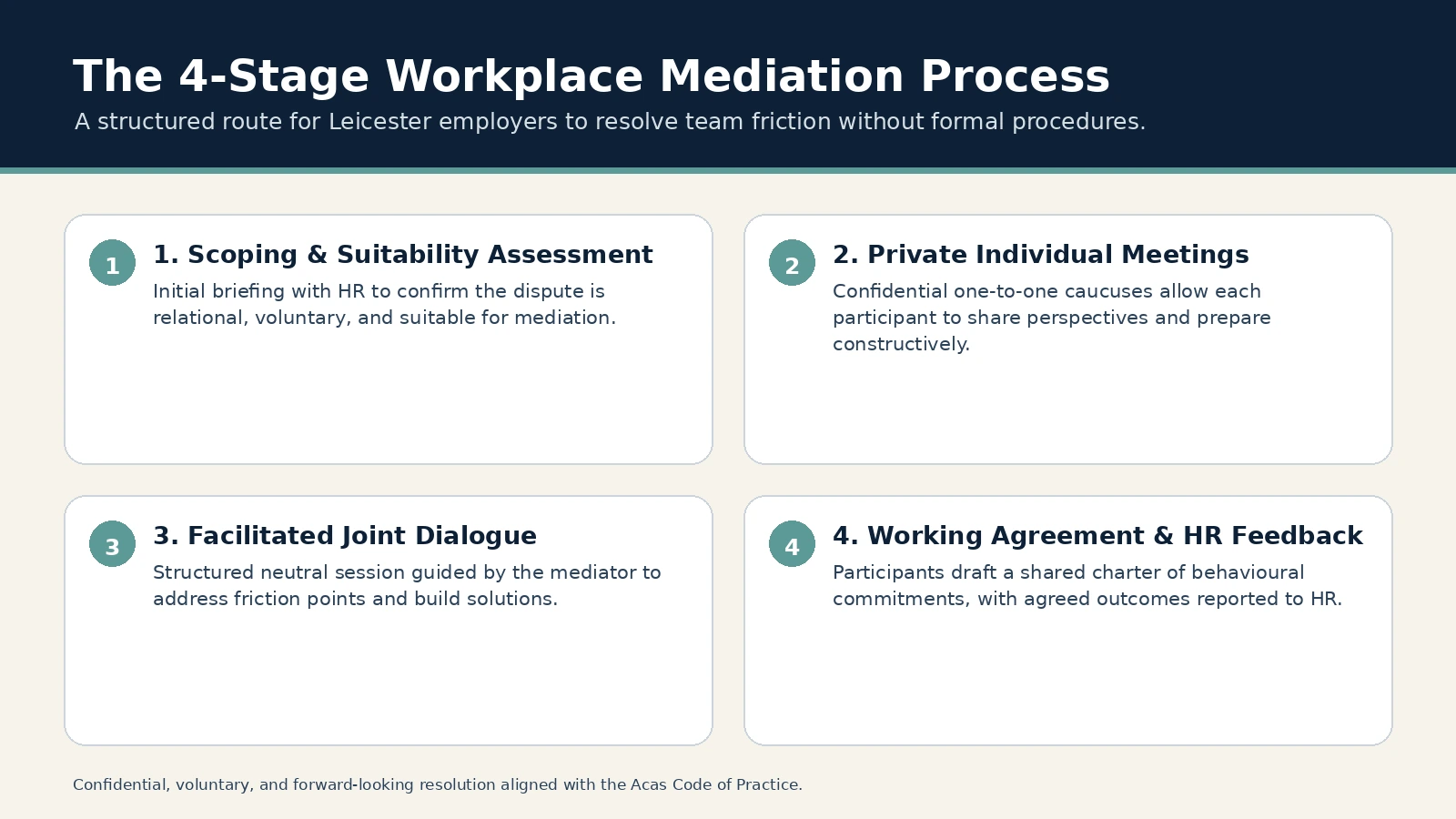
The 4-Stage Workplace Mediation Process for Leicester Employers
For business leaders and HR managers commissioning workplace mediation Leicester services, understanding the structured workflow ensures smooth preparation and realistic expectations for all participants.
Stage 1: Scoping and Suitability Assessment
The process begins with an initial briefing between the mediator and the commissioning HR professional or business owner. This stage defines the general background of the dispute, confirms that the issues are relational and suitable for mediation, and establishes voluntary participation. The mediator ensures that all participants understand the purpose, confidentiality rules, and non-judgmental nature of the process before proceeding.
Stage 2: Confidential Individual Meetings
The mediator meets separately with each participant in a private, confidential session. These individual caucuses allow each party to explain their perspective without interruption, explore how the conflict has affected their work and well-being, and identify what practical changes they need moving forward. The mediator helps participants reflect on their own contributions to the dynamic and prepare constructive discussion points for the joint meeting.
Stage 3: Facilitated Joint Meeting
Both participants come together in a structured, neutral setting. The mediator establishes clear conversational ground rules to ensure mutual respect and prevent speaking over one another. The session progresses through several phases:
- Uninterrupted opening statements: Each participant shares their primary concerns and desired outcomes in their own words.
- Direct dialogue: The mediator guides a focused conversation addressing specific operational friction points, misconceptions, and communication barriers.
- Joint problem-solving: The parties explore realistic, practical options to overcome day-to-day workplace hurdles and establish collaborative boundaries.
Stage 4: Drafting the Working Agreement and HR Feedback
Once acceptable solutions are identified, the mediator assists the participants in drafting a written agreement or working charter. This document outlines concrete behavioural commitments, revised communication protocols, and practical steps for managing future disagreements. With the participants’ consent, an agreed summary is provided to HR or management confirming that an agreement has been reached, accompanied by a planned review milestone to evaluate ongoing progress.
Preparing for Mediation: Practical Steps for Employers and Participants
Adequate preparation is critical to the success of independent workplace mediation Leicester. When introducing the concept to employees who may be feeling defensive, anxious, or mistrustful, line managers and HR leaders should emphasise that mediation is not a disciplinary hearing, a performance management tool, or a fact-finding exercise.
Organisations commissioning workplace mediation in Leicester should focus on practical preparatory steps:
- Clarifying Voluntariness: Ensure both individuals understand that their participation is completely voluntary and that they retain full control over what they agree to.
- Securing Neutral Space: Arrange meeting rooms that offer complete privacy, free from interruptions by colleagues or visual exposure to shift floors. Off-site venues or private conference facilities across Leicestershire can be used where on-site neutrality is difficult to maintain.
- Reframing Objectives: Encourage participants to look forward rather than backward. The goal is not to prove who was right in past exchanges, but to agree on how to interact professionally and sustainably moving forward.
- Managing Managerial Reassurance: Reassure staff that participating in mediation does not reflect negatively on their performance record or future career progression within the business.
Implementing and Sustaining Practical Agreements in Leicestershire Businesses
The effectiveness of workplace mediation in Leicester depends significantly on how well the agreed outcomes are embedded back into everyday workplace operations. An agreed working charter is not an abstract exercise; it functions as a practical roadmap designed to govern future interactions and eliminate common friction triggers.
What an Agreed Working Charter Typically Contains
While tailored to the individual dynamic, mediated workplace agreements frequently establish clarity across key operational areas:
- Communication Protocols: Explicit guidelines on communication channels, response expectations, and methods for addressing urgent queries without causing unnecessary pressure.
- Feedback and Supervision Mechanisms: Clear agreements regarding how constructive criticism is delivered, ensuring discussions take place in private rather than on shared shift floors or open offices.
- Delegation and Task Allocation: Clearly defined responsibilities for collaborative tasks or handover stages to prevent task overlap, confusion, or perceptions of unfair workload distribution.
- Early Escalation Steps: A shared commitment to raise emerging misunderstandings directly between the parties before frustration builds, avoiding informal side-complaints to colleagues.
The Role of HR and Line Management Post-Mediation
Although the substantive content of mediation discussions remains confidential between the participants and the mediator, line managers and HR leaders play an essential supporting role in sustaining the resolution. Once informed of the broad agreed outcomes and operational requirements, management should ensure that the agreed working arrangements are respected and given the operational breathing room to succeed.
Scheduling a structured 30-day or 60-day check-in between the participants and their manager helps review whether the new communication patterns are holding firm under day-to-day pressure. If unexpected operational challenges arise, this review allows the parties to refine their working charter cooperatively rather than falling back into old confrontational habits.
Whether conducted on-site in a private meeting space in Leicestershire or via secure remote video conferencing, structured mediation offers a reliable pathway to resolve simmering workplace tension. If your organisation is managing an active team dispute or sensitive grievance, you can speak to an EDR mediator to discuss whether independent mediation is suitable for your circumstances.
Frequently asked questions
Is workplace mediation in Leicester legally binding on the participants?
No. Workplace mediation produces a practical working agreement rather than a legally binding contract. The commitments made—such as communication protocols and behavioural standards—rely on the mutual goodwill and consent of the participants, though HR may support the implementation of the agreed steps.
Can an employee still raise a formal grievance if mediation does not work?
Yes. Participation in workplace mediation is voluntary and does not extinguish an employee’s right to pursue a formal internal grievance or legal claim if the process is discontinued or fails to resolve the underlying issues.
What information is shared with HR or directors after a mediation session?
Discussions remain confidential between participants and the mediator, with only agreed outcomes or process status shared with HR, subject to rare safeguarding or legal exceptions. HR and business owners typically receive only the agreed outcome statement, process completion confirmation, and any specific operational requests that the parties have mutually agreed to disclose.
Where are workplace mediation sessions typically conducted in Leicestershire?
Sessions can take place at an employer’s premises if neutral, private meeting rooms are available, at an external neutral venue across Leicester and Leicestershire, or via secure remote video sessions depending on participant preference.
How does early mediation relate to the statutory Acas Code of Practice?
The Acas Code of Practice encourages employers and employees to resolve grievances informally whenever possible, and accompanying Acas guidance recognises the role of independent mediation. Demonstrating reasonable attempts at informal dispute resolution aligns with statutory good practice.
Authoritative UK guidance and further reading
Primary and official sources
- Raise a grievance at work: Mediation – GOV.UK (gov.uk)
- Trade Union and Labour Relations (Consolidation) Act 1992 (legislation.gov.uk)
- Trade Union and Labour Relations (Consolidation) Act 1992 (legislation.gov.uk)
- Trade Union and Labour Relations (Consolidation) Act 1992 (legislation.gov.uk)
This guide provides general information about dispute resolution and mediation. It is not legal advice. The appropriate approach depends on the facts, documents, procedural position and the parties involved; obtain legal advice where required.