

In brief
The question: How can employers in Derby use independent workplace mediation to resolve staff conflict and grievances effectively without escalating to formal disciplinary proceedings or Employment Tribunals?
The short answer: Workplace mediation in Derby provides an independent, confidential, and voluntary process designed to rebuild damaged working relationships and resolve staff disputes before positions harden. In Derby’s engineering, manufacturing, and commercial corridors, interpersonal friction within technical or operational teams can severely impair daily productivity. By introducing an impartial mediator early, employers enable participants to address root causes, establish practical communication compacts, and maintain focus on operational performance. This approach aligns with the informal resolution principles set out in the 2015 Acas Code of Practice on Disciplinary and Grievance Procedures, allowing organisations to manage conflict constructively while protecting workplace collaboration.
Operational Friction in Derby’s Commercial and Technical Workplaces
Relational friction inside operational teams develops progressively. When communication strains emerge between colleagues across specialised environments in Derby and the wider Derbyshire region, they show up first as quiet friction points rather than formal complaints. Shift handovers become blunt or monosyllabic, collaborative engineering projects encounter uncharacteristic delays, and operational managers spend increasing portions of their week managing interpersonal friction between key personnel.
Across advanced manufacturing plants, transport engineering offices, rail supply chains, and distribution hubs, close cross-functional collaboration is essential. When a senior design engineer and a fabrication lead stop engaging directly, the friction travels across the entire workflow. Drawings are queried via formal email rather than quick desk-side discussion, handoffs slow down, and small disagreements over specifications escalate into defensive territorial standoffs. Colleagues around them begin adjusting their own communication patterns, routing work around the bottleneck or taking sides in informal disputes.
Left to simmer, this interpersonal friction extracts a heavy operational toll. Line managers find themselves pulled into acting as message couriers and informal referees. When frustration reaches a tipping point and an employee raises a formal grievance, the organisation enters a structured, adversarial procedure that often locks both parties into fixed positions rather than resolving the daily friction between them.
Why Formal Grievance Procedures Can Entrench Workplace Deadlocks
Internal grievance procedures exist to investigate formal complaints and uphold workplace fairness. However, applying formal grievance machinery to interpersonal conflict frequently intensifies the rift it was intended to heal. Grievance investigations are backwards-looking and adjudicative: they focus on assembling evidence, interviewing witnesses, and determining whether a specific policy violation occurred.
This legalistic structure obliges participants to defend their past conduct and build a case against their colleague. The act of drafting written statements and submitting documentation encourages individuals to view the situation through a win-or-lose lens. What began as a dispute over working styles, differing communication expectations, or unaligned shift priorities hardens into formal allegations and counter-allegations.
Furthermore, internal HR leads and owner-directors in small and mid-sized enterprises often find themselves in an awkward position when trying to mediate informally. Because internal HR professionals hold managerial authority and have ongoing reporting obligations, employees may worry that candid admissions will influence performance appraisals or future career prospects. Using an external specialist for workplace mediation in Derby introduces a distinct, impartial space where colleagues can speak openly about the causes of friction without creating a permanent disciplinary paper trail.
Workplace Mediation in Derby vs Formal Grievance: Operational Comparison
Selecting the right path to address internal conflict requires a clear understanding of how independent mediation differs from a formal grievance investigation. While formal investigations remain necessary for assessing specific wrongdoing, they are not structured to repair day-to-day operational cooperation between colleagues who need to continue working side by side.
| Operational Dimension | Independent Workplace Mediation | Formal Internal Grievance Investigation |
|---|---|---|
| Primary Purpose | Rebuilding working relationships, establishing mutual behavioural compacts, and agreeing forward-looking arrangements. | Investigating specific past allegations, establishing factual findings, and determining procedural culpability or sanction. |
| Impartiality & Independence | Conducted by an impartial mediator—who may be internal or external—who is independent of the dispute and holds no line-management authority over the participants. | Managed internally by line managers or HR personnel who retain operational and disciplinary responsibilities. |
| Confidentiality Framework | Discussions are private and confidential between participants unless agreed otherwise, subject to standard legal exceptions such as serious health and safety risks or unlawful acts. | Formal statements, witness notes, and written findings are documented on internal personnel files. |
| Participant Control | Parties retain ownership of the outcome, co-designing practical commitments that work for their daily routines. | Outcomes and management instructions are decided and imposed by the investigating manager or panel. |
| Impact on Collaboration | Focuses on constructive dialogue and de-escalation, creating a viable basis for ongoing professional contact. | Often reinforces adversarial positions, entrenching defensive behaviour across the affected team. |
| Statutory Guidance Context | Actively supported as an informal mechanism under the Acas Code of Practice on Disciplinary and Grievance Procedures. | Forms the structured, formal stage of an organisation’s statutory workplace procedures. |
For HR teams reviewing their conflict-resolution policies, understanding workplace mediation under the Acas Code helps clarify how informal intervention operates alongside statutory obligations without compromising organisational standards.
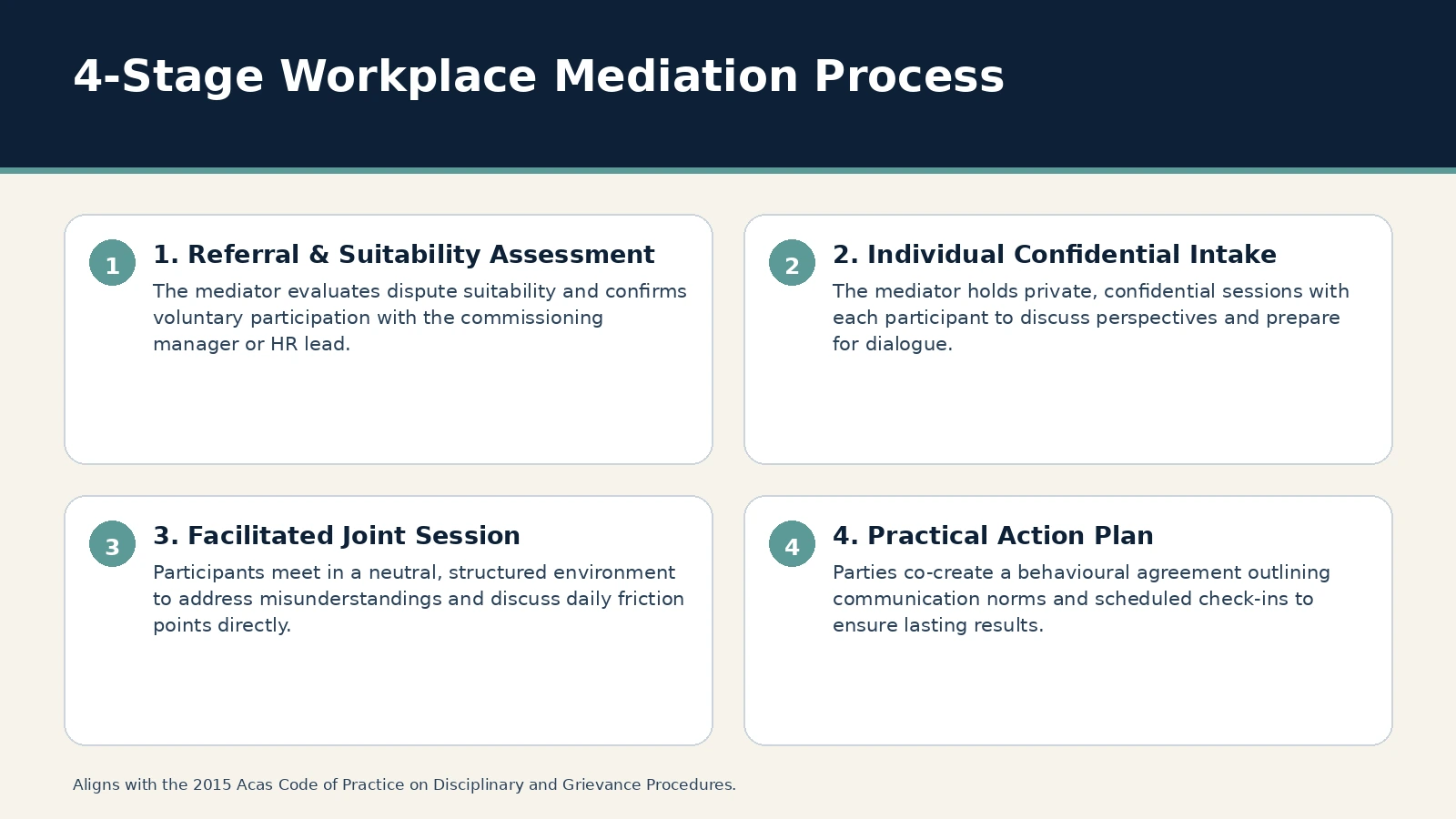
The 4-Stage Independent Workplace Mediation Process in Practice
Independent workplace mediation follows a disciplined, structured framework designed to guide participants from entrenched conflict toward a sustainable working compact. For organisations arranging workplace mediation in Derby, the intervention is typically delivered over a single focused day or across structured sessions to minimise operational downtime.
1. Referral and Suitability Assessment
The engagement begins with a consultation between the mediator and the commissioning manager or HR lead. This intake step confirms whether the dispute is suitable for mediation and verifies that all participants are willing to take part voluntarily. If a formal grievance procedure has already commenced, the employer and employee may agree to pause internal grievance procedures safely while mediation takes place.
The mediator sets clear procedural parameters with the organisation. Management is informed that while they will receive an agreed action plan or high-level summary at the end of the process, the private discussions, admissions, and personal perspectives explored during the sessions remain confidential between the parties and the mediator.
2. Individual Confidential Intake Sessions
The mediator meets with each participant individually for a private, uninterrupted discussion. These intake sessions give individuals the space to describe the dispute from their perspective, identify what has made working together difficult, and think through what a workable professional relationship looks like in practice. The mediator explains the ground rules, verifies mutual confidentiality, and helps each person prepare constructively for direct dialogue.
Individual sessions offer the psychological safety needed to step back from defensive stances. A participant who feels undermined by a colleague’s management or communication style can examine their specific operational triggers and define realistic, practical adjustments that would make day-to-day collaboration workable again.
3. Facilitated Joint Mediation Session
When both participants are prepared, the mediator convenes a joint session in a quiet, neutral environment. The joint meeting provides a structured space for participants to explain their views, clear up misunderstandings, and discuss daily friction points directly. The mediator guides the discussion, keeps the tone constructive, and assists the parties in shifting from past grievances to future working arrangements. Private caucus breaks allow either party to pause and consult with the mediator as needed.
The joint session is carefully managed to maintain balanced dialogue. The mediator steers participants away from generalised character judgements and toward concrete operational realities: handover protocols between shift leaders, methods for raising urgent engineering queries, and clear expectations for feedback during team meetings.
4. Practical Action Plan and Follow-Up
The process concludes with the co-creation of a practical, party-owned behavioural agreement. This document sets out agreed communication norms, clear handover steps, shared boundaries, and a straightforward approach for resolving minor friction in the future. The agreement remains confidential to the participants, though an agreed summary of operational commitments can be shared with line management to support implementation. Scheduled check-ins ensure that the agreed adjustments remain practical and effective over time.
Rather than relying on broad aspirations to communicate better, a durable action plan focuses on specific daily habits. For instance, the parties might agree that urgent project revisions are discussed by phone rather than over email, that operational queries between departments follow an agreed checklist, or that monthly check-ins are held to review project milestones collaboratively.
Evaluating Dispute Suitability: When to Commission Workplace Mediation in Derby
Recognising when mediation is the right intervention helps HR directors and operational heads protect both team performance and employee well-being. Workplace mediation in Derby is particularly effective when professional relationships have fractured but the individuals must continue working together to deliver core operations.
Workplace mediation is well suited to resolving:
- Peer-to-peer disputes: Colleagues whose interpersonal friction creates operational bottlenecks or undermines team morale.
- Manager-employee conflict: Disagreements over management styles, task allocation, or performance feedback that have generated informal grievances.
- Cross-departmental friction: Tensions between technical, operational, and commercial teams where conflicting functional priorities block workflow.
- Post-restructuring friction: Teams navigating interpersonal stress following departmental reorganisations, reporting realignments, or operational mergers.
- Return-to-work transitions: Re-establishing sustainable day-to-day relationships following an employee’s return from extended sickness absence or after a formal investigation has concluded.
Conversely, mediation is not designed to replace formal investigations where there are credible allegations of serious misconduct, physical violence, fraud, or unlawful harassment requiring statutory findings of fact. In those circumstances, formal disciplinary or grievance mechanisms must proceed.
Preparing Your Organisation for Workplace Mediation in Derby
To give independent mediation the best chance of producing lasting improvements, HR professionals and leadership teams should establish supportive conditions before the sessions begin.
Ensuring Voluntary and Informed Participation
Mediation depends on genuine, voluntary engagement. Employees must understand that their participation is an open choice rather than a mandatory management instruction or a disciplinary condition. Presenting mediation as an opportunity for both parties to design their own practical solution away from formal procedural records encourages authentic dialogue and mutual ownership of the outcome.
Providing a Dedicated, Neutral Environment
Conducting mediation away from daily operational noise is essential for maintaining focus. If sessions are held on company premises, choose a private meeting room well away from the participants’ immediate workspace, ensuring that discussions cannot be overheard and daily tasks will not interrupt the process. Off-site venues across Derby often provide the ideal neutral setting, giving participants the mental distance needed to focus entirely on resolution.
Supporting Agreed Operational Compacts
Line management plays a pivotal role in embedding the outcomes of workplace mediation in Derby. While managers do not attend the private mediation sessions, they must support the operational adjustments agreed by the participants. Respecting the confidentiality of the discussions and allowing agreed communication protocols the time and space to take root gives teams the foundation they need to maintain healthy working relationships over the long term.
For organisations across Derby and the wider Derbyshire region, addressing interpersonal friction early preserves valuable specialist talent, reduces management strain, and protects organisational performance. If your organisation is managing internal friction and you wish to assess whether a structured intervention is appropriate, you can speak to an EDR mediator to discuss practical next steps.
Frequently asked questions
Is workplace mediation in Derby legally binding on the participants?
Standard workplace mediation produces a practical, future-focused behavioural agreement rather than a legally binding contract. The agreement reflects commitments made between colleagues regarding communication, day-to-day collaboration, and working arrangements. Because it is owned by the participants, compliance is built on mutual clarity rather than contractual enforcement, though separate formal legal agreements can be prepared if required.
Can an employee be required to attend workplace mediation?
No. Under the Acas framework, workplace mediation is an entirely voluntary process. While employers can encourage staff to participate and explain the practical benefits of resolving issues informally, compelling an unwilling employee undermines the openness and trust required for genuine resolution.
What happens if a formal grievance is already underway?
If a formal grievance procedure has already commenced, the employer and employee can agree to pause the formal timetable to attempt workplace mediation. If mediation reaches a successful resolution, the employee often chooses to withdraw the grievance. If mediation does not resolve the issue, the formal procedure can resume from where it was paused, with neither party disadvantaged by having attempted mediation.
Are discussions during workplace mediation kept confidential from HR and management?
Yes. Discussions within mediation are private and confidential between the participants and the mediator. Matters discussed cannot be disclosed to HR, management, or used in subsequent hearings without both parties’ consent, subject to standard exceptions such as serious safety risks or unlawful conduct. Typically, only the agreed action plan or an agreed summary is shared with management to support implementation, subject to the parties’ agreement and standard legal exceptions.
Authoritative UK guidance and further reading
Primary and official sources
- Pride network – Our Derbyshire (staff.derbyshire.gov.uk)
- New employment rights: Guidance for businesses and workers (business.gov.uk)
- Plan to Make Work Pay and Employment Rights Act: timeline update – GOV.UK (gov.uk)
Further professional reading
- Acas consultation: draft Code of Practice on disciplinary and grievance procedures | Acas (acas.org.uk)
This guide provides general information about dispute resolution and mediation. It is not legal advice. The appropriate approach depends on the facts, documents, procedural position and the parties involved; obtain legal advice where required.