

In brief
The question: When should an employer offer facilitative mediation for bullying allegations rather than initiating an adversarial formal grievance investigation?
The short answer: Effective workplace dispute resolution depends on distinguishing between interpersonal relationship breakdowns and serious misconduct. Facilitative mediation is appropriate when bullying complaints stem from interpersonal friction, communication breakdowns, management style clashes, or perceived incivility, and both parties voluntarily agree to work on their professional relationship. In contrast, formal grievance machinery remains essential where complaints involve allegations of unlawful harassment under the Equality Act 2010, gross misconduct, physical threats, or where disciplinary sanctions are being sought. Employers can pause a formal grievance timetable by mutual agreement to explore mediation, retaining the right to resume formal procedures if mediation does not achieve an agreed outcome.
Interpersonal Friction vs Formal Misconduct: Understanding the Bullying Continuum
When an employee submits a complaint citing workplace bullying, operational leaders and HR directors face an immediate procedural challenge. The term is applied across a broad spectrum of organisational tension, from abrasive feedback in high-pressure environments and perceived micromanagement to targeted mistreatment. However, in England and Wales, bullying has no standalone statutory definition in employment law. Conduct generally acquires formal legal significance when it constitutes unlawful harassment under the Equality Act 2010 or breaches the implied contractual term of mutual trust and confidence.
Traditional grievance processes are designed around retrospective fact-finding and evidence evaluation. An appointed investigator examines historical interactions, reviews correspondence, interviews colleagues, and determines whether an allegation is substantiated under internal organisational policies. While this investigative structure is necessary when addressing conduct that may warrant formal disciplinary measures, applying it to nuanced interpersonal friction often produces unintended organisational consequences.
When colleagues who share operational responsibilities are drawn into an investigative process, their daily working relationship rarely emerges intact. Preparing formal statements, producing selected email exchanges, and participating in separate investigative interviews inevitably encourages defensive posturing. The focus shifts toward justifying past actions and disproving the other person’s account, rather than examining how two professionals can establish functional boundaries moving forward.
In contrast, engaging professional workplace mediation offers an alternative framework that concentrates on direct communication and behavioural change. Where friction reflects unaligned working styles, unchecked misunderstandings, or differing expectations around autonomy and oversight, facilitative mediation provides a confidential setting in which both individuals can explain their experience, understand the operational effect of their interaction, and agree on practical rules for future collaboration.
Navigating Workplace Dispute Resolution: Comparing Mediation and Grievance Routes
Selecting the appropriate pathway requires an understanding of how informal dialogue and formal investigation differ in their operational focus, procedural dynamics, and long-term effect on team cohesion. The matrix below outlines how these two approaches operate in practice.
| Dimension | Workplace Mediation | Formal Grievance Investigation |
|---|---|---|
| Dispute Focus | Forward-looking: improving communication, clarifying expectations, and agreeing practical working boundaries. | Backward-looking: examining past evidence to determine whether specific allegations are substantiated under policy. |
| Process Ownership | Voluntary and party-driven: participants retain control over the issues they discuss and the commitments they make. | Employer-led: the investigator directs witness evidence, reviews documentation, and determines findings of fact. |
| Relationship Impact | Encourages direct dialogue, addresses mutual friction, and seeks to re-establish working collaboration. | Can heighten polarisation between colleagues by requiring formal statements, witness involvement, and fault-finding. |
| Outcome Structure | A confidential, consensual behavioural compact tailored to the participants’ daily operational reality. | A formal written report with findings (substantiated or unsubstantiated) and recommendations for management. |
| Procedural Status | Can run informally or pause an active grievance timetable by mutual written consent. | Governed by organisational policy, relevant employment contracts, statutory employment protections, and the Acas statutory benchmark of procedural fairness. |
Neither approach is suitable for every situation. A formal grievance investigation remains the appropriate mechanism when an employer must establish accountability or consider disciplinary action. Facilitative mediation provides a constructive route when the fundamental objective is restoring collaboration, reducing workplace stress, and establishing workable communication protocols.
A Practical Triage Framework for HR and Operational Leaders
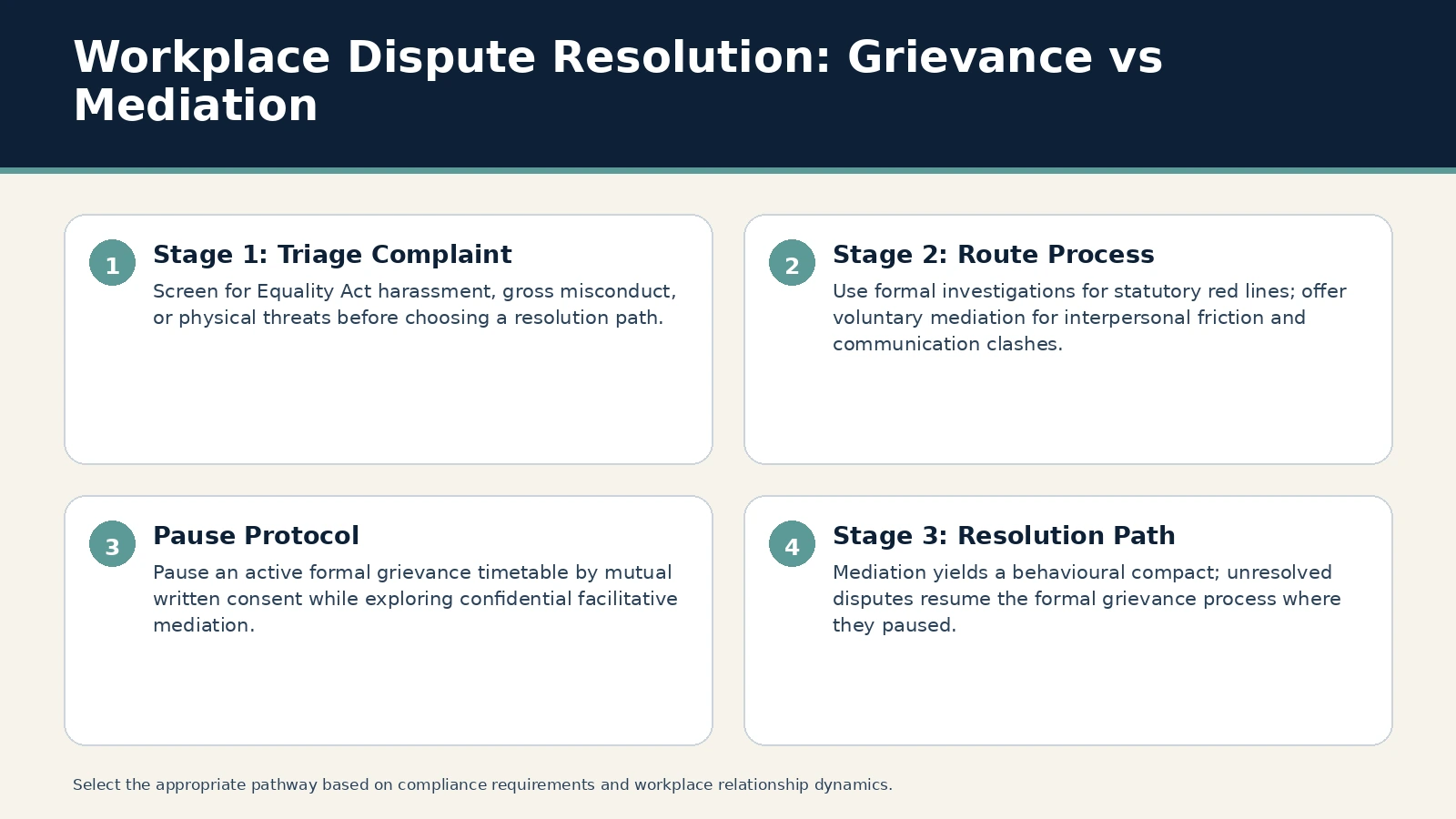
To determine the most appropriate approach to workplace dispute resolution, HR leaders and executive managers should evaluate complaints against established operational criteria, identifying whether the situation involves non-negotiable compliance issues or interpersonal friction.
Screening for Non-Negotiable Red Lines
Mediation is not an alternative to disciplinary action and should never be used to bypass mandatory employer obligations. An organisation must proceed with a formal investigation where a complaint involves:
- Allegations of unlawful discrimination, harassment, or victimisation linked to protected characteristics under the Equality Act 2010.
- Physical violence, explicit threats of harm, or severe intimidating behaviour.
- Financial impropriety, fraud, or gross misconduct requiring disciplinary review.
- Circumstances where the complainant explicitly seeks formal disciplinary sanctions that only an employer-led investigation can determine.
Assessing Interpersonal Suitability
Where statutory red lines and gross misconduct are absent, facilitative mediation offers substantial benefits when the following practical factors are present:
- Ongoing operational necessity: The individuals must continue to interact, collaborate on project deliverables, or share management responsibilities within the team.
- Subjective behavioural friction: The dispute centres on interpersonal friction, perceived tone in electronic communication, feedback delivery styles, perceived micromanagement, or differing professional expectations.
- Voluntary willingness to engage: Both individuals freely agree to participate. Workplace mediation cannot be mandated by management; compulsory attendance removes the personal agency necessary for genuine resolution.
- Shared interest in functional change: Both parties recognise that the current working dynamic is unsustainable and express an openness to agreeing operational boundaries.
For a detailed discussion on addressing communication failures between colleagues before positions harden, refer to our guide on workplace communication breakdowns.
The Grievance-to-Mediation Pause Protocol: Protecting Process Integrity
A frequent operational dilemma for People Directors is how to offer informal resolution without undermining procedural fairness or appearing to minimise employee concerns. Under the statutory benchmark of the Acas Code of Practice on Disciplinary and Grievance Procedures—where unreasonable failure to comply gives Employment Tribunals discretion under section 207A of the Trade Union and Labour Relations (Consolidation) Act 1992 to adjust compensation awards by up to 25%—employers are explicitly encouraged to explore informal resolution and mediation at any stage where appropriate.
When a formal grievance has been submitted, an employer can establish a structured pause protocol to explore mediation while maintaining procedural integrity.
Transparent Consultation
The HR lead or senior manager discusses the mediation option with the complainant and the respondent in separate conversations. This discussion explains that mediation is confidential, forward-looking, and voluntary. The employer makes clear that exploring mediation is not an attempt to dismiss the complaint, but an opportunity to resolve the underlying friction directly and quickly.
Mutual Written Agreement to Pause the Grievance
If both colleagues agree to participate, the organisation documents in writing that the formal grievance timetable is paused by mutual consent for an agreed period. This written confirmation explicitly records that if mediation does not result in an outcome acceptable to the participants, the formal grievance procedure will resume at the exact stage where it was paused. For an operational examination of procedural management during active complaints, consult our guide on pausing procedures during a formal grievance.
Facilitated Private and Joint Sessions
An impartial workplace mediator conducts separate individual meetings with each participant. These private sessions allow each person to articulate their perspective, identify key friction points, and consider what changes would make their working arrangement functional. If both parties remain willing to proceed, the mediator facilitates a structured joint session. The mediator does not act as an investigator, determine liability, or assign blame. Instead, they guide a professional conversation focused on clarifying misaligned assumptions, understanding the operational effect of behaviour, and exploring workable solutions.
Establishing a Functional Behavioural Compact
When mediation is successful, the participants co-create a clear, written behavioural agreement tailored to their day-to-day responsibilities. Rather than relying on broad aspirations, an effective agreement establishes practical operational commitments, such as:
- Defined channels, response times, and formats for daily work requests and project updates.
- Agreed protocols for delivering constructive performance feedback and handling professional disagreements privately.
- Expectations for professional interactions in group meetings and cross-departmental forums.
- Clear operational boundaries regarding task handovers, review sign-offs, and escalation routes when deadlines face pressure.
- A scheduled internal review point between the participants to evaluate how the agreed arrangements are functioning in practice.
Operational Implementation and Post-Mediation Reintegration
Reaching an agreed behavioural compact is a critical milestone, but the long-term success of workplace dispute resolution relies on thoughtful post-mediation reintegration. HR leaders and line managers play a vital supporting role in enabling the agreed arrangements to take root without intruding upon the confidential nature of the mediation itself.
Because the detailed discussions within mediation remain confidential between the participants and the mediator, management is typically provided only with the agreed action points that require operational support. This separation protects employee trust while allowing the business to allocate resources, adjust reporting lines if mutually requested, or schedule collaborative check-ins.
Operational managers should schedule structured thirty, sixty, and ninety-day reviews with both individuals independently. These check-ins focus exclusively on operational functionality: Are the agreed communication channels working smoothly? Are project handovers occurring without friction? Is feedback being delivered according to the agreed format? By maintaining consistent, neutral oversight, HR ensures that minor misunderstandings are resolved immediately before they accumulate into renewed interpersonal tension.
Confidentiality and Sustainable Workplace Dispute Resolution
Confidentiality is an essential foundation of effective workplace dispute resolution. What is discussed during mediation remains private between the participants and the mediator. Matters disclosed within the process are not reported to HR, senior management, or grievance investigators, unless both individuals expressly agree to share a summary of their agreed outcome. This procedural confidentiality gives colleagues the reassurance needed to discuss interpersonal tensions openly, acknowledge their own contribution to communication breakdowns, and negotiate practical working arrangements without concern that their comments will be cited in formal proceedings.
By applying structured triage and offering facilitative mediation for interpersonal friction, organisations protect operational capacity, reduce absence driven by workplace stress, and support teams in establishing sustainable working relationships. Where an organisation faces complex interpersonal friction and requires an impartial professional to facilitate resolution, you can contact Echelon Dispute Resolution to discuss whether workplace mediation is appropriate for your circumstances.
Frequently asked questions
Can an employer force an employee to attend mediation instead of hearing their formal grievance?
No. Workplace mediation is strictly voluntary and requires the genuine consent of both parties. An employer cannot compel an employee to mediate, nor can they refuse to hear a formal grievance simply because mediation was declined. Forcing participation undermines the trust required for constructive resolution.
What happens to a formal grievance if workplace mediation does not result in an agreement?
If the parties pause a formal grievance to attempt mediation and the process does not achieve an agreed outcome, the formal grievance procedure simply resumes from the point at which it was paused. Discussions held during mediation remain confidential and cannot be introduced as evidence in the resumed grievance investigation.
Does participating in workplace mediation mean the employer is sweeping bullying allegations under the carpet?
No. Facilitative mediation is an active, structured method of addressing the root causes of interpersonal conflict. It allows parties to establish firm behavioural boundaries and accountability. Mediation is particularly effective for resolving interpersonal conflict and communication breakdowns, but it is generally unsuitable where serious misconduct requires formal disciplinary investigation or where a formal determination of statutory rights is needed.
What is typically included in a workplace mediation agreement?
A workplace mediation agreement is a private, forward-looking behavioural compact drafted and agreed by the participants. It typically sets practical ground rules for daily communication, meeting conduct, delegation protocols, feedback mechanisms, and agreed steps to take if friction arises again in the future.
Authoritative UK guidance and further reading
Primary and official sources
- Solve a workplace dispute: Mediation, conciliation and arbitration – GOV.UK (gov.uk)
- Plan to Make Work Pay and Employment Rights Act: timeline update – GOV.UK (gov.uk)
- Workplace sexual harassment and third-party harassment (business.gov.uk)
- Statutory obligations regarding workplace bullying, harassment and safety – GOV.UK (gov.uk)
This guide provides general information about dispute resolution and mediation. It is not legal advice. The appropriate approach depends on the facts, documents, procedural position and the parties involved; obtain legal advice where required.