

In brief
The question: How can commercial landlords, residential property owners, developers, and local businesses in Lichfield resolve complex real estate, boundary, and tenancy disagreements without being drawn into protracted County Court litigation?
The short answer: Property dispute mediation in Lichfield provides a structured, private forum where disputing parties work with an independent mediator to negotiate a legally binding settlement. Rather than waiting for allocated trial dates at regional court centres in Walsall, Stafford, or Birmingham, parties can address operational friction, lease covenants, access rights, or boundary demarcations directly. Engaging in mediation complies with court expectations under the Civil Procedure Rules (CPR Parts 1 and 3) to explore settlement, while protecting parties from potential adverse costs sanctions under CPR Part 44 for unreasonable refusals to negotiate.
Local Property Disagreements Across Lichfield and South Staffordshire
Real estate conflicts across the Lichfield District rarely develop in a vacuum. They arise from the day-to-day realities of managing historic buildings, expanding commercial parks, shared accessways, and sensitive boundaries between residential and agricultural land. When a disagreement takes hold, the immediate challenge for property owners and commercial tenants is balancing the protection of their proprietary rights against the mounting disruption, distraction, and expense of a drawn-out dispute.
Engaging professional property dispute mediation services allows all sides to step back from entrenched correspondence and evaluate realistic commercial and physical outcomes. In Lichfield, Shenstone, Whittington, and the surrounding commercial corridors, several distinct categories of dispute benefit from early mediation:
- Historic City Centre Leases and Mixed-Use Buildings: Along central streets such as Market Street, Bird Street, Bore Street, and Tamworth Street, older and listed properties present complex management challenges. Disagreements frequently emerge over interim and terminal dilapidations liabilities, the apportionment of service charges, unauthorised alterations, and disputes over lease renewals or break-clause conditions.
- Logistics, Industrial, and Commercial Estate Operations: At major employment hubs including Fradley Park and Burntwood Business Park, operational friction often centres on shared infrastructure. Typical conflicts involve heavy goods vehicle turning rights, obstructed loading bays, allocated parking enforcement, yard maintenance cost allocation, and unclear boundaries between adjacent industrial plots.
- Semi-Rural Boundaries and Agricultural Easements: Across South Staffordshire’s rural periphery, physical landscape features—such as ancient hedgerows, drainage ditches, shared tracks, and field boundaries—frequently diverge from modern Land Registry title plans. These discrepancies create bitter and costly disagreements over rights of way, drainage access, and livestock fencing.
- Development Land and Construction Access: Infill residential schemes, commercial extensions, and brownfield redevelopments across the district regularly trigger friction regarding crane oversailing licences, temporary construction access, party wall disagreements, and contested rights of light or services connection points.
For broader strategic insight into landlord and occupier negotiations, see our dedicated guide on property dispute mediation for real estate and lease conflicts.
Why Property Dispute Mediation in Lichfield Offers a Practical Alternative to Court
When informal dialogue stalls, issuing formal court proceedings in the County Court is often considered the natural next step. However, local civil and property claims originating in Lichfield are generally allocated to regional hearing centres, including Walsall County Court, Stafford Combined Court Centre, or the Birmingham Civil and Family Justice Centre. These regional centres handle extensive civil caseloads across the West Midlands, which can result in listing backlogs, procedural case management hearings, and escalating legal costs long before a trial takes place.
Civil courts actively expect parties to attempt alternative dispute resolution before trial. Under the Civil Procedure Rules (CPR Parts 1 and 3), judges possess wide case management powers to encourage alternative dispute resolution, including staying active proceedings to allow property dispute mediation in Lichfield to occur. Furthermore, under CPR Part 44, the court exercises discretion over costs orders, taking into account the conduct of the parties—including whether a party unreasonably refused to engage in mediation. An unyielding refusal to negotiate can result in adverse costs penalties, even for a party that partially succeeds at trial.
Beyond meeting procedural expectations, choosing property dispute mediation in Lichfield gives the parties direct control over their resolution. Rather than spending months awaiting a formal judgment from a judge who has no ongoing relationship with the property, the parties can craft bespoke agreements that reflect operational priorities, physical constraints, and sensible commercial compromises.
Comparing Resolution Routes: Civil Property Mediation vs Regional Court Proceedings
Evaluating the practical differences between private property dispute mediation and regional County Court litigation assists property owners, directors, and landlords in choosing an effective dispute resolution strategy.
| Decision Factor | Civil Property Mediation | Regional County Court Litigation |
|---|---|---|
| Decision-Making Control | Parties retain complete autonomy; outcomes require mutual agreement. | A judge decides the matter based strictly on legal merits and available evidence. |
| Scheduling and Speed | Convened swiftly on a mutually agreed date at a local venue or online. | Subject to regional court listing schedules and procedural timetables. |
| Scope of Settlement | Flexible, creative agreements (e.g., revised boundaries, access licences, phased repairs). | Limited to formal legal and equitable remedies, declarations, or financial damages. |
| Confidentiality and Privacy | Private and confidential discussions conducted without public disclosure. | Public court proceedings, judgments, and potential public register entries. |
| Commercial Relationships | Constructive structure designed to preserve ongoing neighbour or tenant ties. | Adversarial dynamic that can permanently damage working relationships. |
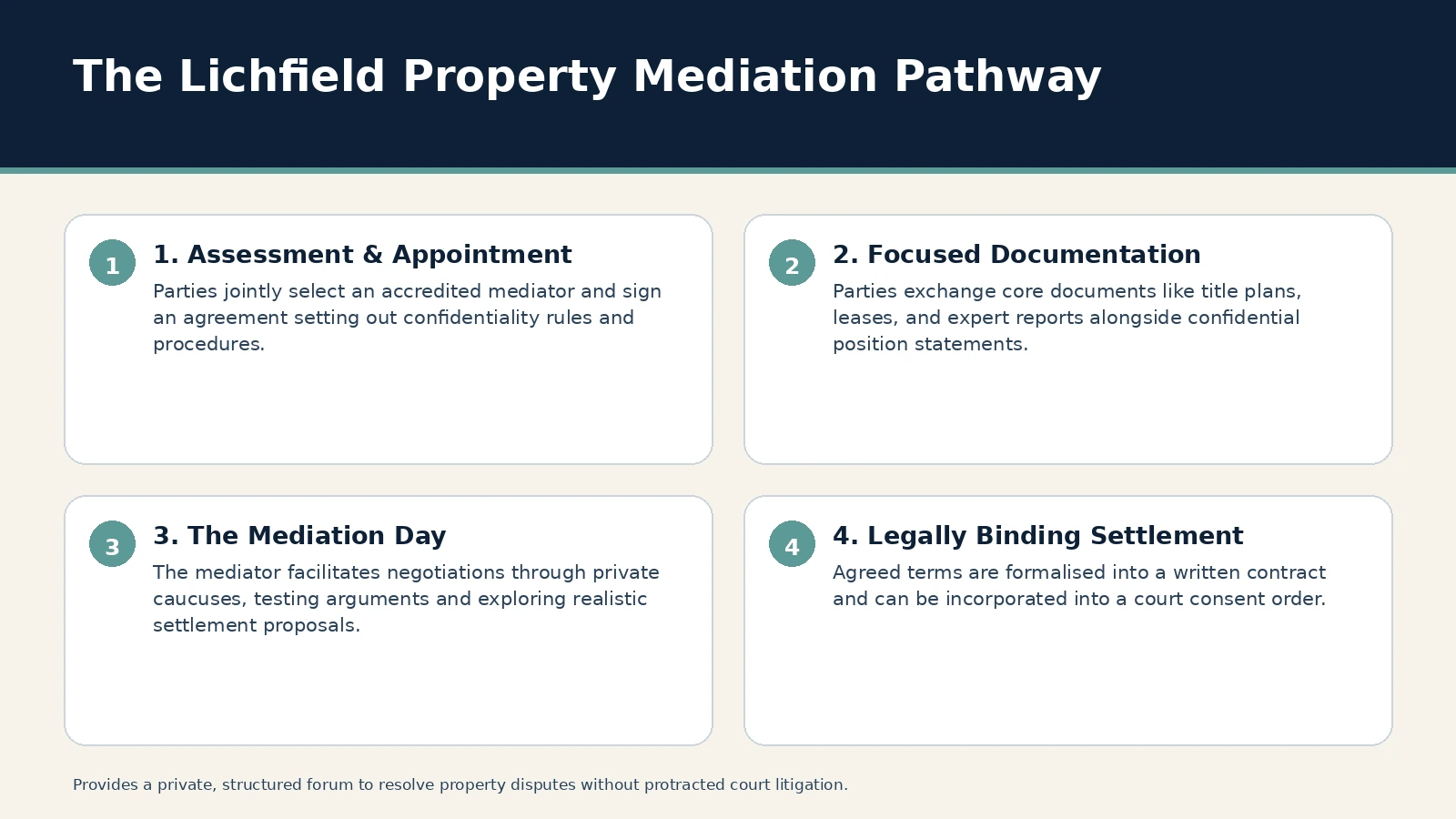
The Property Mediation Pathway: From Document Exchange to Settlement
A structured property dispute mediation in Lichfield moves through four distinct, manageable stages designed to shift parties from fixed positions toward realistic, mutually beneficial solutions.
1. Initial Assessment and Mediator Appointment
The process begins when both sides agree to mediate—either voluntarily prior to issuing proceedings, or under a formal stay granted by the court. The parties jointly select an accredited mediator who understands commercial property, land law principles, and practical construction issues. The mediator ensures there are no conflicts of interest, agrees on the administrative arrangements, and has both parties sign a standard property mediation agreement that sets out the ground rules of confidentiality and procedural fairness.
2. Focused Document Bundles and Position Statements
Clear, objective documentation forms the backbone of effective real estate negotiations. Before the mediation date, both parties exchange a focused bundle containing core documents: Land Registry title registers and title plans, lease agreements, expert surveyor reports, photographic evidence, and key correspondence. Each party also prepares a short, confidential position statement for the mediator. This statement sets out the background, key factual contentions, commercial objectives, and potential areas of flexibility that might not be openly disclosed to the other side at the outset.
3. The Mediation Day: Exploration and Private Caucuses
On the mediation day—held at a neutral venue in Lichfield or conducted securely online—the mediator establishes a collaborative working environment. While an initial joint meeting may take place to confirm the timetable and ground rules, the majority of the day is conducted through private caucuses (separate rooms for each party). The mediator shuttles between the rooms, testing the realistic strengths and weaknesses of each argument, exploring underlying motivations, and facilitating realistic settlement proposals that address both sides’ core needs.
4. Drafting and Formalising the Settlement Agreement
Once acceptable terms are reached, the parties and their legal advisers reduce the agreement into a formal, written Settlement Agreement. In property disputes, this often includes practical schedules: detailed plans showing agreed boundary lines, surveyor-supervised repair timetables, access covenants, or financial settlement terms. Once signed, the agreement forms a legally binding contract. If court proceedings have already been issued, the terms can be incorporated into a formal consent order to conclude the litigation.
To understand the breadth of disputes where this process is applied, explore our property and real estate disputes hub.
Preparing the Property Bundle and Practical Evidence
Thorough preparation directly influences the effectiveness of property dispute mediation in Lichfield. Arriving with well-organised, objective evidence allows discussions to focus on realistic problem-solving rather than speculative debate. When compiling materials for mediation, consider the following practical elements:
- Title Plans and Conveyance History: Secure official Land Registry title registers and title plans. If the dispute concerns historic access rights or boundary alignments, locate pre-registration conveyance deeds and plans, which often contain exact measurements and relevant covenants not fully detailed on general title plans.
- Independent Technical and Surveyor Reports: In disputes involving structural defects, tree root ingress, drainage failures, or dilapidations, obtaining an independent surveyor’s report or schedule of condition provides an objective baseline for discussing remedial works and cost apportionments.
- Visual and Spatial Evidence: Clear, date-stamped photographs, aerial imagery, or drone footage of the disputed area—whether showing a shared access yard, boundary fence, or right of way—help clarify physical conditions without requiring site visits during the mediation session.
- Financial and Commercial Documentation: In commercial lease conflicts, assemble rent records, service charge reconciliations, schedules of dilapidations, and repair estimates to support any financial adjustments or settlement figures.
- Decision-Making Authority: Ensure that those attending the mediation have the full authority to agree to settlement terms, including financial commitments, boundary realignments, or lease variations, so that a final agreement can be signed on the day.
Structuring Practical Real Estate Solutions
A significant advantage of property dispute mediation in Lichfield is the flexibility to design practical arrangements that court judgments rarely accommodate. While litigation typically results in an all-or-nothing outcome focused on declarations or damages, mediation allows parties to create workable, tailored compromises.
In retail and commercial lease disputes in central Lichfield, mediation can produce structured rent repayment plans, agreed surrender dates with agreed dilapidations caps, or agreed licences for alterations that allow tenants to carry out necessary refits. In business park yard and access disputes, parties frequently agree on dedicated vehicle delivery timetables, designated parking allocations, or cost-sharing mechanisms for road resurfacing. In boundary and easement conflicts, settlements routinely involve agreeing on surveyor-marked boundary lines, the installation of shared acoustic fencing, or the grant of formal deeds of variation to resolve ambiguous historic rights.
If you are managing a commercial lease dispute, boundary disagreement, or property conflict in Staffordshire and wish to explore structured settlement options, contact Echelon Dispute Resolution to discuss how an experienced civil mediator can assist your case.
Frequently asked questions
Why should local property owners consider mediation before issuing court claims?
Mediation provides a swift, confidential, and cost-controlled process to resolve property conflicts. It avoids the listing delays associated with regional trial centres in Walsall, Stafford, or Birmingham, while allowing parties to craft practical commercial solutions that protect ongoing relationships and comply with Civil Procedure Rule expectations.
What types of real estate disputes in Lichfield are suitable for mediation?
Nearly all civil and commercial property disputes can be mediated, including commercial lease renewals, dilapidations, service charge disagreements, business park access disputes, boundary line conflicts, rights of way, and party wall disagreements across Lichfield and South Staffordshire.
How long does a property dispute mediation usually take?
Most property mediations are completed within a single structured day or a series of planned sessions. Prior to the mediation day, parties typically spend a short period preparing document bundles and confidential position statements with the mediator.
Is a settlement reached during property mediation legally binding?
Yes. Once terms are agreed, the parties and their legal advisers draft and sign a formal Settlement Agreement. This document becomes a legally binding contract under English law. If court proceedings have already commenced, the agreement can be formalised into a court consent order.
Authoritative UK guidance and further reading
Primary and official sources
- Birmingham Circuit Commercial Court – Courts and Tribunals Judiciary (judiciary.uk)
- Courts and Tribunals Judiciary (judiciary.uk)
- Courts and Tribunals Judiciary (judiciary.uk)
- Civil – Civil Procedure Rules – Justice UK (justice.gov.uk)
This guide provides general information about dispute resolution and mediation. It is not legal advice. The appropriate approach depends on the facts, documents, procedural position and the parties involved; obtain legal advice where required.