

In brief
The question: When facing complex commercial litigation, should corporate decision-makers select Early Neutral Evaluation (ENE) to test legal merits, or pursue facilitative dispute resolution mediation to negotiate a confidential business settlement?
The short answer: Early Neutral Evaluation and dispute resolution mediation serve distinct strategic functions. ENE provides an independent, non-binding legal appraisal from an experienced evaluator—such as a senior barrister, retired judge, or sector specialist—designed to challenge partisan assumptions and clarify trial risks on specific legal or technical issues. In contrast, commercial mediation allows the parties themselves to construct tailored, commercially workable agreements through confidential negotiation. While an evaluator assesses past liability and contractual terms, an accredited mediator helps parties explore forward-looking solutions, restructured supply arrangements, and practical financial compromises. Parties can also deploy both mechanisms sequentially, using an evaluation upstream to calibrate legal risk before entering mediation to settle the wider dispute.
Core Distinction: Testing Legal Merits vs Crafting Commercial Terms
Commercial disputes do not always stall solely because of factual complexity; differing legal interpretations, valuations, and tactical considerations often also impede settlement. More often, impasse arises from divergent expectations of how a trial judge would interpret a contract, assess quantum, or apportion liability. When direct negotiations stall, parties must decide whether their impasse requires an evaluative reality check or a facilitated commercial negotiation through commercial mediation.
Early Neutral Evaluation is an evaluative process. The parties appoint an independent legal specialist to review written submissions, evidence, and key documents. The evaluator delivers an objective, non-binding opinion on the merits of the claim, the relative strength of each party’s arguments, and the likely range of outcomes if the dispute proceeds to trial. The primary value of ENE lies in tackling entrenched optimism. Disputing parties frequently convince themselves that their legal position is unassailable. An objective evaluation provides an unvarnished assessment of legal risk, enabling boards and in-house counsel to re-evaluate their exposure before incurring substantial trial costs.
Facilitative dispute resolution mediation operates on an entirely different premise. The mediator does not judge the merits, evaluate legal prospects, or issue a ruling. Instead, an independent neutral works confidentially with all parties to uncover underlying commercial priorities, bridge communication breakdowns, and structure consensual settlement terms. Where an evaluator examines past conduct under legal rules, a mediator helps the parties look forward, exploring practical business remedies such as restructured payment plans, contract variations, or revised scopes of work.
Under Paragraph 8 of the Practice Direction – Pre-Action Conduct and Protocols, parties are expected to consider whether negotiation, mediation, early neutral evaluation, or another dispute resolution process could resolve their dispute before issuing court proceedings. Selecting the appropriate mechanism depends on whether the primary barrier to settlement is legal uncertainty or commercial deadlock.
Comparative Framework: Evaluating ENE Against Dispute Resolution Mediation
Choosing the appropriate pathway requires legal teams and managing directors to evaluate several practical dimensions: the level of control they wish to retain, the nature of the outcome sought, and the broader commercial relationship. For deeper insight into how structured dispute resolution influences expenditure, see our guide on mediation vs litigation costs in contract disputes.
| Strategic Dimension | Early Neutral Evaluation (ENE) | Facilitative Commercial Mediation |
|---|---|---|
| Primary Focus | Independent merits assessment and legal trial-risk appraisal | Interest-based negotiation and commercial problem-solving |
| Role of the Neutral | Independent evaluator delivering an objective opinion on legal issues | Impartial facilitator structuring dialogue without advising or judging |
| Party Control | Parties submit evidence but delegate the assessment to the neutral | Parties retain complete control over whether and on what terms to settle |
| Nature of Outcome | Non-binding written or oral legal evaluation (unless agreed otherwise) | Legally binding settlement agreement upon signature by all parties |
| Remedial Scope | Focused on contractual rights, legal remedies, and pleaded claims | Flexible, bespoke commercial arrangements tailored by mutual agreement |
| Relationship Impact | Structured analysis of past conduct and legal default | Collaborative engagement focused on preserving or concluding trading ties |
As the comparison illustrates, ENE serves as an advisory reality check, whereas commercial mediation is an active settlement engine. In ENE, the neutral’s opinion provides valuable intelligence, but it does not bring the dispute to an end on its own. The parties must still agree on how to act on that opinion. In mediation, the primary goal is typically to facilitate negotiations towards a binding settlement, which may resolve the dispute in whole or in part, or help narrow the issues.
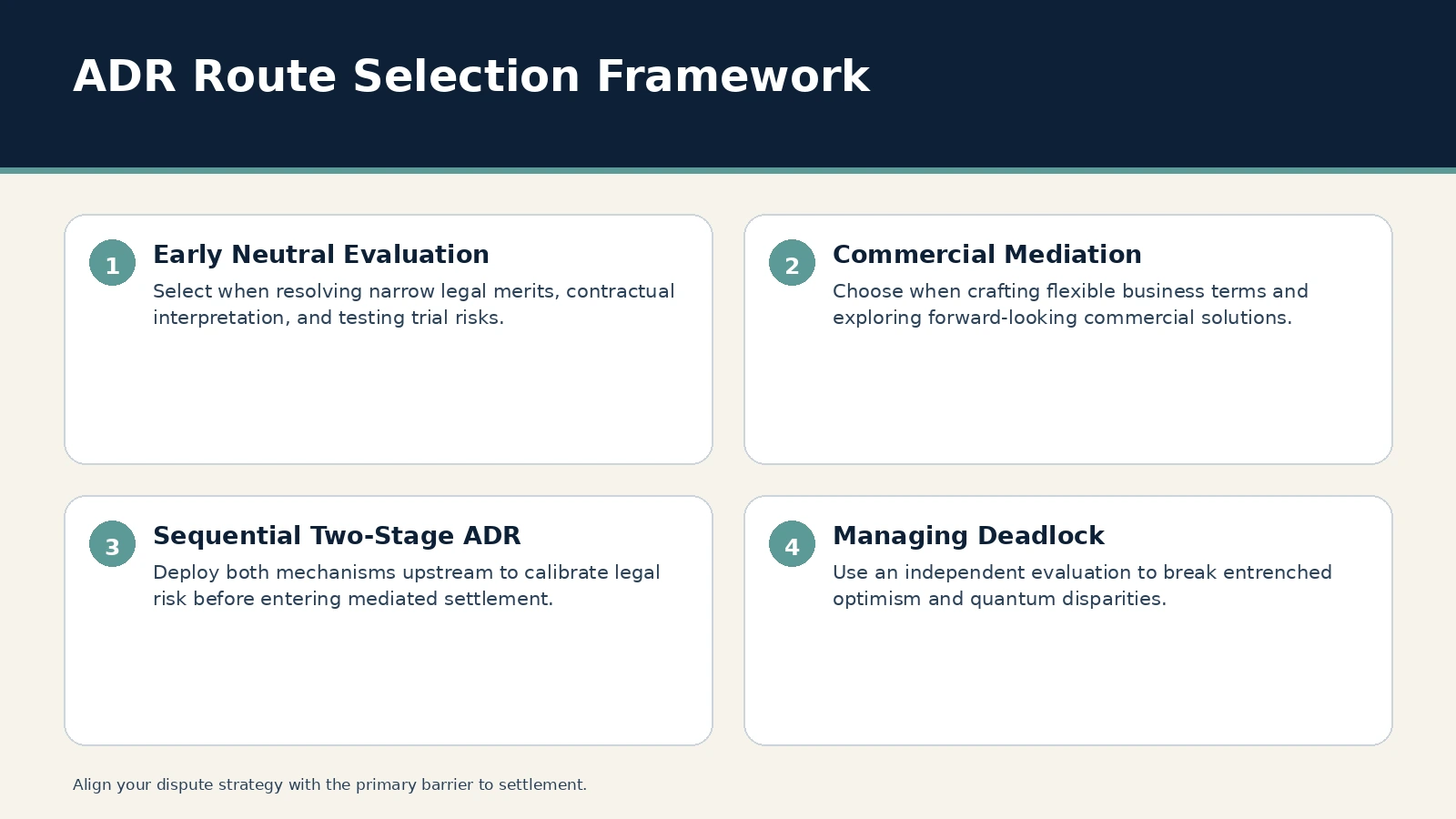
Navigating Deadlock: When an Evaluative Opinion Unlocks Negotiation
There are specific commercial disputes where facilitative negotiation alone struggles to gain traction. In such cases, obtaining an independent evaluation can serve as a catalyst for meaningful discussion.
1. Entrenched Optimism on a Pure Point of Law
When two well-advised commercial entities take fundamentally opposing views on a narrow legal issue—such as the construction of an exclusion clause, the validity of a termination notice, or the interpretation of a contractual formula—negotiations often stall. Each side’s legal team may provide conflicting assurances of success. In this scenario, facilitative dispute resolution mediation can struggle because neither party feels compelled to compromise on quantum. An ENE provides an authoritative, neutral perspective on that specific legal pivot, breaking the deadlock and allowing subsequent settlement discussions to proceed on a realistic foundation.
2. Extreme Quantum Disparity and Technical Complexity
In complex commercial claims involving loss of profits, warranty breaches, or delayed project delivery, parties frequently advance widely disparate damage assessments. Where accounting assumptions or technical methodologies clash directly, an independent expert evaluator can assess which quantum methodology is more robust under the contract terms. This helps the parties narrow the financial gap before attempting to negotiate final figures.
3. Governance and Board-Level Mandate Reassessment
Corporate directors and in-house counsel manage organizational risk carefully. When a litigation team faces an entrenched board, credit committee, or foreign parent company that insists on defending a claim on principle, an independent ENE assessment from a respected senior practitioner can provide the objective evidence required to adjust settlement mandates. To understand how procedural timing influences negotiation leverage, review our guidance on settlement strategy and ADR timing.
Strategic Considerations of the Evaluative Route
While Early Neutral Evaluation offers clear benefits for resolving narrow legal questions, it also introduces tactical factors that commercial parties should weigh carefully:
- Impact on Negotiating Leverage: If the neutral evaluator delivers an opinion that questions your primary legal argument, your counterpart’s settlement expectations may harden immediately. What was once an open commercial discussion may become more rigid.
- Absence of Automatic Finality: Because an ENE opinion is non-binding by default, a party that receives an unfavourable evaluation remains free to proceed towards trial, leaving the dispute unresolved and adding an extra procedural step.
- Focus on Historical Conduct: Evaluators review legal rights based on past events and contractual drafting. They do not structure forward-looking commercial solutions, such as future contract restructuring or revised service delivery terms, which often form the basis of a lasting business resolution.
- Managing Procedural Costs: While less expensive than a full trial, commissioning detailed ENE position statements and retaining a specialist evaluator represents a distinct upfront cost that does not itself execute a binding agreement.
Where the dispute involves ongoing commercial relations, intellectual property sharing, or multiparty contracts, an interest-based process like dispute resolution mediation provides a wider canvas to explore mutual value without triggering adverse win-lose reactions.
Designing a Two-Stage Strategy: Combining ENE with Dispute Resolution Mediation
Commercial dispute resolution does not require an absolute choice between an evaluative appraisal and a facilitated negotiation. Litigants often employ a sequential, two-stage dispute strategy that harnesses the distinct strengths of both mechanisms.
Stage One: Targeted Early Evaluation
The parties agree to submit a defined legal or technical question to an independent neutral for an expedited, non-binding opinion. By limiting the evaluation to a specific gateway issue—such as the meaning of a disputed indemnity or the enforceability of a liquidated damages clause—the parties keep procedural costs manageable while obtaining the objective insight needed to test their litigation risk. To manage this stage effectively, parties should establish precise written terms of reference, agreeing on the specific documents to be submitted, the timetable for written submissions, and whether the evaluation will be delivered in writing or via a private evaluative conference.
Stage Two: Facilitated Commercial Mediation
Armed with the neutral’s appraisal, the parties transition into confidential dispute resolution mediation. The evaluator’s opinion serves as a realistic benchmark for risk, reducing posturing and recalibrating subjective settlement expectations. The mediator then assists the commercial decision-makers in navigating the broader dispute, exploring flexible remedies, structuring payment terms, and crafting a comprehensive settlement agreement.
This sequential approach is particularly effective in high-value contract claims, joint venture disputes, and supply chain conflicts where legal uncertainty blocks commercial pragmatism. For further detail on managing breach claims, explore our analysis of contract dispute mediation for commercial breaches.
Procedural Mechanics: Setting Up ENE and Mediation Effectively
To implement either process successfully, legal teams must establish clear procedural ground rules before entering the room or exchanging written bundles.
Drafting the Evaluation Agreement
When selecting Early Neutral Evaluation, the parties must formalise the evaluator’s scope of authority in a bespoke agreement. Key provisions should specify whether the evaluator is assessing liability, quantum, or a discrete point of contractual construction. The agreement should confirm that the process is strictly confidential, that the resulting opinion is inadmissible in subsequent court proceedings, and that the evaluator cannot be called as a witness if the matter proceeds to trial.
Structuring the Mediation Agreement
In facilitative mediation, the standard tripartite agreement provides for confidentiality and confirms that discussions are conducted on a without prejudice basis, subject to established legal and statutory exceptions. It also establishes the mediator’s neutral role, ensuring that the mediator will not offer legal advice or impose terms, leaving commercial principals with complete autonomy over the final agreement.
Practical Preparation for Commercial Decision-Makers
Whether pursuing ENE, commercial mediation, or a hybrid combination, thorough preparation is essential to achieving an optimal commercial outcome. Corporate teams should focus on four core preparation pillars:
- Identify the True Settlement Barrier: Determine whether your primary obstacle is an unresolved legal argument (favouring ENE) or an impasse over commercial terms, risk appetite, and relationship dynamics (favouring mediation).
- Select the Right Neutral Profile: For an ENE, parties require a subject-matter expert with deep specialist experience whose opinion carries clear authority. For commercial mediation, parties require a skilled process facilitator adept at managing complex commercial negotiations, exploring value-creation options, and maintaining constructive dialogue.
- Clarify Decision-Making Authority: Ensure that the commercial representatives attending the process possess full authority to negotiate and conclude a binding settlement agreement during the session, without needing external sign-off from absent executives.
- Define Commercial Priorities Beyond Legal Claims: Identify practical settlement variables—such as extended payment schedules, altered delivery milestones, confidentiality terms, or future supply opportunities—that can bridge financial differences.
- Align Internal Stakeholders Early: Ensure operational managers, finance teams, and legal advisers share a unified assessment of acceptable settlement ranges, identifying alternative commercial options if primary negotiation targets are not achieved.
By assessing whether the conflict requires a diagnostic legal evaluation or a facilitated commercial negotiation, leadership teams can select the most effective forum. Engaging in structured dispute resolution mediation early provides commercial principals with direct control over the resolution, containing litigation expenditure while preserving strategic business relationships.
If you are assessing the most effective dispute pathway for an active commercial claim, you can contact Echelon Dispute Resolution to discuss whether commercial mediation may be suitable for your dispute.
Frequently asked questions
What is the primary difference between Early Neutral Evaluation and commercial mediation?
Early Neutral Evaluation (ENE) provides an independent, non-binding legal appraisal of the merits of a dispute from an experienced evaluator. Commercial mediation is a confidential negotiation process where an impartial mediator helps the parties explore practical business solutions and reach their own binding settlement without expressing a formal ruling on who would win at trial.
Is an Early Neutral Evaluation legally binding on the parties?
An Early Neutral Evaluation is non-binding by default. It provides an objective assessment of the strengths and weaknesses of each side’s legal arguments. However, parties can agree in writing before the process begins that they will accept the evaluator’s opinion as binding, though this is less common in commercial disputes.
Can commercial parties use both ENE and mediation in the same dispute?
Yes. Parties can adopt a sequential approach where a narrow legal or technical interpretation point is submitted to ENE first. Once the neutral evaluator provides an objective appraisal on that issue, the parties convene a facilitative mediation to negotiate a commercial settlement based on those calibrated risks.
What happens if a party receives an unfavourable ENE opinion?
Because ENE is non-binding by default, a party receiving an unfavourable opinion is not legally bound by it and can still proceed to litigation. However, an unfavourable evaluation usually influences negotiating expectations and provides a clear reason to reassess settlement strategy and financial mandates before incurring further trial costs.
How do pre-action rules encourage parties to consider ENE and mediation?
Pre-action protocols expect parties to consider whether negotiation, mediation, early neutral evaluation, or another dispute resolution method could resolve their dispute before issuing court proceedings, helping to narrow issues and avoid unnecessary litigation.
Authoritative UK guidance and further reading
Primary and official sources
- The Civil Procedure (Amendment No. 3) Rules 2024 (legislation.gov.uk)
- service.gov.uk (assets.publishing.service.gov.uk)
- The Civil Procedure Rules 1998 (legislation.gov.uk)
- Civil – Civil Procedure Rules – Justice UK (justice.gov.uk)
This guide provides general information about dispute resolution and mediation. It is not legal advice. The appropriate approach depends on the facts, documents, procedural position and the parties involved; obtain legal advice where required.