

In brief
The question: How can businesses, property owners, and individuals in Stafford resolve civil and commercial disagreements quickly and cost-effectively without enduring formal litigation at the County Court?
The short answer: Engaging in independent mediation civil disputes stafford provides a structured, private negotiation process led by an accredited mediator. Rather than waiting for contested hearings at the Stafford Combined Court Centre, disputing parties can explore pragmatic, legally binding settlements in a single session. This facilitative approach allows commercial operators, landlords, contractors, and individuals to maintain direct control over settlement terms, preserve working business relationships, and avoid the disproportionate costs and procedural delays associated with formal litigation.
Local Commercial and Property Friction: Why Civil Disputes Escalate in Stafford
Civil disagreements across Stafford and the wider Staffordshire area rarely happen in isolation. Local commerce relies on interconnected supply chains, regional trade partnerships, agricultural interfaces, and commercial landlord-tenant arrangements. When a contractual breach occurs, a boundary line is contested, or construction works stall, the dispute frequently involves parties who operate within the same local business community or geographical network.
When disagreements escalate toward formal proceedings at the Stafford Combined Court Centre, several distinct operational pressures emerge:
- Listing timetables and procedural friction: Court administrative workloads mean cases can take considerable time to reach trial, tying up working capital, diverting management focus, and creating prolonged operational uncertainty.
- Escalating expenditure: Legal representation, court fees, and expert witness costs can accumulate rapidly, creating financial exposure that becomes disproportionate to the actual sum in dispute.
- Public exposure and damaged trading relationships: Contested court hearings are public. The adversarial nature of litigation often polarises positions, making future collaboration, trade credit, or ongoing commercial interaction impossible.
To avoid these outcomes, parties involved in civil and commercial disagreements increasingly choose private dispute resolution. Opting for commercial mediation services allows organisations and private individuals to address the practical substance of their dispute confidentially, before legal costs expand and working relationships deteriorate beyond repair.
The Strategic Role of Mediation Civil Disputes Stafford
When selecting a path for resolving contentious matters, commercial decision-makers in Staffordshire must balance risk, speed, and enforceability. Choosing mediation civil disputes stafford provides an effective mechanism for testing the strengths and weaknesses of each side’s position in a controlled, non-adversarial setting. Rather than waiting for external judicial intervention, the parties use the mediator’s independent facilitation to examine practical options that align with their operational realities.
In many regional conflicts—whether concerning commercial tenancy dilapidations along the town centre, unpaid sub-contractor invoices on local developments, or professional services disputes—the underlying disagreement is often compounded by miscommunication, differing interpretations of contract variations, or cash-flow constraints. Independent mediation creates a forum where these factors can be analysed openly without compromising a party’s legal position if the matter does ultimately proceed to trial.
Evaluating Resolution Paths: Mediation Civil Disputes Stafford vs. County Court Litigation
When assessing how to handle civil conflict, parties must weigh the practical differences between private dispute resolution and contested court litigation. The Civil Procedure Rules in England and Wales expect disputing parties to consider Alternative Dispute Resolution (ADR) prior to trial. An unreasonable refusal to participate in mediation can lead the court to impose adverse costs sanctions at the conclusion of a case, regardless of who wins the substantive argument.
Beyond costs protection, the primary advantage of civil dispute mediation in Stafford lies in autonomy and flexibility. In court, a judge is limited to legal remedies—primarily awarding monetary damages, dismissing claims, or granting specific injunctions. By contrast, mediation enables the parties to negotiate tailored arrangements that reflect genuine commercial needs, such as renegotiated payment schedules, rectified scopes of work, or restructured lease agreements.
For organisations evaluating their options across the region, our Staffordshire dispute mediation guidance provides additional regional context on managing local dispute risks.
| Decision Dimension | Civil Dispute Mediation | County Court Litigation |
|---|---|---|
| Control over Outcome | The parties retain full authority; no settlement is binding until mutually agreed and signed. | A judge decides the matter and imposes a legally binding judgment after a contested hearing. |
| Flexibility of Remedies | Permits tailored commercial solutions, revised contracts, staged payments, or agreed practical actions. | Limited to formal legal remedies, such as monetary judgment awards, interest, or dismissals. |
| Confidentiality & Privacy | Conducted in private; discussions and terms remain confidential between the participants. | Conducted in open court, with judgments and proceedings forming part of the public record. |
| Relationship Preservation | Facilitates constructive dialogue, helping to maintain working, supply, or neighbourly ties. | Adversarial process that often polarises the parties and damages ongoing commercial connections. |
| Procedural Efficiency | Can be arranged within days or weeks; substantive negotiations typically conclude in a single session. | Subject to formal court timetables, standard disclosure phases, and local court listing availability. |
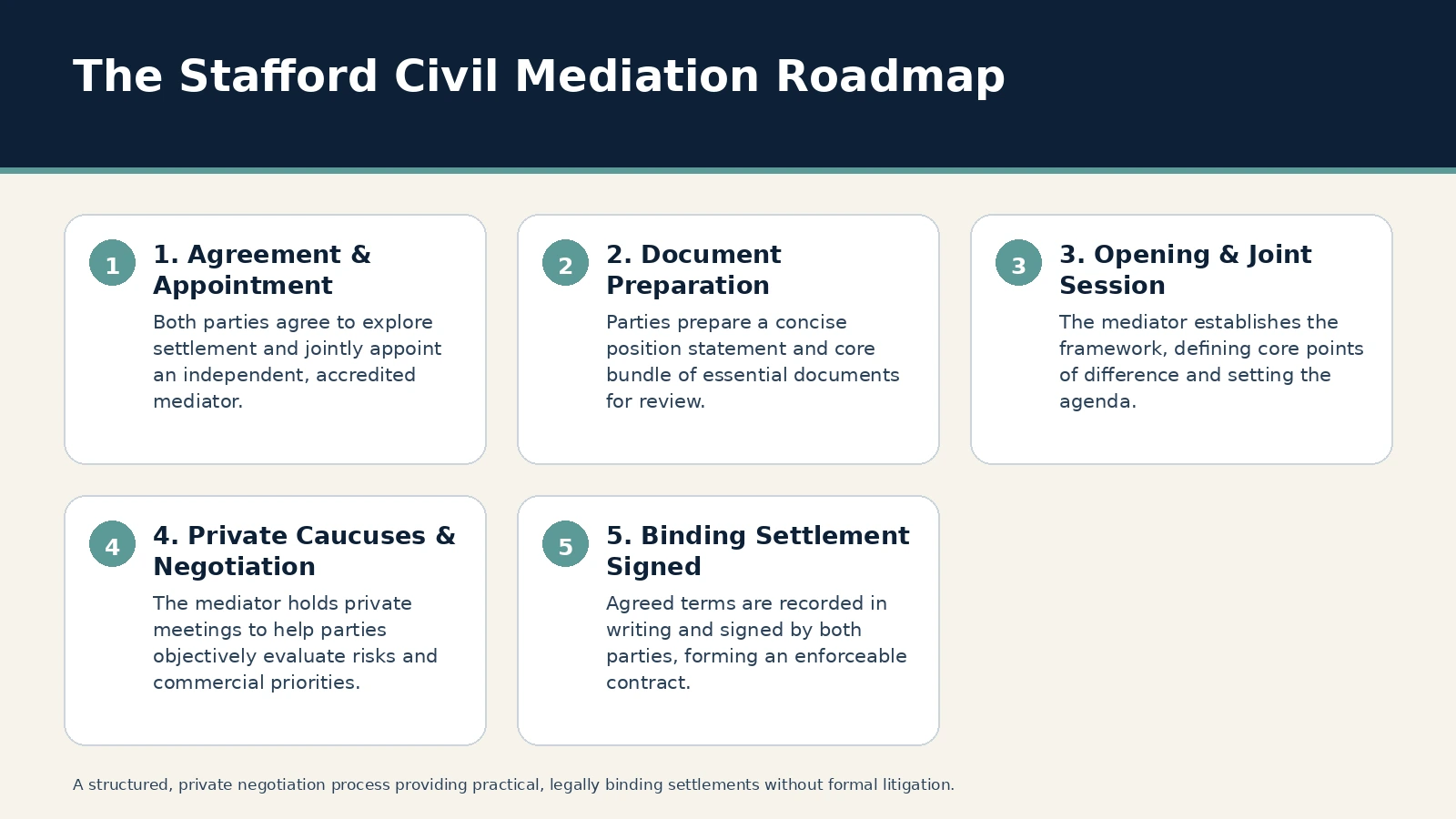
The 5-Stage Civil Mediation Process for Stafford Disputes
The structured process of civil mediation civil disputes stafford ensures that both sides have a fair, balanced platform to express their position, test legal risks, and build practical settlement terms. The procedure follows five distinct stages:
1. Agreement to Mediate and Mediator Appointment
The process begins when both parties agree to explore settlement and jointly appoint an independent, accredited mediator. The mediator confirms appointment terms, establishes a structured timetable, and sets clear ground rules ensuring fairness, independence, and confidentiality throughout the process.
2. Preparation and Document Exchange
Each party prepares a concise summary of the dispute—often referred to as a position statement—alongside a core bundle of essential documents. This material is shared with the mediator and exchanged with the other party ahead of the session, ensuring discussions focus on substantive issues rather than procedural disagreements.
3. Opening and Joint Exploration
On the mediation day—which can take place at a neutral business venue in Stafford or via a secure online platform—the mediator sets the working framework. Where appropriate, the parties may participate in a joint opening session to define the core points of difference and set a clear agenda for the day.
4. Private Caucuses and Commercial Negotiation
The substantive negotiation occurs primarily through private meetings, known as caucuses. The mediator moves between private rooms, helping each party objectively evaluate legal risks, financial exposure, and commercial priorities. The mediator will not disclose private information to the opposing room without permission or consent, unless required to do so by law, creating a secure environment for candid discussions.
5. Binding Settlement Agreement
When consensus is reached, the agreed terms are recorded in writing and signed by both parties. Once signed, the agreement forms an enforceable legal contract. If court proceedings have already been issued, the agreement is typically recorded in a formal court order to stay proceedings while the terms are fulfilled.
Understanding these procedural steps is central to managing broader litigation risk; explore our mediation and ADR settlement strategy resources or read our guide on settlement strategy and CPR costs to see how proactive ADR aligns with Civil Procedure expectations.
Common Civil and Commercial Disputes Resolved via Mediation in Stafford
Independent mediation is well-suited to a broad spectrum of non-family civil and commercial disputes commonly encountered across the Stafford area. Because the process is flexible and confidential, it adapts effectively to conflicts involving both technical complexity and personal or commercial friction.
Contractual and Commercial Supplier Disputes
Commercial contracts often run into difficulties when supply costs fluctuate, delivery schedules slip, or specifications are subject to competing interpretations. In Stafford’s industrial, logistics, and retail sectors, litigation over unpaid invoices or disputed goods can swiftly exhaust working capital. Mediation enables businesses to examine account reconciliations, renegotiate supply pricing, or agree phased payment terms that protect cash flow while resolving outstanding liabilities.
Building, Construction, and Contractor Conflicts
Disputes between property owners, developers, main contractors, and specialist trades often involve multi-layered issues including defective workmanship claims, delayed completion, variations, and final account disputes. Rather than commissioning extensive expert reports for trial, parties can use mediation to agree practical remediation schedules, independent defect re-inspections, or adjusted final payment sums.
Commercial Property, Dilapidations, and Lease Renewals
Landlord and tenant disagreements over repair covenants, service charge allocations, lease covenants, and end-of-tenancy dilapidations can lead to prolonged standoffs. Mediation provides commercial landlords and tenants in Stafford with a private forum to negotiate lease variations, agreed works in lieu of damages, or managed exit arrangements without triggering public possession actions.
Neighbour, Boundary, and Property Rights Disagreements
Civil disputes regarding boundaries, rights of way, easements, and shared access points frequently generate high emotional distress and disproportionate legal costs. Contested court litigation over property boundaries often damages neighbourly relationships permanently. Through facilitative mediation, property owners can agree precise boundary demarcations, land registration updates, or shared maintenance covenants through practical compromise.
Practical Preparation: Documents, Roles, and Settlement Parameters
Successful civil mediation requires structured preparation. Parties who enter mediation civil disputes stafford with a clear understanding of their numbers, documents, and negotiating boundaries consistently achieve stronger commercial outcomes.
Organising Essential Documentation
Rather than assembling extensive files of correspondence, focus on the core evidence that directly influences liability and financial loss. Helpful materials include:
- The underlying commercial contract, purchase order, lease, or relevant agreement.
- Written variations, email exchanges, or site minutes that record key developments.
- Invoices, payment logs, and detailed schedules of financial loss or remediation costs.
- Independent professional reports, such as surveyor assessments or technical valuations, where factual matters are disputed.
Aligning Decision-Makers and Professional Advisers
Civil dispute mediation is most effective when individuals with authority to agree a financial settlement are present or readily contactable throughout the session. If a decision-maker must seek external board approval or corporate sign-off, this can stall momentum during sensitive negotiations. While legal advisers frequently attend to guide clients on rights and draft the final settlement terms, the process is client-led, keeping commercial priorities at the forefront.
Defining Settlement Boundaries and Walk-Away Parameters
Before the session begins, establish clear settlement parameters. Determine your best-case outcome, realistic compromise zones, and your walk-away point based on an objective evaluation of ongoing litigation costs, management disruption, and trial risks. Consider non-monetary elements that carry value—such as future supply terms, extended performance deadlines, agreed public statements, or mutual releases from ongoing liabilities.
Structuring and Enforcing the Mediated Agreement
A primary benefit of resolving civil disputes through facilitative mediation is the certainty and finality of the resulting agreement. While discussions during the mediation day remain confidential, the conclusion of a successful session results in a clear, written settlement document that binds both sides.
The settlement agreement typically details the exact financial figures to be paid, payment methods, definitive milestone dates, and any practical actions required (such as returning property, carrying out defined remedial works, or executing formal contract variations). Furthermore, the agreement will incorporate comprehensive waiver and release clauses confirming that all existing claims, counterclaims, and associated costs between the parties are fully settled.
Where formal court proceedings have already commenced prior to mediation, the settlement terms can be converted into a consent order (such as a Tomlin order) submitted to the County Court. This mechanism stays the litigation while preserving the right to enforce the agreed terms directly through the court system if a party fails to meet their obligations.
If you are managing an active dispute and wish to explore whether civil mediation is appropriate for your circumstances, you can contact Echelon Dispute Resolution to discuss scheduling, mediator appointment, and process suitability with our team.
Frequently asked questions
Is a mediated civil settlement legally binding in England and Wales?
Yes. While mediation discussions are confidential, once the parties reach an agreement and sign written terms of settlement, it creates a legally binding contract. If formal court proceedings have already started, the signed terms can be incorporated into a formal consent order (such as a Tomlin order), ensuring the settlement is fully enforceable through the courts if breached.
Can I bring my solicitor or legal adviser to civil mediation in Stafford?
Yes. Parties are welcome to attend mediation with their legal advisers. Solicitors provide valuable guidance during private caucuses, assess litigation risk, and assist in drafting the final binding settlement agreement. However, parties may also attend unrepresented if they feel confident managing commercial discussions directly.
What happens under Civil Procedure Rules if the opposing party refuses to mediate?
The Civil Procedure Rules in England and Wales expect disputing parties to consider Alternative Dispute Resolution (ADR) prior to trial. If a party unreasonably refuses an invitation to mediate, the court may impose adverse costs sanctions against them at the end of litigation, even if they ultimately win the underlying claim.
Can civil dispute mediation in Stafford take place online?
Yes. Mediation can be conducted in person at a neutral venue in Stafford or remotely using secure video conferencing. Remote mediation provides the same private caucus rooms, document sharing, and mediator facilitation while saving travel time and venue expenses for all participants.
Authoritative UK guidance and further reading
Primary and official sources
- parliament.uk (publications.parliament.uk)
- Rules & Practice Directions – Civil Procedure Rules – Justice UK (justice.gov.uk)
- PRACTICE DIRECTION – PRE-ACTION CONDUCT AND PROTOCOLS – Civil Procedure Rules – Justice UK (justice.gov.uk)
- Make a court claim for money: Resolve your claim through mediation – GOV.UK (gov.uk)
This guide provides general information about dispute resolution and mediation. It is not legal advice. The appropriate approach depends on the facts, documents, procedural position and the parties involved; obtain legal advice where required.