

In brief
The question: How can claimants, professionals, and indemnity insurers resolve professional negligence disputes through civil dispute mediation without incurring disproportionate court costs or exposing professional standing to public trial?
The short answer: Civil dispute mediation offers a structured, private forum that enables claimants, insured practitioners, and professional indemnity insurers to negotiate a binding settlement before trial costs exceed the underlying sum in dispute. Allegations of professional negligence against solicitors, accountants, or surveyors frequently involve divergent expert opinions and commercial tensions between a practitioner’s professional standing and an insurer’s economic exposure. Mediation provides a confidential setting where parties can explore flexible financial and non-monetary solutions—such as fee revisions, document releases, and mutual confidentiality—without requiring an admission of fault. Exploring mediation aligns with court expectations to treat formal litigation as a last resort, avoiding procedural costs penalties while delivering definitive commercial closure.
Escalating Expense and Polarised Evidence: Why Professional Negligence Claims Stall
Allegations of professional error rarely follow a straightforward path. When a client alleges that a conveyancing solicitor overlooked an onerous easement, an auditor failed to detect accounting irregularities, or a chartered surveyor misjudged property defects, the dispute quickly acquires layers of procedural and personal complexity. In these sensitive circumstances, participating in civil dispute mediation introduces a practical, neutral alternative to the financial friction and entrenched positions typical of such allegations.
A primary barrier to early resolution is the divergence of expert opinion. A claimant’s independent expert may identify departures from standard practice, while the defendant’s expert concludes the work fell within an acceptable band of professional judgment. In valuation and surveying disputes, English law acknowledges that properties lack a single-figure value; practitioners operate within recognised valuation margins, and an assessment within those boundaries cannot be held negligent. Rather than narrowing the gap, exchanging formal expert reports can harden positions, leaving the parties facing trial expenses to determine which technical interpretation a judge prefers.
As claims move towards formal proceedings, the commercial ratio between litigation spend and the underlying loss breaks down. Undertaking disclosure, questioning opposing technical witnesses, and funding court attendances can generate legal bills that rival or outstrip the damages claimed. Under pre-action principles, court action is treated as a last resort, with paragraph 12 of the Pre-Action Protocol for Professional Negligence providing that parties should consider alternative dispute resolution, such as civil dispute mediation, before issuing proceedings. Failing to heed this expectation carries costs risks: under CPR Rule 44.2(5)(e), civil courts possess express discretion to consider penalising a party in costs if they unreasonably fail to engage in alternative dispute resolution.
Beyond the legal fees, the management time absorbed by an ongoing claim imposes a steady operational drain. Partners and senior fee earners find their attention diverted from fee-earning client work to reconstructing historical files, drafting detailed witness statements, and conferring with defence counsel. For corporate and individual claimants, unresolved financial losses can restrict cash flow or disrupt business planning. The procedural timetable of formal litigation extends these uncertainties over many months, creating compounding overheads that both sides have a strong commercial interest in arresting early.
Furthermore, early dialogue in mediation allows parties to examine the real-world utility of continuing the fight. When each side steps back from formal correspondence, it becomes possible to assess whether the dispute is truly about irrecoverable capital losses or whether practical commercial accommodations—such as uncoupling intertwined commercial contracts, adjusting historic invoices, or completing unfinished advisory tasks—can restore commercial equilibrium without prolonged procedural conflict.
The Three-Way Negotiation Dynamic: Aligning Insured, Insurer, and Claimant
Unlike ordinary commercial contract disputes where two commercial entities negotiate directly across a table, professional liability negotiations involve a three-way negotiation dynamic. Understanding this operational triad is central to achieving an effective outcome through civil dispute mediation.
On one side sits the claimant, seeking financial redress for an alleged error and closure on an issue that has caused commercial disruption. On the opposing side sit two distinct interests operating within the defence camp: the insured practitioner and the professional indemnity insurance (PII) claims handler. Under standard professional indemnity policies, the insurer holds conduct of the defence and controls settlement funds. While the insurer evaluates the dispute through an economic lens—weighing potential damages, legal spend, and reserve levels—the practitioner is personally concerned with professional reputation, client goodwill, policy excesses, and the impact of a claim on future insurance renewals.
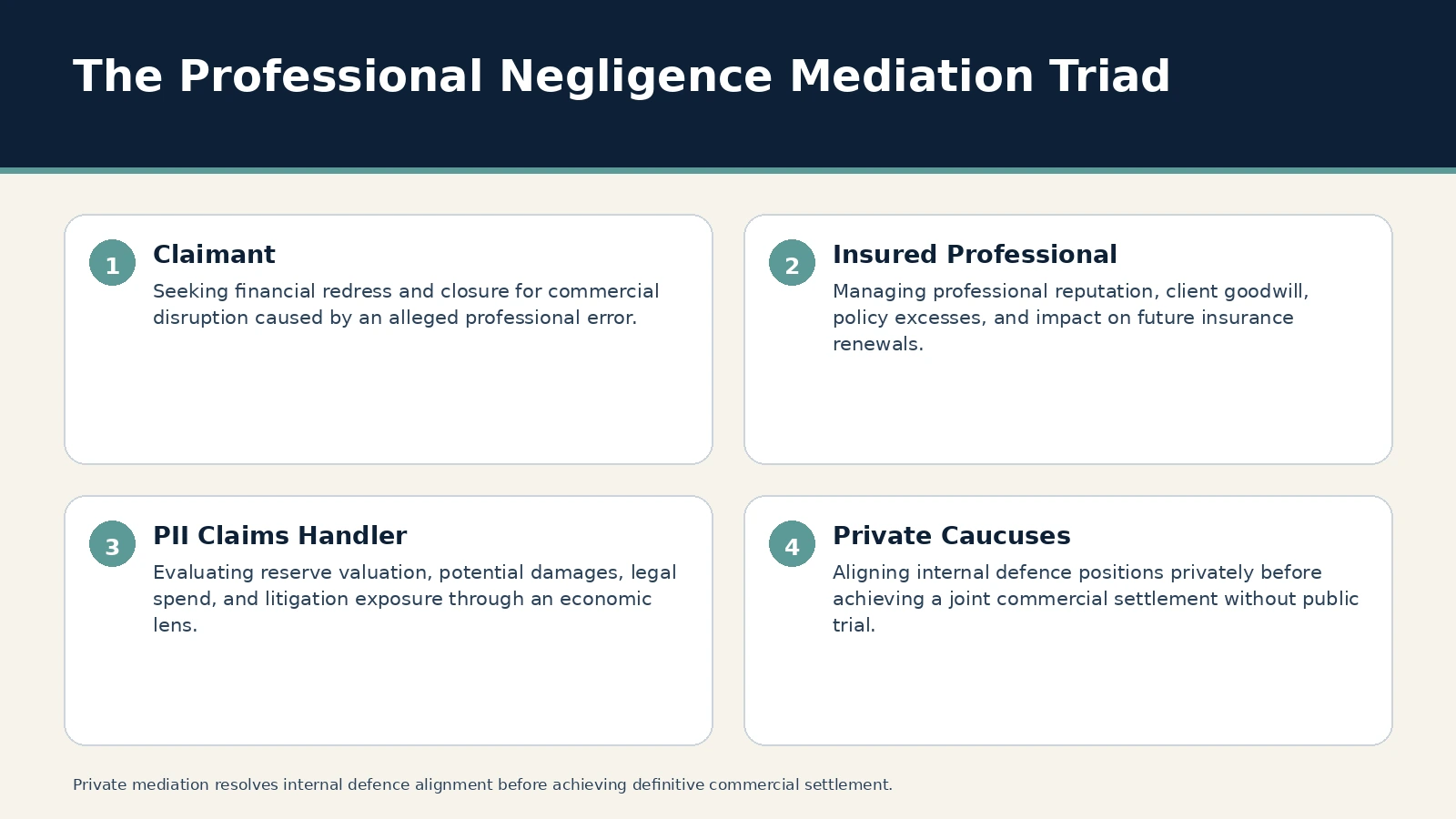
This dynamic within the defence room can complicate informal correspondence. A practitioner may feel defensive and resistant to making any settlement that implies poor competence, while an insurer may recognise that defending an unpredictable technical dispute at trial represents poor commercial risk. A structured mediation process allows these tensions to be addressed in confidence. In private meetings facilitated by a neutral mediator, the insurer and insured can align their commercial posture and discuss financial exposures without revealing internal policy debates to the claimant. This preparation enables the defence team to formulate a realistic settlement proposal that meets the claimant’s financial requirements while protecting the professional’s standing.
Inside the defence room, practical arrangements regarding policy excess payments and future risk profiles can also be evaluated calmly. An insured professional may be prepared to make a contribution within their uninsured excess if an overall compromise puts an end to partner time loss and public reputational risk. Conversely, an insurer can clarify how defensive litigation spend erodes policy limits or how protracted claims administration impacts insurance risk profiles. Resolving these internal questions privately is essential before any workable offer can be presented across the table.
The mediator’s role in this structure is to maintain open communication channels across both divides. By moving between rooms, the mediator helps the claimant understand the realistic boundaries of the insurer’s reserve valuation, while assisting the insured professional in separating personal frustration from commercial pragmatism. Addressing these concerns in separate discussions removes posturing, allowing each participant to explore compromise without prejudice to their formal legal positions.
Evaluating Resolution Paths: Formal Court Proceedings vs Civil Dispute Mediation
When professional negligence disputes stall, parties must decide whether to commit to public trial or explore consensual negotiation. While a court judgment provides an imposed, binding determination based on evidence, liability, and legal principles, it carries strict procedural constraints and public exposure that neither party can fully control. Parties considering their tactical approach can examine the strategic balance of settlement strategy and CPR costs protections to assess how early dispute processes protect their broader commercial position.
The table below outlines the core qualitative differences between proceeding through formal court litigation and resolving a professional negligence claim through civil dispute mediation:
| Decision Dimension | Formal Court Proceedings | Civil Dispute Mediation |
|---|---|---|
| Procedural Control | Strict procedural timetable directed by the court; judgment is imposed by a judge after evaluating legal evidence. | Flexible, consensual process managed by an independent mediator; settlement is agreed only when all parties consent. |
| Handling Expert Evidence | Adversarial examination of expert witnesses; judge decides which technical opinion to accept in an all-or-nothing outcome. | Confidential reality-testing of competing expert reports; parties acknowledge evidential risks and negotiate commercial compromises. |
| Confidentiality and Standing | Public court hearings and publicly published judgments, creating unavoidable professional and market visibility. | A private process where discussions are generally confidential, safeguarding professional goodwill and client relationships, subject to recognised legal exceptions. |
| Scope of Settlement Terms | Determines legal remedies such as financial damages, interest, and costs awards as established by law. | Broad commercial scope; allows fee waivers, return of files, structured payment plans, and non-disparagement agreements without admitting fault. |
| Costs and Risk Management | Incurs procedural expenditure; parties risk judicial costs sanctions under CPR 44.2(5)(e) if they fail to comply with an ADR order or unreasonably fail to engage in alternative dispute resolution. | Halts legal expenditure early; protects both parties from uncontrollable trial costs while meeting protocol expectations. |
Examining these process distinctions illustrates how civil dispute mediation enables parties to construct practical outcomes that reflect commercial realities rather than formal court outcomes. Parties are able to preserve existing business relationships where viable, or agree clean breaks that avoid prolonged public scrutiny. Any settlement reached can be concluded on an express basis containing no admission of liability. Detailed procedural tracks—such as intermediate or multi-track designations—are discussed further within our overview of civil disputes guidance.
Another major consideration when choosing between formal litigation and mediation is the preservation of third-party goodwill and ongoing commercial operations. When a professional firm is sued in court, current clients, lenders, and professional networks can quickly become aware of the dispute through industry reporting or public filings. In mediation, confidentiality provisions protect commercial standing from broader market disruption, enabling the firm to continue day-to-day operations with minimal reputational turbulence while the parties work towards an equitable, mutually accepted conclusion.
Preparing the Core Civil Dispute Mediation Bundle: Reports, Schedules, and Authority
Achieving a decisive outcome on the day of mediation requires careful, disciplined preparation. Because professional negligence claims turn on detailed factual records and expert scrutiny, arriving with incomplete documentation or unclear decision-making authority will undermine negotiations. Parties preparing for civil dispute mediation should focus their efforts on four fundamental areas:
- The core factual narrative: Rather than assembling voluminous lever-arch files containing every piece of background correspondence, prepare a focused bundle containing the original engagement letter, retainers, critical advice notes, key emails, and transaction documents directly relevant to the alleged breach.
- Expert valuation and liability reports: Ensure that expert witness evidence is focused on the central issue—whether the professional acted with reasonable skill and care. If the experts have produced joint statements highlighting points of agreement and disagreement, these should be placed prominently in the bundle.
- A substantiated schedule of loss: Claimants must outline their alleged damages with verifiable financial evidence rather than estimated calculations. Consequential losses, tax implications, or rectification costs must be substantiated so the insurer’s claims handler can adjust their settlement reserve accordingly.
- Clear settlement authority: The professional indemnity insurer must ensure their attending representative holds sufficient financial authority to conclude an agreement on the day. If attendance is remote, an open communication line with the claims committee or senior underwriter must be maintained to avoid late-afternoon negotiation bottlenecks.
Beyond documentation, managing communication between advisers on the day is critical. Legal representatives, expert advisers, and clients should clarify beforehand who will speak on technical points during joint sessions and who will lead on commercial proposals. When each attendee knows their role, negotiations progress smoothly and the mediation can focus on constructive problem-solving rather than procedural discord.
By bringing key decision-makers into a private, facilitated setting, mediation allows all sides to evaluate risk objectively and construct terms suited to their operational priorities. If you are assessing resolution options in an ongoing professional liability dispute, you can contact Echelon Dispute Resolution to discuss scheduling an independent civil mediator.
Frequently asked questions
Does participating in civil dispute mediation mean admitting professional fault?
No. Civil dispute mediation is a consensual, confidential negotiation. Any settlement reached can be concluded on an express basis containing no admission of liability. This allows professionals and insurers to resolve claims economically while safeguarding professional standing against an adverse public finding of negligence.
Can an insured solicitor, surveyor, or accountant settle a claim directly without their insurer?
No. Standard professional indemnity policies give the insurer full conduct of the defence. To preserve indemnity, professionals should not admit liability, offer payments, or agree settlements without their insurer’s consent, as doing so risks breaching policy conditions and entitling insurers to decline cover.
What happens if a party ignores an invitation to mediate a professional negligence claim?
Under pre-action principles, court action is treated as a last resort, with paragraph 12 of the Pre-Action Protocol for Professional Negligence providing that parties should consider alternative dispute resolution, such as civil dispute mediation, before issuing proceedings. If an invitation to mediate is unreasonably refused or ignored, the court can exercise its discretion under CPR Rule 44.2(5)(e) to penalise that party in litigation costs, even if they later win at trial.
What non-financial settlement terms can be agreed in professional negligence mediation?
Mediation allows for flexible commercial solutions, including waiving or abating outstanding professional fees, returning or releasing original client documents, executing formal letters of mutual apology, and entering into binding confidentiality and non-disparagement agreements.
Authoritative guidance and further reading
Primary and official sources
- Pre-Action Protocol for Professional Negligence – Civil Procedure Rules – Justice UK (justice.gov.uk)
- PART 44 – GENERAL RULES ABOUT COSTS – Justice UK (justice.gov.uk)
- James Churchill -v- Merthyr Tydfil County Borough Council – Courts and Tribunals Judiciary (judiciary.uk)
Further professional and framework reading
- About Mediation — Civil Mediation (civilmediation.org)
- hsfkramer.com (hsfkramer.com)
- Update to the Civil Procedure Rules: Court Power to Order ADR – Hamlins LLP (hamlins.com)
This guide provides general information about dispute resolution and mediation. It is not legal advice. The appropriate approach depends on the facts, documents, procedural position and the parties involved; obtain legal advice where required.