

In brief
The question: How can businesses, directors, and legal representatives resolve fast-track and intermediate-track civil money claims (£10,000 to £100,000) using civil dispute mediation before unrecoverable litigation expenditure erodes the commercial value of the dispute?
The short answer: Engaging in civil dispute mediation allows commercial parties to negotiate binding, tailored settlements before incurring heavy trial preparation expenses. In civil claims valued between £10,000 and £100,000, fixed recoverable costs cap the legal fees that can be recovered from an opponent, potentially leaving businesses with an unrecoverable shortfall. Civil mediation offers a confidential, structured forum to test practical arguments, restructure commercial arrangements, agree staged payments, and resolve claims efficiently while satisfying court expectations regarding dispute resolution engagement.
The Economics of Mid-Tier Claims: Fixed Costs and the Net Recovery Gap
Commercial litigation involving sums between £10,000 and £100,000 operates under strict financial realities in England and Wales. Standard money claims within this bracket are generally allocated to either the fast track (£10,000 to £25,000) or the intermediate track (£25,000 to £100,000). Under Part 45 of the Civil Procedure Rules (CPR), recoverable legal costs for these claims are capped according to fixed tables linked to the procedural stage reached.
While fixed costs provide certainty regarding adverse cost exposure, they introduce a distinct commercial challenge: the net recovery gap. If a business incurs substantial professional legal fees to pursue or defend an intermediate-track dispute through to trial, the statutory recoverable costs awarded to the prevailing party may only cover a predetermined portion of that expenditure. The shortfall must be funded from the client’s own resources or deducted directly from the damages recovered. When combined with potential court listing delays, running a mid-tier claim to a contested trial can turn a legal victory into a net financial deficit.
This dynamic alters the commercial calculation for claimants and defendants alike. For a claimant, an award of damages after incurring unrecoverable solicitor fees, counsel fees, and disbursements yields a significantly reduced net recovery—before accounting for internal management time. For a defendant, successfully defending a claim at trial may still leave an unrecovered legal bill. Civil dispute mediation addresses this balance directly. By bringing the dispute to an independent neutral before trial preparation expenses escalate, both sides can negotiate around realistic commercial outcomes rather than continuing to fund an uncommercial litigation process. To explore how early negotiation interacts with overall litigation exposure, parties often review how contract dispute mediation compares with litigation costs over the full lifecycle of a claim.
Strategic Timing: When to Propose Civil Dispute Mediation
Deciding when to propose civil dispute mediation is critical to maximising cost containment while ensuring both sides possess sufficient clarity to negotiate meaningfully. Mediating too early, before basic facts or quantum calculations are disclosed, can leave parties hesitant to commit. Conversely, waiting until witness statements are finalised and trial bundles are prepared forfeits the primary financial advantages of alternative dispute resolution.
In practice, commercial disputants evaluate two primary procedural windows for effective pre-trial engagement:
- Post-Letter of Response / Pre-Action Window: Initiating mediation once letters of claim and detailed responses have been exchanged allows the parties to evaluate core documentary evidence without incurring formal court issue fees or allocation costs. At this stage, legal costs remain modest, which means the parties’ settlement flexibility is not constrained by accumulated legal spend.
- Post-Allocation / Pre-Directions Window: Once proceedings are issued and allocated to the fast track or intermediate track, parties receive formal directions. Exploring mediation at this juncture enables the parties to explore a stay in proceedings and resolve the dispute before expert evidence, extensive disclosure, and witness preparations commence.
Civil courts in England and Wales actively encourage parties to engage in dispute resolution. Where a party unreasonably refuses an invitation to mediate, the court can take that conduct into account when assessing costs under CPR 44.2. Carefully timing a formal civil dispute mediation proposal demonstrates constructive engagement while protecting the client’s commercial position. Litigants planning their timetable often consult guidance on settlement timing and CPR costs strategy to identify optimal negotiation points.
Comparing Resolution Routes: Contested Court Determination vs Civil Dispute Mediation
The choice between taking a mid-tier claim through trial and resolving it via pre-trial civil dispute mediation involves distinct procedural, financial, and relational considerations. While court proceedings provide an authoritative, binding determination on legal rights, mediation allows parties to construct flexible solutions that reflect wider business practicalities, such as ongoing supplier relationships, modified delivery terms, or structured repayment schedules.
| Dispute Route | Control & Flexibility | Cost Recovery Dynamics | Settlement Scope |
|---|---|---|---|
| Fast-Track Litigation (£10k–£25k) | The litigation process is governed by court directions, with final determination decided by a judge at trial. | Recoverable legal fees are capped at statutory fixed sums; unrecovered legal expenditure is borne by the client. | Judicial determination on formal legal claims, resulting in a public court order (such as a financial judgment or dismissal). |
| Intermediate-Track Litigation (£25k–£100k) | Formal procedural timetable; restricted witness and expert evidence up to trial. | Stage-based fixed recoverable costs limit fee recovery, creating potential fee deficits if taken to trial. | Formal court judgment resolving legal rights; potential requirement for further enforcement steps. |
| Pre-Trial Civil Mediation | Parties retain complete control over whether to settle and on what commercial terms. | Predictable, shared mediator fee; avoids ongoing expenditure on trial preparation and expert reports. | Customised solutions agreed by consent, including restructured contracts, payment schedules, and mutual releases. |
Inside the Process: How Civil Dispute Mediation Operates in Practice
Understanding how a commercial mediation unfolds helps legal representatives and business directors approach the session with confidence. Unlike formal court hearings, civil dispute mediation is an adaptable, confidential process managed around the parties’ practical needs.
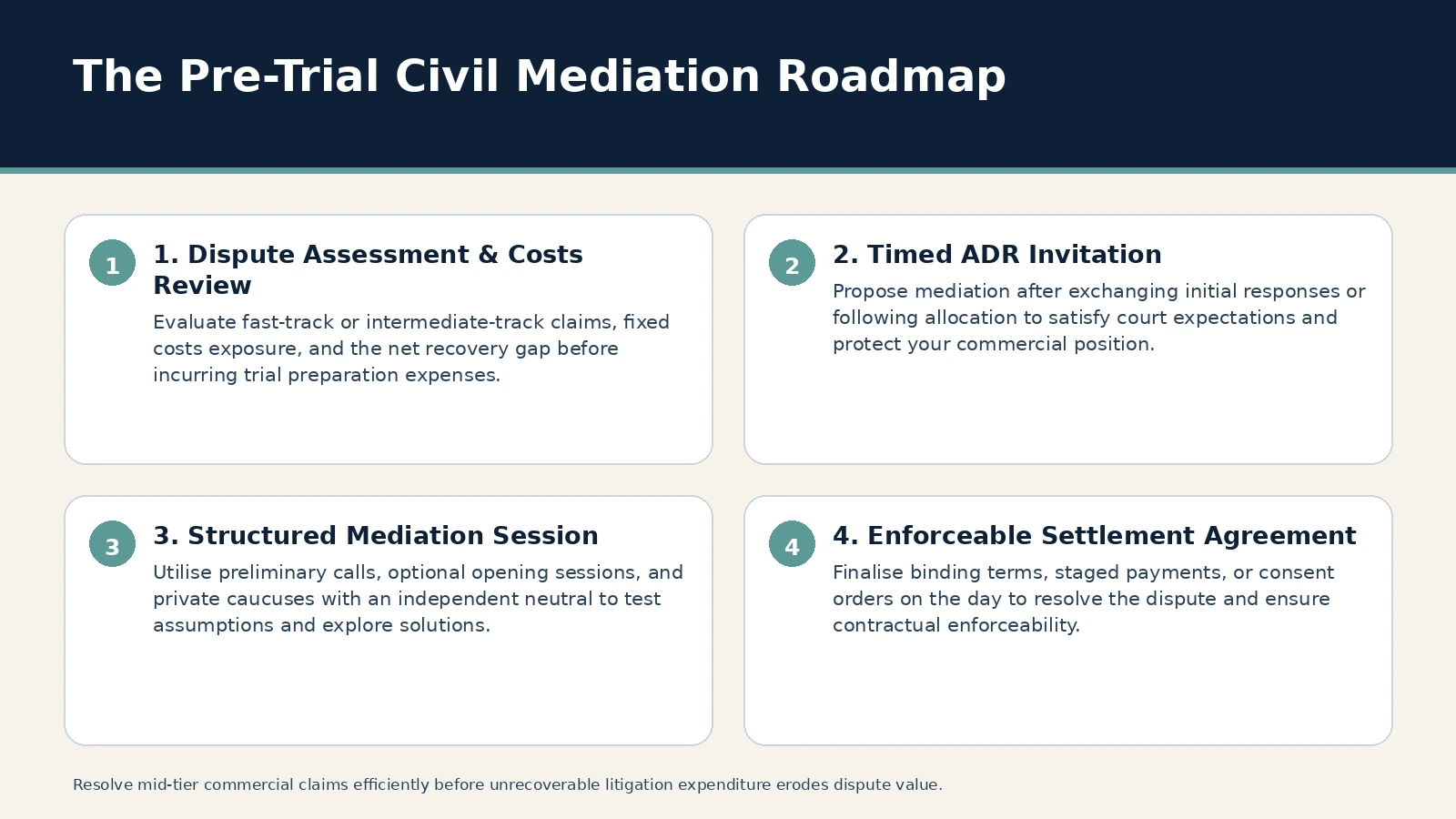
A typical commercial mediation progresses through four distinct stages:
- Preliminary Exchange and Pre-Mediation Calls: Prior to the mediation day, the mediator reviews the position summaries and core documents provided by both sides. The mediator often conducts brief, separate telephone calls with each team and lead decision-maker to clarify practical priorities, identify sensitive commercial dynamics, and establish ground rules.
- Opening and Plenary Sessions: Depending on the dynamics between the parties, the mediator may convene a joint opening session where both sides outline their perspective. In cases where commercial tension is high, the mediator can work directly through separate rooms from the outset.
- Private Caucuses and Exploration: The core of the mediation takes place in private meetings between the mediator and each party. During these caucuses, the mediator tests the factual and commercial assumptions of each party’s case, explores underlying business pressures, and assists the parties in examining settlement options confidentially.
- Formulation and Settlement: Once a commercial consensus emerges, the parties or their legal advisers draft formal settlement documentation. Because the mediator remains available throughout this drafting phase, minor wording disagreements can be resolved immediately, preventing negotiations from faltering at the final stage.
Throughout this structured engagement, parties and their legal advisers work together—evaluating settlement brackets, advising on litigation risk, and ensuring that draft terms are robust and practically workable.
Preparing for the Mediation Day: Position Summaries, Core Documents, and Authority
Effective preparation transforms civil dispute mediation into an efficient settlement engine. Because commercial mediations for fast-track and intermediate claims typically take place over a focused single day or half-day session, entering the room with clear positions and decision-making authority is essential.
Preparation should focus on three practical components:
- The Mediation Summary: Rather than drafting an adversarial legal pleading, prepare a concise summary that explains the factual background, key documentary evidence, and realistic commercial objectives. The mediator uses this document to understand underlying pressures and identify potential common ground. A summary that acknowledges practical commercial realities is consistently more productive than standard litigation argument.
- Core Document Bundle: Assemble a short, joint bundle containing only decisive documents—such as the underlying contract, key email exchanges, invoices, or preliminary expert summaries. Overloading the mediation with excessive background material slows down negotiations. Both parties should agree on the index in advance to ensure all attendees work from identical references.
- Clear Settlement Authority: Each party should ensure their representative has, or has immediate access to, full authority to negotiate and sign binding settlement terms during the mediation. Needing to refer negotiated proposals to an absent decision-maker can halt momentum when a deal is within reach. Where corporate governance requires formal sign-off limits, ensure that senior executives with necessary authority remain readily contactable throughout the session.
Documenting and Implementing the Settlement Agreement
A primary benefit of resolving a mid-tier claim via mediation is that the final settlement can be executed and formalised on the day of the session. Leaving the mediation with an informal understanding rather than signed documentation introduces the risk of subsequent disagreements over drafting nuances.
Once commercial terms are agreed, the parties or their legal representatives typically prepare a binding written settlement agreement or consent order for the parties to sign on the day, creating an enforceable contract (or court order once sealed by the court). Where court proceedings are already underway, the action is stayed while the agreed terms are documented, preserving privacy while providing an enforceable mechanism if a default occurs.
Settlement agreements in commercial disputes frequently encompass practical solutions that extend beyond standard court orders, including:
- Staged Payment Schedules: Structured instalment plans secured by default clauses, allowing a debtor business to manage cash flow while ensuring the creditor recovers agreed sums reliably.
- Contractual Restructuring: Adjusted service specifications, modified delivery timelines, or revised pricing for future orders, turning a dispute into an opportunity to stabilise ongoing business ties.
- Mutual Releases and Confidentiality: Clear releases that protect both parties from future connected claims, combined with agreed confidentiality and non-disparagement commitments to safeguard commercial reputation.
- Agreed Allocation of Costs: Explicit terms specifying how the mediator’s fee and existing legal costs are apportioned, eliminating subsequent disagreements over cost assessment.
Next Steps for Your Dispute
When facing a fast-track or intermediate-track claim in England and Wales, maintaining control over legal expenditure and settlement terms is a commercial priority. Early civil dispute mediation offers a pragmatic, court-recognised route to resolve disputes without the uncertainty, expense, and delay of a full trial. If you are currently evaluating a commercial money claim and wish to explore structured settlement, you can contact Echelon Dispute Resolution to discuss appointment practicalities and determine how mediation can assist your case.
Frequently asked questions
What size of civil dispute is suitable for pre-trial mediation?
Civil mediation is suitable for claims of any size, but it is especially practical for fast-track (£10,000 to £25,000) and intermediate-track (£25,000 to £100,000) disputes where proceeding to trial risks creating an unrecoverable gap between actual legal expenditure and fixed recoverable costs.
Are negotiations during a civil dispute mediation confidential?
Yes. Discussions within civil mediation take place on a private and confidential basis. Information shared in private mediator sessions is kept confidential from the other party unless permission is given, and settlement discussions are generally without prejudice, meaning they cannot ordinarily be referred to in court save for narrow established legal exceptions.
Can the court penalise a party for refusing civil dispute mediation?
Yes. Courts actively encourage parties to engage in alternative dispute resolution. If a party unreasonably refuses an invitation to mediate, the court can take that refusal into account when deciding how to award or assess legal costs under CPR 44.2 at the conclusion of proceedings.
How is a settlement reached at mediation made legally binding?
Once commercial terms are agreed, the parties or their legal representatives typically prepare a binding written settlement agreement or consent order for the parties to sign on the day, creating an enforceable contract (or court order once sealed by the court).
Who needs to attend the mediation session?
Each party should ensure their attending representative has full authority to negotiate and sign binding settlement terms during the session. Legal advisers often attend alongside the decision-maker to advise on settlement terms, evaluate risk, and assist in drafting the final agreement.
Authoritative UK guidance and further reading
Primary and official sources
- The Civil Procedure (Amendment) Rules 2026 (legislation.gov.uk)
- PART 1 – OVERRIDING OBJECTIVE – Civil Procedure Rules – Justice UK (justice.gov.uk)
- PART 45 – FIXED COSTS – Justice UK (justice.gov.uk)
- PRACTICE DIRECTION 45 – TABLES OF FIXED COSTS (2024) – Justice UK (justice.gov.uk)
This guide provides general information about dispute resolution and mediation. It is not legal advice. The appropriate approach depends on the facts, documents, procedural position and the parties involved; obtain legal advice where required.