

In brief
The question: How can family enterprise owners resolve deep-seated disagreements over succession and agree on a workable leadership handover without damaging enterprise continuity or severing family ties?
The short answer: Family Business Succession Disputes rarely stem from balance sheet figures alone; they crystallise where executive authority, founder identity, and generational equity intersect. Gridlock usually takes hold when relatives treat succession as an all-or-nothing struggle for total control of the boardroom. Breaking this impasse requires distinguishing day-to-day operational leadership from underlying share ownership, establishing clear milestones across a phased transfer timetable, and structuring definitive roles for both the outgoing founder and incoming executives. Engaging in commercial mediation gives family members a confidential, professional forum to work through these commercial, operational, and interpersonal priorities without airing grievances in public court. Where consensus is reached, the settlement is formalised in binding legal contracts and implemented across the company’s constitutional governance.
The Anatomy of Family Business Succession Disputes
Succession within a family enterprise is among the most sensitive transitions an organisation can undertake. When business relationships are interwoven with shared childhoods, parental expectations, and sibling dynamics, straightforward business decisions can become intensely contested. At their core, Family Business Succession Disputes generally emerge from distinct, competing tensions that develop over decades rather than isolated operational disagreements.
Founder Reluctance and Identity
Founders and long-serving managing directors frequently tie their personal identity, social standing, and sense of purpose directly to their executive stewardship of the enterprise. For someone who has spent thirty or forty years guiding daily operations, signing every significant cheque, and steering the firm through economic cycles, the prospect of stepping down can feel like personal obsolescence rather than a hard-earned retirement. This hesitation often manifests as shifting goalposts: the founder insists they want to hand over authority, yet second-guesses successors, withholds strategic information, or reverses decisions made by the next generation. The incoming cohort experiences this as a lack of trust, while the founder perceives the successors as unready for executive pressure.
Generational Divergence in Ambition and Capability
Friction often arises between the generation currently running the business and the generation preparing to take over. Next-generation executives often seek to modernise operations, professionalise management structures, enter new digital markets, or alter capital allocation. The established board may view these initiatives as reckless departures from the foundational principles that made the firm resilient. Compounding this challenge is the delicate balance between commercial competence and birthright: having a family surname does not automatically confer executive leadership aptitude. When non-family senior managers, external advisers, or particular relatives identify performance gaps in an heir apparent, discussions can freeze around accusations of disloyalty or favouritism.
Active Managers versus Non-Active Shareholders
A classic structural fault line in multi-generational firms lies between family members who work directly inside the business and those who hold equity as passive shareholders. Active family directors frequently favour reinvesting retained earnings into operational capital, technology, and strategic reserves, earning commercial salaries for their daily labour. Conversely, non-active family shareholders—who may have inherited shares without working in the firm—often prioritise regular, predictable dividend yields and capital preservation. When succession nears, passive owners may fear that an incoming executive cousin or sibling will suppress dividends or steer the firm into high-risk ventures, triggering defensive corporate posturing.
These dynamics closely mirror issues examined in our guide on director dispute mediation and boardroom deadlock exits, where emotional involvement often complicates objective decision-making.
The Primary Mechanism: Uncoupling Equity from Operational Leadership
The single most effective conceptual shift in resolving Family Business Succession Disputes is disentangling the right to manage from the right to own. In early-stage family enterprises, ownership and management are almost identical: the founder owns the shares, sits as the sole or dominant director, and makes operational decisions. As the company expands across generations, preserving this unified model often creates administrative paralysis.
Equity ownership represents an entitlement to capital value and dividend returns. Executive management represents professional responsibility for daily performance and commercial governance. Once families appreciate that an individual can step back from day-to-day operational control while retaining their capital security, or conversely that a talented family member can run operations without needing immediate majority voting control, workable succession pathways begin to emerge.
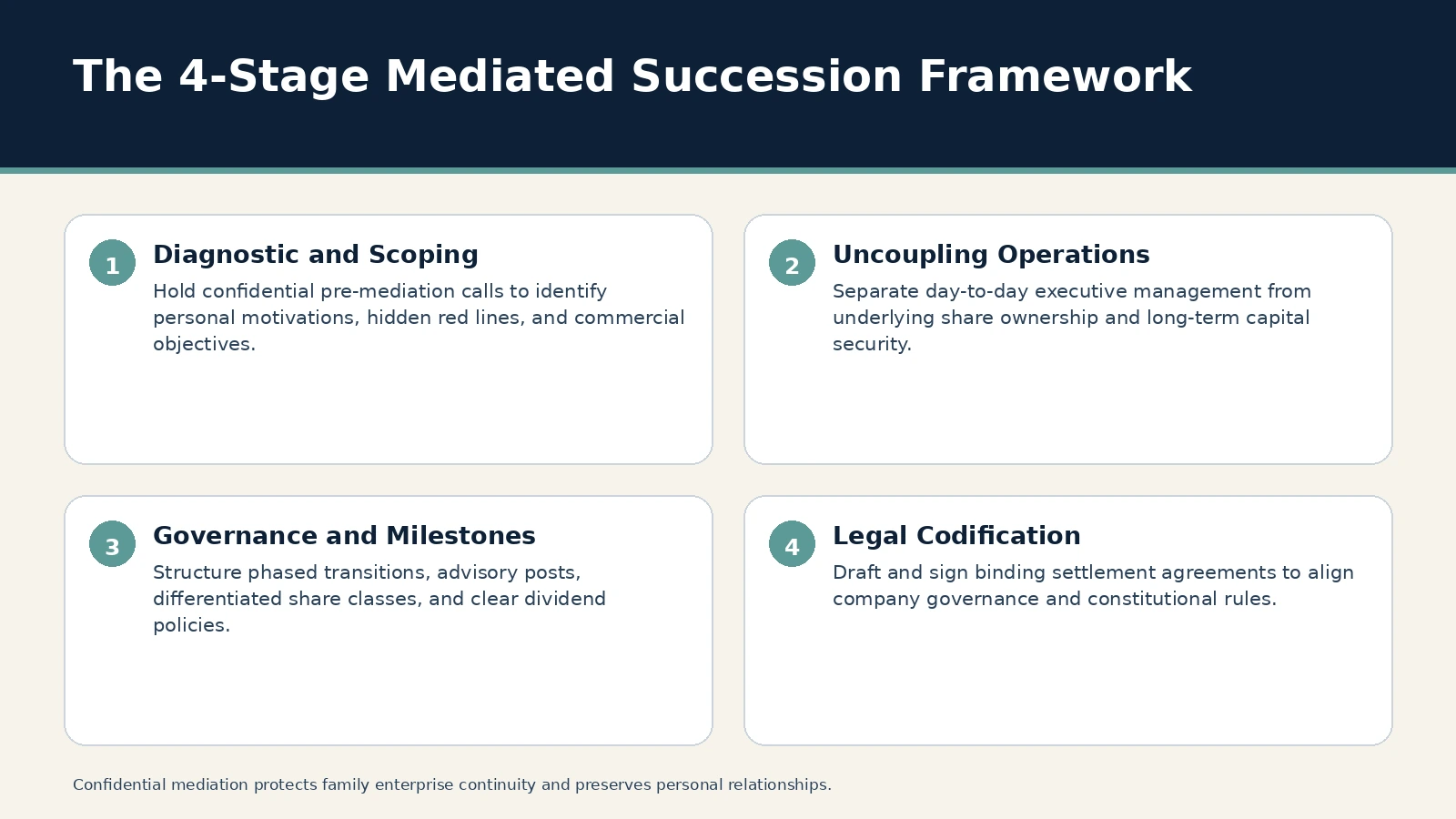
Practical options frequently developed during confidential settlement discussions include:
- Phased Transition to Non-Executive Chair: The outgoing leader steps down from chief executive duties on an agreed date, transitioning into a Non-Executive Director or Chair role with specified oversight responsibilities, advisory access, and a structured consultation schedule that avoids operational interference.
- Differentiated Share Structures: Working with legal and tax advisers, families can explore reclassifying shares into distinct classes to balance voting rights and income streams. For instance, voting shares may be held by active executive directors to ensure operational agility, while dividend-yielding non-voting shares protect income for non-active family branches or retiring founders.
- Formal Dividend Policies: Establishing clear, formulaic dividend thresholds tied to audited net profitability provides predictable income for passive shareholders while assuring active directors that necessary working capital will be retained.
- Independent Non-Executive Appointments: Introducing independent, non-family directors can professionalise board governance, dilute personal friction between competing relatives, and provide objective arbitration for future operational choices.
Where family members determine that an ongoing shared ownership structure is no longer viable, parties may negotiate structured buyouts. Our analysis of minority shareholder dispute valuation and exit mediation outlines how such exits can be structured fairly without destabilising company cash flow.
Comparing Dispute Resolution Pathways
When succession talks stall, family members often contemplate instructing commercial litigation solicitors to enforce their rights, remove directors, or protect minority interests. However, adversarial court proceedings impose substantial commercial and personal consequences that can permanently fracture family relationships and erode enterprise value.
Under the English civil justice system, the courts view litigation as a last resort. The Civil Procedure Rules, specifically the Practice Direction on Pre-Action Conduct and Protocols (paragraphs 8 to 11), expect disputing parties to consider alternative dispute resolution, such as commercial mediation, prior to commencing formal legal proceedings. Parties that unreasonably refuse to engage in dispute resolution risk adverse costs consequences if proceedings are subsequently issued.
The qualitative comparison below illustrates how civil mediation differs fundamentally from formal court litigation across key operational dimensions:
| Operational Dimension | Court Proceedings | Commercial Mediation |
|---|---|---|
| Decision-Making Authority | An external judge imposes a binding ruling based strictly on legal and equitable rights, with no commercial input from the family. | The family and company decision-makers retain full control over whether an agreement is reached and what terms are accepted. |
| Commercial Continuity | Public filings and adversarial testimony can generate commercial instability, unsettle workforce morale, and cause banking friction. | Private, confidential discussions take place away from public records, protecting the firm’s commercial reputation and stability. |
| Flexibility of Handover Arrangements | Outcomes are limited to formal legal orders, which cannot design nuanced, multi-year executive mentorship or advisory frameworks. | Parties can tailor bespoke commercial solutions, such as phased retirements, advisory posts, dividend formulas, and governance covenants. |
| Preservation of Family Relationships | Adversarial cross-examination and sworn affidavits entrench hostility, almost invariably causing irreversible personal rifts. | A neutral mediator facilitates balanced dialogue that separates personal emotion from commercial necessity, helping preserve ties. |
| Procedural Alignment | Represents the final, escalatory step within the civil justice system, subject to strict procedural timetables and substantial cost risk. | Directly aligns with CPR pre-action expectations, demonstrating a genuine, constructive effort to settle matters cooperatively. |
How Commercial Mediation Resolves Succession Deadlocks
Commercial mediation is a confidential, voluntary process in which an independent neutral professional helps parties in dispute explore practical options to reach an agreed settlement. In the context of Family Business Succession Disputes, the mediator does not act as an arbitrator, judge, or family counsellor. Instead, they provide a structured negotiation framework where participants can address the complex interplay between company governance, commercial strategy, and family heritage.
The Practical Mediation Process
A typical commercial mediation for a family enterprise succession dispute is carefully prepared well in advance of joint discussions:
- Pre-Mediation Consultations: The mediator holds confidential individual calls with each key participant and their respective legal advisers. This allows the mediator to understand the underlying personal motivations, hidden red lines, historical grievances, and commercial objectives that parties might hesitate to voice openly in front of family members.
- Establishing the Setting: Mediations can take place in neutral professional meeting suites or across secure digital platforms. A commercial mediation typically utilises separate private breakout rooms for each family faction or individual, alongside a neutral joint room where discussions can take place if and when constructive.
- Exploration and Reality Testing: The mediator shuttles between rooms, reality-testing each party’s commercial assumptions, identifying areas of common interest, and exploring alternative leadership models. A skilled mediator helps parties understand how their proposals are perceived by other stakeholders and challenges impractical expectations in private caucus.
- Structuring the Commercial Agreement: Once the broad architecture of a succession plan is agreed—such as handover timelines, share reclassifications, dividend commitments, or consultancy retainers—the parties and their legal advisers draft and sign a legally binding settlement agreement.
Mediation provides the privacy necessary to review candid company valuations and succession candidates without leaks that could unsettle key staff or commercial partners, a benefit highlighted by professional dispute resolution bodies such as the Civil Mediation Council.
Document Preparation and Governance Alignment
Succession arrangements negotiated in mediation cannot remain informal understandings. Relying on casual family promises is precisely what precipitates governance gridlock when circumstances change. A mediated settlement must be drafted to integrate seamlessly into the enterprise’s corporate governance framework.
Under the Companies Act 2006 (Part 10), the appointment, duties, and removal of company directors must adhere to formal statutory requirements and the company’s constitutional documents. Therefore, an agreed handover framework will typically require updating several core company instruments:
- The Articles of Association: Amending the company’s articles to reflect newly created share classes, weighted voting rights on specific reserved matters, or specific director appointment rights for different family branches.
- The Shareholders’ Agreement: Incorporating robust transfer provisions, pre-emption rights, valuation mechanisms for departing family members, and agreed deadlock-resolution mechanisms for future generations.
- Service Contracts and Consultancy Agreements: Setting out precise operational duties, remuneration, and termination terms for incoming directors, as well as clear, limited remits for retiring founders serving in advisory roles.
- A Family Constitution or Charter: While often non-binding in commercial law, establishing a documented family governance charter clarifies entry criteria for future family employees, educational requirements, and communication protocols.
Preparing for a Succession Mediation
Parties attending mediation will maximise the likelihood of an enduring settlement by assembling clear financial and operational information in advance. Crucial materials include recent audited accounts, realistic cash-flow projections, existing constitutional documentation, independent share valuation indications, and clear written summaries of what each participant needs for financial security and personal peace of mind.
Taking the Next Step
Disputes over leadership and generational continuity do not resolve themselves with time; prolonged indecision erodes morale, distracts executive attention from market pressures, and deepens personal divides. Mediation provides a dignified, commercial path to agree on a leadership handover that honours the achievements of the founding generation while empowering the next to lead.
If your family enterprise is facing a leadership transition impasse, you can contact Echelon Dispute Resolution to discuss confidentially whether mediation is suitable for your circumstances.
Explore our Shareholder, Partnership & Director Disputes guides.
Frequently asked questions
What is the primary cause of family business succession disputes?
These disputes typically arise when executive operational control is tangled with equity ownership. Clashes between a founder’s reluctance to relinquish daily authority, competing ambitions among next-generation relatives, and differing dividend expectations between active managers and passive family shareholders are common catalysts.
Is an agreement reached during succession mediation legally binding?
Mediation discussions themselves are confidential and conducted without prejudice. However, once the participants reach an agreed framework, their legal advisers draft a written settlement agreement. Once signed by the parties, this document becomes a legally binding contract enforceable under English law, which is then implemented through updated company articles and board resolutions.
Can mediation help if a founder refuses to step down?
Yes. Commercial mediation allows founders to explore dignified transition pathways that do not force an abrupt exit. Solutions often involve moving to an advisory Non-Executive Chair role, retaining strategic input while stepping back from operational management, thereby preserving personal purpose alongside enterprise continuity.
Do all family shareholders need to attend the mediation sessions?
Not necessarily. While all key decision-makers and individuals whose legal or shareholding rights will be directly amended must participate, mediation can be structured flexibly. A representative for non-active family branches or distinct shareholding groups can attend alongside legal advisers, ensuring the room remains focused and constructive.
How should our family prepare for a succession mediation?
Parties should gather the company’s Articles of Association, any existing Shareholders’ Agreement, recent financial accounts, and valuation reports. Crucially, each participant should reflect with their professional advisers on their core financial requirements, realistic handover timelines, and long-term personal objectives prior to the first session.
Authoritative UK guidance and further reading
Primary and official sources
- Running a family business – Companies House (companieshouse.blog.gov.uk)
- Companies Act 2006 (legislation.gov.uk)
- UK legislation — legislation.gov.uk (legislation.gov.uk)
- PRACTICE DIRECTION – PRE-ACTION CONDUCT AND PROTOCOLS – Civil Procedure Rules – Justice UK (justice.gov.uk)
This guide provides general information about dispute resolution and mediation. It is not legal advice. The appropriate approach depends on the facts, documents, procedural position and the parties involved; obtain legal advice where required.