

In brief
The question: How can project employers, main contractors, and specialist sub-contractors resolve contested variations and final account disputes without enduring months of costly, adversarial proceedings over dense line-item spreadsheets?
The short answer: Addressing variations and final account disputes through mediation allows commercial parties to step back from granular, item-by-item arguments and evaluate their positions as an interconnected commercial balance sheet. Rather than debating dozens or hundreds of individual variation lines, parties group claims into practical commercial categories: valuation principles, disputed scope, prolongation costs, and defect contra-charges. Facilitated by an independent mediator, decision-makers test project risks candidly, explore pragmatic financial compromises, and structure comprehensive settlement agreements that deliver immediate cash flow certainty and complete contractual closure.
Roots of Stalemate: Interlocking Variations, Contra-Charges, and Retentions
By the time a construction or engineering project reaches practical completion, relationships between the commercial team and the site delivery team have often weathered intense operational pressure. Deadlocks over the final account rarely stem from a single clean disagreement. Instead, they typically emerge from an accumulation of unresolved events that occurred across the life of the works.
A common catalyst is the tension between operational site pace and formal contractual notice requirements. During project execution, unforeseen ground conditions, design adjustments, or client-driven changes require immediate physical action to prevent site delays. Site managers frequently instruct variations informally or orally, with both parties deferring precise measurement and pricing until final account reconciliation. When the project finishes, the employer or main contractor may scrutinise the contract strictly, rejecting variation claims for lack of contemporaneous written instructions or failure to submit formal notices within contractual timeframes.
This dynamic creates immediate friction. The contractor or sub-contractor submits a comprehensive final account application featuring extensive variations alongside delay or disruption costs. In response, the paying party introduces defect notifications, incomplete work contra-charges, and withholdings against retentions. What began as an exchange about physical site changes freezes into an intractable commercial deadlock.
When parties attempt to address this deadlock line-by-line using exhaustive Scott Schedules, progress frequently halts. Commercial managers become trapped in evidential exhaustion, arguing over nominal amounts on individual items while commercial cash flow remains frozen. Exploring commercial mediation within the broader framework of construction and engineering disputes offers a practical mechanism to break this cycle by shifting focus from line-item litigation posturing to holistic commercial resolution.
The spreadsheet trap often conceals the commercial drivers that actually matter to the businesses involved. For a sub-contractor, an unresolved account can impair working capital, restrict banking covenants, and hinder the ability to secure performance bonds on new projects. For a main contractor or employer, an open final account leaves project financial close unresolved, impedes audit sign-off, and exposes the developer to potential funder scrutiny. When technical discussions become bogged down in hundreds of contested line items, neither side can convert its legal or commercial position into workable liquidity.
Resolving Variations and Final Account Disputes Through Structured Dialogue
When parties reach an impasse over final accounting, formal dispute routes such as adjudication or Technology and Construction Court litigation are frequently considered. While these processes produce enforceable determinations, they require rigorous evidential dissection of every contested variation order, daywork sheet, and notice compliance timeline. This approach demands extensive document assembly, significant expert surveyor involvement, and legal expenditure that can quickly become disproportionate to the sums at stake.
Commercial mediation operates on a fundamentally different principle. Under official guidance from GOV.UK, civil mediation is defined as an impartial, confidential process where an independent neutral assists the parties in reaching an agreed settlement. Rather than imposing a binding decision based on strict legal winners and losers, a mediator helps commercial principals explore practical settlement options that remain entirely within their own control.
This framework is formally recognised within England and Wales. Under the Pre-Action Protocol for Construction and Engineering Disputes (2nd Edition) , parties are expected to consider alternative dispute resolution before issuing proceedings. Paragraph 9.3 of the Protocol confirms that the required pre-action meeting can itself take the form of an ADR process, including mediation. Engaging in mediation allows parties to comply with pre-action expectations while retaining complete commercial authority over whether, and on what terms, they settle.
Managing variations and final account disputes through facilitated discussions does not strip a party of its contractual or statutory rights. If talks do not result in an acceptable compromise, either party remains free to pursue formal determination. However, for most commercial organisations, structured negotiation provides an opportunity to preserve business relationships and achieve finality without the uncertainty of an external imposed ruling.
| Decision Dimension | Adjudication / TCC Litigation | Commercial Mediation |
|---|---|---|
| Decision Authority | An impartial third party determines rights and liabilities by applying contractual terms and legal principles to the submitted evidence, rather than facilitating a commercial compromise. | Commercial decision-makers retain full authority; no outcome can be imposed without mutual agreement. |
| Scope of Issues | Decisions focus strictly on the specific disputes formally referred within the procedural notice. | Parties can address variations, retentions, defects, and future commercial work in one combined discussion. |
| Remedy Flexibility | Determinations primarily focus on legal declarations and directed financial payments, although courts also possess equitable powers such as granting injunctions. | Parties can agree tailored solutions, including structured payments, defect inspection protocols, and mutual releases. |
| Dispute Costs & Speed | Demands exhaustive witness and quantum expert evidence, with costs escalating across procedural stages. | Focuses on core commercial reconciliations, conducted over an agreed timetable without extensive formal disclosure. |
| Commercial Relationships | Adversarial dynamic tests ongoing partnerships and public reputational profiles. | Confidential setting allows frank commercial negotiation while preserving supply chain trust. |
Assessing Variations and Final Account Disputes Through Thematic Packaging
The central obstacle in any final account mediation is the volume of contested detail. When an account contains dozens or hundreds of disputed variations alongside opposing claims for liquidated damages and defect rectifications, negotiating item-by-item across a table is commercially unfeasible within a standard mediation session.
The solution lies in thematic packaging. Working prior to and during the mediation, the mediator assists the parties in converting granular line items into distinct commercial themes. Rather than debating every individual variation line, the dispute is organised into four primary categories:
- Category 1: Agreed Scope, Disputed Quantum: Items where both parties agree the work constituted a legitimate change, but disagree on measurement, plant rates, or labour hours applied.
- Category 2: Contested Scope and Contract Interpretation: Items where the paying party argues the work formed part of the original base contract documents, while the contractor maintains it was an unforeseen extra instructed on site.
- Category 3: Time-Related Claims: Claims for site preliminaries, delay, and disruption, balanced against the employer’s assertions regarding non-completion or delay deductions.
- Category 4: Defect Offsets and Retentions: Real or alleged workmanship defects, incomplete snagging, and withheld cash retention figures.
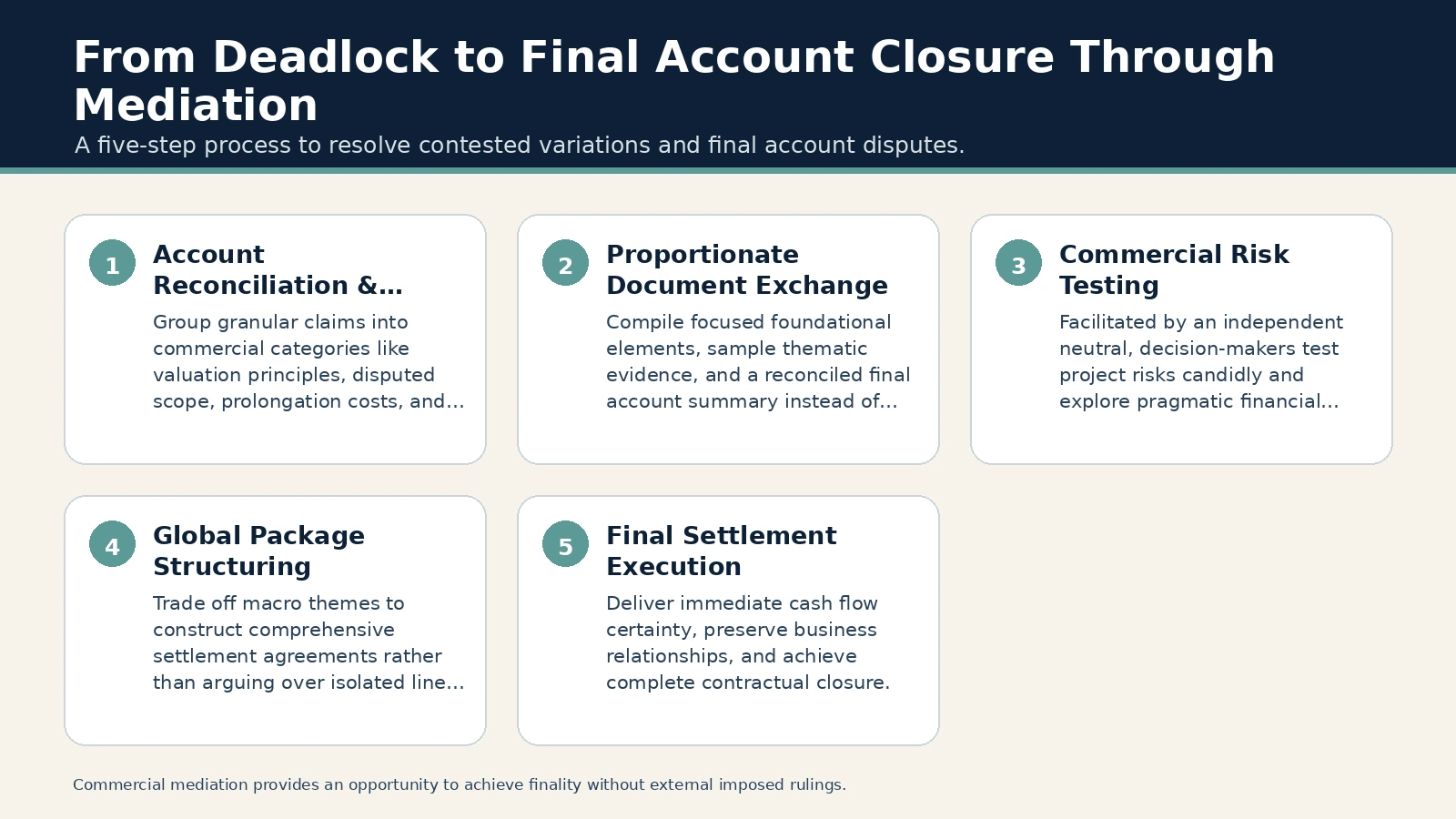
By reorganising the dispute into these macro themes, commercial principals can stop arguing over isolated line values and begin exploring balanced trade-offs. For example, a contractor may accept a practical valuation adjustment on disputed scope changes in exchange for the immediate, unconditional release of held retention and formal sign-off on alleged defects. Similarly, an employer may agree to compromise on certain unnoted variations in return for a fixed, agreed timetable for minor outstanding rectification works.
This approach aligns with principles outlined in industry standards, such as the RICS Final Account Procedures , which emphasise structured reconciliation between contract administrators and contractors. To explore how this mechanism functions in related payment deadlocks, parties can review guidance on construction payment dispute mediation and final account deadlock.
Thematic grouping also transforms the tone of negotiations. In private caucus rooms, the mediator can challenge both parties to look at realistic recovery probabilities across each theme rather than clinging to complete entitlement on every single item. When commercial managers see that a concession in Category 1 can unlock an equivalent concession in Category 4, the dynamic changes from defending historic project positions to constructing an acceptable overall balance sheet.
Document Preparation: Assembling a Proportionate Commercial Mediation Bundle
Parties often worry that preparing for mediation requires compiling unmanageable multi-lever-arch files containing every drawing, daily site diary, and email ever exchanged. This assumption is incorrect and often counterproductive. A successful mediation depends not on evidentiary exhaustion, but on narrative and commercial clarity.
A well-prepared commercial mediation bundle should remain proportionate, containing four foundational elements:
- The Core Contract Terms: The primary contract agreement, relevant conditions relating to variations, notices, and payment mechanisms, and key pricing schedules.
- The Reconciled Final Account Summary: A concise dashboard illustrating the baseline contract sum, total approved variations, total disputed variations, claimed loss and expense, applied deductions, retentions held, and the resulting net difference between the parties.
- Sample Thematic Evidence: Rather than providing hundreds of separate variation backup files, include detailed documentation for two or three representative items within each disputed theme. This allows the mediator to test each party’s valuation logic and contractual arguments efficiently during private meetings.
- A Realistic Settlement Ledger: An internal, confidential calculation of what outcomes are commercially workable, accounting for ongoing business risk, management diversion, and the potential costs of formal proceedings.
Parties navigating broader contractual issues alongside final valuation questions may also benefit from reviewing our overview of the construction contract dispute mediation process.
Compiling this focused material early provides clear advantages. When project quantity surveyors collaborate to produce an agreed statement of differences before the mediation day, they eliminate arguments over basic arithmetic. The mediation can then focus entirely on resolving the genuine differences in scope, valuation methodology, and risk allocation that have stalled final payment.
Ensuring Effective Decision-Making and Achieving Binding Finality
Achieving an immediate, binding settlement requires that attendees possess genuine authority to agree commercial terms. In construction disputes, joint commercial teams frequently attend, combining the project quantity surveyor or commercial manager who understands the project history with a commercial director or principal who possesses unconstrained authority to agree financial figures.
If the person attending needs board approval for any figure outside a narrow margin, negotiations will almost certainly stall when inventive settlement packages emerge. Decision-makers must come prepared to look at the project ledger holistically, balancing disputed sums against the commercial value of immediate finality, prompt cash receipt, and the elimination of ongoing legal and administrative costs.
During the mediation, negotiations frequently move through distinct stages. The day often begins with brief joint introductions, allowing both teams to outline their commercial perspective directly to the other side. The mediator then holds private meetings with each party in separate rooms. These private discussions allow each team to examine the strengths and weaknesses of their case without posturing, explore potential compromises in confidence, and test whether non-financial trade-offs can bridge financial differences.
When an agreement is reached, the mediator assists the parties and their legal advisers in recording the settlement terms immediately in a written settlement agreement. To prevent future disputes from emerging, a robust final account settlement document will typically address:
- The Global Settlement Sum: A clear, net financial figure agreed between the parties, stating whether it is inclusive or exclusive of VAT.
- Payment Timelines and Mechanisms: Exact payment dates, designated bank details, and any structured payment milestones.
- Full and Final Settlement Scope: Clear wording confirming that the agreed sum resolves all claims, counterclaims, variations, extensions of time, loss and expense, defects, and retentions arising under or in connection with the contract.
- Defect Protocols: Specific provisions governing any agreed return to site for identified remedial items, including agreed inspection protocols, access dates, and formal handover sign-offs.
If your organisation is facing an unresolved final account, contested variations, or circular contra-charges, structured mediation offers a direct, commercial path to resolution. To discuss whether mediation is appropriate for your project dispute, you can contact Echelon Dispute Resolution to speak with an experienced commercial mediator.
Frequently asked questions
Does agreeing to mediate stop either party from referring the dispute to adjudication?
No. Under English law, entering into mediation is voluntary and does not waive or prejudice a party’s right to pursue formal adjudication. Parties can agree to pause ongoing proceedings while mediation takes place, but if mediation concludes without a settlement, all formal contractual and statutory avenues remain fully available.
How can we mediate if our variation claims lack formal written site instructions?
A lack of formal written orders is common in fast-moving construction projects. In mediation, parties are not limited strictly to technical notice rules. The mediator helps the parties evaluate the practical commercial realities, such as evidence that the work was actually requested, performed, and incorporated into the finished project, facilitating a pragmatic compromise on quantum.
Who needs to attend the mediation to ensure a binding resolution is achieved?
Achieving an immediate, binding settlement requires that attendees possess genuine authority to agree commercial terms. Typically, parties attend with their project commercial manager or quantity surveyor for technical knowledge, accompanied by their legal representative and an authorised company director or business owner who can execute the binding settlement agreement.
Can mediation resolve disputed retentions and defect contra-charges alongside variations?
Yes. One of the primary advantages of commercial mediation is its ability to handle all interconnected ledger items simultaneously. Disputed variation sums, loss and expense, defect contra-charges, and retained cash funds can be packaged together into a comprehensive global settlement agreement, avoiding separate serial disputes.
What happens if we cannot reach an agreement on the day of mediation?
While many construction disputes resolve during the mediation session itself, an agreed outcome is never forced. If negotiations do not conclude on the day, the process still provides value by clarifying core issues, narrowing financial gaps, and establishing communication channels that often lead to a negotiated settlement in subsequent days.
Authoritative UK guidance and further reading
Primary and official sources
- Pre-Action Protocol for Construction and Engineering Disputes – Civil Procedure Rules – Justice UK (justice.gov.uk)
- Resolving neighbour disputes: Use a mediation service – GOV.UK (gov.uk)
- A guide to civil mediation – GOV.UK (gov.uk)
Further professional reading
This guide provides general information about dispute resolution and mediation. It is not legal advice. The appropriate approach depends on the facts, documents, procedural position and the parties involved; obtain legal advice where required.