

In brief
The question: How can commercial creditors and corporate debtors resolve contested B2B invoices through pre-action mediation without escalating to court proceedings?
The short answer: Engaging in b2b payment dispute mediation gives finance directors, commercial managers, and credit controllers a private, facilitated forum to negotiate contested commercial invoices before litigation begins. Standard credit control procedures and collection agencies function effectively while debts remain undisputed. The moment a customer raises substantive objections over project scope, deliverable quality, or administrative records, debt recovery pauses. Pre-action mediation allows commercial decision-makers to evaluate the reality of underlying grievances in a private setting. Backed by pre-action court procedural expectations and statutory interest leverage, the parties can negotiate practical outcomes—such as phased repayment arrangements, scope remediation, or credit adjustments—that protect essential cash flow and maintain ongoing trading accounts.
Beyond Debt Collection: Why Contested Commercial Accounts Stall
Trade credit procedures run smoothly until an account encounters substantive friction. Automated payment reminders, credit control follow-ups, and collection agencies handle administrative oversights or routine cash-flow timing differences. However, conventional recovery mechanisms stop when a corporate customer asserts a formal dispute—whether alleging defective performance, incomplete deliverables, unauthorised variations, or commercial disruption. In professional credit management, an asserted dispute pauses automated dunning, leaving internal finance teams facing an uncomfortable choice between writing down valuable work or escalating to formal dispute resolution.
For finance directors and credit controllers, this transition creates working-capital bottlenecks and inflates Days Sales Outstanding. Yet escalating directly to court action involves an upfront court fee of up to 5% of the disputed sum for claims over £10,000, alongside legal expenditure that can rapidly outstrip the margin on the original supply. Furthermore, issuing formal proceedings almost invariably terminates the commercial trading account, turning an otherwise manageable billing problem into the permanent loss of recurring customer revenue. Engaging commercial mediation services offers an alternative path that moves past entrenched positions to examine the operational realities behind the unpaid ledger.
In practice, unpaid B2B invoices rarely arise from a clean, single legal disagreement. What looks externally like a flat refusal to pay often conceals a combination of operational friction, internal procedural gaps, and competing commercial priorities:
- Operational deliverable disconnects: Goods or services were supplied by operational teams, but formal customer sign-off was disputed, undocumented, or never communicated to the accounts payable team.
- Informal project variations: Scope modifications, expedited delivery, or additional personnel hours were requested informally without a revised purchase order, leaving the final invoice misaligned with procurement records.
- Liquidity constraints obscured as quality complaints: A debtor managing short-term cash-flow shortages may raise late-stage, tactical objections around service quality simply to defer payment timing.
- Intertwined counterclaims and set-off claims: The customer asserts that isolated delivery defects justify withholding settlement across unrelated invoices, confusing discrete contractual obligations.
A specialist commercial mediator helps the parties untangle these overlapping dynamics. By exploring the background in an executive, neutral forum, parties can separate genuine contractual or performance grievances from tactical delay excuses, converting a contentious collection battle into a structured business negotiation.
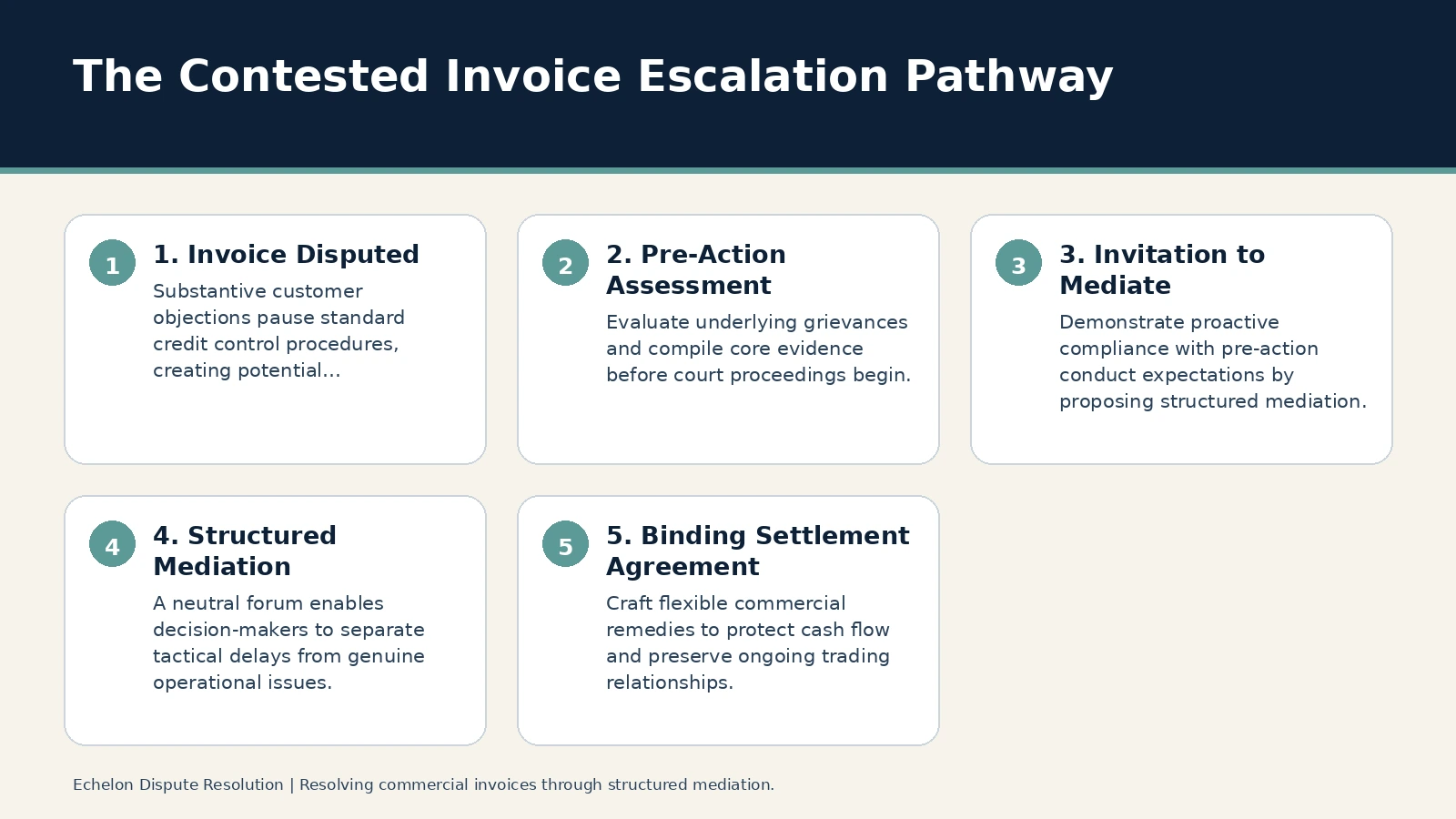
Resolving Commercial Invoice Disputes: County Court Claims vs B2B Mediation
When an invoice remains contested, business owners and finance directors should weigh the practical implications of issuing formal proceedings against exploring structured out-of-court dispute resolution. Formal adjudication determines liability under strict legal rules. While litigation provides an authoritative determination, it can involve upfront capital commitments, procedural time, and internal operational attention.
Commercial contract dispute mediation approaches the problem from a different perspective. Rather than having a binding determination imposed upon them, the parties retain complete control over whether an agreement is made and what terms it contains. Where court proceedings focus on whether a debt is strictly due under the contract, mediation gives the parties space to explore how the underlying liability can be satisfied within the operational and financial realities of both organisations. Comparing formal money claims with b2b payment dispute mediation highlights why structured dialogue is often the preferred commercial pathway.
| Operational Dimension | County Court Money Claim | B2B Payment Dispute Mediation |
|---|---|---|
| Process Control | Procedural timetable, directions, and the final decision are determined by the court. | The parties retain control over the outcome and determine whether settlement terms are agreed, with the mediator facilitating discussions. |
| Range of Outcomes | Adjudication determines strict legal liability under contractual terms. | Settlements can incorporate tailored terms, such as structured repayment schedules, scope rectification, credit adjustments, or revised supply terms. |
| Trading Relationships | Adversarial litigation risks ending ongoing trading accounts and mutual goodwill. | A collaborative, private forum helps organisations preserve supply chain continuity and valuable commercial accounts. |
| Discretion and Privacy | Hearings and formal judgments are generally matters of public record. | Discussions and formal agreements remain confidential between the participating businesses. |
| Pre-Action Conduct | Court rules expect litigation to be a last resort, with potential costs consequences if started prematurely. | Directly aligns with pre-action expectations by demonstrating proactive engagement in alternative dispute resolution. |
Beyond operational considerations, court procedural expectations in England and Wales provide meaningful legal context for pre-action conduct. Under paragraphs 8 to 11 of the CPR Practice Direction – Pre-Action Conduct and Protocols (PD-PAC, which governs corporate B2B disputes, distinguishing them from individual debt recovery under the separate Debt PAP), litigation should be a last resort, and businesses are expected to consider alternative dispute resolution, such as mediation, before launching court proceedings. A commercial party that unreasonably refuses an offer to mediate or ignores pre-action overtures can face adverse costs sanctions when the court considers cost recovery, even if that party is technically successful on the underlying invoice value.
Commercial Settlement Levers: Structuring Workable Solutions for Unpaid Accounts
The core advantage of b2b payment dispute mediation lies in the flexibility of the commercial remedies the parties can design. In formal litigation, judicial decisions focus on contractual entitlement and monetary awards. The court cannot rewrite contracts, restructure commercial partnerships, or craft business concessions. Mediation, by contrast, gives commercial decision-makers the latitude to construct multi-layered arrangements that address cash-flow pressures, outstanding deliverables, and recurring trade value.
Deploying Statutory Late Payment Entitlements as Commercial Leverage
Creditors often underutilise statutory late payment rights as commercial negotiating tools. Under sections 1 and 5A of the Late Payment of Commercial Debts (Interest) Act 1998, qualifying commercial creditors are entitled to claim statutory interest alongside fixed compensation sums and reasonable recovery costs where the underlying contract does not provide a substantial alternative remedy.
In mediation, these statutory entitlements serve as effective commercial bargaining levers rather than purely punitive measures. A creditor can strategically offer to compromise or waive accrued interest and fixed recovery compensation in return for an immediate lump-sum payment of the principal balance or an agreed, non-negotiable instalment schedule. This adjustment provides the debtor with an immediate financial incentive to settle, allowing finance leaders to recover core working capital without eroding their primary invoice margins.
Practical Non-Cash and Structured Remedies
When a debtor faces genuine liquidity constraints, or where aspects of the delivered work require practical remediation, settlements can be structured through diverse commercial mechanisms:
- Structured Payment Schedules: Agreeing phased instalments supported by clear default clauses, enabling the debtor to manage cash outflows while the creditor establishes enforceable recovery milestones.
- Remediation Coupled with Staged Releases: Where deliverables or service standards are contested, agreeing defined rectification steps supervised by designated operational leads, with proportional funds released upon agreed milestone completion.
- Credit Adjustments Against Future Business: Issuing a partial credit note against the disputed invoice in exchange for binding future purchase commitments or extended contract terms, preserving customer lifetime value.
- Security and Direct Guarantees: In higher-value disputes where debtor solvency presents an ongoing credit risk, incorporating personal director guarantees or commercial security charges to support the agreed payment plan.
Reviewing these mechanisms helps finance teams managing broader commercial contract disputes align their settlement strategy with balance-sheet recovery rather than protracted procedural disputes.
Preparing for B2B Payment Dispute Mediation: Documentation, Authority, and Conduct
Achieving a decisive outcome through b2b payment dispute mediation requires structured preparation. An effective mediation session is not an informal chat; it requires the same analytical discipline applied to complex contract negotiations and commercial credit underwriting. Organisations preparing for invoice mediation should concentrate on three central elements: objective documentation, decision-making authority, and enforceable settlement drafting.
1. Assembling the Core Evidence Bundle
Parties should compile objective documentation that establishes the contractual debt and addresses any anticipated performance counterclaims. Preparing these materials in advance allows discussions to focus on practical resolution rather than basic evidentiary questions. Useful documentation includes:
- The underlying master services agreement, supply contract, or terms and conditions, including records showing customer incorporation.
- Authorised purchase orders, work instructions, and contemporaneous written records verifying requested scope changes or expedited delivery.
- Proof-of-delivery receipts, signed delivery notes, milestone acceptance forms, or digital verification records.
- The contested invoices alongside correspondence, credit management notes, and audit logs showing when objections were first communicated.
- A clear financial breakdown of the outstanding ledger balance, distinguishing the principal debt from statutory interest and recovery costs.
2. Ensuring Settlement Authority
A common impediment in commercial debt negotiation is the attendance of representatives who lack the mandate to make commercial decisions. For mediation to deliver a binding outcome, participants attending the session should hold sufficient settlement authority—such as a finance director, managing director, or commercial counsel—or have immediate remote access to ultimate decision-makers. Representatives should possess the authority to compromise debt amounts, agree binding payment plans, issue credit notes, or renegotiate trade terms, or ensure that off-site commercial decision-makers remain readily accessible throughout negotiations to provide required approvals promptly.
Where personal friction has developed between front-line project managers or sales teams during the dispute, introducing senior finance professionals or commercial counsel who possess executive perspective often facilitates productive dialogue. Pairing an operational specialist familiar with project deliverables with a finance director who manages working capital provides an effective negotiating team. Further guidance on structuring negotiation representation is available in our overview on how to prepare for commercial mediation.
3. Documenting an Enforceable Commercial Settlement
A mediation finishes successfully when the agreed commercial consensus is reduced to writing. While mediation discussions are confidential, the resolution becomes a legally binding commercial contract once the parties draft and sign a formal written Settlement Agreement detailing payment sums, timelines, default terms, and mutual releases. An effective agreement clearly defines payment dates, explicit banking instructions, agreed default remedies if instalments lapse, and comprehensive mutual releases ensuring neither party can reassert the underlying claims or offset disputes.
When overdue commercial invoices threaten cash flow and traditional collection routes reach an impasse, early mediation provides a structured way to recover debt while safeguarding trading accounts. Commercial creditors and corporate debtors can speak to an EDR mediator to discuss process suitability and explore practical pre-action steps.
Frequently asked questions
Can mediation resolve a B2B payment dispute if the debtor claims poor service quality?
Yes. Commercial mediation is well suited to invoices delayed by quality or scope complaints. In a confidential setting, the parties can separate genuine performance defects from tactical payment delays. Practical outcomes often combine agreed remedial steps, credit adjustments, or staged payments tied to verified delivery milestones.
Who needs to attend a B2B invoice mediation session?
Each party should be represented by an individual holding sufficient settlement authority—such as a finance director, managing director, or commercial counsel—or immediate remote access to ultimate decision-makers. Representatives should hold authority to compromise balances, agree terms, and sign settlements, or ensure off-site decision-makers remain readily accessible throughout negotiations to provide required approvals promptly.
Is an agreement reached through B2B payment dispute mediation legally binding?
Yes. While mediation discussions are confidential, the resolution becomes a legally binding commercial contract once the parties draft and sign a formal written Settlement Agreement detailing payment sums, timelines, default terms, and mutual releases.
What happens if a debtor refuses an invitation to mediate an unpaid invoice?
Under paragraphs 8 to 11 of the CPR Practice Direction – Pre-Action Conduct and Protocols, courts expect businesses to treat litigation as a last resort and consider out-of-court options before issuing formal proceedings. An unreasonable refusal to engage in mediation can result in adverse costs sanctions imposed by the court, potentially limiting the refusing party’s cost recovery even if they succeed on the claim.
How long does a commercial invoice mediation typically take to arrange?
Unlike court proceedings that involve formal listing delays, commercial invoice mediations can often be organised and concluded within a single day or over a short timeframe once both parties agree to participate and supply their essential documentation.
Authoritative guidance and further reading
Primary and official sources
- Help with unpaid invoices – Small Business Commissioner (smallbusinesscommissioner.gov.uk)
- Options if you're owed money – GOV.UK (gov.uk)
- PRACTICE DIRECTION – PRE-ACTION CONDUCT AND PROTOCOLS – Civil Procedure Rules – Justice UK (justice.gov.uk)
Further professional and framework reading
- Amending the CPR to Accommodate the Impact of Churchill — Civil Mediation (civilmediation.org)
- Pre-Action Protocol for Debt Claims (UK): A Plain-English Guide for B2B Creditors Navigating Debt Recovery – Taurus Collections (tauruscollections.com)
- thomsonreuters.com (uk.practicallaw.thomsonreuters.com)
This guide provides general information about dispute resolution and mediation. It is not legal advice. The appropriate approach depends on the facts, documents, procedural position and the parties involved; obtain legal advice where required.