

In brief
The question: How can organisations use workplace dispute resolution to address underlying interpersonal friction and prevent sickness absence relapse when an employee returns to work?
The short answer: When long-term sickness absence is caused or prolonged by interpersonal friction, treating return to work purely as a medical or scheduling exercise often risks triggering an absence relapse or formal grievances. Early, voluntary workplace dispute resolution provides a confidential, prospective process that resolves relational conflict and establishes practical working ground rules alongside a phased return. By addressing interpersonal tension through structured, facilitated dialogue rather than adversarial procedures, employers and employees can rebuild psychological safety, protect working relationships, and sustain a durable return to work while keeping formal capability policies in reserve.
The Relational Impasse: Why Standard Return-to-Work Plans Break Down
Absence management procedures are often framed around physical recovery and logistical adjustments. Line managers and human resources professionals review fit notes, adjust working patterns, adapt workstations, or reallocate discrete responsibilities. While these steps address practical capability, they rarely resolve the underlying friction when an employee’s absence was sparked by an interpersonal breakdown.
In the UK, employees can self-certify sickness absence for up to 7 calendar days; absence exceeding 7 days requires a medical fit note from a registered healthcare professional. When medical certificates indicate work-related stress, anxiety, or depression, relational friction is often part of the backdrop. This tension might involve communication problems with a supervisor, peer disputes, perceived micromanagement, or uncertainty around operational restructuring. According to Acas research (Estimating the costs of workplace conflict, 2021), workplace conflict costs employers an estimated £2.36 billion annually in formal disciplinary and grievance procedures, while overall workplace conflict costs an estimated £28.5 billion across the UK economy. Furthermore, the Acas 50th-anniversary conflict prevalence report (November 2025) shows that 44% of working-age adults in Great Britain experienced individual workplace conflict in the preceding 12 months. When that strain drives an employee away from work, returning to an unchanged working relationship often produces familiar patterns of disengagement.
The Revolving Door Trap
One of the hardest cycles to interrupt in absence management is the revolving door of short-lived returns. An employee steps away on stress-related leave. In time, occupational health advice indicates that they are fit to undertake a phased return with modified hours. The organisation makes the necessary administrative arrangements, welcomes the individual back, and assumes the situation is resolved.
Yet the relational climate between the returning employee and their colleague or line manager remains untouched. The misunderstandings or communication styles that provoked the original distress are still present. Within days, an ambiguous email, an unmanaged disagreement over task ownership, or perceived exclusion during a briefing can trigger renewed distress. Without agreed ground rules, the employee relapses and returns to sick leave. Addressing the logistical arrangement without clarifying how the individuals will interact day to day leaves the core difficulty in place.
Navigating Competing Anxieties
When interpersonal friction persists, both parties often hold strong, understandable anxieties that make spontaneous reconciliation difficult:
- Line manager concerns over managerial authority: Managers often worry that engaging in informal discussions implies fault for the employee’s absence or weakens their standing to supervise work effectively across the wider team.
- Returning employee fears of unsupported meetings: Returning staff, having spent weeks or months disconnected from the working environment, often fear walking into an adversarial confrontation without protection, worrying that speaking candidly will invite subtle reprisals.
- Friction with automated attendance triggers: Organisational absence management policies often continue generating standard procedural notifications. When formal absence review notices arrive while informal resolution is being attempted, the employee can view the environment as defensive, which complicates reintegration.
Navigating these scenarios in complex workplace disputes requires an approach to workplace mediation that addresses interpersonal clarity separately from procedural attendance tracking.
Comparing Pathways: Formal Grievance Investigation vs Workplace Dispute Resolution
When unresolved conflict coincides with medical absence, organisations sometimes default to formal procedures. Employees may submit a formal grievance to establish a protected record of their concerns, or managers may initiate capability steps regarding performance concerns that predated the leave. While formal procedures exist for clear reasons, relying on them as the primary way to handle interpersonal strain can entrench defensive positions.
Under contract law, an employer owes an employee an implied term of mutual trust and confidence: an employer must not, without reasonable and proper cause, conduct itself in a manner calculated or likely to destroy or seriously damage that relationship. Forcing an employee who is recovering from psychological distress straight back into an unaddressed, hostile, or fractured working environment can amount to a fundamental repudiatory breach of contract, entitling the employee to resign and claim constructive unfair dismissal. Currently, employees generally require two years of continuous service to bring an ordinary unfair dismissal claim. However, under the Employment Rights Act 2025, effective from 1 January 2027, the continuous service requirement drops to six months and the statutory cap on compensatory awards is abolished, significantly increasing an employer’s financial exposure when unaddressed friction forces an employee out. (Where constructive dismissal risks arise, formal legal advice may be needed.)
Choosing an appropriate framework requires understanding how formal inquiries differ from informal workplace dispute resolution:
| Operational Dimension | Formal Grievance Investigation | Workplace Dispute Resolution |
|---|---|---|
| Primary Objective | Evaluating historical evidence and reaching findings on specific allegations. | Clarifying perspectives and agreeing on practical arrangements for future working contact. |
| Process Character | Evidence-driven and backwards-looking, requiring written witness accounts and cross-referencing past events. | Collaborative and prospective, allowing participants to examine communication needs in a supported setting. |
| Confidentiality Boundaries | Shared through investigation records, interview notes, and management reports. | Private and confidential discussions between participants and the mediator; shared outputs only by mutual agreement. |
| Impact on Health & Reintegration | Can increase personal stress while formal findings are prepared and examined. | Provides an emotionally contained forum to resolve practical concerns before daily responsibilities resume. |
| Nature of Outcome | Formal determination upholding or dismissing points, which may leave ongoing daily collaboration unguided. | Agreed behavioural arrangements establishing clear boundaries for day-to-day contact and feedback. |
Acas research indicates that informal resolution costs are roughly ten times lower than running full formal disciplinary and grievance proceedings. Where formal investigation files tend to fix parties into entrenched stances, informal workplace dispute resolution provides a way to explore misunderstandings without damaging the professional standing of either participant.
Applying Workplace Dispute Resolution Alongside Phased Reintegration
Aligning informal dialogue with medical absence requires sensible sequencing. Asking an employee to engage in demanding discussions while acutely unwell can undermine recovery. Conversely, delaying dialogue until the employee is back working at full capacity risks triggering an early setback.
The statutory Acas Code of Practice on Disciplinary and Grievance Procedures (the 2015 Code) establishes the statutory benchmark of reasonableness, advising that employers and employees should resolve issues informally wherever possible. While an unreasonable failure to adhere to the statutory Code does not generate automatic liability, an employment tribunal may adjust compensation awards by up to 25% where it applies to a formal grievance or disciplinary matter. While the current statutory Code does not itself regulate mediation, non-statutory Acas guidance actively encourages parties to introduce an independent third-party mediator at any stage to resolve workplace issues informally. (Acas consulted in 2026 on a revised Code that proposes express provisions on informal resolution and mediation, but the 2015 Code remains the operative statutory standard.) Organisations seeking practical guidance on aligning with official frameworks can review our overview of workplace mediation under the Acas Code.
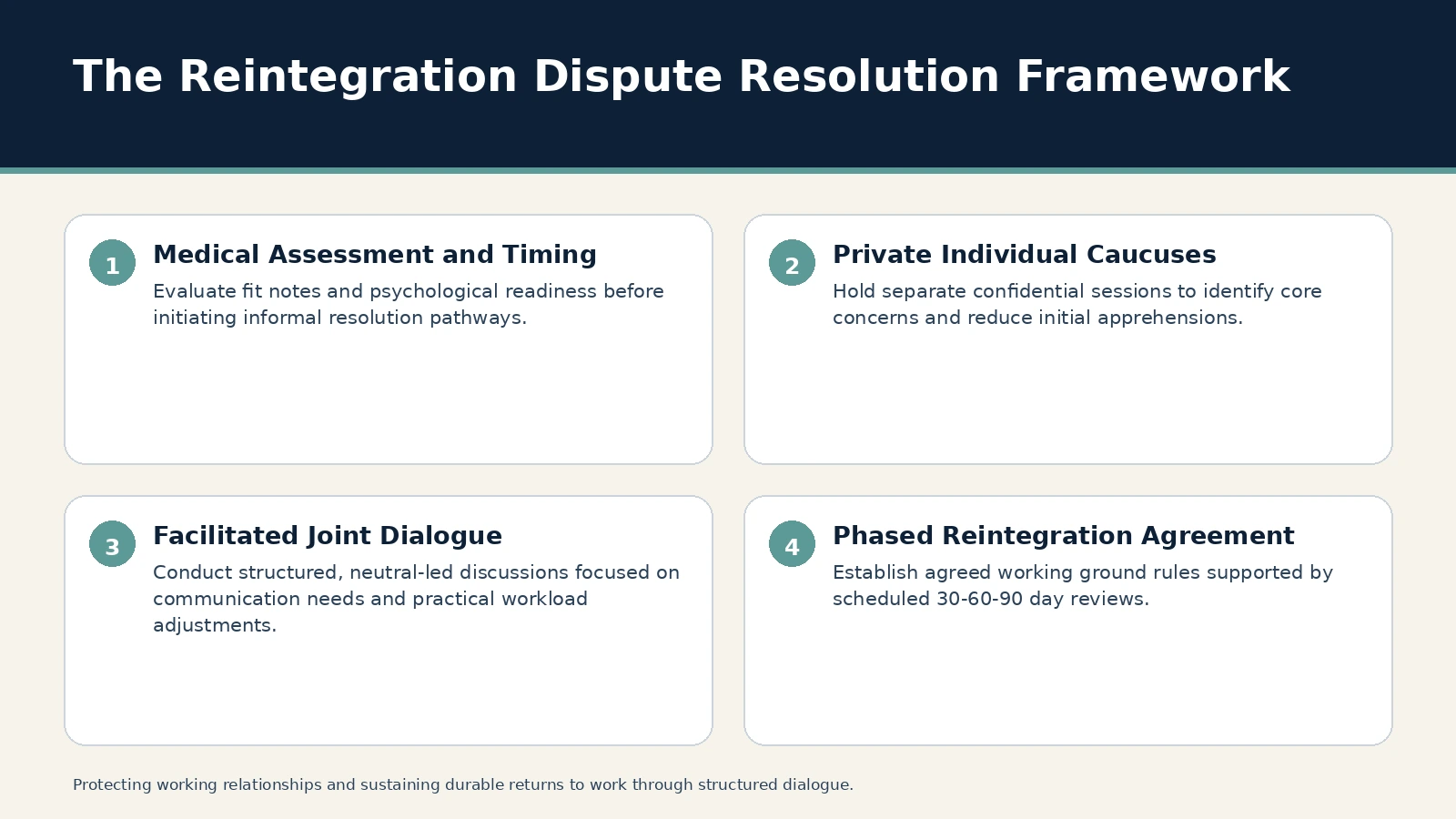
Step 1: Assessing Medical Readiness and Timing
Discussions regarding informal resolution usually begin when occupational health advice notes that the employee’s health is steadying, but identifies interpersonal tension as the primary obstacle to a stable return. If a formal grievance was lodged during the leave, the employer and employee can agree to pause internal grievance timelines to explore an informal pathway. Pausing formal timelines should always occur by mutual agreement; while an internal grievance procedure is governed by organisational policy and the Acas Code rather than existing as a standalone statutory right, securing mutual agreement ensures that neither party can claim unreasonable procedural delay or a breach of trust and confidence. Workplace mediation is suited to interpersonal and communication disputes; it is not appropriate for allegations of gross misconduct, physical violence, fraud, or serious unlawful harassment, which require formal management investigation.
Step 2: Private Pre-Mediation Caucuses
An essential stage in return-to-work mediation is the separate, confidential preparatory session. The mediator meets individually with the returning employee and the manager or colleague before any joint meeting takes place. These private sessions allow the participants to:
- Discuss how the relational dispute developed and explain what adjustments would make daily interaction manageable.
- Give the line manager space to outline operational priorities, team pressures, and personal perspectives calmly without feeling judged.
- Allow the mediator to assess whether both parties are ready for constructive dialogue and assist them in focusing on practical working arrangements rather than past blame.
Where either participant feels substantial apprehension about direct contact, the mediator can conduct shuttle mediation by speaking to the parties in separate physical rooms or remote breakout spaces until there is enough mutual reassurance to meet together.
Step 3: Facilitated Dialogue and Practical Reality-Testing
When the participants are ready, the mediator chairs a joint session. This is not an evidentiary hearing; there is no formal cross-examination. The mediator ensures that the conversation remains respectful, interruptions are managed, and defensive remarks are redirected toward clear operational solutions. Where an employee experiences cognitive fatigue or neurodivergent processing differences that contributed to workplace strain, pacing the dialogue deliberately is essential; further guidance is discussed in our guide to manager-employee conflict and neurodiversity.
During joint discussions, broad statements of frustration are unpacked into concrete daily practices, such as agreeing how urgent task adjustments will be communicated or clarifying how performance discussions should be structured. In this context, proactive workplace dispute resolution helps bridge the gap between abstract policy and everyday working dynamics.
Structuring the Post-Absence Working Agreement
The outcome of a successful workplace dispute resolution process is a shared behavioural agreement between colleagues who need to collaborate. Unless the parties deliberately choose to formalise specific terms through a statutory settlement agreement with independent legal advisers, these documents remain internal operational commitments rather than legally binding court orders.
Practical Ground Rules for Daily Work
A durable return-to-work agreement outlines day-to-day interactions clearly:
- Communication channels: Setting agreed expectations for assigning work. For instance, agreeing that priority changes will be noted in workflow software rather than delivered via informal instant messages late in the day.
- Feedback arrangements: Establishing clear parameters for supervisory feedback. If unexpected public feedback contributed to original stress levels, the participants might agree that performance reviews will occur strictly within scheduled one-to-one meetings.
- Phased workload coordination: Aligning operational duties directly with medical fit notes, stress risk assessments, and phased return schedules to prevent an early overload of complex duties. For practical ways to manage interpersonal friction, see our guide to resolving workplace communication breakdown.
- Early escalation points: Agreeing on a simple mechanism to raise emerging concerns. Setting an agreed check-in allows both individuals to address minor misunderstandings before frustration leads to another absence.
Maintaining Momentum Through Voluntary Review Points
Rebuilding working confidence takes time, and increasing workloads during a phased return can test newly formed understandings. It is sensible for participants to agree on informal review points—such as after several weeks—to evaluate how the arrangements are functioning in practice.
These check-ins remain focused on operational realities. If an agreed approach to project handovers proves impractical during busy operational cycles, the parties adjust the protocol cooperatively. For wider considerations on restoring collaborative working after conflict, explore our analysis of workplace mediation after a grievance.
Internal HR Facilitation vs Independent External Mediation
Organisations frequently weigh whether to facilitate return-to-work discussions internally or engage an external professional. Internal HR practitioners hold valuable understanding of company context and can helpfully resolve many day-to-day misunderstandings. However, appointing an independent external mediator is worth considering when:
- The returning employee feels internal HR is closely aligned with operational management or holds preconceptions regarding the dispute.
- The dispute involves senior leadership, department heads, or specialist personnel where internal detachment is structurally hard to achieve.
- Existing formal complaints have produced deeply entrenched arguments or widespread internal documentation.
- The business risks around continued absence or potential constructive dismissal claims are notable.
An external specialist operates completely outside the organisation’s management hierarchy. Because the mediator has no reporting relationship within the business, both parties are generally freer to discuss their practical concerns honestly.
If your organisation is planning an employee return complicated by unresolved relational friction, you can contact Echelon Dispute Resolution to discuss how independent workplace dispute resolution can support a sustainable return to work.
Frequently asked questions
Can an employer force a returning employee to attend mediation?
No. Voluntary participation is a foundational requirement of workplace mediation under Acas guidance. Workplace mediation is voluntary and relies on participant agreement; employers should not compel participation, though an unreasonable refusal to engage in resolving conflict may be considered when deciding on subsequent management or formal procedures. However, an employer can encourage the process by explaining that it is confidential, forward-looking, and designed to establish practical working ground rules rather than assign blame.
Can formal grievance or absence procedures be paused while mediation takes place?
Yes, provided both the employer and the employee mutually agree. While the statutory Acas Code of Practice on Disciplinary and Grievance Procedures applies specifically to disciplinary and grievance matters—not genuine ill-health absence capability proceedings—organisations can choose to pause internal grievance investigations or absence capability processes as a matter of internal policy and mutual consent. If mediation does not resolve the relational issue, the paused internal procedure resumes from the point it was held.
What happens if the employee and line manager cannot agree during mediation?
Mediation does not guarantee complete resolution. If the parties cannot find common ground, discussions held within private mediation generally remain confidential under the mediation agreement and should not be used in future internal hearings, subject to limited safeguarding or legal exceptions. The employer simply returns to its standard operational procedures, which may involve resuming a paused grievance investigation, reviewing medical recommendations and reasonable adjustments, or exploring redeployment to another team.
Is an agreement reached in workplace mediation legally binding?
No. Agreements reached in workplace mediation are informal behavioural pacts between colleagues, focusing on practical communication, workload boundaries, and daily interactions. They are not legally binding court orders or employment tribunal determinations unless the parties specifically choose to formalise contractual terms via legal advisers through a statutory settlement agreement.
Can mediation take place before the employee has physically returned to the office?
Yes. Conducting preliminary private caucuses or remote video mediation while an employee is still on sick leave is often beneficial, provided the employee is medically well enough for dialogue. Addressing interpersonal tension before physical reintegration helps alleviate return-to-work anxiety, ensuring that the phased return begins with clear ground rules already established.
Authoritative guidance and further reading
Primary and official sources
- A guide to civil mediation – GOV.UK (gov.uk)
- October 2026 issue of the employer bulletin – GOV.UK (gov.uk)
- PRACTICE DIRECTION – PRE-ACTION CONDUCT AND PROTOCOLS – Civil Procedure Rules – Justice UK (justice.gov.uk)
Further professional and framework reading
- Reducing absence – Managing sickness absence – Acas (acas.org.uk)
- Mediation Services – Magrath : Magrath (magrath.co.uk)
- £41,000 for a cup of tea? What the tea round case really says about constructive dismissal – Thrive Law (thrivelaw.co.uk)
This guide provides general information about dispute resolution and mediation. It is not legal advice. The appropriate approach depends on the facts, documents, procedural position and the parties involved; obtain legal advice where required.