

In brief
The question: How can corporate buyers and selling shareholders resolve post-completion earn-out conflicts when disagreements over EBITDA calculations overlap with allegations of operational interference or broken contractual promises?
The short answer: When deferred consideration targets are missed or contested, disagreements rarely stay confined to accounting line items. Sellers often suspect operational interference, revenue diversion, or artificial overhead loading, while buyers point to commercial underperformance. Standard expert determination clauses can interpret accounting definitions, but an independent accountant generally lacks jurisdiction over operational covenant claims. Breach of contract mediation provides a confidential, structured forum where both accounting disagreements and broader legal allegations can be resolved together. Under the expectations of English civil justice set out in the Practice Direction – Pre-Action Conduct and Protocols, commercial parties are expected to consider alternative dispute resolution before initiating proceedings. Mediation allows buyers and sellers to renegotiate hurdles, restructure deferred payments, or agree clean commercial exits without the delays, disclosure, and reputational fallout of High Court litigation.
Breach Of Contract Mediation: The Split-Forum Dilemma: Why Post-Sale Earn-Out Disputes Stall
Deferred consideration and earn-out mechanisms are designed to bridge valuation gaps between buyers and sellers. As with many complex commercial contract disputes, when an earn-out period draws to a close and the calculated payout falls short of expectations, commercial frustration can quickly escalate into formal conflict. What begins as a debate over financial statements frequently transforms into an allegation of contractual failure.
In mid-market corporate sales, these disputes tend to encounter a specific structural obstacle known as the split-forum dilemma. Most sale and purchase agreements (SPAs) featuring completion accounts or earn-out mechanisms contain an expert determination clause. This clause directs that disagreements over completion accounts or earn-out figures be referred to an independent forensic accountant. However, the mandate of an expert accountant is strictly defined by the contract. An independent expert is empowered to scrutinise figures and review compliance with accounting policies, but they generally have no contractual authority to evaluate whether a party breached operational covenants, diverted client opportunities, or cross-charged head-office expenses in bad faith.
For a founder who stayed on as managing director during the earn-out period, the dispute is rarely just about accounting standards. If the buyer integrated the business into a wider corporate group, moved sales pipelines to other trading entities, or introduced central overhead charges that depressed local EBITDA, the issue is fundamental: has the buyer broken an operational covenant or interfered with the agreed management autonomy? When selling shareholders raise these arguments, the dispute crosses from an accounting review into the territory of contractual enforcement.
When parties face this divide, dual-track formal proceedings can emerge. The accounting metrics might be destined for an independent expert, while the breach of contract claims head toward the High Court. This parallel approach risks substantial costs, contradictory evidence, and extended institutional deadlock. Engaging in commercial breach of contract mediation bridges this procedural divide, bringing accounting experts, retained solicitors, and commercial principals into a single forum where all disputed elements can be evaluated together.
Resolution Routes Compared: Independent Accounting, Litigation, and Commercial Mediation
Before committing to adversarial escalation, company directors and founding sellers must weigh how different dispute resolution forums approach earn-out conflicts. The table below outlines how expert determination, High Court litigation, and commercial mediation compare across practical and operational dimensions.
| Dispute Dimension | Expert Determination | High Court Litigation | Commercial Mediation |
|---|---|---|---|
| Scope of Disputed Issues | Confined to accounting calculations and defined contractual accounting policies, subject to the specific scope defined in the dispute resolution clause. | Addresses formal breach of contract and legal claims, but may stay or bifurcate valuation questions. | Unifies accounting variances, operational covenant claims, and personal employment or exit issues into one process. |
| Process and Procedural Control | Governed by the expert terms of reference; limited procedural flexibility once commenced. | Strict civil procedure rules, formal pre-trial directions, and external court scheduling. | Parties determine the timetable, select the mediator, and decide what documents to explore. |
| Confidentiality and Commercial Privacy | Private contractual procedure between the parties and the expert. | In open court proceedings, sensitive financial metrics, margins, and management friction risk becoming public under open justice principles, unless the court grants confidentiality orders or directs a private hearing. | Private and confidential process, protecting internal corporate financial data and market standing. |
| Final Resolution Structure | A binding valuation determination on the contested numbers, without room to alter the underlying terms. | A formal judgment determining liability and damages within the pleadings. | Consensual settlement agreements enabling restructured payments, extended timelines, equity adjustments, or clean exits. |
| Impact on On-Going Operations | Narrow interaction focused on technical accounting submissions. | Adversarial positioning can place strain on daily business operations, particularly if the founder remains employed. | Provides a managed forum to address executive tension, enabling workable interim management or an agreed departure. |
Commercial litigators recognise that English civil justice expects parties to explore resolution constructively before and during court action. Under the overriding objective of the Civil Procedure Rules, dealing with a case justly and at proportionate cost includes promoting alternative dispute resolution, and courts actively encourage parties to mediate. Similarly, under paragraphs 8 to 11 of the Practice Direction – Pre-Action Conduct and Protocols, litigation should be treated as a last resort, and an unreasonable refusal to mediate carries the risk of adverse costs consequences. You can read more about balancing these dynamics in our guide on settlement strategy and civil procedure costs protections.
Practical Settlement Levers: Restructuring Consideration and Operational Control
A central practical benefit of commercial mediation is that parties can shape custom commercial arrangements rather than being limited to the strict terms of the original agreement. While adjudicative decisions are bound by existing contractual terms and pleaded claims, breach of contract mediation enables corporate buyers, investors, and sellers to explore arrangements that reflect how the business has evolved since completion.
Because mediation is consensual, parties can craft solutions tailored to current trading realities rather than static forecasts settled during original deal negotiations. In earn-out deadlocks, several practical settlement levers frequently help parties find workable common ground:
- Restructuring Payment Profiles: Where cash flow constraints make an immediate earn-out payment challenging, parties can agree to amortise agreed sums over promissory notes, modify payment schedules, or attach interest components that reflect the revised timing.
- Hurdle and Baseline Re-benchmarking: If post-acquisition trading conditions or unexpected economic shifts suppressed revenue, the parties may agree to adjust EBITDA hurdles in exchange for lengthening the earn-out measurement period.
- Accelerated Buyout at an Agreed Compromise: A buyer wishing to fully integrate the acquired entity and remove bespoke operational restrictions can negotiate an immediate lump-sum settlement of deferred rights, releasing both parties from future accounting audits.
- Operational Autonomy Adjustments: Where the founder remains in post but feels constrained by group policies, mediation allows the parties to redefine management governance, adjust reporting lines, or clarify expenditure thresholds for the remainder of the performance period.
- Dignified Executive Departures: When personal working relationships have become strained, a negotiated settlement often incorporates an orderly transition plan. This can include early release from restrictive covenants, agreed consultancy terms, and mutual non-disparagement provisions that protect professional reputations in the sector.
These flexible arrangements turn what seemed like an intractable dispute into a renegotiated commercial framework. For founders and acquirers navigating parallel valuation questions, reviewing principles from shareholder exit and valuation mediation can provide helpful perspective on structuring pragmatic financial separations.
Preparing Financial and Contractual Materials for an Earn-Out Mediation
Achieving a clear outcome in an earn-out mediation requires disciplined preparation. Because these disputes sit squarely at the intersection of forensic finance and contractual interpretation, attending a session with generalised grievances or unverified spreadsheets will undermine constructive negotiation. Parties should work closely with their retained solicitors and accounting advisers to assemble a coherent, evidence-based bundle.
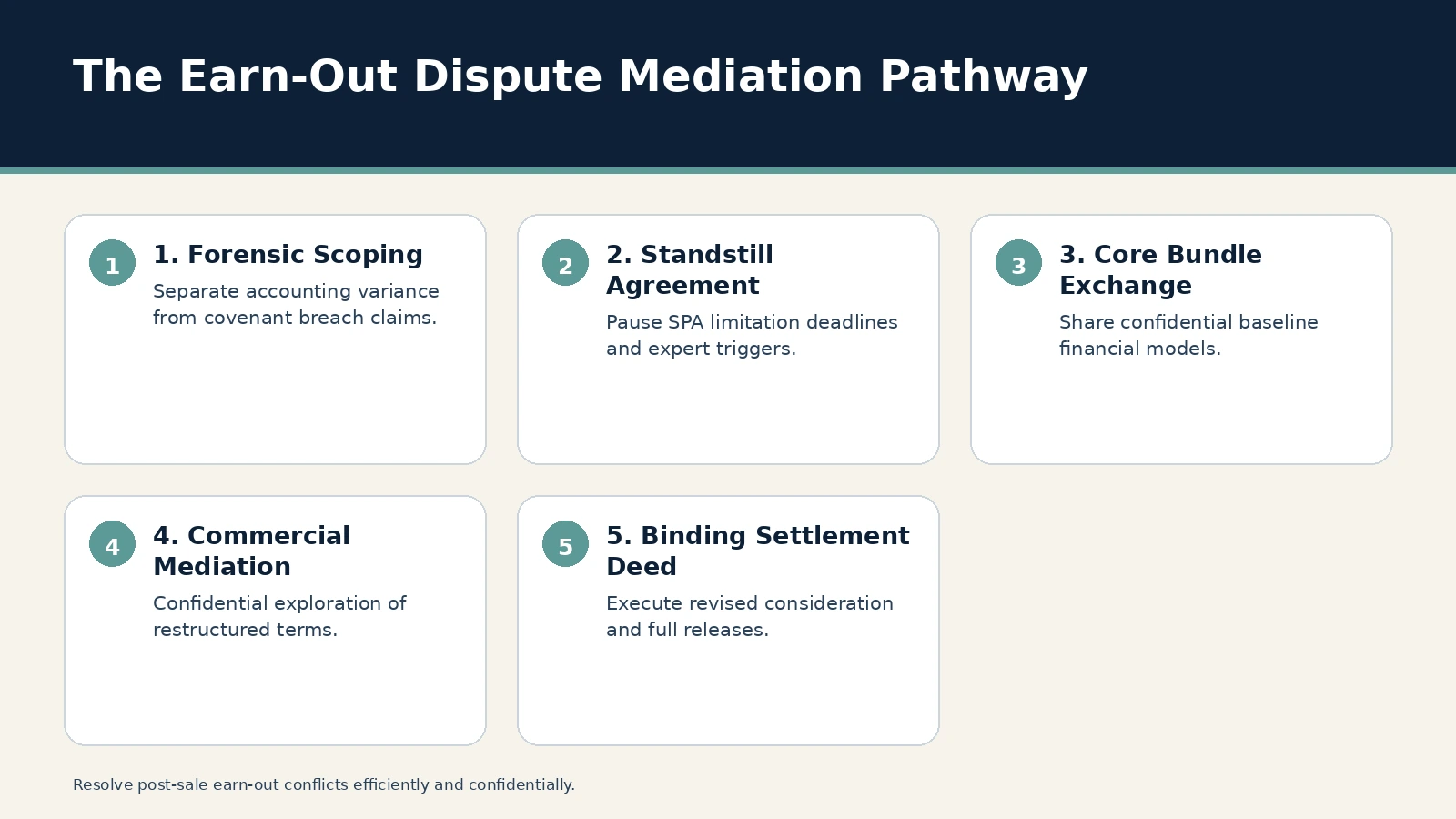
An effective preparation strategy involves several practical stages:
- Isolate Accounting Adjustments from Covenant Allegations: Construct a clear reconciliation schedule. Separate disputed accounting items (such as depreciation policies, bad debt provisions, or revenue recognition timing) from broader breach of contract claims (such as alleged client diversion or unauthorised group overhead allocations). This helps the mediator test the financial sensitivity of each individual issue.
- Address Approaching Limitation and Contractual Deadlines: Commercial SPAs often feature strict notice periods and response clocks for challenging accounts. Where limitation deadlines approach before mediation, buyers and sellers may instruct solicitors to execute a standstill agreement. Properly drafted, this suspends statutory limitation and agreed contractual deadlines, ensuring that participating in mediation does not prejudice either side’s procedural position.
- Prepare a Joint Core Financial Model: Rather than exchanging competing, irreconcilable financial projections, agree on an uncontentious historical baseline. Knowing precisely how much money is genuinely in dispute narrows the gap and prevents parties from expending negotiation time on agreed figures.
- Ensure Decision-Makers Are Available: Productive mediation typically requires attendees who possess, or have direct and immediate access to those who possess, the legal and commercial authority to agree revised terms. Corporate buyers should ensure an authorised executive director or investment partner attends, while founding sellers should attend alongside their legal advisers.
For more detailed operational checklists on structuring dispute bundles and briefing corporate teams, review our guide to preparing for commercial mediation. Thorough preparation enables parties to focus on realistic financial solutions rather than procedural friction.
Moving Forward: Resolving Post-Sale Deadlocks with Confidence
Unresolved deferred consideration disputes disrupt acquired businesses, distract executive management, and place strain on ongoing commercial relationships. Engaging in breach of contract mediation offers corporate buyers and selling founders a proportionate, private mechanism to confront these disputes directly, evaluate commercial risks, and negotiate terms that protect business value.
Because every SPA contains bespoke dispute mechanisms, notification time limits, and specific operational covenants, parties should seek professional legal advice from their commercial litigation solicitors when assessing their contractual rights. If you are facing an impasse over post-acquisition earn-outs, accounting adjustments, or management covenants, consider whether an independent mediator can help unpack the deadlock. You can contact Echelon Dispute Resolution to discuss how structured commercial mediation can assist in resolving high-value post-sale disputes.
Frequently asked questions
Why can an expert determination clause fail to resolve an earn-out deadlock?
An expert determination clause typically appoints an independent accountant with narrow jurisdiction over defined accounting figures and policies. If the dispute involves broader breach of contract claims—such as a buyer diverting sales pipelines or artificially imposing group overheads—the expert accountant generally lacks the contractual authority to evaluate legal liability or award damages, leaving the wider deadlock unresolved.
Does participating in breach of contract mediation compromise our legal position?
No. Commercial mediation is voluntary in terms of reaching an outcome, and discussions remain confidential. A settlement agreement can become legally binding once agreed. To avoid unintended commitments, parties can conduct negotiations ‘subject to contract’ until executing a formal written agreement or deed. Furthermore, engaging in mediation demonstrates compliance with English civil justice expectations regarding pre-action dispute resolution.
What happens to contractual earn-out notice deadlines while we mediate?
Earn-out clauses in SPAs frequently set strict timetables for delivering objection notices or triggering formal expert referrals. Where limitation deadlines approach before mediation, buyers and sellers may instruct solicitors to execute a standstill agreement. Properly drafted, this suspends statutory limitation and agreed contractual deadlines, ensuring that participating in mediation does not prejudice either side’s procedural position.
Who should attend an earn-out mediation session?
Productive mediation typically requires attendees who possess, or have direct and immediate access to those who possess, the legal and commercial authority to agree revised terms. This generally includes the founding sellers, key corporate buyer executives or private equity partners, retained commercial solicitors, and the forensic or transaction accountants who prepared the contested financial figures.
Can an earn-out mediation address personal employment disputes alongside financial claims?
Yes. When a founding seller remains as an executive or managing director post-sale, contractual earn-out friction often becomes intertwined with service agreements. Mediation provides a unified forum where parties can simultaneously resolve deferred consideration figures, executive departure packages, consultancy arrangements, and post-termination restrictive covenants.
Authoritative guidance and further reading
Primary and official sources
- service.gov.uk (assets.publishing.service.gov.uk)
- PART 1 – OVERRIDING OBJECTIVE – Civil Procedure Rules – Justice UK (justice.gov.uk)
- PRACTICE DIRECTION – PRE-ACTION CONDUCT AND PROTOCOLS – Civil Procedure Rules – Justice UK (justice.gov.uk)
Further professional and framework reading
- Earn-Out Disputes UK: Legal Rights, Buyer Manipulation & How to Claim (jonathanlea.net)
- Earn-outs | How to structure earn-out previsions to avoid disputes (harperjames.co.uk)
- M&A Disputes: Warranty Breaches, Misrepresentation & Fraud | Setfords (setfords.co.uk)
This guide provides general information about dispute resolution and mediation. It is not legal advice. The appropriate approach depends on the facts, documents, procedural position and the parties involved; obtain legal advice where required.