

In brief
The question: How can developers, main contractors, and specialist trade contractors resolve an active or post-completion construction delay dispute involving contentious extension of time requests, disputed critical-path programmes, and threatened liquidated damages without resorting to protracted court litigation or disruptive formal adjudication?
The short answer: A construction delay dispute often stalls active operations because extension of time applications, competing delay analyses, and contractual deductions interact to restrict contractor cash flow while exposing developers to delayed handover costs. Engaging in commercial mediation provides a confidential, structured negotiation forum. Instead of spending months arguing over historical programme records in an adversarial setting, the parties can evaluate project delivery as a whole. By uncoupling immediate financial deductions from schedule adjustments, commercial principals can negotiate revised completion targets, re-baseline live programmes, restructure stage payments, and execute a binding commercial settlement that preserves working relationships and project solvency.
The Delay Deadlock: Why Critical Path Slippage and Delay Deductions Freeze Projects
Progress slippage on complex commercial and infrastructure developments rarely stems from a single, isolated event. Late design releases, client variations, unforeseen ground conditions, supply chain bottlenecks, and contractor resource constraints combine over months of site activity. When physical progress diverges from the baseline master programme, the contractual machinery intended to administer risk can inadvertently create an operational and commercial impasse.
In practice, a delay deadlock develops around three interacting pressures:
- Extension of time (EOT) assessments: The main contractor submits delay notices seeking relief from contractual completion dates and claiming associated prolongation or disruption costs. The employer’s contract administrator or project manager may reject these claims or grant only limited extensions, citing incomplete site records, unproven cause-and-effect links, or concurrent contractor default.
- Concurrent delay arguments: Complex schemes experience overlapping employer risk events and contractor default events occurring across the same operational window. Assessing which event dictated the critical path can lead to competing retrospective programme analyses, which may involve substantial time and cost to prepare, review, and debate.
- Liquidated damages deductions: When sectional or practical completion dates lapse without an agreed extension, employers face mounting financing charges, tenant commitments, or operational revenue losses. Withholding or threatening to deduct liquidated damages from interim valuations immediately tightens contractor cash flow. This deduction reduces site labour resources, slows specialist sub-contractor procurement, and leads to further programme slippage.
This dynamic creates a difficult operational cycle. Withholding funds to protect against potential delay exposure increases financial strain across the site, making physical recovery harder to achieve. Meanwhile, managing formal adjudications or preparing for litigation in the Technology and Construction Court (TCC) consumes commercial and project management resources at the exact moment operational focus is required on site.
Negotiating a Construction Delay Dispute: Extension of Time and Financial Balancing in Mediation
Mediation provides an alternative to the rigid positions that delay and disruption claims produce. In formal determination procedures, an adjudicator or judge assesses historical entitlement based on contract terms, relevant factual and delay evidence, and applicable liability rules. In contrast, mediation enables commercial decision-makers to evaluate commercial exposure realistically and formulate forward-looking solutions tailored to project completion.
Under the formal framework set out in the Pre-Action Protocol for Construction and Engineering Disputes, parties are encouraged to exchange outline information and make genuine attempts to settle their differences before initiating court litigation. The protocol expressly accommodates commercial mediation as a practical route to conduct the required pre-action engagement.
During mediation, an independent commercial mediator works with each party in joint sessions and confidential private caucuses to explore the practical drivers behind the dispute. The mediator assists the parties in moving beyond polarised arguments regarding historical blame, focusing instead on shared commercial priorities: completing the asset, managing financial exposure, and establishing final account certainty. To examine how this collaborative approach applies across the project lifecycle, review our guide to the construction contract dispute mediation process.
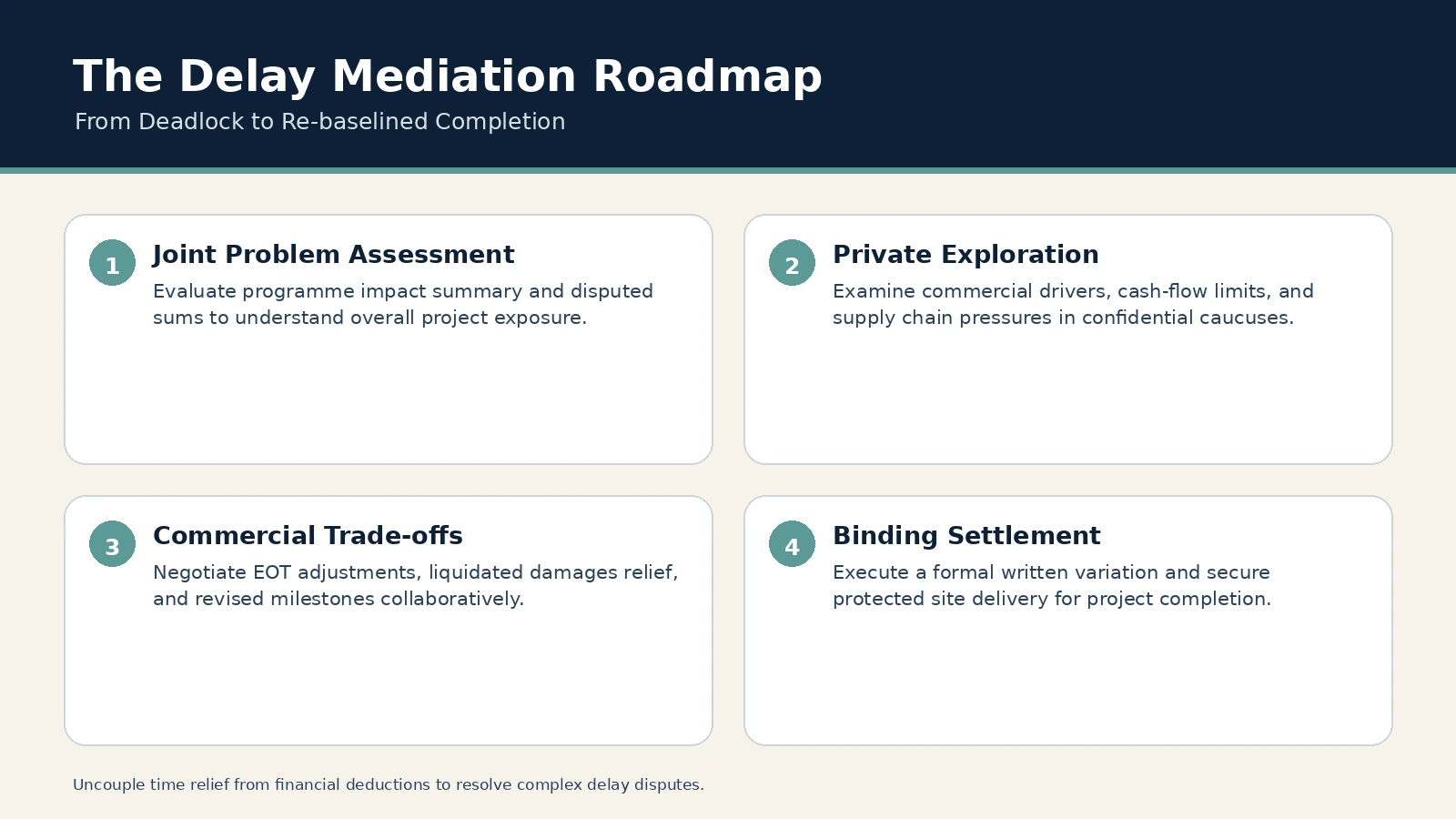
Construction Delay Dispute: Uncoupling Time Relief from Financial Deductions
A primary benefit of mediating a construction delay dispute is the ability to separate programme adjustments from immediate cash deductions. In formal adversarial proceedings, an employer often feels compelled to withhold delay damages defensively, while the contractor responds by maximising prolongation and disruption claims to offset the financial impact.
In mediation, the parties can craft balanced commercial compromises that align with ongoing project delivery, such as:
- Conditional time extensions: Agreeing a revised completion milestone that shields the contractor from immediate liquidated damages deductions, in return for enforceable commitments regarding dedicated site resources, specialist plant, and trade sequencing.
- Incentivised milestone payments: Converting disputed delay deduction figures into structured performance bonuses payable upon achieving critical operational handover phases or sectional completion dates.
- Consolidated account trade-offs: Releasing or capping contested prolongation claims in exchange for the prompt valuation, agreement, and payment of outstanding variation accounts or provisional sum reconciliations.
- Re-sequencing non-critical works: Adjusting fit-out sequences or handover requirements to allow early beneficial occupation of key sections while finishing works continue in separate zones.
This consensual flexibility allows commercial principals to address wider commercial realities. For instance, an employer may be bound by drawdown conditions from development funders or pre-let covenants with commercial tenants that penalise specific handover milestones rather than overall project duration. In mediation, the discussion can pivot to sectional handovers, accelerated fit-out packages, or ring-fenced commissioning schedules that satisfy funder requirements while offering the contractor relief from delay damages on non-critical paths.
Strategic Forum Comparison: Mediation, Statutory Adjudication, and Court Proceedings
Commercial directors, employer agents, and project managers should assess the practical characteristics of mediation alongside formal statutory and judicial routes when managing critical path slippage and associated financial exposures.
| Resolution Route | Process Objective | Remedy and Programme Flexibility | Impact on Live Site Operations |
|---|---|---|---|
| Commercial Mediation | Facilitated commercial negotiation aimed at reaching a voluntary, legally binding settlement agreement. | Broad flexibility. Parties can re-baseline master programmes, adjust milestone payments, trade financial claims, and reallocate project risks by agreement. | Conducts discussions confidentially in private sessions, supporting ongoing collaboration and minimising operational disruption on site. |
| Statutory Adjudication | Interim binding determination by an independent adjudicator within a fast-track statutory framework. | Contractual assessment. Confined to deciding the specific rights and financial sums referred under the contract terms. | Can introduce administrative pressure and divert operational management into preparing extensive formal submissions during live works. |
| TCC Court Litigation | Final, enforceable judicial determination based on legal liability, contractual terms, and expert evidence. | Judicial determination of contractual claims, damages, and costs liabilities under applicable law. | Formal litigation typically involves pre-action preparation, evidential substantiation, commercial risk, and potential legal costs exposure in accordance with court rules. |
Under the Technology and Construction Court Guide 2026, the court expects parties to actively consider alternative dispute resolution, including mediation, throughout the dispute lifecycle, and judges may take unreasonable refusal to engage into account when considering cost assessments.
Preparing the Delay Account: Core Documentation and Negotiation Mandates
Thorough preparation ensures that a mediation session remains productive and focused on commercial solutions rather than becoming entangled in detailed programme mechanics. Because resolving a construction delay dispute involves technical data, presenting clear, structured summaries helps decision-makers evaluate risk effectively.
1. Core Programme and Delay Submissions
Rather than providing voluminous archives of daywork sheets and correspondence, each party should prepare a concise, high-level bundle focusing on the primary events that affected the critical path:
- Baseline versus as-built programme comparison: A visual summary illustrating where actual progress diverged from planned milestone dates and identifying the principal contributing activities.
- Chronology of critical-path notices: A structured schedule of contractual delay notices, requests for information (RFIs), architect instructions, and relevant progress meeting records.
- Financial delay summary: A transparent calculation of asserted prolongation costs, direct disruption expenses, or the employer’s quantified financial exposure resulting from the delayed completion date.
When presenting delay data, simplicity aids negotiation. Commercial decision-makers rarely benefit from competing 300-page retrospective delay models on the day of mediation. Distilling the dispute into three or four critical-path windows with agreed factual start and finish dates allows principals to grasp the core financial exposure quickly and evaluate trade-offs without getting bogged down in expert methodology arguments.
2. Managing Supply Chain and Downstream Exposure
Delay disputes on major commercial schemes frequently involve multiple tiers of the supply chain. If an employer’s delay claim against a main contractor relates to mechanical, electrical, structural, or facade packages, resolving the primary dispute often requires evaluating downstream sub-contractor positions. Main contractors and trade contractors must consider how any mediated outcome aligns with pass-through liabilities and contra-charges. For further guidance on downstream valuation and deduction issues, read our detailed guide on subcontractor payment disputes and contra-charges.
3. Authority Levels and Commercial Representation
Mediation achieves the best results when participants possess clear authority to negotiate and conclude commercial terms. Commercial directors, development managers, and senior commercial managers should attend with the mandate to explore financial adjustments, agree programme revisions, and alter contractual milestones. If board approval or funder consent is formally required for final settlement sign-off, clear communication protocols should be arranged in advance to ensure decisions can be ratified promptly.
Commercial Settlement Mechanics: Programme Re-Baselining and Final Account Integration
When parties reach an agreed solution in mediation, their legal representatives and commercial managers record the terms in a written settlement agreement or formal deed of variation. This ensures that the commercial agreement is binding and integrated into the governing contractual framework.
Typical outcomes agreed in the mediated resolution of a construction delay dispute include:
- Formal deed of variation: Establishing an agreed, re-baselined completion date that resets contractual milestone liability and confirms the status of liquidated damages.
- Global financial reconciliation: Bundling outstanding extension of time claims, disputed variations, and loss-and-expense applications into an agreed net figure, avoiding fragmented disputes at the final account stage. To explore strategies for resolving final account deadlocks, see our guide on construction payment dispute mediation and final account deadlock.
- Revised payment and milestone structures: Creating phased incentive payments tied to measurable handover criteria, supporting contractor working capital while securing the developer’s delivery schedule.
- Confidential settlement terms: Protecting project reputation and commercial relationships by maintaining the confidentiality of agreed financial terms and programme adjustments.
Resolving delay and extension of time disputes through structured mediation enables commercial parties to regain control of project timelines and financial outcomes. When project delivery is threatened by critical-path deadlocks or disputed liquidated damages, you can contact our commercial mediation team to discuss whether mediation is appropriate for your project.
Frequently asked questions
Can we mediate a construction delay dispute while site works are still active?
Yes. Mediating during live construction works is common practice. It allows developers and contractors to address critical-path disagreements, agree on a re-baselined programme, and adjust financial terms confidentially without pausing physical operations on site.
Does engaging in mediation affect our right to refer a delay claim to adjudication?
No. Participating in mediation does not extinguish a party’s statutory right to refer a dispute to adjudication at any time under construction legislation. Mediation provides a collaborative route to resolve delay and financial matters before escalating to formal procedures.
What programme information should be prepared for a delay mediation?
Parties should prepare concise, visual summaries comparing the baseline programme against actual progress milestones. Focusing on the primary events that affected the critical path, supported by key contractual notices and a clear schedule of claimed costs, is more effective than submitting voluminous raw site records.
What occurs if the parties do not reach an agreement during the mediation session?
If settlement is not achieved on the day, mediation discussions remain confidential and without prejudice. The parties retain all their contractual and legal rights to pursue formal adjudication or court proceedings. In practice, mediation often clarifies underlying issues and provides a framework for subsequent direct commercial negotiations.
Authoritative UK guidance and further reading
Primary and official sources
- Technology and Construction Court (TCC) Guide 2026 – Courts and Tribunals Judiciary (judiciary.uk)
- Pre-Action Protocol for Construction and Engineering Disputes – Civil Procedure Rules – Justice UK (justice.gov.uk)
- Courts and Tribunals Judiciary (judiciary.uk)
- Courts and Tribunals Judiciary (judiciary.uk)
This guide provides general information about dispute resolution and mediation. It is not legal advice. The appropriate approach depends on the facts, documents, procedural position and the parties involved; obtain legal advice where required.