

In brief
The question: How can individuals resolve disputed private loans, unwritten debts, or conflicting financial expectations with friends, family members, or business associates without issuing a claim in the County Court?
The short answer: Engaging in Private Loan Dispute Mediation provides a confidential, structured environment to address unpaid personal debts, unclear verbal agreements, and cash-flow difficulties without the expense, delay, and animosity of formal litigation. Rather than entering a protracted court dispute over whether funds were an outright gift, an investment, or a repayable loan, the parties work with an independent mediator to clarify expectations, test informal records, and build pragmatic settlement arrangements. Under the civil justice framework in England and Wales, courts expect parties to consider alternative dispute resolution before issuing a claim. A successful mediation concludes with a signed settlement agreement that functions as a legally binding contract, establishing clear, enforceable terms while avoiding the public entry of a County Court Judgment (CCJ).
The Friction of Informal Lending: Unclear Terms and Personal Relationships
Disagreements over private loans rarely stem from deliberate bad faith. More often, they arise because informal lending between friends, relatives, or business acquaintances starts with trust and optimism rather than formal legal drafting. When money changes hands to assist with a property purchase, support a new venture, or resolve an urgent personal shortfall, the parties seldom document repayment dates, interest provisions, or default consequences.
Over time, personal and commercial circumstances evolve. The lender may experience unexpected financial pressures and request immediate repayment. Meanwhile, the borrower may believe the funds were an outright gift, an equity contribution in an early-stage venture that has yet to turn a profit, or a soft loan repayable only when their wider finances allow. When communication deteriorates, silence or defensive reactions often replace constructive dialogue. The lender interprets delays as avoidance, while the borrower feels cornered, embarrassed, or misunderstood.
Attempting to resolve these personal disagreements through solicitors’ warning letters or immediate court action frequently hardens positions. Threatening legal proceedings tends to escalate defensiveness, transforming a solvable liquidity problem into an entrenched interpersonal dispute. Through professional civil mediation services, both parties can step away from adversarial posturing to examine the reality of what occurred and determine how to resolve the debt constructively.
Mediation creates a private space where the emotional and relational weight of the dispute can be acknowledged alongside the financial figures. In many private loan disagreements, the breakdown in communication is driven by interpersonal stress rather than an outright refusal to settle. By establishing ground rules for constructive dialogue, an independent mediator helps both individuals articulate their practical constraints without fear that acknowledging difficulty will immediately trigger enforcement action.
In many personal loan arrangements, third parties are indirectly involved—such as spouses, parents, or mutual business partners. When payments stall, these secondary relationships experience significant collateral strain. Mediation allows the parties to address these wider interpersonal sensitivities safely, ensuring that any financial compromise reached does not leave lingering resentments that damage extended family or professional networks.
Resolution Pathways: Private Loan Dispute Mediation vs County Court Litigation
When a private loan remains unpaid, individuals may assume their only leverage is issuing a monetary claim in the County Court. However, formal civil litigation carries significant disadvantages for personal financial disputes. Court timetables can involve extensive waiting times, and court issue fees combined with legal representation costs can quickly become disproportionate to the sum in dispute.
Under the Practice Direction – Pre-Action Conduct and Protocols , the civil courts in England and Wales require parties to act reasonably, exchange sufficient information to understand each other’s position, and consider settlement options such as mediation before issuing proceedings. Failing to engage in settlement discussions can lead to costs consequences even if a party ultimately succeeds on the legal merits at trial.
Opting for Private Loan Dispute Mediation shifts the focus from establishing blame to finding workable financial solutions. In mediation, the parties retain control over the outcome. Rather than having a binding order imposed on them by a judge based solely on strict legal tests, they can negotiate terms that reflect actual cash flow, personal priorities, and the practical preservation of relationships.
| Dispute Dimension | Private Loan Dispute Mediation | County Court Litigation |
|---|---|---|
| Decision-Making Control | The parties mutually decide the terms; no outcome can be forced without mutual agreement. | A judge decides the outcome based on legal rules and evidence presented. |
| Repayment Flexibility | Allows bespoke schedules, structured instalments, discounted lump sums, or asset transfers agreed by consent. | Outcomes are determined through standard judicial orders based on formal claims and defences. |
| Privacy and Record | Mediation is confidential (subject to recognised legal exceptions), and private settlement agreements generate no public court records or credit register entries. | Hearings and formal judgments are matters of public record, potentially leading to a CCJ. |
| Relationship Impact | Facilitates calm, private communication to reduce resentment and protect personal ties. | Adversarial procedure that tends to deepen conflict between friends or family members. |
| Pre-Action Compliance | Directly demonstrates reasonable engagement with alternative dispute resolution. | Operates as a contested public process if pre-action resolution cannot be achieved. |
Structuring Sustainable Repayment Options in Mediation
One of the primary benefits of mediation in personal lending disputes is the ability to create nuanced financial arrangements tailored to real-world financial capacities. In formal litigation, a claimant generally seeks an immediate lump-sum judgment. However, obtaining a court judgment does not guarantee payment if the debtor simply lacks the capital to satisfy the debt in a single transaction.
In a private mediation session, the mediator works with both sides in joint discussions and separate private rooms (caucuses) to explore what is realistically achievable. A lender who understands the borrower’s actual balance sheet can make informed choices between waiting for unrealistic full immediate recovery or securing guaranteed, structured repayments over time.
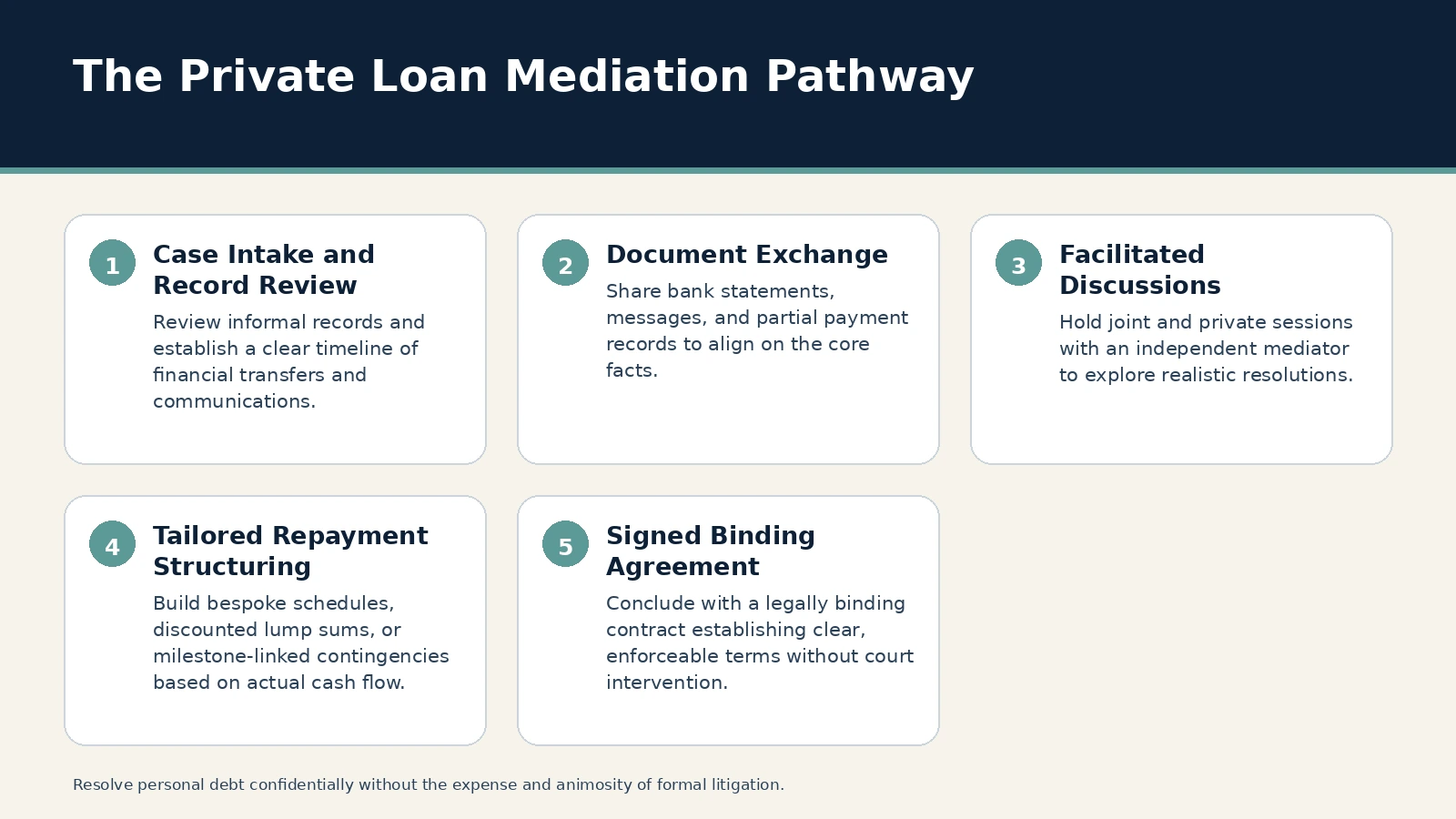
Common settlement structures explored during mediation include:
- Discounted Full-and-Final Settlements: The lender agrees to accept a reduced lump-sum payment by a specified near-term date in exchange for releasing the borrower from the remainder of the balance, providing immediate liquidity and certainty.
- Structured Instalment Schedules: The parties agree on realistic monthly or quarterly repayments matched to the borrower’s verified income and living costs, often incorporating a modest grace period before payments commence.
- Milestone-Linked Contingencies: Repayments are scheduled around anticipated financial events, such as the sale of a property, refinancing of a commercial facility, or distribution of an estate.
- Security and Default Terms: To give the lender confidence, the agreement can stipulate clear terms for default, such as accelerated payment clauses or consensual charges, ensuring certainty without immediate court intervention.
A crucial element in structuring these arrangements is managing risk against future cash-flow volatility. When parties agree to an extended instalment plan, the mediator can help them build sensible safeguard mechanisms—such as an agreed notification period or a short grace window if an unexpected life event temporarily disrupts payment. Establishing these protocols in advance prevents minor administrative delays from immediately reviving the entire dispute.
For individuals handling broader monetary disagreements, our guidance on civil dispute mediation for monetary claims outlines how similar structured outcomes are achieved across civil tracks in England and Wales.
Unravelling Loan versus Gift Disputes
A recurring source of friction in private lending disputes is the absence of formal contractual documentation, which frequently leads to conflicting recollections about the character of the transfer. While a lender may maintain that funds were advanced strictly on the understanding of full repayment, the recipient may recall the transaction as an unconditional gift, an advance on an inheritance, or non-repayable assistance provided during a personal crisis.
In court, resolving this question requires the judge to apply formal evidential tests to ascertain whether the parties intended to create legal relations. In personal and family settings, this enquiry can become intensely adversarial, as private messages, personal conversations, and familial history are scrutinised under cross-examination.
Mediation bypasses this binary contest by reframing the dispute around practical resolution rather than historical fault. The mediator assists both sides in reviewing contemporaneous messages, bank transfer references, and partial repayments to understand how each party formed their perception. This neutral examination allows the parties to move past defensive entrenched positions and construct an agreed financial compromise that respects the dignity of both sides.
During private caucus sessions, the mediator can test each party’s practical exposure in a safe setting. The lender is helped to evaluate the realistic prospects and cost of proving verbal terms in court, while the recipient can consider the reputational and personal costs of maintaining an outright gift defence against someone who provided support in good faith. This reality-testing often opens the door to pragmatic split-difference settlements or partial repayment schedules that neither party would have proposed directly.
Collating Informal Records and Evidentiary Materials for Mediation
Because private loans frequently lack formal contractual documentation, preparing for mediation involves gathering whatever informal records exist. The objective is not to build an adversarial bundle, but to help both parties and the mediator establish a clear timeline of events and financial transfers.
When preparing for Private Loan Dispute Mediation, parties benefit from collating and reviewing:
- Bank Statements: Evidence showing the exact date, amount, and reference description used when the funds were originally transferred.
- Digital Communications: Text messages, messaging app chats, emails, or written notes discussing the transfer, requests for assistance, promises to repay, or acknowledged balances.
- Partial Payment Records: Documentation of any past repayments, bank transfers, or offset arrangements that demonstrate ongoing recognition of the debt.
- Current Financial Information: A transparent summary of income, essential outgoings, and other liabilities, which helps establish realistic repayment capacity and prevents agreeing to unsustainable terms.
Parties may also choose to be accompanied by a legal representative or a trusted professional adviser during the mediation. While formal representation is not mandatory in private loan mediation, having legal or financial guidance can provide reassurance when evaluating proposed instalment amounts and reviewing the final settlement agreement.
Once consensus is reached, the mediator assists the parties or their advisers in drafting the final terms into a clear settlement document. Once signed by both parties, this document creates a legally binding and enforceable contract in England and Wales. This provides the creditor with contractual certainty and the borrower with protection against further claims, allowing both individuals to close the chapter on the dispute with finality.
By bringing clear records to the table, both the lender and borrower can move past conflicting recollections and focus their energy on crafting a sustainable resolution. If you are assessing how to approach an outstanding personal loan or wish to propose mediation to the other party, you can speak to an EDR mediator to discuss whether your dispute is suitable for private civil mediation.
Frequently asked questions
What is private loan dispute mediation?
Private loan dispute mediation is a confidential and voluntary process where an independent mediator helps individuals resolve disagreements over personal debts, informal lending, or unclear repayment terms without going to court.
Is a settlement reached in private loan mediation legally binding?
Yes. When parties reach an agreement in mediation, the terms are written into a formal settlement agreement. Once signed by both parties, this document creates a legally binding and enforceable contract in England and Wales.
How does mediation resolve disputes where there is no written contract?
Where no formal loan agreement exists, a mediator helps parties examine informal records such as bank references, text messages, and email exchanges to clarify intentions, resolve ‘gift versus loan’ disagreements, and negotiate workable repayment terms.
Does resolving a private debt through mediation affect credit ratings?
No. Mediation is confidential (subject to recognised legal exceptions), and private settlement agreements generate no public court records or credit register entries. Because the matter is settled out of court through a private agreement, no public County Court Judgment (CCJ) is issued against the borrower.
Can private loan dispute mediation handle structured instalment plans?
Yes. Mediation allows complete flexibility to agree on bespoke instalment schedules, grace periods, milestone-linked payments, or discounted lump-sum settlements tailored to the borrower’s genuine financial capacity.
Authoritative UK guidance and further reading
Primary and official sources
- PRACTICE DIRECTION 29 – THE MULTI-TRACK – Civil Procedure Rules – Justice UK (justice.gov.uk)
- PRACTICE DIRECTION – PRE-ACTION CONDUCT AND PROTOCOLS – Civil Procedure Rules – Justice UK (justice.gov.uk)
- PRACTICE DIRECTION 51ZE – SMALL CLAIMS TRACK AUTOMATIC REFERRAL TO MEDIATION PILOT SCHEME – Justice UK (justice.gov.uk)
- A guide to civil mediation – GOV.UK (gov.uk)
This guide provides general information about dispute resolution and mediation. It is not legal advice. The appropriate approach depends on the facts, documents, procedural position and the parties involved; obtain legal advice where required.