

In brief
The question: How can HR leaders and employers use workplace mediation after a formal grievance investigation concludes to repair broken working relationships between colleagues without reopening or undermining the formal decision?
The short answer: A formal grievance investigation determines whether specific allegations occurred under company policy, but it rarely resolves the underlying interpersonal resentment or defensive behaviours between colleagues. Introducing workplace mediation after grievance findings are delivered provides a confidential, voluntary framework for participants to address emotional friction and establish agreed operational boundaries. Rather than re-examining evidence or assigning blame, post-investigation mediation focuses on practical day-to-day coexistence. Facilitated by an impartial mediator, the parties agree on concrete communication standards, meeting protocols, and task handover rules captured in a Behavioural Charter, allowing teams to restore collaboration while keeping formal investigation outcomes intact.
The Post-Investigation Reality: Why Formal Grievance Outcomes Leave Interpersonal Fallout
When an employer delivers a formal grievance outcome, management often assumes the matter is settled. In practice, delivering an outcome report marks the beginning of a different operational challenge. Formal grievance procedures assess witness statements, policies, and contemporaneous evidence to conclude whether a complaint is upheld, partially upheld, or not upheld. While this satisfies procedural fairness and organisational compliance, it does not heal the interpersonal friction created during the dispute.
Following a grievance process, colleagues rarely return to smooth collaboration on their own. Instead, workplaces experience subtle yet damaging defensive behaviours. Employees may decline direct verbal conversations, communicating exclusively over email. Routine correspondence suddenly includes extensive CC lists to create an administrative paper trail. Colleagues may avoid attending the same project updates or deliberately exclude one another from informal discussions. Line managers, conscious of previous tensions, often feel hesitant to offer ordinary constructive feedback for fear of triggering fresh complaints or allegations of victimisation.
Left unmanaged, these defensive habits spread across the wider department. Surrounding colleagues feel pressured to take sides, creating departmental silos, social awkwardness, and mutual distrust. Over time, an unaddressed hostile working environment can lead to prolonged stress-related sickness absence, operational stagnation, or valuable staff resigning to pursue constructive dismissal claims based on a breakdown in the implied term of mutual trust and confidence. Employers have an ongoing responsibility to manage the workplace environment following an investigation, making proactive relationship repair an essential business priority.
This is why organisations turn to workplace dispute resolution strategies. Where formal processes determine institutional accountability, Acas guidance on workplace investigations confirms that employers can use third-party workplace mediation at any stage, including after formal proceedings conclude, to help participants find a workable way forward.
Comparing Procedural Determination and Post-Grievance Workplace Mediation
To implement an effective post-investigation strategy, HR professionals and operational leaders must distinguish between procedural determinations and relationship restoration. The table below outlines how formal grievance outcomes differ from post-investigation mediation in purpose, focus, and dynamic.
| Operational Dimension | Formal Grievance Outcome | Post-Grievance Workplace Mediation |
|---|---|---|
| Primary Objective | Establishing factual findings, policy compliance, and institutional accountability. | Rebuilding working communication and establishing practical day-to-day coexistence. |
| Temporal Focus | Retrospective: examining historical events, documents, and witness evidence. | Forward-looking: designing future interactions, boundary setting, and collaboration rules. |
| Outcome Structure | A formal determination (upheld, partially upheld, or not upheld) with procedural recommendations. | A consensual Behavioural Charter tailored to daily operational tasks. |
| Participant Dynamic | Evaluative and evidence-driven, which can leave participants feeling polarised. | Voluntary and collaborative, encouraging parties to articulate concerns and practical needs. |
| Relational Impact | Can heighten interpersonal tension, defensive documentation, and managerial hesitation. | Dismantles defensive working habits, clarifying communication boundaries and restoring functional teamwork. |
Workplace mediation after a grievance does not alter, review, or overturn the investigator’s findings, nor does it affect disciplinary sanctions imposed by management. Instead, it operates alongside formal records by giving colleagues a structured environment to address the emotional fallout and establish practical ground rules for daily professional interactions.
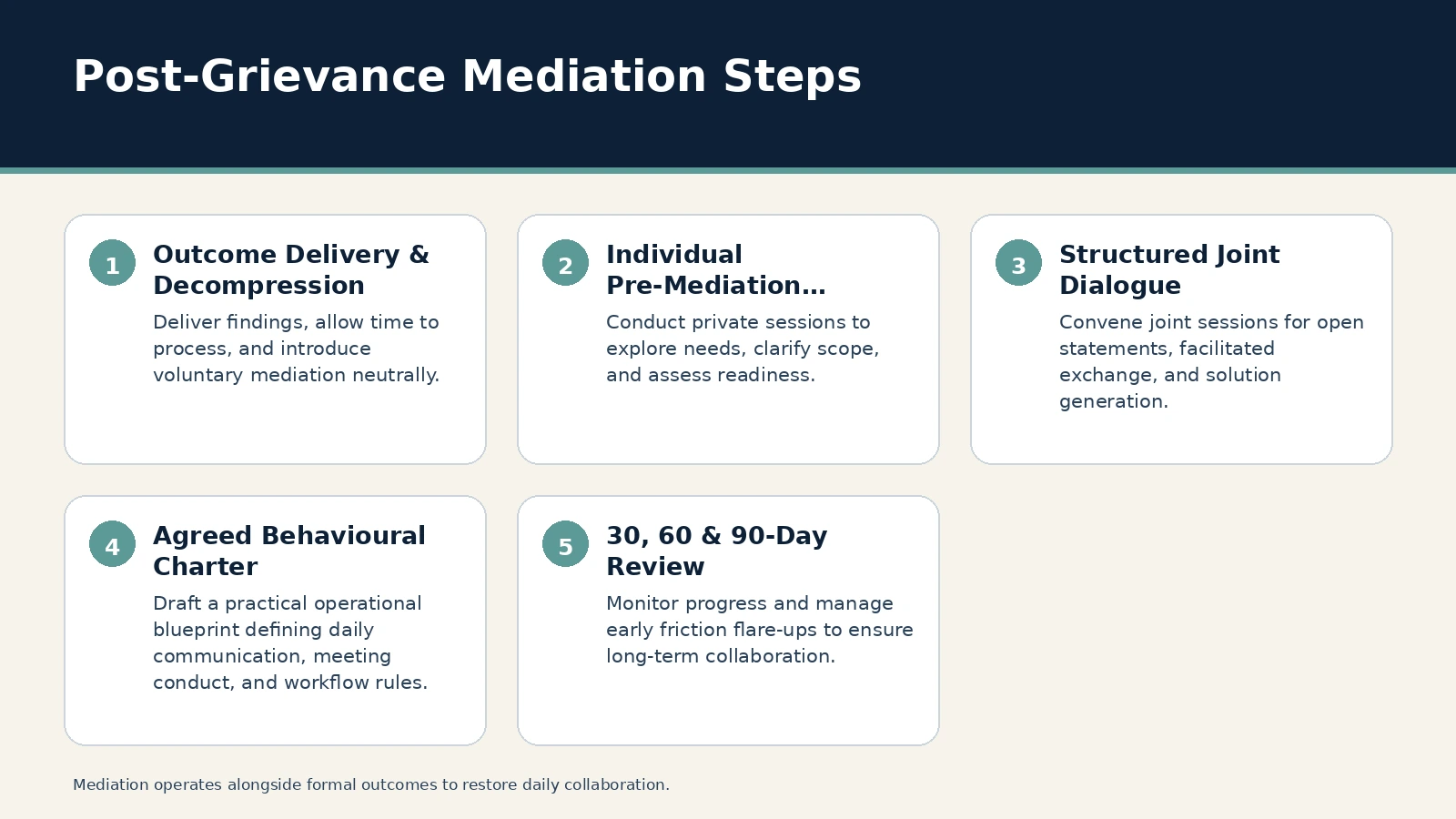
Implementing Workplace Mediation After Grievance Investigations: From Intake to Facilitated Dialogue
Implementing workplace mediation after grievance investigations requires deliberate timing, sensitive communication, and a structured procedural framework. Inviting colleagues into a joint meeting immediately after issuing an outcome report can backfire if individuals have not had time to process the findings. Conversely, waiting several months allows defensive habits to harden into permanent estrangement.
1. The Decompression Period and Neutral Invitation
Once the formal grievance outcome is delivered, employers should provide a brief decompression period. This allows the complainant and the respondent to absorb the investigator’s report, consult support networks, and move past initial emotional reactions. Following this window, HR or a senior leader should introduce mediation neutrally.
Crucially, mediation must remain entirely voluntary. It should never be presented as a mandatory management instruction or a sign that the company is questioning the formal investigation. Instead, frame the process around mutual operational support:
“The formal grievance investigation has concluded and its findings stand. However, we recognise that working alongside one another after a formal process can feel uncomfortable. We would like to offer an independent, confidential mediation process to help you both design practical ground rules for working together moving forward.”
Framing the invitation around functional coexistence—rather than forced friendship or artificial reconciliation—helps lower defensive barriers for both participants. If you are assessing the right procedural approach across parallel or sequential processes, reviewing workplace dispute resolution for sensitive complaints can clarify how formal and informal routes interact.
2. Separate Pre-Mediation Caucuses
Before any joint discussion takes place, the independent mediator conducts confidential, individual pre-mediation sessions (caucuses) with each participant. These private meetings serve several critical functions:
- Exploring Underlying Needs: The mediator allows each party to express their frustration, vulnerability, or apprehension in a secure, confidential environment without interruption from the other person.
- Clarifying the Scope: The mediator explains that the session will not re-investigate past allegations, evaluate evidence, or determine who was right or wrong. The focus remains strictly on forward-looking professional interaction.
- Assessing Readiness: The mediator gauges whether each party is willing to engage in constructive dialogue and helps them identify the specific operational changes they need from their colleague to feel comfortable at work.
- De-escalating Defensive Postures: The mediator helps participants shift away from defensive procedural arguments, prompting them to consider what realistic, day-to-day coexistence looks like once they return to the same team or floor.
3. The Structured Joint Mediation Session
When both participants are prepared, the mediator convenes a structured joint session. Drawing on frameworks supported by Acas dispute resolution resources, the mediator establishes ground rules: uninterrupted speaking time, professional language, and a commitment to exploring practical solutions. The joint session moves through defined phases:
- Uninterrupted Opening Statements: Each party explains how the recent conflict and investigation have affected their day-to-day work experience, personal well-being, and ability to complete operational tasks.
- Direct Facilitated Exchange: The mediator guides a dialogue focused on specific points of friction, encouraging colleagues to clarify misunderstandings, acknowledge professional impact, and articulate what they require from each other going forward.
- Solution Generation: The participants shift from discussing past tensions to proposing concrete operational adjustments. Rather than vague aspirations to “be more respectful,” the discussion explores tangible communication channels, meeting participation, and workflow handovers.
- Drafting Mutual Commitments: The parties consolidate their agreed adjustments into clear, realistic statements of intent that can be monitored without creating intrusive administrative burdens.
Where deeper interpersonal patterns have compromised team performance, our guide on resolving workplace communication breakdown offers detailed strategies for restoring professional dialogue.
Drafting an Actionable Behavioural Charter for Daily Collaboration
The substantive output of successful workplace mediation after a grievance is a written, mutually agreed Behavioural Charter. This document is not a legal contract; rather, it serves as an operational blueprint governing how the individuals will interact, collaborate, and manage disagreements in their daily work.
Key Components of an Effective Behavioural Charter
To prevent future misunderstandings, the charter must translate general intentions into specific, observable workplace behaviours. Effective charters address four core operational areas:
- Direct Communication Protocols: Defining when specific communication channels should be used. For example, agreeing that routine operational updates occur via direct email or project management software, while complex or sensitive task handovers are discussed via scheduled telephone or face-to-face check-ins rather than instant messages.
- Email and Administrative Boundaries: Ending defensive administrative habits by agreeing on clear rules for copying third parties. Charters can specify that line managers will only be CC-ed on final project deliverables or agreed escalation milestones, helping eliminate passive-aggressive copying on routine exchanges.
- Meeting Conduct and Public Interactions: Establishing ground rules for team meetings, project reviews, and shared office spaces. This includes agreeing on professional meeting etiquette, mutual acknowledgement in team settings, and procedures for sharing speaking time during client presentations.
- Handover and Workflow Interfaces: Defining clear turnaround expectations and submission formats for shared responsibilities, reducing room for friction over perceived delays or uncooperative work handoffs.
- Escalation and Early-Intervention Mechanisms: Creating a clear protocol for what either party should do if they feel friction or discomfort resurfacing. Rather than immediately submitting formal correspondence, the charter outlines a low-level resolution step, such as requesting a structured five-minute alignment conversation or contacting an agreed internal contact.
Managerial Support and Handling Early Friction Flare-Ups
Even after a productive mediation, minor moments of tension or awkwardness are natural during the first few weeks of co-working. A successful return to collaboration depends on how line managers handle these early friction points. If a manager overreacts to a minor misunderstanding by threatening fresh formal proceedings, or conversely ignores clear breaches of the charter, the fragile trust built in mediation quickly collapses.
Managers should maintain a steady, neutral stance. When a participant reports discomfort regarding a colleague’s tone or email phrasing, the manager should refer back to the Behavioural Charter as an objective reference point:
“Let us look at what was agreed in your communication protocol. The charter notes that urgent queries should be raised via phone rather than instant message. How can you both apply that agreed step to this situation today?”
This approach depersonalises the issue, placing responsibility back on the agreed commitments and helping colleagues navigate early adjustments without reopening the original dispute.
Monitoring Progress Across 30, 60, and 90 Days
A behavioural charter succeeds only if supported by consistent managerial oversight. While mediation sessions are confidential between participants and the mediator (subject only to rare legal exceptions such as safeguarding or unlawful acts), the agreed action points in the charter can be shared with line management and HR with the parties’ explicit consent.
Management should schedule private, individual check-ins at 30, 60, and 90 days. These short meetings give managers an opportunity to confirm that agreed communication boundaries are being respected, offer support where minor frictions emerge, and reinforce positive professional habits without micromanaging daily tasks. Over time, as cooperative habits take root, the charter naturally becomes second nature, allowing the team to operate effectively without active intervention.
Rebuilding working relationships after formal conflict requires skilled, impartial facilitation. To explore how structured post-investigation dialogue can support your team, you can speak to an EDR mediator about implementing tailored mediation frameworks.
Frequently asked questions
Does participating in post-grievance mediation mean reopening or overturning the formal investigation outcome?
No. Post-grievance mediation does not review, alter, or overturn formal investigation findings or disciplinary penalties. The formal investigation outcome remains fully intact on the organisation’s records. Mediation focuses strictly on future working relationships, establishing practical communication rules, and agreeing on behavioural standards so colleagues can collaborate professionally moving forward.
Can an employer force an employee to attend workplace mediation after a grievance?
No. Workplace mediation is an entirely voluntary process that requires the willing consent of both participants to be effective. While line managers and HR can strongly encourage participation and explain its practical benefits, an employer cannot compel attendance as a mandatory management instruction or penalise an employee for declining.
What happens if one or both parties refuse to participate in post-grievance mediation?
If an employee declines mediation, the employer must still manage the working dynamic. Line management should set clear, objective behavioural expectations and professional standards through standard management processes. Managers should monitor team interactions, maintain reasonable communication boundaries, and address any unacceptable conduct or victimisation under standard workplace policies.
Are discussions during post-grievance workplace mediation confidential from HR and management?
Yes. Mediation sessions are confidential between participants and the mediator, subject only to rare legal exceptions such as safeguarding or unlawful acts. They do not form part of formal HR records. Only the practical, agreed outcomes—such as a joint Behavioural Charter—are shared with HR and line managers, and only with the explicit consent of both participants.
How soon after a formal grievance outcome should mediation be introduced?
Employers should allow a short decompression window after delivering the formal investigation outcome. This gives both parties time to absorb the findings and manage initial emotional reactions. Once this brief period has passed, HR should introduce mediation proactively before defensive habits or team silos become entrenched.
Authoritative UK guidance and further reading
Primary and official sources
- Trade Union and Labour Relations (Consolidation) Act 1992 (legislation.gov.uk)
- Employment Rights Act 1996 (legislation.gov.uk)
- Employment Rights Act 1996 (legislation.gov.uk)
- Dismissal: your rights: Unfair and constructive dismissal – GOV.UK (gov.uk)
This guide provides general information about dispute resolution and mediation. It is not legal advice. The appropriate approach depends on the facts, documents, procedural position and the parties involved; obtain legal advice where required.