

In brief
The question: How can surviving partners, family members, beneficiaries, and executors resolve dependency and financial provision disputes under the Inheritance Act 1975 without depleting the estate in court proceedings?
The short answer: Inheritance Act claims mediation provides a confidential negotiation forum where parties work alongside an independent neutral to reach practical, mutually acceptable financial arrangements. Judicial evaluation of reasonable financial provision carries inherent uncertainty, and contentious litigation costs can diminish the net estate available for distribution. Through mediation, executors manage administrative risk, beneficiaries protect their intended inheritance, and claimants can secure prompt financial clarity regarding housing or maintenance needs. Addressing disputes early through inheritance act claims mediation also manages the pressure created by statutory limitation deadlines, allowing families to explore tailored solutions while preserving estate wealth.
The Realities of 1975 Act Financial Provision Disputes
Disputes under the Inheritance (Provision for Family and Dependants) Act 1975 arise when a will or the statutory rules of intestacy are alleged to fail to make reasonable financial provision for an eligible applicant. These claims rarely present as simple financial disagreements. Instead, they represent an intersection of grief, family history, economic vulnerability, and conflicting expectations about what the deceased intended.
When an individual passes away, those left behind may face sudden financial exposure. A cohabiting partner may find that the family home passes entirely to adult children from a previous marriage under the terms of an outdated will. An adult child with health difficulties or modest earnings may find themselves excluded in favour of distant relatives or charitable institutions. Conversely, named beneficiaries who cared for the deceased in their final years may view an unexpected claim as an unwelcome interference with clear testamentary wishes.
Executors and personal representatives occupy an uncomfortable position in the middle. Charged with fiduciary duties to collect and administer estate assets, they must remain neutral in hostile claims between competing beneficiaries and claimants. If contentious correspondence escalates, executors face operational paralysis, unable to distribute funds while exposed to procedural costs risks if they take partisan steps. The unpredictability of court adjudication means that neither claimants nor beneficiaries can rely on a guaranteed outcome at trial. Engaging in inheritance act claims mediation provides all participants with a controlled environment to assess financial realities and design pragmatic outcomes before litigation expenses erode the value of the estate.
Negotiation Dynamics in Inheritance Act Claims Mediation
Estate assets are rarely comprised entirely of cash in a bank account. More often, an estate consists of a residential property, personal chattels, business interests, pension death benefits, or illiquid investments. When claims are litigated to a final contested hearing, the court evaluates statutory factors to decide whether to award lump sums, periodic payments, or property transfers. However, court adjudication is inherently adversarial and constrained by formal pleadings.
In contrast, inheritance act claims mediation allows parties to look behind positional statements and examine the practical, underlying needs of everyone involved. This commercial and personal flexibility permits the construction of tailored settlement terms that address individual circumstances directly:
- Housing and Property Solutions: Rather than forcing an immediate sale of a family home during unfavourable market conditions, parties can agree on a lifetime right of occupation, a deferred charge against the property, or an agreed sale where proceeds are partitioned to allow the claimant to purchase a smaller home while preserving the reversionary capital for the original beneficiaries.
- Structured and Conditional Payments: Settlements can establish phased distributions, maintenance funds held on trust, or capital payments released upon specific life events, offering security to a dependant while safeguarding the residual estate.
- Asset Exchanges and Clean Restructuring: Parties can agree to exchange specific estate assets, offset liabilities, or implement variations that ensure distributions are completed cleanly.
- Personal Possessions and Sentimental Chattels: Mediation creates a space to resolve disagreements over family heirlooms, jewellery, and personal items—matters that carry immense emotional significance to family members but receive limited attention in formal court hearings.
By using probate and inheritance dispute discussions to explore these mechanisms, claimants obtain financial certainty without waiting through protracted proceedings, while beneficiaries maintain a defined share of the estate without watching the fund reduce through mounting legal fees.
Procedural Timing and the Statutory Limitation Clock
A primary complication in 1975 Act claims is the statutory timetable governing financial provision applications. Under Section 4 of the Inheritance (Provision for Family and Dependants) Act 1975, claims must generally be made within six months from the date representation (probate or letters of administration) is first taken out, except with court permission. A comprehensive background of this framework can be seen on the Inheritance Act 1975 overview.
This six-month window creates immediate tactical tension. Claimants must investigate the estate and quantify their financial needs promptly to avoid missing the deadline. If negotiations are ongoing as the six-month mark approaches, the claimant must protect their position. While parties in ordinary civil disputes might agree on standstill terms, in 1975 Act disputes private standstill agreements cannot bind the court regarding limitation, meaning claimants frequently issue protective proceedings and then seek a stay of proceedings to enable mediation to proceed safely.
Civil courts in England and Wales place significant emphasis on alternative dispute resolution under the Civil Procedure Rules (CPR). The rules expect parties to consider mediation at every stage of a dispute. If a party unreasonably refuses an invitation to mediate, the court retains broad discretion under CPR 44.2 to impose adverse costs consequences at the conclusion of trial, regardless of whether that party succeeded on the substantive claim. Using inheritance act claims mediation demonstrates proactive engagement with dispute resolution, safeguarding executors and beneficiaries against costs criticism from the court.
Decision Framework: Comparing Court Adjudication and Mediation
When deciding whether to pursue formal court proceedings or explore a negotiated settlement through mediation, executors, beneficiaries, and claimants should evaluate the practical distinctions between the two approaches.
| Decision Factor | Court Adjudication | Civil Mediation |
|---|---|---|
| Control Over Terms | A judge determines the outcome using statutory discretion, leaving the final distribution outside the parties’ direct control. | The parties retain decision-making authority; in mediation, settlements generally become binding once all parties agree and execute written terms. |
| Outcome Flexibility | Adjudication focuses on granting statutory orders, transfers of value, or dismissing the application. | Enables bespoke solutions, including shared property arrangements, conditional trusts, and creative asset division. |
| Confidentiality and Privacy | Court hearings and formal judgments are generally open to the public, exposing family finances and personal history. | Conducted privately; all discussions and offers remain confidential to the participants and their advisers. |
| Impact on Estate Funds | Trial preparation, formal disclosure, and expert reports generate substantial legal costs that diminish the estate. | Focuses discussions on commercial realities, helping to resolve the matter and preserve the estate fund. |
| Interpersonal Relationships | Formal cross-examination and adversarial evidence can cause permanent damage to family relationships. | Provides a managed, respectful environment that allows parties to address differences without confrontation. |
Preparing for an Inheritance Act Claims Mediation
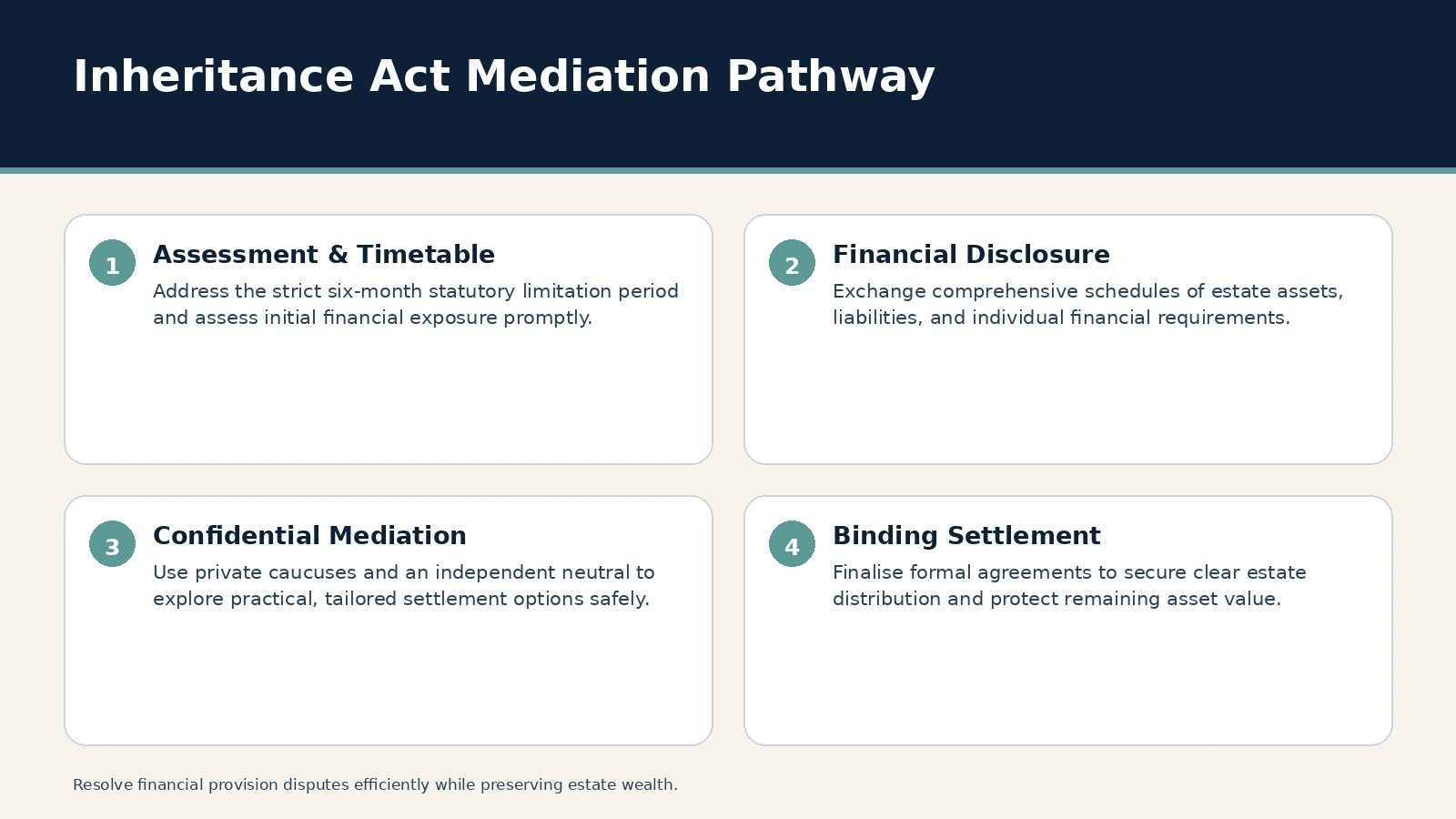
A productive mediation depends on thorough, disciplined preparation. Because 1975 Act disputes centre on whether reasonable financial provision was made and what resources are available, negotiations cannot progress effectively without transparent financial disclosure. Parties preparing for inheritance act claims mediation should focus on four essential areas:
1. Verifying the Net Estate Value
Executors must assemble a comprehensive schedule of estate assets and liabilities. This should set out up-to-date property valuations, bank balances, investment values, outstanding debts, tax liabilities, and administration costs. Knowing the exact net fund available prevents parties from negotiating around inaccurate assumptions.
2. Quantifying Claimant Needs and Resources
The claimant needs to provide a clear, evidence-based schedule of their current financial position and future requirements. This includes current income, pensions, capital assets, and detailed monthly living expenses. Rather than presenting aspirational figures, claimants should substantiate their requirements with realistic documentation, such as mortgage capacity estimates, rental listings, or specific care cost breakdowns.
3. Documenting Beneficiary Circumstances
The financial needs, obligations, and resources of named beneficiaries are central to the evaluation of any settlement. If a beneficiary has personal financial commitments, dependent children, or health considerations that depend on their testamentary gift, documenting these factors ensures that settlement proposals reflect the legitimate interests of all parties.
4. Ensuring Proper Representation and Authority
Every party with authority to settle the dispute must participate in the mediation session, accompanied by their contentious probate legal advisers. Having legal counsel present ensures that proposed settlement structures can be reviewed immediately for enforceability, tax efficiency, and procedural validity. For detailed guidance on preparing for the session day, consult our overview of the probate and inheritance dispute mediation process.
Structuring the Mediation Session
Inheritance Act mediations are designed to avoid direct confrontation between family members who may be experiencing acute emotional distress. The mediator normally conducts the day using separate private rooms (caucuses) for each party, rather than insisting on extended joint meetings.
During the session, the mediator shuttles between rooms, discussing the core concerns of each side in strict confidence. Information shared in private caucus is never disclosed to the other room without explicit authorisation. This enables parties to speak openly about personal priorities, acknowledge vulnerabilities in their positions, and explore settlement options without compromising their formal legal stance.
As discussions advance, the mediator assists the participants in shifting their focus away from past family grievances toward practical future arrangements. When common ground is identified, the legal representatives draft a formal, legally binding document—such as a settlement agreement or a Tomlin Order. Where settlements involve minors or protected parties, the agreement is drafted subject to formal court approval under CPR Part 21 to ensure complete legal finality.
Taking Practical Next Steps
When an estate faces an unresolved financial provision claim, prolonged contentious correspondence increases legal costs and deepens personal division. Exploring early dispute resolution provides an opportunity to resolve differences constructively, protect the estate from excessive expenditure, and achieve finality on mutually agreed terms.
If you are an executor managing a contentious claim, a beneficiary defending your entitlement, or an applicant seeking financial security, you can contact Echelon Dispute Resolution to discuss how independent mediation can assist in resolving your 1975 Act dispute.
Frequently asked questions
What is inheritance act claims mediation?
Inheritance Act claims mediation is a confidential dispute resolution process where an independent mediator assists executors, beneficiaries, and financial dependants in negotiating an agreed settlement under the Inheritance (Provision for Family and Dependants) Act 1975, avoiding the expense and unpredictability of a court trial.
How does the 6-month statutory limitation period affect mediation?
Under Section 4 of the Inheritance (Provision for Family and Dependants) Act 1975, claims must generally be made within six months from the date representation is first taken out, except with court permission. Because private standstill agreements cannot bind the court in 1975 Act claims, claimants often issue protective proceedings before the deadline and then invite the court to stay the litigation so that mediation can proceed.
Do the parties have to meet face-to-face during the mediation?
No. In contentious probate and inheritance disputes, mediators typically conduct the session using separate private rooms (caucuses). The mediator moves between the parties, allowing negotiations to proceed constructively without direct personal confrontation.
Is an agreement reached at mediation legally binding?
Yes. Once terms are agreed, legal representatives prepare a formal written settlement agreement or Tomlin Order. When signed by capable parties, the terms form a binding contract, subject to formal court approval where minors or protected parties are involved under CPR Part 21.
What are the costs risks if a party refuses an offer to mediate?
Under CPR Part 44, the court retains broad discretion over costs and may penalise a party’s unreasonable refusal to participate in mediation through adverse costs orders, even if that party is ultimately successful on the substantive claim at trial.
Authoritative UK guidance and further reading
Primary and official sources
- IHTM35231 – the Inheritance (Provision for Family and Dependants Act) 1975: introduction – HMRC internal manual – GOV.UK (gov.uk)
- IHTM35232 – the Inheritance (Provision for Family and Dependants Act) 1975: persons who may apply – HMRC internal manual – GOV.UK (gov.uk)
- Inheritance (Provision for Family and Dependants) Act 1975 (legislation.gov.uk)
- Inheritance (Provision for Family and Dependants) Act 1975 (legislation.gov.uk)
This guide provides general information about dispute resolution and mediation. It is not legal advice. The appropriate approach depends on the facts, documents, procedural position and the parties involved; obtain legal advice where required.