

In brief
The question: How can employers and employees use informal workplace mediation to resolve interpersonal grievances and rebuild damaged working relationships without derailing statutory workplace procedures?
The short answer: Introducing mediation for workplace grievance disputes allows organisations and staff to address underlying interpersonal friction before formal positions harden. Under the framework established by the Acas Code of Practice on Disciplinary and Grievance Procedures, formal grievance timetables can be paused by mutual consent to explore voluntary, confidential mediation. Rather than conducting an adversarial investigation focused solely on historical blame, an impartial mediator helps colleagues establish clear communication protocols, define acceptable working behaviours, and agree on practical operational boundaries. If mediation produces a durable working accord, the grievance is typically resolved or withdrawn; if not, the formal process resumes with all statutory and contractual rights preserved.
Why Formal Grievance Machinery Struggles with Relational Breakdown
Workplace conflict rarely emerges overnight. In most organisations, disputes stem from cumulative misunderstandings, perceived changes in management style, shifting workloads, or mismatched communication habits. When these interpersonal tensions go unaddressed, one party inevitably lodges a formal grievance. While formal policies are necessary for compliance and accountability, triggering formal investigative machinery changes the dynamic of interpersonal conflict in several distinct ways:
- Defensive positioning: Once a formal written statement is submitted, participants often retreat into defensive postures. Colleagues can become cautious about everyday contact, communication may become strained or cease, and normal collaboration can be disrupted or halt.
- Retrospective focus on fault: A formal grievance investigation is designed to establish whether a specific policy violation occurred. It looks backward to collect witness statements and documentary evidence, establishing liability rather than addressing how colleagues will interact on Monday morning.
- Operational strain and absence: The stress of participating in formal grievance interviews, collating evidence, and awaiting written findings frequently leads to workplace absence, lowered team morale, and substantial diversion of managerial focus.
- Polarisation of teams: Formal investigations often require colleagues to act as witnesses, inadvertently creating internal factions, entrenching mistrust across departments, and making future reintegration far more complex.
Exploring professional workplace mediation offers an alternative route. It allows organisations to address the behavioural and relational issues that formal investigation panels are neither equipped nor designed to resolve.
Using Mediation for Workplace Grievance: When Is Informal Resolution Appropriate?
Mediation is not a universal substitute for every formal workplace procedure. Successful conflict management depends on accurately evaluating whether a dispute is suitable for an informal, facilitated conversation or requires a formal, evidence-led investigation.
Organisations managing active disputes should assess the nature of the core grievance against several clear indicators.
Situations Well Suited to Informal Mediation
Workplace mediation is particularly effective where the dispute involves:
- Communication breakdown: Ongoing friction between line managers and team members regarding feedback delivery, tone, task allocation, or performance expectations.
- Peer-to-peer personality clashes: Friction between colleagues on the same operational tier whose daily friction disrupts wider team cohesion.
- Cross-departmental friction: Competing priorities or resource disputes between team leads that have degenerated into personal animosity.
- Post-reorganisation tension: Difficulties adapting to structural change, reporting line adjustments, or revised role remits.
- Misaligned working styles: Differing approaches to remote working, email response expectations, project delegation, or perceived lack of professional respect.
Situations Requiring Immediate Formal Investigation
Workplace mediation is generally inappropriate—at least in the first instance—where the allegations involve serious misconduct that the organisation has an independent duty to investigate. This includes formal allegations of unlawful discrimination, sexual harassment, physical violence, fraud, or serious whistleblowing disclosures. In such cases, an employer should conduct a reasonable and proportionate investigation to establish the facts and satisfy duty of care and fairness obligations.
Where the boundary between interpersonal friction and actionable misconduct is blurred, HR leaders often consult guidance on workplace bullying and choosing between workplace mediation and formal grievance procedures to determine the safest operational path.
Pausing Formal Grievance Procedures for Mediation Under the Acas Framework
A frequent concern for HR professionals and employees is whether initiating workplace mediation forfeits formal procedural rights or breaches organisational grievance timelines.
The operative statutory benchmark in England & Wales is the Acas Code of Practice on Disciplinary and Grievance Procedures (issued under section 199 of the Trade Union and Labour Relations (Consolidation) Act 1992). The Code expressly encourages employers and employees to resolve grievances informally where possible. (Note: While Acas published a draft Code of Practice in July 2026 proposing to strengthen the emphasis on informal resolution, the 2015 Code remains the current operative statutory standard.) Formal grievance processes can be paused at any stage by mutual, written consent to permit an agreed window for workplace mediation.
Pausing the formal process operates on three clear principles:
- Voluntary engagement: Neither the employer nor the employee can be forced into mediation. Both parties must freely agree to participate.
- Ring-fenced confidentiality: Discussions within the mediation room are confidential and conducted under a formal mediation agreement, subject to standard legal exceptions such as safeguarding or serious criminal activity. What is said during mediation is not shared with HR or disciplinary panels, nor is it placed on personnel files without the express agreement of all participants.
- Preservation of procedural standing: If mediation does not yield a mutually acceptable agreement, the formal grievance timetable resumes exactly where it was paused. No party loses their right to a formal investigation or hearing by attempting informal resolution.
HR directors looking to manage this procedural transition safely can refer to our detailed guidance on how to pause formal grievance procedures safely.
Under section 207A of the Trade Union and Labour Relations (Consolidation) Act 1992, Employment Tribunals have the discretionary power to adjust compensation awards by up to 25% (upwards or downwards) if an employer or employee unreasonably fails to follow the Acas Code. While participation in workplace mediation itself remains voluntary, demonstrating that an organisation actively offered and facilitated informal resolution avenues supports a clear record of fair, proportionate process.
Comparing Procedural Pathways: Formal Grievance vs. Workplace Mediation
When deciding whether to deploy mediation for workplace grievance scenarios or proceed with a formal hearing, understanding the procedural contrasts helps HR leaders set realistic expectations for everyone involved.
| Operational Dimension | Formal Grievance Procedure | Workplace Mediation |
|---|---|---|
| Primary Objective | Establish factual findings on past conduct and determine policy compliance. | Rebuild communication and establish practical working arrangements for the future. |
| Decision-Maker | Appointed grievance hearing officer or independent investigator. | The participants themselves, facilitated by an impartial mediator. |
| Focus of Dialogue | Specific historical allegations, written evidence, and policy thresholds. | Interpersonal dynamics, operational impact, communication styles, and practical needs. |
| Process Confidentiality | Internal confidentiality bounded by HR records and potential tribunal disclosure. | Operational confidentiality governed by a mediation agreement, subject to standard legal exceptions such as safeguarding. |
| Outcome Structure | Binary findings: grievance upheld, partially upheld, or dismissed. | Tailored behavioural compacts, communication plans, and agreed working protocols. |
| Impact on Collaboration | Can entrench defensive division between colleagues. | Allows direct dialogue to rebuild personal trust and ongoing professional cooperation. |
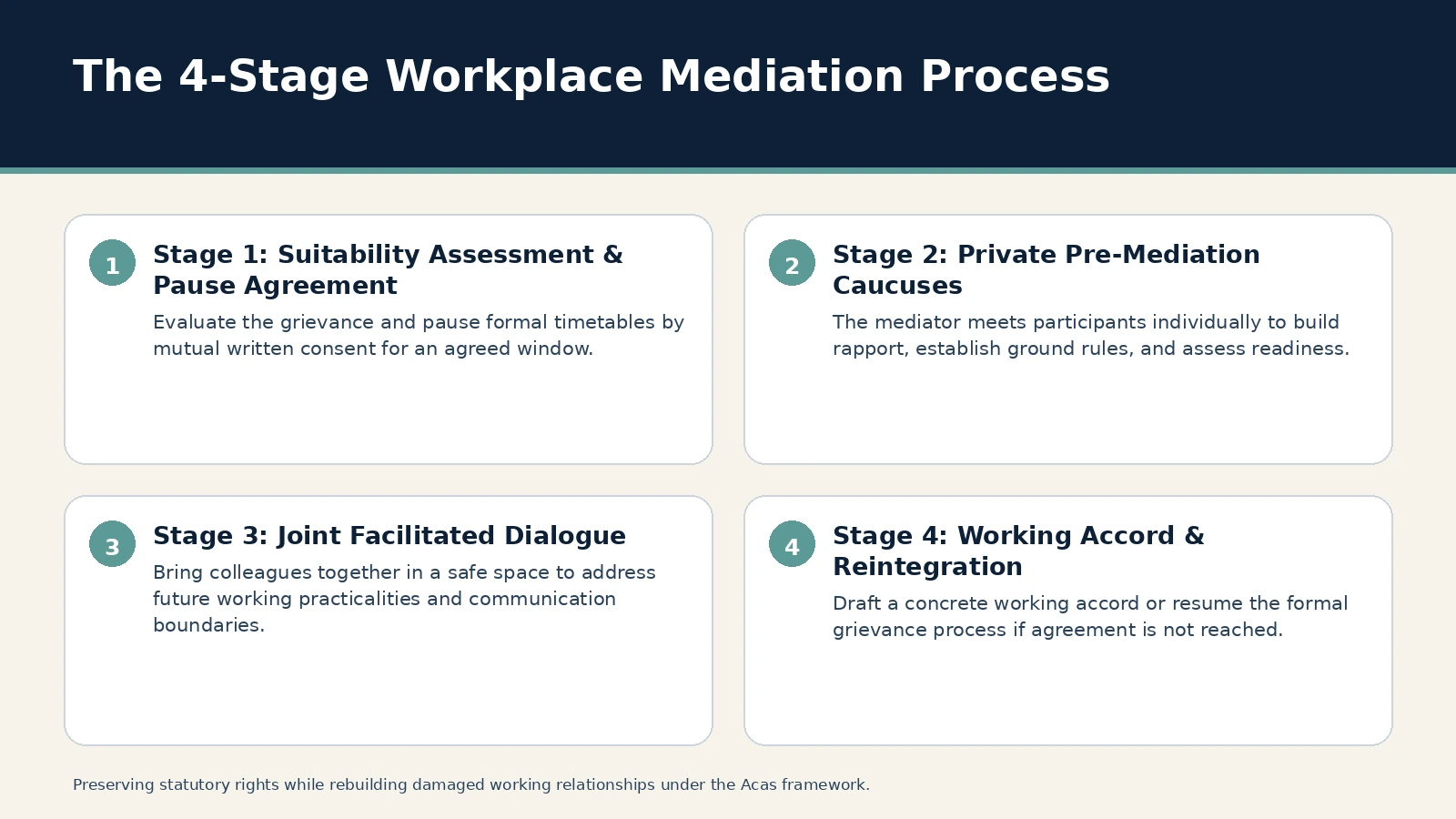
The Practical 4-Stage Process: Introducing Mediation for Workplace Grievance Disputes
Successfully integrating mediation for workplace grievance issues into active dispute management requires clear procedural stages. A structured approach ensures participants feel safe, heard, and supported throughout.
Stage 1: Suitability Assessment and Written Pause Agreement
Once a grievance is submitted or severe friction is identified, HR or line management evaluates whether informal resolution is appropriate. If suitable, the parties are invited to consider workplace mediation. A brief written agreement is recorded, confirming that the formal grievance timetable is temporarily paused by mutual consent, and outlining the expected mediation window.
This written pause agreement clarifies that:
- Formal investigation steps are frozen without prejudice to either party.
- The confidentiality of all mediation sessions is agreed in advance.
- A specific target date is set for completing mediation (typically within two to three weeks) to prevent unnecessary procedural drift.
Stage 2: Individual Pre-Mediation Meetings (Private Caucuses)
The mediator meets individually with each participant in a private, confidential meeting. These separate discussions allow each party to explain their perspective without interruption, articulate their frustrations, and explore what they need to achieve a workable day-to-day relationship. The mediator uses this session to establish rapport, explain ground rules, and assess readiness for joint dialogue.
In these private sessions, the mediator works with participants to shift their perspective from purely rehearsing past grievances to identifying constructive future conditions. Individuals can discuss their personal triggers, operational pressures, and practical expectations in a secure environment without fear that their comments will be quoted in a formal report.
Stage 3: The Joint Facilitated Dialogue
When both participants are prepared, the mediator brings them together in a structured, safe joint meeting. The mediator manages the conversation dynamics, ensuring both parties can express how the conflict has affected them and listen to the other’s perspective. The dialogue shifts from rehashing past grievances to addressing future working practicalities: task handovers, meeting etiquette, escalation routes for disagreements, and mutual behavioural boundaries.
The mediator maintains an even balance of participation, intervenes if discussions become hostile or unproductive, and helps the participants untangle factual disagreements from relational friction. By focusing on shared workplace responsibilities and mutual professional boundaries, colleagues can develop practical solutions that reflect their actual day-to-day working reality.
Stage 4: Working Accord and Reintegration
If common ground is established, the participants draft a concrete working accord with the mediator’s assistance. This document records their practical commitments—such as weekly check-ins, agreed methods of communication, or revised operational boundaries. Generally, only the agreed joint outcome or working accord is shared, with the consent of both participants, subject to standard legal exceptions such as safeguarding. Once the agreement is in place, the formal grievance is formally withdrawn or recorded as informally resolved.
A well-structured working accord focuses on actionable, verifiable commitments rather than vague intentions. It might define how work tasks will be assigned, how disagreements will be handled before escalating to management, and what support may be requested from HR to ensure smooth implementation.
What Happens If Mediation Does Not Resolve the Dispute?
Not every mediation concludes with a comprehensive agreement. In some instances, participants remain unable to establish common ground, or one party determines that the working relationship cannot be salvaged through informal adjustments.
When mediation for workplace grievance friction concludes without agreement, the process remains constructive:
- Confidentiality is maintained: Nothing disclosed during mediation can be reported back to the grievance officer or used against either party in subsequent formal proceedings, subject to standard legal exceptions such as safeguarding.
- Formal process resumes cleanly: The pause on the formal grievance procedure is lifted, and the formal investigation or hearing resumes from the exact stage at which it was suspended.
- Clarified core issues: Even without a full accord, participants often gain a clearer understanding of each other’s perspectives, narrowing the scope of personal hostility during the remaining formal process.
Workplace mediation provides organisations with a controlled, safe environment to address the human dimension of workplace conflict, protecting operational continuity while respecting fair dispute standards under the Acas framework.
If you are managing an active workplace dispute or evaluating whether an ongoing grievance is suitable for informal resolution, you can speak to an EDR mediator to discuss practical next steps and explore confidential mediation options.
Frequently asked questions
Can an employee or employer be forced to enter workplace mediation?
No. Participation in workplace mediation is entirely voluntary for all participants. While employers and employees are encouraged by the Acas Code of Practice to explore informal dispute resolution where appropriate, neither party can be compelled to mediate, and either participant may withdraw at any point.
What happens to the formal grievance timeline while mediation takes place?
The formal grievance timetable is paused by mutual written consent between the employer and the employee. If mediation successfully resolves the dispute, the grievance is formally closed or withdrawn. If mediation ends without an agreement, the formal grievance process resumes exactly where it was paused.
Is what we discuss in workplace mediation shared with HR or management?
No. Workplace mediation is confidential and governed by an agreed mediation agreement, subject to standard legal exceptions such as safeguarding. The mediator will not report the content of discussions, admissions, or emotional disclosures to HR, management, or any grievance panel. Generally, only the agreed joint outcome or working accord is shared, with the consent of both participants, subject to standard legal exceptions such as safeguarding.
What is the role of the mediator during a workplace grievance dispute?
An impartial workplace mediator does not judge the dispute, assign blame, or make formal rulings. Instead, the mediator acts as an independent facilitator who manages the conversation, de-escalates tension, and helps the participants identify underlying friction to build practical, workable agreements for their future working relationship.
How does unreasonable failure to follow the Acas Code affect an Employment Tribunal claim?
Under section 207A of the Trade Union and Labour Relations (Consolidation) Act 1992, an Employment Tribunal has the discretionary power to adjust compensation awards by up to 25% (upwards or downwards) if it finds that either an employer or an employee unreasonably failed to comply with the relevant provisions of the operative Acas Code of Practice.
Authoritative UK guidance and further reading
Primary and official sources
- Trade Union and Labour Relations (Consolidation) Act 1992 (legislation.gov.uk)
- Trade Union and Labour Relations (Consolidation) Act 1992 (legislation.gov.uk)
- Trade Union and Labour Relations (Consolidation) Act 1992 (legislation.gov.uk)
- Code of practice on dismissal and re-engagement issued by the Secretary of State under section 203 of the Trade Union and Labour Relations… (gov.uk)
This guide provides general information about dispute resolution and mediation. It is not legal advice. The appropriate approach depends on the facts, documents, procedural position and the parties involved; obtain legal advice where required.