

In brief
The question: How can property owners, estate managers, and developers resolve conflicts over private rights of way, shared driveways, and easement access without escalating into protracted litigation?
The short answer: An escalating right of way dispute typically arises from practical friction—such as blocked shared driveways, disputed gate controls, parking spillover, or contested road maintenance contributions. While court proceedings focus on determining legal rights, remedies, or substantial interference under common law, civil mediation enables landowners to create bespoke, workable operational protocols. Through facilitated negotiation, parties can establish binding maintenance formulas, clear vehicular access rules, and formal deeds of variation. This consensual approach satisfies court expectations under the pre-action conduct rules, avoids severe costs risks, and protects the future saleability of the properties involved.
Why a Right of Way Dispute Escalates Between Adjoining Owners
Access conflicts are among the most persistent and commercially disruptive property disputes in England and Wales. Whether involving rural access tracks, commercial loading yards, residential shared driveways, or development site access, a private right of way connects separate freehold or leasehold titles in permanent physical proximity. When a right of way dispute arises, daily life or business operations feel the strain immediately.
Most disagreements do not start with fundamental challenges to underlying title deeds. Instead, they develop incrementally from changing patterns of land use and misaligned expectations over daily operations:
- Vehicular parking and loading: A right of passage permits movement across land, but disputes frequently emerge when visitors, delivery vans, tradespeople, or residents park vehicles on the access route, narrowing the passage.
- Physical barriers and security controls: The installation of automated security gates, bollards, width restrictions, or code locks often creates tension between the landowner’s desire for security and the easement holder’s right to convenient, unimpeded passage.
- Maintenance and surface deterioration: Unsurfaced tracks or shared tarmac driveways inevitably suffer wear and tear. When potholes appear or drainage fails, parties often disagree over who should carry out repairs and how the costs must be apportioned.
- Increased intensity of use: Property extensions, agricultural diversification, business expansions, or backland residential developments can intensify vehicular traffic across an existing easement, sparking objections from the underlying landowner.
- Boundary and alignment creep: Over time, the physical track may shift away from the historic line marked on title plans due to encroaching hedges, fence replacements, or uneven terrain, leading to competing spatial assertions.
Because the parties remain neighbours or adjoining commercial operators, initial irritation can harden into entrenched hostility. Exchanging formal solicitor letters often intensifies defensive posturing, turning manageable friction into an entrenched conflict that threatens personal peace, commercial logistics, and asset liquidity.
The Practical Limits of Court Action for Daily Access Friction
When parties reach an impasse, their initial reaction is often to seek a definitive legal remedy through court proceedings. However, formal litigation operates under legal principles that may not address the practical realities of sharing access on a day-to-day basis.
Under English common law, aside from distinct claims for direct trespass or breach of express covenant, an obstruction to a private right of way is generally actionable in court as an interference only if it crosses the legal threshold of “substantial interference” with the reasonable exercise of the grant. Minor, intermittent, or temporary inconveniences—such as a delivery vehicle briefly waiting on a driveway or a slightly narrower gate opening that still permits vehicular passage—may not meet this standard. As a result, parties who spend considerable financial resources litigating minor grievances may find the court unable to provide the detailed, day-to-day management rules they actually need.
Furthermore, under general common law principles, the owner of the land burdened by an easement (the servient owner) is under no general obligation to maintain or repair the right of way for the benefit of the party using it (the dominant owner), unless an express covenant or obligation has been formally agreed in the title deeds. While the dominant owner normally has an ancillary right to enter and repair the route at their own expense, the law rarely imposes an active maintenance duty on the landowner. A judicial determination will clarify the strict legal rights, but it does not establish a collaborative mechanism for managing ongoing repair costs, selecting contractors, or resolving minor usage disagreements.
Property owners also face practical pre-action requirements. Under the Civil Procedure Rules (specifically the Practice Direction – Pre-Action Conduct and Protocols), the courts expect parties to consider alternative dispute resolution, such as mediation, before starting formal legal proceedings. Under CPR 44.2, a court has the power to impose adverse costs penalties on a party who unreasonably refuses to engage in mediation, even if that party ultimately succeeds at trial. When legal fees in boundary and easement cases can rapidly accumulate, pursuing court action without attempting structured negotiation carries substantial financial risk.
Comparing Resolution Pathways: Formal Litigation vs Mediation
Choosing how to handle an escalating access conflict involves assessing whether court proceedings, mediation, or another dispute resolution method best serves your commercial and operational objectives.
| Key Dimension | County Court Litigation | Facilitated Property Mediation |
|---|---|---|
| Primary Focus | Determines legal title, historical easement construction, or substantial interference. | Addresses practical day-to-day access, operational rules, and future coexistence. |
| Flexibility of Outcome | Primarily focused on formal declarations of legal rights, injunctions, or damages. | Enables bespoke agreements, including designated parking bays, electronic gate protocols, and maintenance funds. |
| Control over the Process | Procedural timetable and binding outcome are imposed by the judge. | Parties retain control over whether to agree terms, within a flexible process facilitated by the mediator. |
| Ongoing Relationships | Adversarial dynamic that often damages long-term neighbourly or commercial relations. | Confidential forum designed to de-escalate tension and rebuild workable communication. |
| Property Saleability & Disclosures | Active litigation creates significant disclosure issues on conveyancing forms, affecting transactions. | Settled disputes can be formally documented, helping clarify title and easing conveyancing enquiries. |
The Impact on Property Marketability and Conveyancing
An unresolved right of way dispute presents a serious commercial obstacle when selling or refinancing real estate. Standard conveyancing enquiries, such as the Law Society Property Information Form (TA6), require sellers to disclose any disputes, complaints, or unresolved negotiations concerning boundaries, shared access, or maintenance contributions with neighbouring owners.
Prospective purchasers and commercial lenders are cautious when reviewing titles burdened by ongoing access friction. Buyers may demand substantial price reductions, request retention funds, or withdraw from the purchase entirely. By contrast, resolving an access conflict through mediation enables landowners to replace ambiguous arrangements with a comprehensive, written settlement agreement. If required, the agreed terms can be formalised through a registrable Deed of Variation or Deed of Grant, extinguishing the dispute and satisfying conveyancing enquiries.
Operational Solutions Achieved in Right of Way Dispute Mediation
Mediation provides a confidential, flexible environment where property owners, estate managers, and their legal advisers can negotiate workable, tailored solutions. Unlike formal proceedings that focus strictly on historic rights, mediation looks forward, focusing on how the shared space will function sustainably in practice.
Experienced property mediators regularly assist parties in crafting detailed operational protocols, such as:
- Vehicular movement and delivery windows: Agreeing clear operational schedules for commercial deliveries, agricultural machinery movements, or contractor parking to prevent access blockages during peak hours.
- Physical access and barrier management: Establishing specific protocols for gate operations, including shared keypads, fob distribution, mobile intercom access, and clear agreements on when gates remain closed or unlocked.
- Shared maintenance deeds and sinking funds: Constructing clear, proportionate formulas for sharing road maintenance and resurfacing expenses. Parties can agree on inspection schedules, quoting procedures, and annual contributions to a shared repair fund.
- Boundary line and spatial adjustments: Resolving overlapping spatial claims by negotiating modest boundary adjustments, passing bays, or reciprocal easement grants, formalised alongside neighbour boundary dispute settlements.
- Communication protocols: Establishing clear, businesslike channels for future notifications—such as advance warning for utility works, tree surgery, or major deliveries—preventing daily misunderstandings from reigniting conflict.
The Mediation Process for Access and Easement Conflicts
Property mediation follows a structured, interest-based framework designed to move parties away from entrenched positions and toward durable operational agreements. Understanding how the process unfolds helps participants engage constructively.
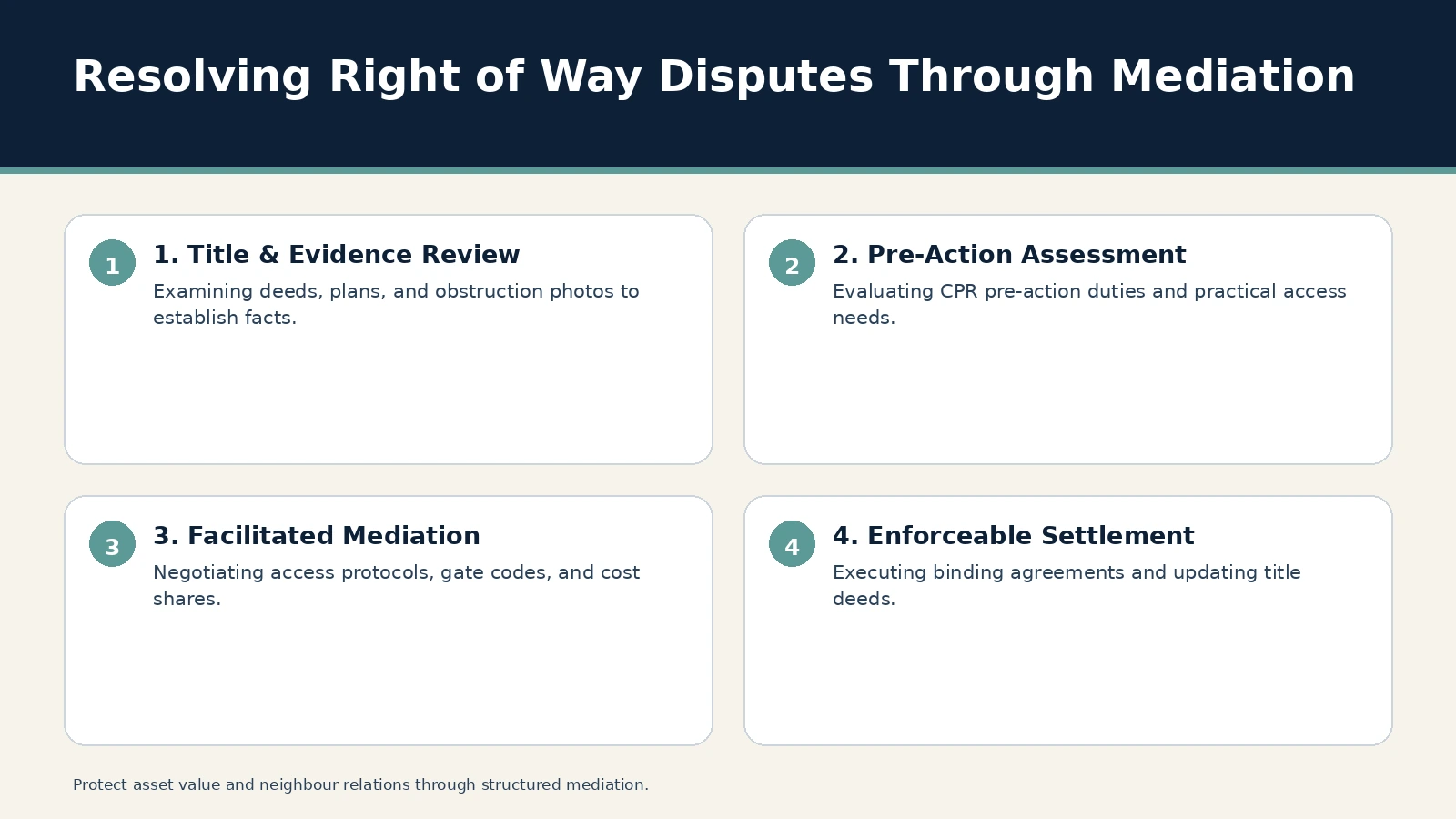
1. Initial Preparation and Document Sharing
Before the mediation day, the mediator reviews key documents provided by both parties. These typically include Land Registry title registers, filed title plans, historic conveyance deeds, relevant correspondence, and photographic evidence. The mediator may also conduct brief, separate telephone calls with each party and their legal advisers to clarify core operational priorities and establish the procedural parameters.
2. The Mediation Day Structure
On the day of the mediation, the process is structured to accommodate the parties’ preferences and emotional dynamics:
- Opening Joint Discussion (Optional): If both parties are comfortable, the mediator may facilitate a brief joint opening meeting to set an objective, collaborative tone. Alternatively, where personal relationships are strained, the entire mediation can proceed in separate private rooms (shuttle mediation).
- Private Caucus Sessions: The mediator spends the majority of the day moving between private rooms. These confidential discussions allow each side to explore practical options, test proposals, and express commercial concerns without exposing negotiation positions to the other party.
- Exploring Trade-Offs and Protocols: The mediator helps the parties identify creative trade-offs that go beyond legal arguments. For instance, a servient owner may agree to widen a narrow gate post in exchange for the dominant owner agreeing to a capped annual maintenance contribution or restricted delivery hours.
3. Drafting and Executing the Settlement Agreement
Once consensus is reached, the parties and their legal representatives draft a formal, written settlement agreement. This document defines the exact operational rules, financial contributions, and execution steps. Where structural changes or title modifications are involved, the agreement will stipulate the drafting and registration of a formal Deed of Variation, Deed of Grant, or Land Registry plan rectification.
Preparing for a Right of Way Dispute Mediation
To ensure a productive mediation session, thorough preparation between landowners and their legal representatives is essential. Entering the process with clear information allows negotiations to focus on practical, realistic outcomes.
- Collate Title Deeds and Historic Plans: Gather Land Registry title registers, title plans, original conveyance deeds, and any historic grant wording. High-resolution, scaled plans are crucial for identifying the precise alignment and width of the easement.
- Compile Objective Operational Evidence: Rather than relying on subjective recollections, collect photographic evidence of obstructions, gate positions, turning circles, and road surface conditions. A concise chronological log of specific access difficulties provides an objective factual foundation.
- Obtain Professional Repair Estimates: If maintenance is in dispute, obtain independent quotes from qualified contractors for road resurfacing, drainage clearance, or gate installation. Having realistic figures helps prevent speculative arguments over repair costs during the session.
- Identify Your Operational Priorities: Distinguish between non-negotiable practical needs (such as emergency access width or specific delivery vehicle requirements) and flexible preferences (such as cosmetic gate styles or maintenance timing).
- Align with Your Legal Adviser: Ensure your legal representative understands that the primary goal of the mediation is to achieve an enforceable, practical settlement that safeguards property value, in line with court pre-action expectations outlined in our guide on CPR compliance and mediation.
When parties come prepared to negotiate practical operational protocols rather than argue over historic grievances, property mediation delivers clear, binding agreements that protect asset value and restore long-term stability. To discuss how our accredited mediators can help resolve a shared access, easement, or driveway conflict, please contact Echelon Dispute Resolution.
Frequently asked questions
What is the threshold for an actionable obstruction in a right of way dispute?
Under English common law, aside from claims involving direct trespass or specific covenant breaches, an obstruction to an easement is generally actionable only if it causes substantial interference with the reasonable exercise of the right of way. Minor, trivial, or temporary interruptions do not generally meet this legal threshold, which is why negotiating practical operational rules in mediation is often far more effective than taking court action.
Who is legally responsible for maintaining and repairing a shared driveway?
While the dominant owner normally has an ancillary right to enter and repair the route at their own expense, the law rarely imposes an active maintenance duty on the landowner. Unless the title deeds contain an express covenant or maintenance obligation, the servient landowner has no general common law duty to repair or maintain a right of way for the dominant user. Mediation allows parties to agree a fair, shared maintenance schedule and cost-sharing formula.
Does having a right of way grant give me the right to park vehicles on the land?
Generally, an easement granting a private right of way provides a right of passage and repassage across the land, not an automatic right to park vehicles on it. Parking rights can be expressly granted, acquired by long uninterrupted use (prescription), implied by law, or agreed between the parties through an operational protocol or formal Deed of Variation.
How does resolving an access dispute in mediation affect selling my property?
Standard conveyancing enquiries, such as the Law Society Property Information Form (TA6), require sellers to disclose any disputes, complaints, or unresolved negotiations concerning boundaries, shared access, or maintenance contributions with neighbouring owners. Reaching a binding, written settlement agreement or executing a formal Deed of Variation in mediation formally resolves the dispute, clarifying access arrangements and reducing conveyancing risks for potential buyers.
What costs risks arise if a party refuses to mediate an access dispute before issuing court proceedings?
Under the Civil Procedure Rules (specifically the Practice Direction – Pre-Action Conduct and Protocols), the courts expect parties to consider alternative dispute resolution, such as mediation, before starting formal legal proceedings. If a party unreasonably refuses an invitation to mediate, the court can penalise them by making adverse costs orders, regardless of who wins the trial.
Authoritative UK guidance and further reading
Primary and official sources
- Civil – Civil Procedure Rules – Justice UK (justice.gov.uk)
- Online Procedure Rules 2026 – GOV.UK (gov.uk)
- UK Supreme Court (supremecourt.uk)
- PART 44 – GENERAL RULES ABOUT COSTS – Justice UK (justice.gov.uk)
This guide provides general information about dispute resolution and mediation. It is not legal advice. The appropriate approach depends on the facts, documents, procedural position and the parties involved; obtain legal advice where required.