

In brief
The question: How can residential property owners and leaseholders resolve escalating neighbour friction through pre-action mediation before issuing County Court proceedings, and what are the procedural risks of bypassing alternative dispute resolution?
The short answer: Under the Civil Procedure Rules (CPR) and the Practice Direction – Pre-Action Conduct and Protocols (PDPAC) in England and Wales, litigation should be a last resort. Engaging in pre-action civil mediation provides a confidential forum facilitated by an independent neutral to resolve domestic friction, such as private nuisance, trespass, noise, shared amenities, or access rights. Mediation enables parties to construct pragmatic, enforceable operational covenants that a trial judge lacks jurisdiction to order, while mitigating conveyancing disclosure blight on the Law Society Property Information Form (TA6) and insulating both parties against adverse judicial costs orders for failing to engage in alternative dispute resolution (ADR).
Domestic Proximity, Conveyancing Blight, and Financial Exposure
Neighbour disputes rarely begin with formal legal correspondence. They often start with everyday friction: an unpruned boundary hedge, recurring evening noise, blocked access across a shared driveway, surface water drainage, or a disputed replacement fence. Because the parties share immediate physical proximity, these frictions can escalate quickly into entrenched conflict. Unresolved arguments can rapidly lead to formal letters before action, allegations of private nuisance or trespass, and threatened County Court claims.
Proceeding straight to litigation over domestic property friction creates distinct difficulties for property owners:
- Acute Domestic Proximity: Unlike commercial disputes where parties can sever commercial ties after trial, neighbours must continue living side-by-side during and after proceedings. Contested court litigation is adversarial and creates an embittered losing party, permanently damaging the living environment.
- Conveyancing Disclosures (Form TA6): When selling a residential property, vendors are typically asked to complete the Law Society Property Information Form (TA6), which asks whether there have been any disputes, complaints, or notices regarding the property. An active, unresolved civil claim creates immediate conveyancing blight, which can delay or disrupt property sales and undermine property values. A formal, documented mediated settlement provides a clear record that the dispute has been formally resolved.
- Disproportionate Legal Expenses: Fully contested County Court proceedings, involving expert evidence, disclosure, interim hearings, and trial representation, can generate legal costs that rapidly dwarf the financial value of the underlying dispute. If a claimant recovers only nominal damages or a limited injunction, they remain exposed to substantial unrecovered costs.
For detailed consideration of disputes focused primarily on property lines, see our guide on neighbour boundary dispute mediation.
Pre-Action Conduct Rules and the Cost Risks of Bypassing ADR
The civil courts in England and Wales require parties to explore non-court dispute resolution mechanisms before seeking judicial intervention. Where no bespoke protocol exists (such as for private nuisance, noise, or general trespass claims), the Practice Direction – Pre-Action Conduct and Protocols (PDPAC) governs party behaviour prior to the issue of proceedings.
Paragraph 8 of the PDPAC establishes the baseline expectation:
“Litigation should be a last resort. As part of a relevant pre-action protocol or this Practice Direction, the parties should consider whether negotiation or some other form of ADR might enable them to settle their dispute without commencing proceedings.”
Ignoring a formal offer to mediate or refusing to engage in ADR without robust objective justification carries procedural consequences under the rules. Paragraph 11 of the PDPAC specifies:
“If proceedings are issued, the parties may be required by the court to provide evidence that ADR has been considered. A party’s silence in response to an invitation to participate or a refusal to participate in ADR might be considered unreasonable by the court and could lead to the court ordering that party to pay additional court costs.”
Furthermore, under PDPAC paragraph 14(c), “The court may decide that there has been a failure of compliance when a party has— … (c) unreasonably refused to use a form of ADR, or failed to respond at all to an invitation to do so.”
Case Management Powers and ADR Orders under the CPR
The Civil Procedure Rules reinforce this framework across the life of a claim. The overriding objective under CPR 1.1(2)(f) includes “(f) promoting or using alternative dispute resolution;”, while CPR 1.4(2)(e) directs the court to further that objective by “(e) ordering or encouraging the parties to use, and facilitating the use of, alternative dispute resolution;”. Under CPR 3.1(2)(o), the court has explicit power to “(o) order the parties to engage in alternative dispute resolution;”.
This power was confirmed by the Court of Appeal in Churchill v Merthyr Tydfil County Borough Council [2023] EWCA Civ 1416, where Sir Geoffrey Vos MR held that:
“…the court can lawfully stay proceedings for, or order, the parties to engage in a non-court-based dispute resolution process provided that the order made does not impair the very essence of the claimant’s right to proceed to a judicial hearing, and is proportionate to achieving the legitimate aim of settling the dispute fairly, quickly and at reasonable cost.”
When the court comes to assess costs at the conclusion of proceedings, CPR 44.2(5)(e) mandates that the judge consider “(e) whether a party failed to comply with an order for alternative dispute resolution, or unreasonably failed to engage in alternative dispute resolution.” Consequently, a party who bypasses pre-action mediation or ignores an ADR proposal risks being deprived of their costs, or ordered to pay the other side’s costs, even if they achieve partial success on their legal claim at trial. For an analysis of cost dynamics across broader civil disputes, see our guidance on settlement strategy and CPR costs protections.
Pre-Action Mediation vs County Court Litigation: Key Differences
The differences between resolving a neighbour dispute through pre-action mediation and pursuing formal court proceedings affect financial exposure, procedural speed, available remedies, and ongoing residential relations.
| Parameter | Pre-Action Civil Mediation | County Court Litigation |
|---|---|---|
| Core Objective | Facilitated negotiation to achieve a practical, workable consensus and end ongoing conflict. | Adjudication of legal rights, liability, and strict legal remedies by a trial judge. |
| Decision-Making Control | Retained entirely by the parties; no agreement is imposed without mutual consent. | Ceded to the trial judge, whose final order is binding regardless of party satisfaction. |
| Remedy Flexibility | Broad and practical: tailored maintenance rotas, planting regimes, noise curfews, and access protocols. | Strictly adjudicative: awarding damages, granting prohibitory or mandatory injunctions, issuing formal declarations, or dismissing the claim. |
| Ongoing Coexistence | De-escalates personal tension via confidential private caucus sessions and structured communication. | Polarises neighbours through adversarial evidence and cross-examination, leaving an embittered loser. |
| Property Conveyancing (TA6) | Produces a signed settlement agreement confirming the formal and final resolution of the dispute. | Requires active disclosure of ongoing litigation, creating property sale blight. |
| Costs Exposure | Controlled, predictable costs shared equally between the parties prior to litigation spend. | High risk of substantial trial expenses, with adverse costs exposure under CPR Part 44. |
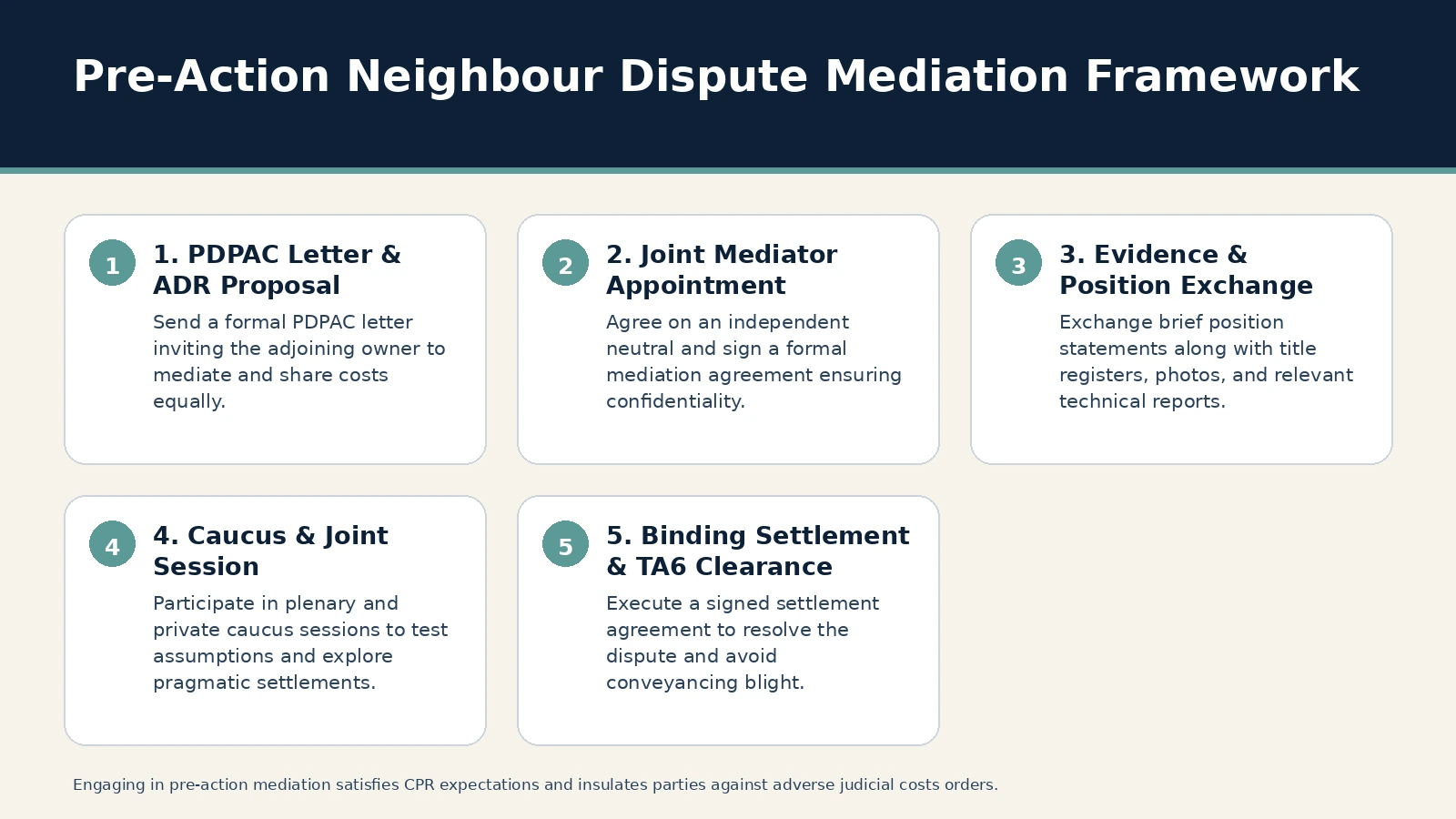
A Structured 4-Stage Pre-Action Mediation Process
Pre-action mediation follows a four-stage process structured to move adjoining owners from deadlock to a workable, documented settlement.
1. The Pre-Action Invitation and Agreement to Mediate
When informal communication stalls, one party (or their instructed solicitor) sends a formal letter under the PDPAC inviting the adjoining owner to participate in civil mediation. The letter outlines the issues in dispute, proposes an independent mediation provider or panel of accredited neutrals, and suggests sharing the mediator’s fee equally. Once agreed, the parties sign a formal Agreement to Mediate, establishing procedural confidentiality and appointing the mediator.
2. Document Exchange and Position Statements
Prior to the mediation session, both sides exchange brief position statements alongside core supporting documents. Rather than comprehensive court trial bundles, the parties assemble essential materials: Title Registers and Plans, historic conveyances, dated photographic logs, acoustic reports, or relevant local authority correspondence. These documents are provided to the mediator in advance to clarify the factual background.
3. Plenary and Private Caucus Sessions
The mediation can take place at a neutral venue or remotely via secure video conference. While mediations can begin with an opening joint session, mediators in neighbour disputes frequently work primarily through separate private rooms (caucuses). This format allows each party to discuss issues candidly without direct confrontation. The mediator moves between the rooms, testing assumptions, exploring practical priorities, clarifying litigation risks, and relaying settlement proposals.
4. Drafting and Executing the Binding Settlement
Once acceptable terms are reached, the parties and their legal advisers draft a written settlement agreement. Upon signature by both parties, this document becomes a legally binding contract. Where court proceedings have already been issued, the terms can be scheduled to a formal Tomlin Order to stay the claim. If the dispute involved property line demarcation, the agreement can be used to prepare a Land Registry Form DB application under Section 60 of the Land Registration Act 2002 to register a Determined Boundary.
For broader procedural context regarding court stays and judicial expectations, see our overview of court-ordered mediation and CPR rules.
Preparing Evidence and Document Bundles for Mediation
Thorough preparation directly supports a productive mediation. Because the mediator acts as a facilitator rather than an adjudicating judge, documentation is used to clarify risk and build negotiating credibility rather than to pursue procedural arguments.
Key documentation to organise includes:
- Title Registers and Title Plans: Official copies from HM Land Registry for both adjoining properties, identifying relevant covenants, easements, or registered rights of way.
- Historic Conveyancing Deeds: Pre-registration conveyances, indentures, and transfer deeds that may contain detailed wording regarding boundary maintenance, party walls, or shared access rights.
- Objective Contemporaneous Records: Incident logs noting specific dates, times, and durations of alleged noise or nuisance, accompanied by clear, dated photographs or video recordings.
- Technical and Expert Reports: Where technical questions arise (such as tree root encroachment, drainage capacity, or acoustic transmission), exchanging an independent expert report or agreeing on a single joint expert assists both parties in understanding their legal position.
- Financial Cost Schedules: A clear breakdown of expenses incurred or anticipated rectification costs (such as contractor quotes for fence replacement, drainage repair, or soundproofing works).
Structuring Practical Living Solutions Beyond Judicial Remedies
A central advantage of pre-action mediation is its capacity to establish practical, tailored arrangements that fall outside the jurisdiction of a court. In a County Court trial, the judge’s powers are strictly adjudicative: awarding damages, granting prohibitory or mandatory injunctions, issuing a formal declaration, or dismissing the claim. A court lacks the jurisdiction to draft or manage ongoing bespoke household behavioural schedules between neighbours.
Mediated settlement agreements routinely incorporate practical solutions, including:
- Shared Access and Parking Protocols: Defining specific parking bays, turning areas, and loading timeframes on shared driveways, eliminating recurring access disputes.
- Vegetation and Planting Regimes: Specifying exact maximum heights for hedgerows, establishing an agreed schedule and contractor for annual trimming, and defining who bears maintenance costs.
- Noise and Amenity Curfews: Agreeing operational guidelines for domestic machinery, building works, music, or commercial vehicle deliveries, tailored to the shift patterns or domestic needs of both households.
- Drainage and Structural Maintenance Charters: Formulating shared payment and contractor-selection procedures for unadopted access roads, shared septic tanks, or retaining walls.
- Communication Protocols: Establishing that future domestic communications must take place via email or a designated third party, avoiding confrontational doorstep encounters.
By resolving the underlying friction and formalising the terms in a signed, binding agreement, both parties eliminate ongoing litigation risk, protect their home environment, and satisfy the pre-action expectations of the civil courts.
To explore pre-action mediation for an ongoing property or civil dispute, contact Echelon Dispute Resolution to discuss whether mediation may be suitable for your matter.
Frequently asked questions
Can a neighbour refuse to attend pre-action mediation?
Mediation is generally a consensual process, and a neighbour cannot be physically compelled to attend prior to proceedings being issued. However, under Paragraph 11 and Paragraph 14(c) of the Practice Direction – Pre-Action Conduct, unreasonable refusal to participate in ADR or failing to respond to an invitation can result in judicial costs sanctions if court proceedings follow.
Does a mediated neighbour settlement fix issues on the TA6 Property Information Form?
Yes. While sellers completing Law Society Form TA6 are asked to disclose disputes truthfully, being able to provide a signed, binding settlement agreement demonstrates to prospective buyers and their conveyancers that the dispute has been formally and permanently resolved, thereby mitigating property sale blight.
What happens if my neighbour breaches the signed mediation settlement agreement?
A signed settlement agreement is an enforceable contract under English law. If one party breaches its terms, the innocent party can issue a claim in the County Court for breach of contract to enforce the agreed terms or claim damages, without having to re-litigate the original underlying dispute.
Do we need solicitors present during pre-action neighbour mediation?
While legal representation is not mandatory, having solicitors present or available to review the agreement is highly advisable. Legal advisers assist in identifying legal risk, reality-testing settlement proposals, and ensuring that the final settlement agreement or Tomlin order is legally binding and enforceable.
Can pre-action mediation be used for boundary and fence disputes?
Yes. Mediation is frequently used to resolve boundary lines and fence maintenance responsibilities. If the parties agree on a precise boundary demarcation, the settlement agreement can be accompanied by an agreed plan and submitted to HM Land Registry via Form DB under Section 60 of the Land Registration Act 2002 to record a Determined Boundary.
Authoritative UK guidance and further reading
Primary and official sources
- PRACTICE DIRECTION – PRE-ACTION CONDUCT AND PROTOCOLS – Civil Procedure Rules – Justice UK (justice.gov.uk)
- Courts and Tribunals Judiciary (judiciary.uk)
- Dispute resolution and remedies in SEP licensing – GOV.UK (gov.uk)
- The Civil Procedure (Amendment No. 3) Rules 2024 (legislation.gov.uk)
- PART 1 – OVERRIDING OBJECTIVE – Civil Procedure Rules – Justice UK (justice.gov.uk)
- service.gov.uk (assets.publishing.service.gov.uk)
- PART 44 – GENERAL RULES ABOUT COSTS – Justice UK (justice.gov.uk)
- Civil – Civil Procedure Rules – Justice UK (justice.gov.uk)
This guide provides general information about dispute resolution and mediation. It is not legal advice. The appropriate approach depends on the facts, documents, procedural position and the parties involved; obtain legal advice where required.