

In brief
The question: How can unmarried partners, family co-owners, or joint investors resolve serious deadlocks over property sales, buyout values, and disputed equity splits without pursuing contested court applications under the Trusts of Land and Appointment of Trustees Act 1996 (TOLATA)?
The short answer: Engaging in professional civil property dispute mediation gives co-owners a confidential, voluntary setting to resolve ownership impasses by mutual agreement. Rather than waiting for a judge to decide whether an asset must be sold or to declare beneficial interests under Section 14 of the Trusts of Land and Appointment of Trustees Act 1996, the parties can explore workable exit strategies. Mediation allows for tailored outcomes such as phased buyout windows, agreed valuation protocols, and negotiated adjustments for unequal mortgage contributions or past renovations. Crucially, actively pursuing alternative dispute resolution demonstrates constructive engagement with the pre-action expectations set out in the Civil Procedure Rules, reducing the financial risk of adverse court costs sanctions if proceedings later become unavoidable.
The Friction in Joint Property Ownership: Why Co-Owners Reach an Impasse
Joint property ownership is often entered into during periods of optimism and mutual trust. Whether buying a first home as an unmarried couple, pooling resources with a family member, or purchasing a residential asset with an investment partner, formal legal agreements detailing future exit mechanics are frequently overlooked. When personal relationships break down or financial goals diverge, co-owners often discover that their legal interests and practical priorities no longer align.
Deadlock commonly develops around a few distinct operational pressures:
- Competing objectives on sale versus retention: One owner may need to realise their capital to rehouse or service independent obligations, while the other wishes to remain in occupation, preserve stability for dependents, or wait for an upturn in the housing market.
- Disputed financial contributions: Property titles registered without an explicit, updated declaration of trust can spark disputes over initial deposit contributions, unequal mortgage repayments, or self-funded home improvements. Disentangling past personal expenditure from capital equity shares often creates deep resentment.
- Mortgage liability and borrowing capacity: An owner who has vacated the property remains personally liable under the joint mortgage covenant. This lingering debt often prevents them from securing new borrowing, leaving them legally tethered to an asset they no longer occupy or control.
When communication breaks down, joint owners often default to issuing formal legal correspondence. Threatening contested court claims under property trusts legislation can polarise positions, driving up professional fees and draining the very equity the parties wish to protect. To explore broader context on how alternative dispute resolution addresses wider land conflicts, see our guide to property dispute mediation across real estate and leasehold conflicts.
Comparing Resolution Routes: Civil Property Dispute Mediation vs Court Proceedings
When parties cannot reach an informal agreement, options generally include alternative dispute resolution like mediation, or court applications—such as under Section 14 of the Trusts of Land and Appointment of Trustees Act 1996. While the court provides an authoritative determination of legal and beneficial ownership, it operates within established procedural rules and cannot match the flexibility of a negotiated settlement.
Under the Civil Procedure Rules, including the Practice Direction on Pre-Action Conduct and CPR Part 44, parties in civil disputes are expected to consider alternative dispute resolution before initiating formal proceedings. Civil courts possess wide discretion regarding costs and can penalise a party who unreasonably refuses or fails to engage in mediation. Seeking an early, voluntary resolution is not merely a practical alternative; it is an essential procedural safeguard.
| Practical Dimension | Property Dispute Mediation | Court Proceedings |
|---|---|---|
| Process Control & Decision-Making | Parties retain control over mediation outcomes; nothing is legally binding until an agreed settlement is executed in writing by or on behalf of each co-owner. | A judge makes a final, binding determination based on legal title, trust and equitable principles, and relevant statutory criteria. |
| Remedies & Structural Flexibility | Enables bespoke solutions, including structured buyout timelines, staged refinancing, and agreed offsets for past contributions. | Relies on established judicial orders, such as granting or refusing an immediate order for sale or declaring beneficial ownership shares. |
| Financial Exposure & Fee Risk | Mediation fees are agreed in advance and shared between parties in accordance with the mediation agreement, avoiding prolonged procedural expense and managing financial exposure. | Litigation involves ongoing legal representation, court fees, and potential exposure to adverse costs orders under court discretion. |
| Confidentiality & Working Relations | Private, confidential discussions conducted without public disclosure, helping protect personal and commercial relationships. | Public court proceedings, formal witness statements, and judicial rulings accessible on the public record. |
| Compliance with CPR Pre-Action Expectations | Demonstrates constructive engagement with pre-action dispute resolution principles, reducing procedural friction. | Litigation commenced without exploring settlement risks adverse judicial cost consequences if a refusal to mediate is deemed unreasonable. |
Property Dispute Mediation: Practical Settlement Options for Shared Equity and Property Exits
The primary advantage of property dispute mediation is the freedom to craft settlement structures tailored to the co-owners’ real-world circumstances. In court, judicial decisions tend to focus on whether the property must be sold and what proportion of the net proceeds each owner holds. In mediation, discussions can expand into nuanced commercial arrangements that address mortgage lending rules and realistic personal timelines.
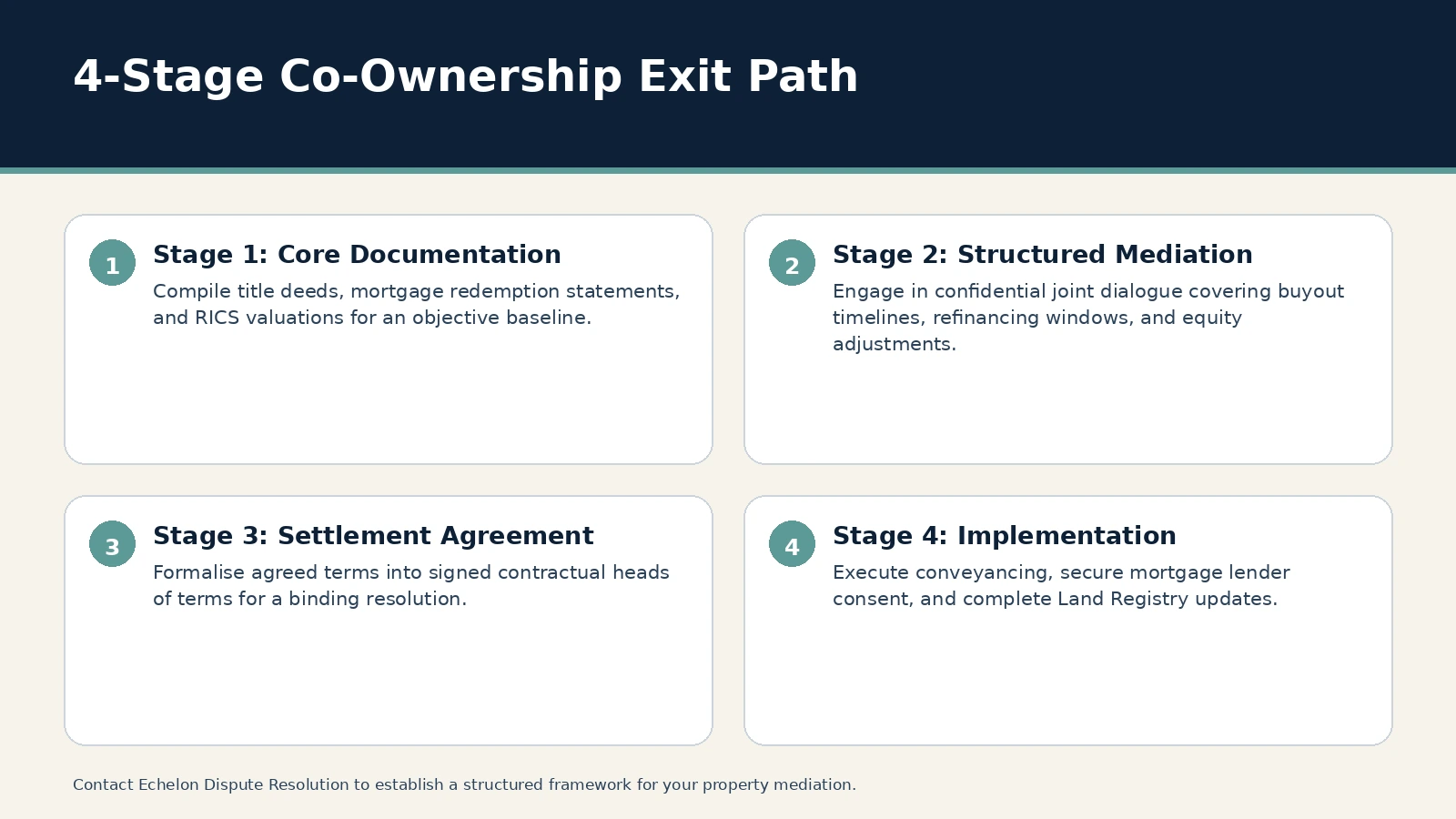
Consensual negotiations frequently explore several practical mechanisms:
- Structured refinancing windows: If one party wishes to buy out the other, mediation can establish a realistic timeline to secure mortgage approval, conduct an independent valuation, and obtain a formal release of the departing co-owner from the existing lending covenant.
- Contingency exit plans: Parties can agree on a primary plan alongside a structured fallback mechanism. For instance, an occupier might be given an agreed window to complete a buyout; if refinancing cannot be secured by that date, the agreement may provide for the property to be placed on the open market through an agreed estate agent.
- Marketing controls and reserve pricing: When a property must be sold, mediation allows owners to pre-agree the choice of selling agent, the initial listing price, and scheduled review milestones to adjust marketing prices systematically, eliminating future arguments over sale strategy.
- Financial adjustments and accounting credits: Instead of engaging in protracted debates over historical expenditure, owners can agree on a practical lump-sum offset to reflect unequal deposit payments, capital mortgage paydowns, or documented renovations.
It is important to recognise that while a signed mediation settlement agreement creates binding contractual obligations, neither the mediator nor the parties can unilaterally bind commercial third parties. A transfer of equity involving mortgaged property generally requires lender consent, and releasing a departing co-owner from liability depends on the lender agreeing to discharge them or approving replacement borrowing. Understanding these lending requirements early is critical to drafting terms that can be carried out smoothly.
Similar dynamics frequently arise in contested estates where siblings or beneficiaries hold unequal claims over inherited real estate. To understand how these co-ownership principles apply within probate scenarios, review our analysis of inheritance dispute mediation for broken estate promises.
Preparing the Core Information: Valuations, Mortgage Data, and Contributions
A productive property dispute mediation relies on objective, verifiable information. Arriving at the negotiation table with incomplete documentation or disputed figures stalls progress and diverts energy into secondary debates. Preparing clear financial and legal records allows both parties to evaluate settlement proposals against realistic parameters.
Before entering mediation, joint owners should assemble the following essential records:
- Current property valuations: Obtain two or three independent market appraisals from local estate agents or, where valuation differences are substantial, instruct an agreed independent RICS surveyor. Working from a recognised baseline prevents protracted disputes over hypothetical property values.
- Mortgage redemption statements: Secure an up-to-date redemption figure from the existing lender, detailing the outstanding capital balance, any early repayment penalties, and daily interest accruals. Net equity cannot be assessed without exact mortgage figures.
- Title documents and conveyancing records: Review official copies of the Land Registry register and title plan, alongside any original TR1 transfer form, deed of trust, or cohabitation agreement completed during the initial purchase.
- Contribution summaries: Compile a clear, itemised chronology of material financial inputs, including initial deposit transfers, capital payments toward home improvements, and records of regular mortgage service contributions.
When parties approach mediation supported by clear documentation, the conversation can shift from historical grievances to practical settlement mechanics. While a civil mediator facilitates constructive dialogue and helps parties reality-test settlement options, they do not provide legal advice or act as an advocate for either party. Each co-owner should obtain independent legal advice from a qualified solicitor before signing a binding settlement agreement to ensure their rights and conveyancing obligations are fully protected.
If you are facing an impasse over joint property ownership, equity division, or an order for sale, our experienced civil mediators can assist in establishing a structured framework for negotiation. Please contact Echelon Dispute Resolution to discuss whether mediation is suitable for your situation.
Frequently asked questions
Can property dispute mediation help if one owner refuses to sell?
Yes. Mediation provides a private forum to explore the reasons behind the refusal. Parties can negotiate practical solutions, such as agreeing a structured timeframe for one owner to refinance and buy out the other, or setting clear, staged conditions for an open-market sale if mortgage approval cannot be secured.
Can a mediator decide who owns what share of the property equity?
No. A civil mediator is an impartial facilitator, not a judge or arbitrator. The mediator does not decide legal beneficial shares, evaluate personal claims, or impose a settlement. Instead, they help the co-owners explore realistic financial options and reach their own mutually acceptable, binding contractual agreement.
How does a mediated co-ownership settlement become legally binding?
At the end of a successful mediation, a written settlement agreement setting out the agreed terms is executed in writing by or on behalf of each party. Once executed, this creates an enforceable contract. The co-owners’ legal representatives then handle the formal legal conveyancing, Land Registry updates, and mortgage refinancing needed to carry out the agreement.
What happens regarding the existing joint mortgage during mediation?
A mediated agreement can set out terms for a buyout or sale, but it cannot compel a mortgage lender to release an owner from their covenant. Any transfer of equity must be formally approved by the existing lender or completed alongside a replacement mortgage arranged through an alternative provider.
What are the court costs risks of refusing mediation under the Civil Procedure Rules?
Under the Civil Procedure Rules (including CPR Part 44 and pre-action practice directions), courts expect parties to consider alternative dispute resolution. If a co-owner unreasonably refuses an invitation to mediate, the court can take this into account when making costs orders, potentially imposing cost sanctions even on a successful party.
Authoritative guidance and further reading
Primary and official sources
- PRACTICE DIRECTION – PRE-ACTION CONDUCT AND PROTOCOLS – Civil Procedure Rules – Justice UK (justice.gov.uk)
- Options if you're owed money – GOV.UK (gov.uk)
- Trusts of Land and Appointment of Trustees Act 1996 (legislation.gov.uk)
Further professional and framework reading
- What Happens to Your House if Your Joint Owner Refuses to Sell? – TSABI Law (tsabi.law)
- Equitable Accounting Explained: What Property Owners Need to Know → Direct Access Barrister (chancerybarrister.com)
- Equitable Accounting in Property Disputes (anthonygold.co.uk)
This guide provides general information about dispute resolution and mediation. It is not legal advice. The appropriate approach depends on the facts, documents, procedural position and the parties involved; obtain legal advice where required.