

In brief
The question: How can families, executors, and claimants resolve high-stakes disputes over unwritten estate and land promises without forcing the sale or financial ruin of the underlying farm, property, or business?
The short answer: Proprietary estoppel disputes typically arise when someone is promised an interest in land or an estate, relies on that promise to their detriment over many years, and is later left out of a will or excluded from ownership. Proving these claims in court involves substantial personal friction, high legal expenditure, and the risk that a judge’s ruling might require liquidating the asset to pay a lump-sum award. Engaging in proprietary estoppel mediation offers a private, pragmatic route to explore tailored solutions by agreement—such as structured land partitions, phased buyouts, or residential arrangements—while meeting the expectation under English civil procedure rules that parties actively attempt dispute resolution.
The Anatomy of Broken Inheritance Promises: Reliance, Expectation, and Asset Friction
Disputes involving broken promises over land and estates represent some of the most intricate conflicts in civil and contentious probate practice. In many farming families, landed estates, and family-run commercial enterprises, operational arrangements are rarely reduced to formal contracts or employment deeds. Instead, businesses frequently operate across decades on informal understandings, verbal assurances, and evolving family expectations. A family member, adult child, or long-standing associate may dedicate their working life to maintaining agricultural holdings, modernising buildings, or managing a trading property portfolio—often accepting below-market remuneration, working long hours, and turning down independent career opportunities—under the explicit or implicit understanding that the underlying property would eventually pass to them.
When the landowner dies, or when relationships deteriorate during their lifetime, that long-held expectation often collides with the formal legal position. A deceased’s will may divide the estate equally between siblings who pursued outside careers, or leave the operational property to a surviving spouse or unrelated beneficiary. In equity, this friction forms the foundation of a proprietary estoppel claim. The claimant asserts that the landowner made clear assurances regarding specific land or property, that the claimant reasonably relied upon those assurances, and that they suffered personal or financial detriment as a direct consequence, making it unconscionable for the estate or legal owner to renege on the promise.
For executors and trustees, defending against an estoppel claim poses complex challenges. The alleged promises may have been made in private conversations decades earlier, leaving minimal contemporaneous documentation. Meanwhile, claimants often experience profound personal grievance, having shaped their entire working life around expectations that the estate now disputes. Because agricultural holdings and family enterprises are typically asset-rich but cash-poor, litigating these issues directly threatens the continuity of the enterprise. Incurring multi-track Chancery trial costs or facing an adverse monetary order risks forcing the sale of the land, which is why parties increasingly look to civil mediation services to address the dispute constructively before legal expenditure escalates.
How Proprietary Estoppel Mediation Unlocks Practical Settlement Structures
When an unwritten land promise is pursued through court proceedings, the judicial process operates within formal, binary parameters. The court must assess whether the three elements of representation, reliance, and detriment have been established, and determine an equitable remedy to satisfy the equity. However, judicial remedies generally take the form of specific property transfers or lump-sum financial awards. In practice, satisfying a substantial court-ordered financial award often requires executors to subdivide and sell prime acreage, auction operational buildings, or liquidate a trading partnership to raise immediate capital. This outcome can disrupt the commercial viability of a multi-generational business and deepen family estrangement.
In contrast, proprietary estoppel mediation enables the parties to step away from rigid legal stances and design practical commercial arrangements that protect the operational viability of the enterprise. Because mediation is a voluntary and confidential negotiation, the participants have the freedom to agree on custom settlement terms that reflect their genuine commercial, agricultural, and personal priorities.
Across estate and land disputes, structured mediation discussions frequently explore collaborative settlement mechanisms that go beyond standard court orders:
- Land Partitioning and Boundary Realignment: Rather than selling an entire holding on the open market, parties can agree to divide specific parcels of land. The claimant might retain productive working acreage, operational sheds, and necessary rights of way to continue farming independently, while non-working beneficiaries receive residential dwellings, development plots, or amenity land that can be retained or sold separately.
- Phased Buyouts and Security Charges: Where one party wishes to preserve the entire enterprise intact, a settlement can structure a buyout over an agreed timetable. Payments can be funded from ongoing business cash flow, external commercial refinancing, or the planned disposal of non-core property. Departing beneficiaries can be granted legal charges or deferred payment terms to secure their financial entitlements.
- Life Interests and Residential Rights: Where a surviving spouse or elderly family member resides in a farmhouse or cottage on the contested holding, a mediated agreement can create formal life interests or occupation rights. This ensures immediate personal security and housing continuity for the resident while transferring the underlying freehold or operational land to the claimant.
- Commercial Leases and Tenancy Agreements: Parties can translate disputed equitable claims into formal commercial arrangements, such as long-term agricultural tenancies, updated partnership deeds, or profit-sharing agreements. This structure separates operational management from capital ownership and provides revenue to non-operating beneficiaries while safeguarding working rights for the claimant.
By exploring these tailored arrangements, parties can resolve deep-seated disputes while preserving the integrity of the underlying enterprise. Those seeking broader context on how informal family assurances are managed in dispute resolution can review our detailed guide on inheritance dispute mediation for broken promises.
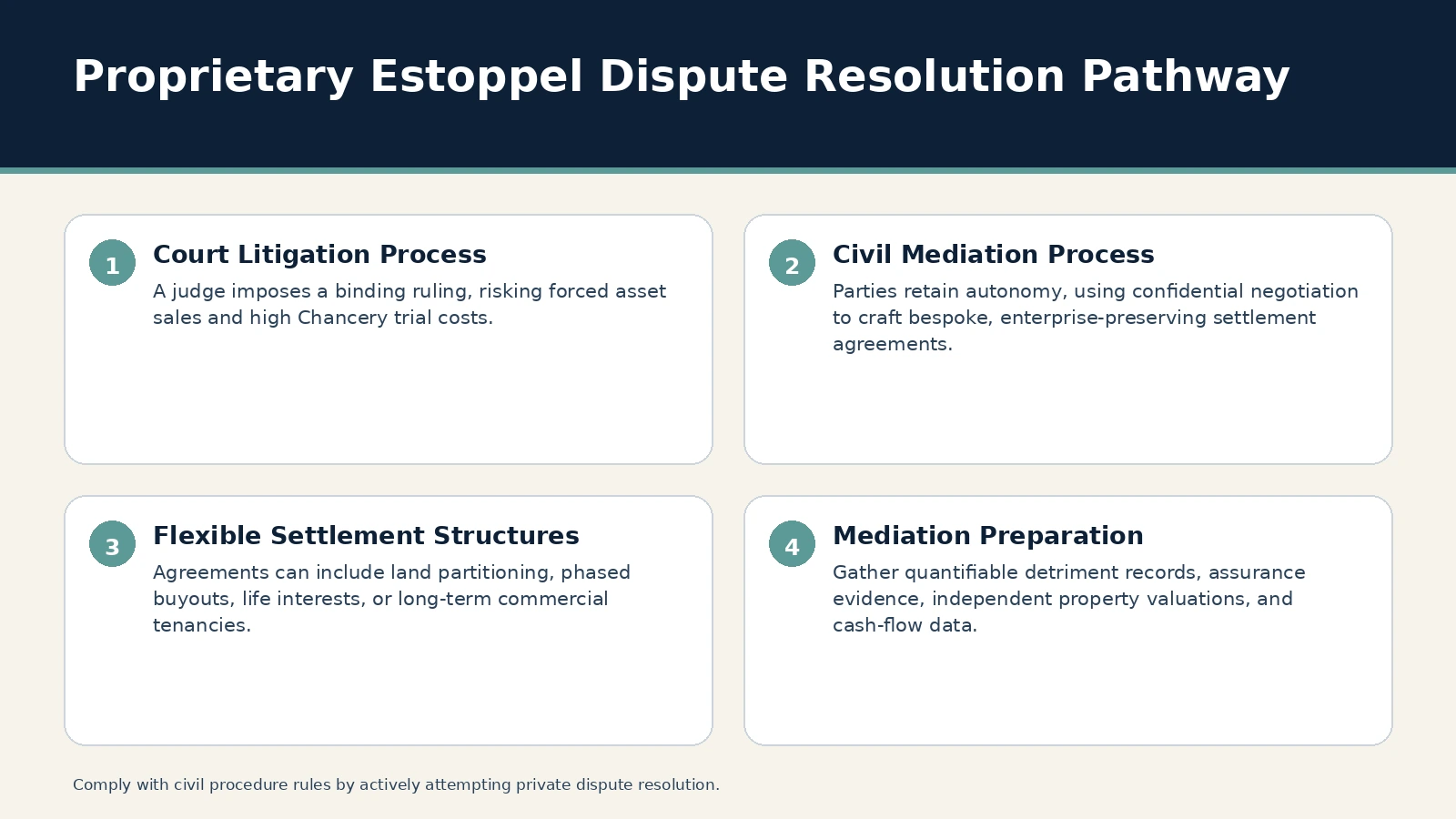
Pathway Comparison: Resolving Broken Promises Through Court Litigation vs Proprietary Estoppel Mediation
Evaluating how to manage an inheritance or land promise dispute requires a clear comparison between formal court proceedings and private negotiation. The Civil Procedure Rules in England and Wales explicitly place alternative dispute resolution at the centre of case management. Under procedural rules, courts expect litigating parties to engage in constructive settlement discussions, and an unreasonable refusal to mediate can lead to adverse costs penalties, even for a party that succeeds at trial.
The following qualitative comparison illustrates how formal litigation and proprietary estoppel mediation differ across key practical and decision-making dimensions:
| Dispute Dimension | Chancery Court Proceedings | Civil Mediation Process |
|---|---|---|
| Decision-Making Control | A judge imposes an enforceable ruling based on the law and evidence, determining the final remedy judicially rather than through party negotiation. | The parties retain autonomy over settlement; under standard mediation terms, no outcome is legally binding until the disputing parties (or their authorised representatives) willingly execute a written settlement agreement. |
| Settlement Flexibility | Remedies focus on formal property transfers or lump-sum financial awards, which may not fit family operating needs. | Parties can agree on custom solutions, including phased payments, agricultural tenancies, life interests, or land restructuring. |
| Enterprise & Asset Impact | Monetary orders or substantial trial costs can force the distress sale or liquidation of farms and property portfolios. | Negotiations prioritise enterprise survival, allowing assets to be preserved, partitioned, or refinanced sustainably. |
| Privacy and Confidentiality | Hearings and filed evidence are generally public, exposing personal family friction and financial details to scrutiny. | Discussions take place in private; mediation confidentiality allows parties to speak candidly without public disclosure. |
| Cost and Relationship Risk | Lengthy multi-track litigation generates high legal costs and deepens interpersonal divisions through hostile cross-examination. | Process is completed swiftly with controlled costs, providing a constructive environment that helps limit lasting relational damage. |
Information and Document Readiness: Preparing for an Estoppel Mediation Session
Achieving a durable outcome in proprietary estoppel mediation requires thorough preparation. Because proprietary estoppel claims frequently concern historical events, informal conversations, and financial contributions spanning decades, attending a session without organised documentary and valuation evidence can impede progress. Claimants, executors, and their legal and financial advisers must establish a clear factual baseline prior to the mediation day.
Key categories of information and documentation that support effective negotiations include:
- Quantifiable Records of Detriment and Reliance: Historical accounts, bank statements, wage slips, and partnership tax returns showing below-market remuneration over extended periods. Documentation of personal capital invested in property improvements, unpaid physical labour, or alternative career opportunities turned down provides clear context on the scale of reliance.
- Corroborating Evidence of Assurances: Although promises are rarely formalised in contracts, supporting documentation may include draft wills, family letters, diary entries, professional correspondence with land agents, planning applications submitted in the claimant’s name, or statements from non-party family members and agricultural contractors.
- Independent Professional Valuations: Comprehensive, up-to-date valuations of all estate property, land parcels, agricultural buildings, livestock, machinery, and potential development hope value. Agreeing single-joint or clear comparative valuation figures before mediation ensures discussions focus on settlement structures rather than basic pricing debates.
- Commercial Cash-Flow and Refinancing Data: Realistic financial projections, enterprise borrowing limits, mortgage statements, and cash-flow forecasts. Having accurate financial parameters enables parties to test whether proposed phased buyouts, land divisions, or pension transfers are commercially viable.
- Interaction with Surrounding Estate Claims: A clear mapping of how the proprietary estoppel claim intersects with other estate administration matters, such as claims under the broader probate and inheritance framework or contested partnership dissolution accounts.
Navigating the Mediation Day: Process Dynamics and Settlement Implementation
On the day of the mediation, the process is structured to provide both privacy and constructive engagement. The mediator generally convenes opening discussions before moving between separate, confidential rooms (or virtual breakout rooms) assigned to each party. This private caucus structure allows claimants, executors, and beneficiaries—alongside their solicitors, barristers, and land advisers—to speak openly with the mediator without the pressure of direct cross-examination.
During these private exchanges, the mediator works to reality-test legal positions, examine the commercial and tax implications of different proposals, and assist each side in evaluating the practical risks of proceeding to a contested multi-track trial. Crucially, the mediator helps the parties look beyond historical grievances and focus on forward-looking solutions: how to preserve the working enterprise, achieve a fair division of capital, and provide closure to all interested parties.
When agreement is reached, the legal representatives draft a formal settlement deed or a draft consent order setting out the precise terms of property transfers, payment milestones, security mechanisms, and releases of claims. Once signed by all parties, the agreement becomes legally binding, concluding the dispute definitively. If you are an executor, trustee, or claimant facing an unwritten property or estate dispute and wish to explore structured dispute resolution, you can contact Echelon Dispute Resolution to discuss how proprietary estoppel mediation can help preserve your family assets and enterprise.
Frequently asked questions
What is the primary role of proprietary estoppel mediation in land and estate disputes?
Proprietary estoppel mediation provides a confidential, structured setting where claimants, executors, and beneficiaries can resolve claims over unwritten land or inheritance promises by mutual agreement. Rather than risking a court-ordered sale of the property, the mediator assists the parties in exploring practical outcomes—such as partitioning land, setting up phased buyouts, or establishing life interests—tailored to their specific needs.
Can a proprietary estoppel mediation resolve other probate or family business disputes at the same time?
Yes. Mediation allows parties to address multiple interconnected issues concurrently. A single mediated settlement can resolve the core land promise claim alongside related partnership dissolutions, executor administration disputes, and wider inheritance claims, establishing a comprehensive resolution that formal court hearings cannot easily combine.
What documents should parties bring to prepare for an estoppel mediation?
Parties should prepare independent property valuations, financial accounts, evidence of historical promises (such as letters, planning records, or witness statements), and documentation demonstrating detriment (such as wage records, capital investment proofs, or declined career opportunities). Clear financial data helps both sides assess realistic settlement proposals.
Is an agreement reached during proprietary estoppel mediation legally binding?
Discussions during mediation remain confidential and without commitment until the parties reach a consensus. Once agreed, a written settlement agreement or draft consent order is prepared by the parties or their representatives. Signed settlement agreements form binding contracts; consent orders become enforceable once approved and sealed by the court.
What happens if one party refuses an invitation to mediate an estate promise dispute?
Under English civil procedure rules, the courts actively encourage alternative dispute resolution. An unreasonable refusal to participate in mediation can result in adverse costs penalties ordered by the court at the conclusion of litigation, regardless of who wins the underlying trial.
Authoritative guidance and further reading
Primary and official sources
- PART 1 – OVERRIDING OBJECTIVE – Civil Procedure Rules – Justice UK (justice.gov.uk)
- PRACTICE DIRECTION – PRE-ACTION CONDUCT AND PROTOCOLS – Civil Procedure Rules – Justice UK (justice.gov.uk)
- PART 44 – GENERAL RULES ABOUT COSTS – Justice UK (justice.gov.uk)
Further professional and framework reading
- Developments in Mediation since 2025 – Legatia Law (legatialaw.com)
- Proprietary Estoppel Solicitors for Inheritance and Land Disputes (myerson.co.uk)
- Should you use arbitration or expert determination for a commercial rent review dispute? (higgsllp.co.uk)
This guide provides general information about dispute resolution and mediation. It is not legal advice. The appropriate approach depends on the facts, documents, procedural position and the parties involved; obtain legal advice where required.