
In brief
The question: How can transformation leaders, HR directors, and engineering heads resolve operational and interpersonal Scrum Master and Product Owner conflict during a Scaled Agile Framework (SAFe) transformation before delivery stalls or formal workplace grievances arise?
The short answer: Scrum Master and Product Owner conflict in a SAFe transformation usually develops from systemic friction between commercial delivery scope and sustainable agile process integrity, often aggravated by legacy management practices. In scaled agile environments, Product Owners face commercial demands from Business Owners and release roadmaps, while Scrum Masters (or Team Coaches) hold responsibility for process discipline, team health, and sustainable capacity limits. When these competing pressures overlap without clear working protocols, friction emerges over user story scope, technical debt, and planning cadences. Engaging early, informal workplace mediation allows both leaders to redefine their operational boundaries, establish explicit working agreements, and restore psychological safety without recourse to formal grievance procedures.
Root Causes: Scope Pressure versus Agile Process Integrity
Enterprise transformations under the Scaled Agile Framework deliberately create an operational tension between commercial strategy and technical execution. The Product Owner focuses on maximising value, feature delivery, and backlog prioritisation. The Scrum Master focuses on team health, agile practice adherence, and realistic capacity planning. In a mature agile environment, this dynamic produces balanced, sustainable delivery. However, during an enterprise transformation across an Agile Release Train (ART), this delicate equilibrium easily tilts into destructive friction.
Several underlying operational factors drive peer friction between these key leadership roles:
- Cadence and Scope Pressures: Product Owners face commercial expectations during Program Increment (PI) Planning to commit to extensive roadmaps and executive milestone commitments. Scrum Masters must simultaneously safeguard development capacity, uphold Work-in-Progress (WIP) limits, and maintain the Definition of Done. When commercial commitments push teams past their sustainable velocity, the two roles collide over feasibility and quality.
- Legacy Management Habits: Many enterprises transition traditional project managers, business analysts, or engineering leads directly into agile roles without extensive coaching. A former project manager operating as a Product Owner may fall back into directive command-and-control behaviour, dictating architecture or delivery timelines. Conversely, a Scrum Master with a delivery management background may overstep by challenging commercial backlog priorities rather than coaching process health.
- Synchronisation and High-Visibility Stress: Framework ceremonies—such as PI Planning, system demos, and joint refinement sessions—are public and highly visible. When disagreements arise over acceptance criteria, user story sizing, or capacity allocations, discussing these in front of the wider team or external stakeholders damages professional trust and undermines team psychological safety.
When professional dialogue breaks down, disputes over estimation or sprint goals can degenerate into personal accusations of operational micromanagement or commercial obstruction. Recognising the early signs of a workplace communication breakdown allows organisations to intervene constructively before entrenched patterns disrupt sprint execution.
Friction Points Across Sprints and PI Planning
To address peer conflict effectively, leadership must identify how structural friction manifests across the delivery lifecycle. In enterprise agile environments, friction rarely begins as an overt interpersonal clash; instead, it surfaces through recurring operational flashpoints where responsibilities intersect under tight timeframes.
Understanding these practical friction zones helps transformation leaders distinguish between natural framework debate and destructive interpersonal deadlock:
- Backlog Refinement Deadlocks: Disagreements emerge when user stories arrive without sufficient detail or clear acceptance criteria. A Product Owner, pressed for immediate progress by business stakeholders, may insist on bringing unrefined epics into planning. The Scrum Master, guarding team capacity and sprint predictability, may refuse to permit unestimated stories into the sprint backlog. If unaddressed, this boundary enforcement is often perceived as administrative obstruction rather than quality assurance.
- Capacity Allocation and Technical Debt: Engineering teams require capacity for refactoring, non-functional requirements, and architectural runway. When a Product Owner routinely deprioritises technical debt in pursuit of commercial features, the Scrum Master feels compelled to intervene on behalf of engineering stability. Without an agreed split or transparent capacity allocation model, backlog refinement sessions can turn into an ideological battle over short-term commercial delivery versus long-term code maintainability.
- Mid-Iteration Scope Injection: Emergent stakeholder requests or critical defect fixes introduce immediate friction. When a Product Owner bypasses standard agile change controls to introduce urgent scope mid-sprint, the Scrum Master experiences this as an undermining of sprint commitments and team autonomy. Conversely, an overly rigid rejection of urgent business priorities by a Scrum Master leads the Product Owner to view agile governance as detached from business reality.
- PI Planning Objective Setting: During scaled multi-team planning events, the pressure to commit to executive feature sets reaches its peak. Product Owners feel institutional pressure to accept stretch objectives without team consensus. When the Scrum Master challenges these commitments publicly during draft plan reviews, the Product Owner may perceive this as a breach of professional alignment, while the Scrum Master views it as essential protection against team burnout.
Role Boundaries: Product Owner and Scrum Master Accountabilities
Resolving Scrum Master and Product Owner Conflict requires an objective return to canonical role definitions. According to The Scrum Guide and SAFe operational principles, the Scrum Master and Product Owner operate as non-hierarchical peers. Neither individual manages the other; neither holds executive veto over the other’s core accountabilities. Conflict almost invariably develops when one role crosses into the operational domain of the other.
The Product Owner holds content authority over the team backlog. They determine what is built, defining user stories, clarifying acceptance criteria, and sequencing items to optimise commercial and customer value. They act as the primary interface between the team and external business stakeholders, translating strategy into an actionable backlog.
The Scrum Master (or SAFe Team Coach) holds accountability for the process and operational effectiveness of the team. They coach the team in agile principles, eliminate delivery impediments, protect engineering capacity, and ensure that delivery practices remain sustainable over successive iterations. They concentrate on how the team collaborates to deliver value.
| Operational Dimension | Product Owner Domain | Scrum Master / Team Coach Domain | Mediation & Resolution Focus |
|---|---|---|---|
| Primary Accountability | Maximising business value and prioritising the team backlog. | Team effectiveness, process integrity, and removing delivery blockers. | Aligning value delivery with sustainable engineering pacing. |
| Decision Authority | Content, user story acceptance criteria, release sequencing. | Agile facilitation, WIP limits, retrospective actions, capacity protection. | Clarifying decision rights to eliminate overlapping authority. |
| Common Pressure Points | Executive deadlines, shifting commercial priorities, stakeholder demands. | Technical debt, team burnout, unrealistic velocity expectations. | Separating organisational delivery stress from interpersonal behaviour. |
| Transformation Friction | Overriding engineering estimates; bypassing backlog refinement. | Over-policing minor framework rules; blocking rapid commercial pivots. | Co-creating practical operational handoffs and communication norms. |
When transformation leads treat persistent peer clashes purely as personal misconduct or performance issues, they overlook the structural pressures driving the dispute. Addressing the conflict requires a structured approach that tackles both the interpersonal tension and the operational grey areas between the roles.
When Internal Agile Coaching Reaches an Impasse
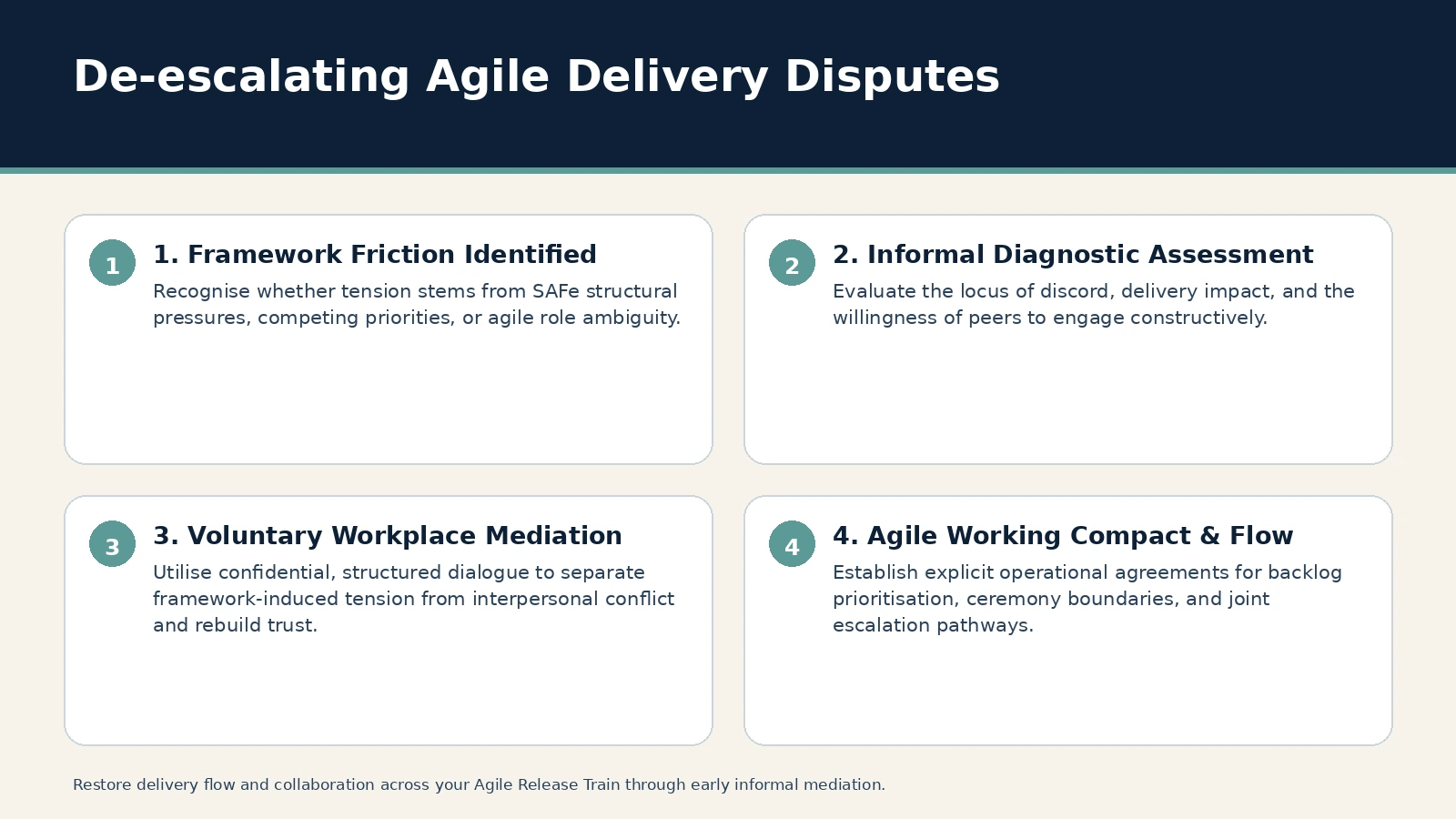
In enterprise transformations, the initial response to peer friction between a Scrum Master and Product Owner is internal agile coaching or intervention by a Release Train Engineer (RTE). While internal facilitation resolves routine procedural misunderstandings, it often struggles when friction becomes personal, prolonged, or entwined with performance management.
Internal coaches and RTEs operate inside the organisational hierarchy. They have ongoing reporting lines, shared delivery deliverables, and existing professional relationships with delivery managers or business owners. When a dispute deepens, either the Product Owner or the Scrum Master may perceive an internal coach as partial—favouring delivery targets over sustainable pacing, or vice versa.
Engineering leadership and HR business partners should consider independent intervention when specific diagnostic indicators appear:
- Polarisation of Delivery Ceremonies: Retrospectives or sprint planning sessions become combative, with engineers feeling forced to take sides between product priorities and team wellbeing.
- Communication via Intermediaries: Direct bilateral communication between the Product Owner and Scrum Master breaks down, resulting in requirements and concerns being routed through line managers or written tickets.
- Escalation to Formal HR Channels: Either party expresses an intention to raise formal grievances regarding workplace stress, micromanagement, or perceived professional undermining.
- Impact on Sickness and Retention: Sustained interpersonal tension contributes to team member disengagement, increased unplanned absences, or resignation risks among key delivery personnel.
The Informal Workplace Mediation Process for Agile Leaders
When internal agile coaching and standard management interventions reach an impasse, HR leaders and engineering directors may feel pushed toward formal disciplinary or grievance investigations. However, formal procedures frequently polarise peer working relationships, cementing defensive stances and creating lasting disruption across the Agile Release Train.
The Acas Code of Practice on Disciplinary and Grievance Procedures encourages employers and employees to resolve workplace issues informally wherever possible. Independent workplace mediation provides an established, voluntary, and confidential framework to achieve this.
Mediation operates as an alternative dispute resolution process that can be used before, alongside, or as an informal stage within workplace procedures. A neutral workplace mediator has no personal stake in project deliverables, focusing on communication dynamics, role boundaries, and facilitating a mutually agreed working protocol. The process typically follows a proven three-stage approach:
- Individual Confidential Explorations: The mediator holds separate, private discussions with the Scrum Master and the Product Owner. These meetings allow each leader to articulate their operational frustrations, personal working styles, and the systemic transformation pressures they face. Because workplace mediation is voluntary and conducted on a confidential procedural basis, it allows both professionals to speak openly about operational blockages.
- Structured Joint Dialogue: Guided by the mediator, both parties meet in a neutral, private setting. The mediator helps the participants move away from past grievances and personal attributions, focusing instead on objective delivery pressures, unclear handoffs, and misaligned performance metrics.
- Future-Focused Problem Solving: Rather than apportioning blame, the dialogue concentrates on building clear, actionable protocols for how both leaders will interact during backlog refinement, daily stand-ups, sprint reviews, and PI Planning cadences.
This process offers an effective off-ramp from escalating workplace tension, enabling two skilled professionals to reset their working relationship without damaging their professional standing.
Designing a Practical Working Agreement for Sprint and PI Cadences
The concrete outcome of successful workplace mediation between agile leaders is an operational working agreement. Rather than a rigid contractual document, this is a practical operating compact developed and owned directly by the Scrum Master and Product Owner.
An effective working agreement tailored to a SAFe environment typically clarifies four key areas of friction:
- Backlog Refinement and Estimation Protocol: Explicit rules detailing when user stories must be ready for refinement, how technical debt items are prioritised alongside commercial features, and a clear boundary confirming that engineering estimation belongs to the development team.
- Ceremony Governance and Facilitation: Explicit agreements on who chairs specific ceremonies, how disagreements regarding story acceptance are handled in sprint reviews, and a protocol for taking contentious issues offline rather than debating them in front of the delivery team.
- Managing Urgent and Out-of-Band Requests: A documented process for managing stakeholder requests that emerge outside regular planning cadences, ensuring the Product Owner does not disrupt sprint commitments without team consultation and capacity review.
- Direct Interpersonal Conflict Protocol: A clear, bilateral escalation route for resolving professional disagreements privately, including agreed reflection pauses and scheduled regular alignment check-ins between the two leaders.
Sustaining Alignment: The 30/60/90-Day Review Cadence
Mediation does not end when the working agreement is signed. In the dynamic environment of a scaled agile transformation, changes in ART composition, shifting enterprise priorities, or high-pressure release milestones can reintroduce tension. To ensure durable collaboration, the mediation process should establish a structured review cadence.
Embedding regular review checkpoints provides both leaders with an agreed forum to refine their operational compact:
- 30-Day Checkpoint (Operational Calibration): The Scrum Master and Product Owner review how their new communication protocols are functioning across initial sprint ceremonies. This meeting focuses on immediate practical adjustments, such as refining the timing of backlog grooming handoffs or adjusting the format of bilateral check-ins.
- 60-Day Checkpoint (Cadence Stress-Testing): Following a major delivery milestone or PI Planning event, both leaders evaluate how their agreement held up under elevated stakeholder pressure. They assess whether scope injection protocols were respected and ensure that estimation boundaries remained robust.
- 90-Day Checkpoint (Long-Term Embedding): A structured review, often supported by a follow-up conversation with the mediator or an HR partner, to evaluate whether collaborative behaviours have become institutionalised. At this stage, the working agreement is updated to reflect mature working patterns, providing an enduring foundation for team delivery.
By transforming abstract framework principles into explicit day-to-day commitments, a mediated working agreement restores collaborative balance. It gives the Scrum Master the mandate to protect engineering health while helping the Product Owner achieve vital commercial outcomes.
If recurring peer friction is threatening your delivery cadence or team morale, you can contact our dispute resolution team to discuss how independent workplace mediation can restore productive collaboration across your agile delivery teams.
Frequently asked questions
Why does Scrum Master and Product Owner conflict happen so often in SAFe?
Conflict frequently arises because SAFe introduces structured delivery cadences and multi-team synchronisation. Product Owners typically balance commercial expectations to meet product goals, while Scrum Masters facilitate sustainable team pace, team effectiveness, and Scrum process integrity. When these non-hierarchical roles lack clear operational agreements, natural structural tension can turn into interpersonal friction.
Is workplace mediation confidential for agile professionals?
Yes. Workplace mediation is a voluntary and confidential process. Matters discussed during mediation remain confidential between the participants and the mediator, subject to agreed outcomes and standard exceptions such as serious harm or unlawful conduct. Discussions are not shared with HR, line management, or the wider Agile Release Train without consent, allowing both leaders to discuss underlying delivery pressures candidly.
How does mediation differ from agile coaching when resolving peer disputes?
While internal agile coaches focus on framework compliance and team practices, they may be perceived as invested in specific delivery outcomes or aligned with management. A neutral workplace mediator has no personal stake in project deliverables, focusing primarily on communication dynamics, role boundaries, and facilitating a mutually agreed working protocol.
Does participating in informal mediation prevent an employee from raising a formal grievance?
No. Participating in voluntary workplace mediation does not waive either employee’s statutory employment rights or prevent them from initiating a formal internal grievance if informal resolution is unsuccessful. In accordance with the Acas Code of Practice, early informal mediation is encouraged as a constructive first step before formal procedures are used.
What is included in a post-mediation working agreement for agile roles?
A working agreement typically defines concrete operational handoffs: protocols for backlog refinement, guidelines for sprint event facilitation, procedures for handling out-of-scope stakeholder requests, and direct communication norms for resolving future disagreements away from the delivery team.
Authoritative guidance and further reading
Primary and official sources
- Unfair dismissal rights (business.gov.uk)
- Trade Union and Labour Relations (Consolidation) Act 1992 (legislation.gov.uk)
- Trade Union and Labour Relations (Consolidation) Act 1992 (legislation.gov.uk)
Further professional and framework reading
- A new Acas Code of Practice on disciplinary and grievance procedures | Acas (acas.org.uk)
- Agile Teams – Scaled Agile Framework (framework.scaledagile.com)
- Team and Technical Agility Discipline – Scaled Agile Framework (framework.scaledagile.com)
This guide provides general information about dispute resolution and mediation. It is not legal advice. The appropriate approach depends on the facts, documents, procedural position and the parties involved; obtain legal advice where required.